Today I was late for my appointment. Treading water is hard work I wish they fore I was a duck.

Weevles Updates Disabled Bloggers Team
Weevl Bloggers Corner
Today I was late for my appointment. Treading water is hard work I wish they fore I was a duck.
I like playing on my bus simulator game it like driving a bus with people. And I created a bus that i like to drive on my bus simulatior

Here is our community partner NTDF who are providing much needed support to all those in need.


Elizabeth I (7 September 1533 – 24 March 1603)[1] was Queen of England and Ireland from 17 November 1558 until her death on 24 March 1603. Sometimes called the Virgin Queen, Gloriana or Good Queen Bess, Elizabeth was the last of the five monarchs of the House of Tudor.
Elizabeth was the daughter of Henry VIII and Anne Boleyn, his second wife, who was executed two-and-a-half years after Elizabeth’s birth. Anne’s marriage to Henry VIII was annulled, and Elizabeth was declared illegitimate. Her half-brother, Edward VI, ruled until his death in 1553, bequeathing the crown to Lady Jane Grey and ignoring the claims of his two half-sisters, the Roman Catholic Mary and the younger Elizabeth, in spite of statute law to the contrary. Edward’s will was set aside and Mary became queen, deposing Lady Jane Grey. During Mary’s reign, Elizabeth was imprisoned for nearly a year on suspicion of supporting Protestant rebels.
In 1558 upon Mary’s death, Elizabeth succeeded her half-sister to the throne and set out to rule by good counsel.[2] She depended heavily on a group of trusted advisers, led by William Cecil, 1st Baron Burghley. One of her first actions as queen was the establishment of an English Protestant church, of which she became the supreme governor. This Elizabethan Religious Settlement was to evolve into the Church of England. It was expected that Elizabeth would marry and produce an heir; however, despite numerous courtships, she never did. She was eventually succeeded by her first cousin twice removed, James VI of Scotland. She had earlier been responsible for the imprisonment and execution of James’s mother, Mary, Queen of Scots.
In government, Elizabeth was more moderate than her father and half-siblings had been.[3] One of her mottoes was “video et taceo” (“I see but say nothing”).[4] In religion, she was relatively tolerant and avoided systematic persecution. After the pope declared her illegitimate in 1570 and released her subjects from obedience to her, several conspiracies threatened her life, all of which were defeated with the help of her ministers’ secret service. Elizabeth was cautious in foreign affairs, manoeuvring between the major powers of France and Spain. She only half-heartedly supported a number of ineffective, poorly resourced military campaigns in the Netherlands, France, and Ireland. By the mid-1580s, England could no longer avoid war with Spain. England’s defeat of the Spanish Armada in 1588 associated Elizabeth with one of the greatest military victories in English history.
As she grew older, Elizabeth became celebrated for her virginity. A cult grew around her which was celebrated in the portraits, pageants, and literature of the day. Elizabeth’s reign became known as the Elizabethan era. The period is famous for the flourishing of English drama, led by playwrights such as William Shakespeare and Christopher Marlowe, and for the seafaring prowess of English adventurers such as Francis Drake. Some historians depict Elizabeth as a short-tempered, sometimes indecisive ruler,[5] who enjoyed more than her share of luck. Towards the end of her reign, a series of economic and military problems weakened her popularity. Elizabeth is acknowledged as a charismatic performer and a dogged survivor in an era when government was ramshackle and limited, and when monarchs in neighbouring countries faced internal problems that jeopardised their thrones. After the short reigns of her half-siblings, her 44 years on the throne provided welcome stability for the kingdom and helped forge a sense of national identity

In the annals of music history, The Isley Brothers hold a unique place. Ever since the sibling quartet of O’Kelly, Rudolph, Ronald and Vernon started out as a gospel-turned-doo wop outfit back in 1954, the Isleys have followed a path that’s served as a mirror to the changes contemporary rhythm and blues has experienced right up until the present day. What other group can claim that they’ve been covered by The Beatles, acted as a proving ground for Jimi Hendrix, been at the forefront of 1970s funk and served as a major touchstone for hip-hop heavyweights like The Notorious B.I.G. and Ice Cube?
Ronald and younger brother Ernie Isley are the two remaining siblings out on the road as The Isley Brothers. The group is still creatively viable thanks to Tower of Peace, an upcoming project recorded with longtime admirer Carlos Santana that’s set to drop in the spring. It’s an experience Ernie Isley enjoyed quite a bit.
“It was great. Carlos Santana is a fan of our music and we’re fans of his. He was being played in all the dormitories when I was in college, so to have a chance to play with him in the studio and watch him play [was great],” he said.
Santana was equally excited about this opportunity, particularly after getting Ron Isley to sing on a couple of songs from last year’s Santana IV.
“Just to be in the same room as Ronnie Isley is like everything. He did ‘Twist and Shout’ before The Beatles arrived and did it on The Ed Sullivan Show and he did the real ‘Twist and Shout,’” Santana explained. “My wife [drummer Cindy Blackmon] and I recorded 15 songs in four days with [The Isley Brothers]—which is going to be the next album that comes out after [Santana IV], which is going to be called Tower of Peace. When you hear these songs, it’s going to freak you out.”
With O’Kelly, Rudolph and Ronald proving to be the foundation for the group, (Vernon was killed after getting hit by a car when he was 13), the Isley Brothers were 1960s pop/R&B heavyweights thanks to hits like “Shout,” “Twist and Shout” and “This Old Heart of Mine (Is Weak for You).”
Once younger brothers Marvin and Ernie joined the group along with brother-in-law Chris Jasper, the Isley Brothers moved in a harder funk direction that found them reinterpreting songs by non-R&B artists like Seals & Croft (“Summer Breeze”) and Stephen Stills (“Love the One You’re With”) and coming up with their own classic hits (“That Lady,” “Live It Up,” “Fight the Power,” “Harvest for the World”). It was this kind of creative malleability that’s enabled the Isleys to stay relevant to the point that the band was sampled by rapper Kendrick Lamar for 2015’s critically acclaimed To Pimp a Butterfly.
It’s a facet of the group that Ernie Isley is rightfully proud of, particularly when he fondly recalls Hendrix’s stint in the band from March 1963 to November 1965.
“It’s great to have Isley on the Hendrix resume in terms of his life and journey and it’s also great to have Hendrix on the Isley resume in terms of where our career musically wound up going,” Isley explained. “‘Shout’ is a record that sounds one way. ‘Twist and Shout’ sounds a different way. ‘This Old Heart of Mine’ released by Motown sounds a different way. ‘It’s Your Thing’ sounds a different way, but it’s the same group. And then you have ‘That Lady,’—‘That Lady?’…that’s the same group. We were able to musically chase and capture what we were after. It’s crossed generations and musical boundaries. In that way, it’s been our gift.”
The Isley Brothers will appear on Jan. 14 at B.B. King Blues Club and Grill, 237 West 42nd St. NYC. For more information, visit www.bbkingblues.com or call 212-997-4144.
They will also be at NYCB Theatre @ Westbury, 960 Brush Hollow Rd., Westbury on Jan. 15. For more information, visit www.livenation.com or call 877-598-8497.

This easy pancake recipe is the ultimate breakfast treat (and a must-make on Pancake Day of course!) If you’re looking for a reliable and guaranteed delicious pancake recipe, then look no further.
You’ll learn how to make perfect pancake batter by following our easy pancake recipe, which comes with a handy step-by-step video to make sure your pancakes turn out perfect every time. All you need for this recipe for pancakes is some flour, salt, eggs and milk, so it couldn’t be simpler. Highly rated and much loved, this is the best pancake recipe for flipping, topping and filling with lots of tasty ingredients and combinations or just the classic lemon and sugar – it’s up to you!
This might be an easy, basic pancake recipe, but we want to know all of your favourite twists, adaptations and toppings! Let us know how you and your family like to eat your pancakes by commenting below.
This recipe makes 6-8 pancakes sized at 20-23cm round. The pancake batter takes 5 mins to whip up and 5 mins to cook. It’s a must-have recipe for Pancake Day.
Love making pancakes? Why not try one of our ideas for savoury pancakes or give some fluffy American style pancakes a go!
This is one of my favourite bands its Frankie And The Four Seasons I saw the tribute band in New York. They are called The Jersey Boys to tribute to Frankie Valley And The Four Seasons.
By France Today Editors – December 11, 2012 2Print This PostE-Mail article
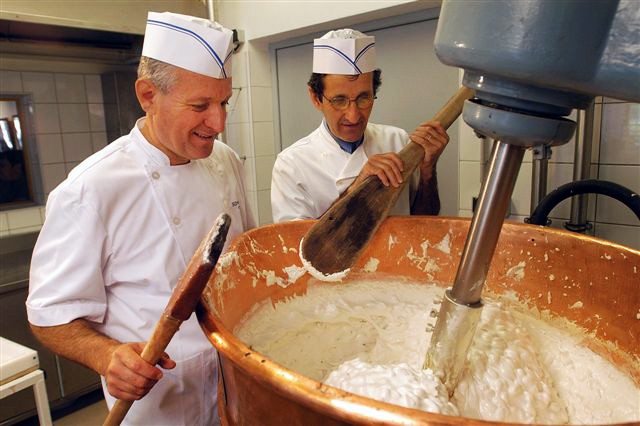
The French are incorrigible gourmands. At a time when sugar has been demonized, they continue to shamelessly manufacture old-fashioned candies—holding fast to an ancestral savoir-faire in a typically ornery response to globalization and the invasion of agribusiness giants.
Of course, there are lots of industrially produced candies in any French bakery or supermarket, but in every province in the country there are still artisans who concoct candies the old-fashioned way. Far from being forgotten, their traditional sweets are becoming more and more treasured. Rare and often expensive bonbons are given as gifts—a way of honoring the recipients by showing how certain you are of their good taste, and how sure you are that the exceptional bonbons will be appreciated for their just worth.
In fact, the ingredients of traditional candies can range from the rare and costly to the very ordinary. Some regional bonbons are well known, others remain secrets within their own little corner of the world. Some might be more beautiful than tasty, but all remain an Ariadne’s thread stretching back through the labyrinth of time, often linked to monastic communities that were all-powerful in centuries past—undoubtedly a little sugar sweetened the rigor of the rules.
While some of these treats are now industrially manufactured—and not always in their traditional place of origin—often small local production continues, patronized by those in the know. Voici, in alphabetical order and not at all objective, our list of authentic artisans—a tour de la France sucrée.
Angélique de Niort
Angelica is an umbelliferous plant that grows in the Marais Poitevin, the marshy area of the Poitou Charente region often compared to Louisiana’s bayous. Originally from northern Europe, where it was eaten as a vegetable, angelica has been cultivated since the Middle Ages, and was named for heavenly assistance because it was believed to cure snakebites and fight off the plague. The medicinal plant became a delicacy in the 18th century thanks to nuns who had the bright idea of candying the stems. Beautifully green in color, the candied stems are widely used in pastry. In Niort, the woody stems are softened for eight days in a sugar solution and, according to tradition, some of the pieces are then shaped into a bestiary of animals native to the marais. Unique and subtle in flavor, angélique has its unconditional fans. It also goes into the making of a highly prized liqueur. Etablissements Thonnard Ave de Sevreau, Niort, 05.49.73.47.42. website
Anis de Flavigny
Everyone in France knows these little white drops made up of a gram of sugar and an anise seed. The last company that still makes them is the Maison Troubat, which turns out some 250 tons of them a year. Their fabrication has hardly changed since the confection’s birth in a Burgundian abbey in the late 16th century. There’s still no artificial flavoring, sweetener or color for these candies, which also come plain or flavored with violets (Miss Marple’s favorite), orange blossom, mint or lemon—but true addicts prefer the refreshing anise. They’re sold in cardboard boxes with the picture of a shepherd offering the sweet to his lady love, with the abbey in the background. The same image has been reproduced on little oval metal boxes that have long been favorites with candy lovers. The plant is open to the public for visits, and the aroma inside is bewitching. Anis de Flavigny Rue de l’Abbaye, Flavigny sur Ozerain, 03.80.96.20.88. website
Bergamote de Nancy
In 1850, following advice from a perfumer friend, confiseur Godefroy Lillich added some essence of bergamot to his boiled sugar sweets. Bergamot, a citrus fruit native to Sicily, is inedible in its natural state but its essential oil is frequently used in perfume. The candy was an immediate success, and by the turn of the century the craze for bergamot candy had spread around the world. The unique bergamot flavor has been granted IGP (Indication Géographique Protégée) status. Bergamot is added to the boiling sugar just before it’s poured out onto an oiled marble slab. The sheet of soft candy is then hand-stamped like a waffle and cut into squares. The color is a beautiful translucent yellow and the flavor is at once subtle and powerful. Pastry chefs in Lorraine use them in ice cream, sorbets and soufflés. Bergamotes are found in many chocolate and pastry shops in Nancy—one good source is the chocolatier-confiseur Lalonde. Nathalie Lalonde 3 rue Stanislas, Nancy, 03.83.35.60.27. website
Berlingot de Carpentras
The berlingot is an ancient candy with a cooked-sugar base. Nantes and Carpentras both claim to be its birthplace, but the translucent, tetrahedron-shaped sweets are made in many provinces. What sets those from Carpentras apart is that they’re made from the sugar syrup used to make candied fruit—another regional specialty. After the fruit is cooked in the syrup and removed, the syrup is boiled down a second time. The sugary mass is then kneaded, spread out on a slab and flavored, originally with anise, mint, orange and lemon. Today the flavor range is larger, including melon, rose, cherry, coffee, chocolate and many others. Legend says the berlingot was invented at the time of Pope Clement V, the first pope to live in nearby Avignon. It was originally a medicinal product, with active ingredients added to the sugar, and it was sold by apothecaries. Only in the mid-19th century did it become a simple candy, which didn’t prevent it from almost disappearing. Today, two manufacturers remain. One of them is Serge Clavel, a fifth-generation confiseur who uses only natural coloring and flavorings and has reintroduced traditional metal boxes. Confiserie de Carpentras Allée Jean Jaurès, Carpentras, 04.90.67.31.30. e-mail
Bêtise de Cambrai
Bêtise means an error, a stupid or silly thing, and the bêtise de Cambrai, it’s said, was born of two mistakes made by an apprentice: He let the sugar cook too long, and was too generous with the mint flavoring. Two manufacturers remain in Cambrai. One is industrial; the other is a very small company, Despinoy, which was the market leader until World War II. The company closed, reopened, and barely struggled along until 1988, when the owner’s son, François Campion, took it over and relaunched it along traditional lines. Now Campion and his seven employees produce 130 tons of bêtises a year, using Mitcham mint. According to Campion, Mitcham mint is to ordinary mint essence what a grand cru Bordeaux is to table wine. The candy’s snowy color comes from microscopic air bubbles formed in the sugar syrup when it is beaten vigorously. Campion also produces a liqueur, La Crème de Bêtise. Confiserie Despinoy 1519 Route Nationale, Fontaine Notre Dame (near Cambrai). 03.27.83.57.57. e-mail
Calisson d’Aix
The calisson is said to have been invented for the second wedding of King René, the Count of Provence, in the mid-15th century. Whether or not that’s true, the calisson is the quintessence of Provence, a mixture of blanched almonds, candied melon and candied orange peel. The almonds are finely ground with the candied fruit, and the resulting paste is kneaded and heated before being molded and baked. The lozenge shape is instantly recognizable—a brilliant white, crunchy frosting covers the soft center that sits on a rice-flour wafer with the consistency of a communion host. Extremely rich and very delicate, its taste is unique. These days the almonds come from Spain and the melon is sometimes replaced by other candied fruits, and every maker has his own secret recipe. What’s important is to buy them from a shop that has a high turnover; calissons harden quickly and they’re best when fresh and soft. A family business, Léonard Parli makes its own candied melon, taking three weeks for the process instead of four days, and the calissons are all the better for it. Another family firm, Fruidoraix, makes mini-calissons whose sugar icing comes in various pastel shades. Léonard Parli 35 ave Victor Hugo, Aix en Provence, 04.42.26.05.71. website. Fruidoraix 295 rue Agate, Pôle d’Activité les Vallades, Eguilles, 04.42.52.51.80. website
Caramel au Beurre Salé
Salted butter caramel was invented only 30 years ago, but few candies have been so often copied. It was a stroke of genius by a young Breton, caramelier-chocolatier Henri Le Roux, who wanted to create a confection that would immediately make customers think of Brittany. The first thalassotherapy spa in Quiberon had become a great success, and thanks to chic spa-goers, the candy’s fame grew rapidly. It was taken up by the press and Le Roux and his wife Lorraine were soon overwhelmed. But there was no question of expanding to industrial size, even though, largely copied, the flavor has spread around the world. Some claim that the original recipe is an ancient family one, but that’s nonsense. While butter has always been salted in Brittany, the region was much too poor in the past to have created such a rich confection. Sugar, salted butter, walnuts, hazelnuts and chopped almonds—that’s the real CBS® whose brand is trademarked. They are instantly addictive. Henri Le Roux 18 rue de Port Maria, Quiberon, 02.97.50.06.83. And in Paris at two addresses: 1 rue de Bourbon-le-Château, 6th, 01.82.28.49.80; and 24 rue des Martyrs, 9th, 01.82.28.49.83. website
Coquelicot de Nemours
Like many other traditional sweets, this flat, rectangular, hard red candy created in 1870 almost disappeared. Once again it was a young entrepreneur, Denis Jullemier, who revived this specialty of the town of Nemours in Ile de France. In June and July, wild poppies are picked from nearby fallow fields made available by farmers who don’t saturate their fields with chemicals. Each year, the harvest of dried petals is converted into a flavoring that goes into candies, syrup, liqueur, vinegar and poppy limonade. Des Lis Chocolat 6 rue Louis Blériot, Nemours, 01.64.29.20.20. website
Cotignac d’Orléans
This confection, between a jelly and a pâte de fruit, made from sugar and quince juice, has been known since the Middle Ages. François I loved cotignacs, and they were a favorite indulgence at the courts of Louis XIV and Louis XV. Sold in little round wooden boxes, they are now made by only one confiseur, Benoît Gouchault, who makes a mere 30,000 boxes a year. Although he was eagerly courted by industrial candy companies, Gouchault decided to pass his recipe on to the local hotel school, so that the tradition could continue and artisan confiseurs would start making them again. For the moment, cotignacs are available in all the good pâtisseries of Orléans. Benoît Gouchault 30 bis rue de Voisinas, Saint-Ay, 02.38.88.84.66. e-mail
Forestine de Bourges
This beautiful bonbon, claiming to be the first filled candy, was invented by Georges Forest in 1878. Since it was inherited by Georges Tavernier at the turn of the century, four generations have maintained the excellence of the delicate candy. As lovely to look at as it is delicious to taste, it resembles a cocoon of silk threads in delicate colors. The outer shell is shiny, crunchy and layered; the praline inside is made of ground hazelnuts, grilled almonds and chocolate. Magnifique! La Maison des Forestines 3 place Cujas, Bourges, 02.48.24.00.24. website
Grisette de Montpellier
A minuscule ball the size of a pea made from licorice, honey and gum arabic, the grisette was offered to pilgrims en route to Santiago de Compostela during the Middle Ages. It took a determined German, Raymond Müller, who had studied agronomy in Montpellier, to bring it back. After a stint in the Foreign Legion and adventures around the world, he returned to Montpellier to relaunch the grisette, following a recipe he’d found by chance—the product derived from the local beekeeping industry and the licorice plant that once grew here so abundantly. A small team now produces 12 tons a year and grisettes are found all over town. Rucher de la Hacienda 1005 blvd de la Lironde, Montferrier sur Lez, 04.67.59.92.26. website
Négus de Nevers
It’s without a doubt one of the most beautiful candies to behold, and also one of the most delicious. Imagine a soft chocolate caramel covered by a hard, translucent, golden layer of more caramel. Ambrosia encased in amber. The sensation when you bite into it is indescribable: two very similar flavors, two very different consistencies. The recipe has not changed since it was created in 1901 for the arrival in France of Menelik II, the “king of kings”, the Negus of Abyssinia (now Ethiopia). Fresh butter and milk, cocoa from the best sources and an unrivaled savoir-faire ensure that the négus of Nevers retains its excellence. It resembles no other candy, except perhaps its cousin, made in a similar way, the coffee-flavored abyssin. Au Négus 96 rue François Mitterrand, Nevers, 03.86.61.06.85. website
Nougat de Montélimar, Nougat de Provence
Montélimar nougat is white and can be either soft or hard; nougat de Provence comes in both black and white. White nougat is composed of blanched and grilled almonds and pistachios, honey, sugar syrup and egg whites—with a minimum of 28% almonds, 28% honey and 2% pistachios. The honey is heated in a double boiler, the egg whites are beaten, and the almonds and pistachios go in last. The more honey, the softer the nougat—and the more expensive. Poured into wooden molds lined with unleavened bread (for easier unmolding) it is then cut into pieces. Black nougat is supposed to be made only with lavender honey and almonds, and the best companies follow that rule. The two nougats are often part of the traditional thirteen desserts at a Provençal Christmas feast. Arnaud Soubeyran RN7, Quartier des Blaches, Montélimar, 04.75.51.01.35. website; Nougaterie André Boyer Place de l’Europe, Sault, 04.90.64.00.23. website; Silvain Frères, Paysans Nougatiers (who produce their own honey and almonds) Place de la Poste, Saint-Didier, 04.90.66.09.57. website
Pâtes de fruits d’Auvergne
At one time, the Auvergne region was full of orchards. To preserve the fruit, starting in the 15th century, the Auvergnats made confiture sèche, or dry jam—now called pâte de fruits. The fruits are first scalded to soften them, then crushed. The pulp is reduced by half through evaporation and the same weight in sugar is added. After lengthy cooking, the reduced pulp is poured onto slabs or into molds. Cut into cubes and sprinkled with sugar, the pâte is wrapped and ready. Noël Cruzilles 226 ave Jean Mermoz, Clermont-Ferrand, 04.73.91.24.46. website
Prasline de Montargis
We owe to Clément Jaluzot, chef for the Duc du Plessis-Praslin, maréchal de France under Louis XIII, the invention of this devilish confection. It has come down to us without any real changes—a high-quality almond, grilled and cooked in a sugar syrup that slowly transforms into caramel. Jaluzot left the duke’s service and returned to his native Montargis, where he opened a boutique to sell his praslines. True praslines are nothing at all like the imitations sold at every carnival. Those from the Maison Léon Mazet, Jaluzot’s former shop, are all sweetness—taste one and you’ll ask for another and another. The adorable Benoît Digeon-Mazet, Léon’s grandson, maintains the tradition in this shop from another era, worth visiting just for the decor. Au Duc de Praslin 43 rue du Général Leclerc, Montargis, 02.38.98.63.55. And in Paris at 37 rue des Archives, 4th, 01.44.05.18.08. website
Violette de Toulouse
In most places, crystallized violets are used only for pastry decoration, but in Toulouse they are popular candies on their own. The tradition of sugared flowers dates to the 13th century. Toulouse’s Candiflor factory opened in 1818 and has been in operation ever since. The flavor of a crystallized violet is extremely subtle and the secret of its fabrication well guarded. What is known is that the flowers can’t wait. As soon as they’re received they’re washed, shaken dry, powdered with icing sugar, dried and sterilized, then kept cool and dry. As needed, they’re plunged into a bath of burning-hot sugar at a precise (and never revealed) temperature and dried in the open air. The same method is used for flower petals, mint leaves, verbena leaves and seeds. Candiflor 12 impasse Descouloubre, Toulouse, 05.34.25.12.25. website
My favourite is probably vanilla, which is soft and wispy and is traditionally in a cone.
The Cathedral Church of Christ, Blessed Mary the Virgin and St Cuthbert of Durham,[1][2][4] commonly known as Durham Cathedral[5][6][7] and home of the Shrine of St Cuthbert,[8] is a cathedral in the city of Durham, England. It is the seat of the Bishop of Durham, the fourth-ranked bishop in the Church of England hierarchy. The present cathedral was begun in 1093, replacing the Saxon ‘White Church’, and is regarded as one of the finest examples of Norman architecture in Europe.[9] In 1986 the cathedral and Durham Castle were designated a UNESCO World Heritage Site.[10]
Durham Cathedral holds the relics of Saint Cuthbert, transported to Durham by Lindisfarne monks in the ninth century, the head of Saint Oswald of Northumbria, and the remains of the Venerable Bede. In addition, its library contains one of the most complete sets of early printed books in England, the pre-Dissolution monastic accounts, and three copies of Magna Carta.
From 1080 until 1836 the Bishop of Durham held the powers of an Earl Palatine, exercising military and civil leadership as well as religious leadership, in order to protect the English Border with Scotland. The cathedral walls formed part of Durham Castle, the chief seat of the Bishop of Durham.[11]
There are daily Church of England services at the cathedral, with the Durham Cathedral Choir singing daily except Mondays and when the choir is on holiday. It is a major tourist attraction and received 694,429 visitors in 2018.https://en.wikipedia.org/wiki/Durham_Cathedral
 Weevles Updates Disabled Bloggers Team