We have had the good fortune to be supported by the Natrional Community Lottery for our new work engaging with our local resdients on matters to do with taking control over the internet. We are poised to establsih a number of outreach sessions culminating in a grand event later this year. If you want to contribute to this project get in touch either by leaving a comment or email: office@parkviewproject.org.uk Park View Portal
Day: February 19, 2020
Cyber Bullying and Online Trolling — Leooooo | The Anxious Teacher

Hello World 💚 Welcome back to #blogtober 🙌 now don’t get me wrong I do see alot of online abuse over on Twitter, but it seems as if this week online hate and trolling has truly picked up speed – especially among the Mental Health community. Something of which really makes me step back and […]
via Cyber Bullying and Online Trolling — Leooooo | The Anxious Teacher
Wispa Gold.
I love eating Wispa Golds all the time I think there are very nice.
Eduard Wagner
Eduard Wagner (1 April 1894 – 23 July 1944) was a general in the Army of Nazi Germany who served as quartermaster-general in World War II. He had the overall responsibility for security in the Army Group Rear Areas, and thus bore responsibility for the war crimes committed by the rear-security units in the occupied areas under the army’s jurisdiction.
He was born in Kirchenlamitz, Upper Franconia. After service in World War I he was a member of the Reichswehr. In World War II he served as the quartermaster-general from 1941 to 1944 and was promoted to General der Artillerie on 1 August 1943.
On 24 July 1939 he drew up regulations that allowed German soldiers to take hostages from civilian population and execute them as response to resistance. He personally welcomed the idea of future invasion of Poland, writing that he looked to it “gladly”. He had a central role in the death sentences for ten Polish prisoners taken in the Defense of the Polish Post Office in Danzig. In May 1941, he drew up the regulations with Reinhard Heydrich that ensured that the Army and Einsatzgruppen would co-operate in murdering Soviet Jews. On the Eastern Front he had a role in ensuring that suitable winter clothing was supplied to the German forces and on 27 November 1941 he reported that “We are at the end of our resources in both personnel and material. We are about to be confronted with the dangers of deep winter.”
In the summer of 1942, before his visit to inspect the 6th Army during the Battle of Stalingrad, he informed Hitler of the “lack of sources of fuel.” By that time, “all the generals avoided contradicting Hitler” as “all feared the hysterical outbursts of this lofty dictator.”
Wagner even was well informed about planned war crimes of the future. In late February 1943, Otto Bräutigam of the Reich Ministry for the Occupied Eastern Territories had the opportunity to read a personal report by Wagner about a discussion with Heinrich Himmler, in which Himmler had expressed the intention to exterminate about 80% of the populations of France and England by special forces of the SS after the German victory. Before, Hitler had called the English lower classes “racially inferior”.
He became a conspirator against Adolf Hitler. When Claus von Stauffenberg sought approval for an assassination attempt on 15 July 1944, he was cited as being definite that the assassination of Hitler should only be attempted if Heinrich Himmler was also present. On 20 July 1944, he arranged the airplane that flew Stauffenberg from Rastenburg back to Berlin after the bomb believed to have killed Hitler had exploded.
After the failure of the coup attempt, he feared that his arrest by the Gestapo was imminent and that he might be forced to implicate other plotters. He committed suicide by shooting himself in the head at noon on 23 July 1944.
Frankie Valli And The Four Seasons.
This is one of my favourite bands its Frankie And The Four Seasons I saw the tribute band in New York. They are called The Jersey Boys to tribute to Frankie Valley And The Four Seasons.
Twirl (chocolate bar)
Twirl is a type of chocolate bar currently manufactured by the British chocolate brand Cadbury. Introduced by Cadbury UK as a single bar in the early 1970s, it was repackaged in 1984 as a twin bar. Although still produced in the United Kingdom it has been marketed internationally since the 1990s and is now one of the best-selling chocolate single bar Cadbury owns.[1][2] It consists of two Flake-style bars covered in milk chocolate. It’s rumoured that the Twirl concept evolved from an over-spill flaw in the Flake manufacturing process.
The Twirl bar also has a snack sized version called Twirl Bites, which come in a bag containing several smaller Twirl like chocolates.
There is also a multipack version containing 4 twin twirl bars. This 4 pack weighs 136 grams, meaning each bar weighs exactly 34 grams.
Product type Confectionery
Owner Cadbury
Country United Kingdom
Introduced June 19, 1984; 35 years ago London, United Kingdom
by Simon schofield
Cadbury Fingers
Fingers are a popular chocolate biscuit in the United Kingdom and Ireland which consists of a biscuit centre covered in chocolate. Fingers are produced at Burton’s Biscuit Company in the United Kingdom and sold by Cadbury UK, and are distributed in markets around the world, including North and South America, Europe and Asia. Since March 2013, Cadbury Fingers have also been sold in Australia with three different varieties available.
Fingers are sold in rectangular boxes contained in a compartmented plastic tray sealed in Cellophane. Double size boxes holding two trays are also available. Promotional boxes containing three trays are also available at times. Boxes contain an average of 24 fingers.
The modern style of Cadbury Fingers were launched in 1951. However, a similar biscuit was first introduced in 1897 as part of a Cadbury biscuit assortment. As of late 2012, the Cadbury Fingers brand is worth £40 million and is the number one brand in the special treats biscuit sector.[1]
Each finger contains 30 calories, 1.5g of fat and 3.4g of carbohydrates. Cadbury describes one serving as consisting of 4 fingers.
by simon schofield
Kernst Kaltenbrunner
SS career
On 18 October 1930, Kaltenbrunner joined the Nazi Party with NSDAP member number 300,179. In 1931, he was the Bezirksredner (district speaker) for the Nazi Party in Oberösterreich. Kaltenbrunner went on to join the SS on 31 August 1931, his SS number was 13,039. He first became a Rechtsberater (legal consultant) for the party in 1929 and later held this same position for SS Abschnitt (Section) VIII beginning in 1932. That same year, he began working at his father’s law practice and by 1933 was head of the National-Socialist Lawyers’ League in Linz.
In January 1934, Kaltenbrunner was briefly jailed at the Kaisersteinbruch detention camp with other National Socialists for conspiracy by the Engelbert Dollfuss government. While there he led a hunger strike which forced the government to release 490 of the party members. In 1935, he was jailed again on suspicion of high treason. This charge was dropped, but he was sentenced to six months imprisonment for conspiracy and he lost his license to practice law.
From mid-1935 Kaltenbrunner was head of the illegal SS Abschnitt VIII in Linz and was considered a leader of the Austrian SS. To provide Heinrich Himmler, Reinhard Heydrich and Heinz Jost with new information, Kaltenbrunner repeatedly made trips to Bavaria. Hiding on a train and on a ship that traveled to Passau, he would return with money and orders for Austrian comrades. Kaltenbrunner was arrested again in 1937, by Austrian authorities on charges of being head of the illegal Nazi Party organization in Oberösterreich. He was released in September.Kaltenbrunner (on the far left), Heinrich Himmler and August Eigruber inspect Mauthausen concentration camp in 1941, in the company of camp commander Franz Ziereis.
Acting on orders from Hermann Göring, Kaltenbrunner assisted in the Anschluss with Germany in March 1938, and was awarded the role as the state secretary for public security in the Seyss-Inquart cabinet. Controlled from behind the scenes by Himmler, Kaltenbrunner still led, albeit clandestinely, the Austrian SS as part of his duty to ‘coordinate’ and manage the Austrian population. Then on 21 March 1938, he was promoted to SS-Brigadeführer. He was a member of the Reichstag from 10 April 1938 until 8 May 1945. Amid this activity, he helped establish the Mauthausen-Gusen concentration camp near Linz. Mauthausen was the first Nazi concentration camp opened in Austria following the Anschluss. On 11 September 1938, Kaltenbrunner was promoted to the rank of SS-Gruppenführer, equivalent to a lieutenant general in the army while holding the position of Führer of SS-Oberabschnitt Österreich (re-designated SS-Oberabschnitt Donau in November 1938). Also in 1938, he was appointed High SS and police leader (Höherer SS- und Polizeiführer; HSSPF) for Donau, which was the primary SS command in Austria (he held that post until 30 January 1943).
World War II
In June 1940, Kaltenbrunner was appointed Police President of Vienna and held that additional post for a year. In July 1940, he was commissioned as a SS-Untersturmführer in the Waffen-SS Reserve. Throughout his many duties, Kaltenbrunner also developed an impressive intelligence network across Austria moving southeastwards, which eventually brought him to Himmler’s attention for the assignment as chief of the RSHA in January 1943. The RSHA was composed of the SiPo (Sicherheitspolizei; the combined forces of the Gestapo and Kripo) along with the SD (Sicherheitsdienst, Security Service). He replaced Heydrich, who was assassinated in June 1942. Kaltenbrunner held this position until the end of the war. Hardly anyone knew Kaltenbrunner and upon his appointment, Himmler transferred responsibility for both SS personnel and economics from the RSHA to the SS Main Economic and Administrative Office. Nonetheless, he was promoted to SS-Obergruppenführer und General der Polizei on 21 June 1943. He also replaced Heydrich as President of the International Criminal Police Commission (ICPC), the organization today known as Interpol.
Fear of a collapsing home-front due to the Allied bombing campaigns and that another “stab-in-the-back” at home could arise, as a result, caused Kaltenbrunner to immediately tighten the Nazi grip within Germany. From what historian Anthony Read relates, Kaltenbrunner’s appointment as RSHA chief came as a surprise given the other possible candidates like head of the Gestapo, Heinrich Müller, or even SD foreign intelligence chief, Walter Schellenberg. Historian Richard Grunberger also added the name of Dr. Wilhelm Stuckart, the future minister of the German Interior as another potential candidate for head of the RSHA; however, he suggests that Kaltenbrunner was most likely selected since he was a comparative “newcomer” who would be more “pliable” in Himmler’s hands.
Like many of the ideological fanatics in the regime, Kaltenbrunner was a committed anti-Semite. According to former SS-Sturmbannführer Hans Georg Mayer, Kaltenbrunner was present at a December 1940 meeting among Hitler, Goebbels, Himmler, and Heydrich where it was decided to gas all Jews incapable of heavy physical work. Under Kaltenbrunner’s command, the persecution of Jews picked up pace as “the process of extermination was to be expedited and the concentration of the Jews in the Reich itself and the occupied countries were to be liquidated as soon as possible.” Kaltenbrunner stayed constantly informed over the status of concentration camp activities, receiving periodic reports at his office in the RSHA.
To combat homosexuality across the greater Reich, Kaltenbrunner pushed the Ministry of Justice in July 1943 for an edict mandating compulsory castration for anyone found guilty of this offense. While this was rejected, he still took steps to get the army to review some 6,000 cases to prosecute homosexuals. Kaltenbrunner with Himmler and Ziereis at Mauthausen in April 1941
During the summer of 1943, Kaltenbrunner conducted his second inspection of the Mauthausen-Gusen concentration camp. While he was there, 15 prisoners were selected to demonstrate for Kaltenbrunner three methods of killing; by a gunshot to the neck, hanging, and gassing. After the killings were performed, Kaltenbrunner inspected the crematorium and later the quarry. In October 1943, he told Herbert Kappler, the head of German police and security services in Rome, that the “eradication of the Jews in Italy” was of “special interest” for “general security.” Four days later, Kappler’s SS and police units began rounding up and deporting Jews by train to Auschwitz concentration camp.
In 1944 when Hitler was in the process of strong-arming Admiral Horthy into submitting Hungary to the Nazis during an arranged meeting in Klessheim Castle in Salzburg, Kaltenbrunner was present for the negotiations and escorted him out once they were over. Accompanying Horthy and Kaltenbrunner on the journey back to Hungary was Adolf Eichmann, who brought with him a special Einsatzkommando unit to begin the process of “rounding up and deporting Hungary’s 750,000 Jews.”
It was said that even Himmler feared him, as Kaltenbrunner was an intimidating figure with his 1.94 metres (6 ft 4 in) height, facial scars, and volatile temper. Kaltenbrunner was also a longtime friend of Otto Skorzeny and recommended him for many secret missions, allowing Skorzeny to become one of Hitler’s favorite agents. Kaltenbrunner was also responsible for heading Operation Long Jump, a plan to assassinate Stalin, Churchill, and Roosevelt in Tehran.
Immediately in the wake of the 20 July Plot on Hitler’s life in 1944, Kaltenbrunner was summoned to Hitler’s wartime headquarters at the Wolfsschanze (Wolf’s Lair) in East Prussia to begin the investigation into who was responsible for the assassination attempt. Once it was revealed that an attempted military coup against Hitler had been launched, Himmler and Kaltenbrunner had to tread carefully, as the military was not under the jurisdiction of the Gestapo or the SD. Since the attempt failed, the conspirators were soon identified. An estimated 5,000 people were eventually executed, with many more sent to concentration camps.Kaltenbrunner (front row, second from left) as a spectator at a People’s Court show trial following the failed 20 July plot.
Historian Heinz Höhne counted Kaltenbrunner among fanatical Hitler loyalists and described him as being committed “to the bitter end.” Field reports from the SD in October 1944 about deteriorating morale in the military prompted Kaltenbrunner to urge the involvement of the RSHA in military court-martial proceedings, but this was rejected by Himmler who thought it unwise to interfere in Wehrmacht (army) affairs. In December 1944, Kaltenbrunner was granted the additional rank of General of the Waffen-SS. On 15 November 1944 he was awarded the Knights Cross of the War Merit Cross with Swords. In addition, he was awarded the NSDAP Golden Party Badge and the Blutorden (Blood Order) Using his authority as Chief of the RSHA, Kaltenbrunner issued a decree on 6 February 1945 that allowed policemen to shoot “disloyal” people at their discretion, without judicial review.
On 12 March 1945, a meeting took place in the Vorarlberg between Kaltenbrunner and Carl Jacob Burckhardt, president of the International Committee of the Red Cross (1945–48). Just over a month later, Himmler was informed that SS-Obergruppenführer (general) Karl Wolff had been negotiating with the Allies for the capitulation of Italy. When questioned by Himmler, Wolff explained that he was operating under Hitler’s orders and attempting to play the Allies against one another. Himmler believed him, but Kaltenbrunner did not and told Himmler that an informant claimed Wolff also negotiated with Cardinal Schuster of Milan and was about to surrender occupied Italy to the Allies. Himmler angrily repeated the allegations and Wolff, feigning offense, challenged Himmler to present these statements to Hitler. Unnerved by Wolff’s demands, Himmler backed down, and Hitler sent Wolff back to Italy to continue his purported disruption of the Allies.
In mid-April 1945, three weeks before the war ended, Himmler named Kaltenbrunner commander-in-chief of the remaining German forces in Southern Europe. Kaltenbrunner attempted to organize cells for post-war sabotage in the region and Germany but accomplished little. Hitler made one of his last appearances on 20 April 1945 outside the subterranean Führerbunker in Berlin, where he pinned medals on boys from the Hitler Youth for their bravery. Kaltenbrunner was among those present, but realizing the end was near, he then fled from Berlin.
Arrest
On 12 May 1945 Kaltenbrunner was apprehended along with his adjutant, Arthur Scheidler, and two SS guards in a remote cabin at the top of the Totes Gebirge mountains near Altaussee, Austria, by a search party initiated by the 80th Infantry Division, Third U.S. Army. Information had been gained from Johann Brandauer, the assistant burgermeister of Altaussee, that the party was hiding out with false papers in the cabin. This was supported by an eyewitness sighting by the Altaussee mountain ranger five days earlier. Special Agent Robert E. Matteson from the C.I.C. Detachment organized and led a patrol consisting of Brandauer, four ex-Wehrmacht soldiers, and a squad of US soldiers to effect the arrest. The party climbed over mountainous and glacial terrain for six hours in darkness before arriving at the cabin. After a short standoff, all four men exited the cabin and surrendered without a shot fired. Kaltenbrunner claimed to be a doctor and offered a false name. However, upon their arrival back to town his mistress, Countess Gisela von Westarp, and the wife (Iris) of his adjutant Arthur Scheidler chanced to spot the men being led away, the ladies called out to both men and embraced them. This action resulted in their identification and arrest by US troops.
In 2001, Ernst Kaltenbrunner’s personal Nazi security seal was found in an Alpine lake in Styria, Austria, 56 years after he had thrown it away to hide his identity. The seal was recovered by a Dutch citizen on holiday. The seal has the words “Chef der Sicherheitspolizei und des SD” (Chief of the Security Police and SD) engraved on it. Experts have examined the seal and believe it was discarded in the final days of the war in May 1945.
Nuremberg trials
Kaltenbrunner wheeled into court during the Nuremberg trials after a brain hemorrhage during interrogation.
At the Nuremberg trials, Kaltenbrunner was charged with conspiracy to commit crimes against peace, war crimes and crimes against humanity. Due to the areas over which he exercised responsibility as an SS general and as chief of the RSHA, he was acquitted of crimes against peace, but held responsible for war crimes and crimes against humanity.Kaltenbrunner as a defendant in the Nuremberg trials
During the initial stages of the Nuremberg trials, Kaltenbrunner was absent because of two episodes of subarachnoid hemorrhage, which required several weeks of recovery time. After his health improved, the tribunal denied his request for pardon. When he was released from a military hospital he pleaded not guilty to the charges of the indictment against him. Kaltenbrunner said all decrees and legal documents that bore his signature were “rubber-stamped” and filed by his adjutant(s). He also said Gestapo Chief Heinrich Müller had illegally affixed his signature to numerous documents in question.
Kaltenbrunner argued in his defense that his position as RSHA chief existed only theoretically and said he was only active in matters of espionage and intelligence. He maintained that Himmler, as his superior, was the person culpable for the atrocities committed during his tenure as chief of the RSHA. Kaltenbrunner also asserted that he had no knowledge of the Final Solution before 1943 and went on to claim that he protested against the ill-treatment of the Jews to Himmler and Hitler. Further denials from Kaltenbrunner included statements that he knew nothing of the Commissar Order and that he never visited Mauthausen concentration camp, despite documentation of his visit. At one point, Kaltenbrunner went so far as to avow that he was responsible for bringing the Final Solution to an end.
Conviction and execution
On 30 September 1946, the International Military Tribunal found Kaltenbrunner not guilty of crimes against peace, but guilty of war crimes and crimes against humanity (counts three and four). On 1 October 1946, the IMT sentenced him to death by hanging.
Kaltenbrunner was executed on 16 October 1946, around 1:15 a.m., in Nuremberg. His body, like those of the other nine executed men and that of Hermann Göring (who committed suicide the previous day), was cremated at the Eastern Cemetery in Munich and the ashes were scattered in a tributary of the River Isar.
White Bonbons – History
French Bonbons
By France Today Editors – December 11, 2012 2Print This PostE-Mail article
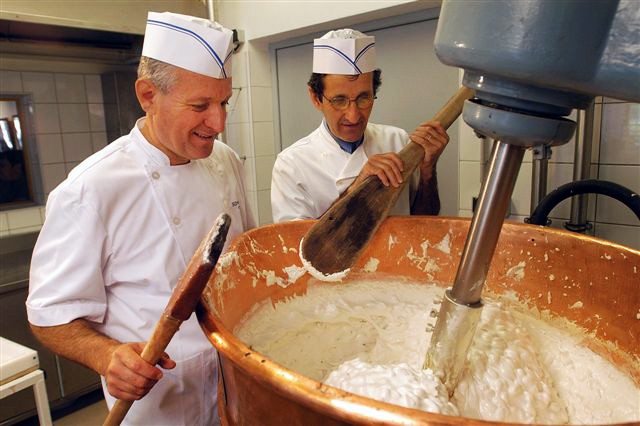
The French are incorrigible gourmands. At a time when sugar has been demonized, they continue to shamelessly manufacture old-fashioned candies—holding fast to an ancestral savoir-faire in a typically ornery response to globalization and the invasion of agribusiness giants.
Of course, there are lots of industrially produced candies in any French bakery or supermarket, but in every province in the country there are still artisans who concoct candies the old-fashioned way. Far from being forgotten, their traditional sweets are becoming more and more treasured. Rare and often expensive bonbons are given as gifts—a way of honoring the recipients by showing how certain you are of their good taste, and how sure you are that the exceptional bonbons will be appreciated for their just worth.
In fact, the ingredients of traditional candies can range from the rare and costly to the very ordinary. Some regional bonbons are well known, others remain secrets within their own little corner of the world. Some might be more beautiful than tasty, but all remain an Ariadne’s thread stretching back through the labyrinth of time, often linked to monastic communities that were all-powerful in centuries past—undoubtedly a little sugar sweetened the rigor of the rules.
While some of these treats are now industrially manufactured—and not always in their traditional place of origin—often small local production continues, patronized by those in the know. Voici, in alphabetical order and not at all objective, our list of authentic artisans—a tour de la France sucrée.
Angélique de Niort
Angelica is an umbelliferous plant that grows in the Marais Poitevin, the marshy area of the Poitou Charente region often compared to Louisiana’s bayous. Originally from northern Europe, where it was eaten as a vegetable, angelica has been cultivated since the Middle Ages, and was named for heavenly assistance because it was believed to cure snakebites and fight off the plague. The medicinal plant became a delicacy in the 18th century thanks to nuns who had the bright idea of candying the stems. Beautifully green in color, the candied stems are widely used in pastry. In Niort, the woody stems are softened for eight days in a sugar solution and, according to tradition, some of the pieces are then shaped into a bestiary of animals native to the marais. Unique and subtle in flavor, angélique has its unconditional fans. It also goes into the making of a highly prized liqueur. Etablissements Thonnard Ave de Sevreau, Niort, 05.49.73.47.42. website
Anis de Flavigny
Everyone in France knows these little white drops made up of a gram of sugar and an anise seed. The last company that still makes them is the Maison Troubat, which turns out some 250 tons of them a year. Their fabrication has hardly changed since the confection’s birth in a Burgundian abbey in the late 16th century. There’s still no artificial flavoring, sweetener or color for these candies, which also come plain or flavored with violets (Miss Marple’s favorite), orange blossom, mint or lemon—but true addicts prefer the refreshing anise. They’re sold in cardboard boxes with the picture of a shepherd offering the sweet to his lady love, with the abbey in the background. The same image has been reproduced on little oval metal boxes that have long been favorites with candy lovers. The plant is open to the public for visits, and the aroma inside is bewitching. Anis de Flavigny Rue de l’Abbaye, Flavigny sur Ozerain, 03.80.96.20.88. website
Bergamote de Nancy
In 1850, following advice from a perfumer friend, confiseur Godefroy Lillich added some essence of bergamot to his boiled sugar sweets. Bergamot, a citrus fruit native to Sicily, is inedible in its natural state but its essential oil is frequently used in perfume. The candy was an immediate success, and by the turn of the century the craze for bergamot candy had spread around the world. The unique bergamot flavor has been granted IGP (Indication Géographique Protégée) status. Bergamot is added to the boiling sugar just before it’s poured out onto an oiled marble slab. The sheet of soft candy is then hand-stamped like a waffle and cut into squares. The color is a beautiful translucent yellow and the flavor is at once subtle and powerful. Pastry chefs in Lorraine use them in ice cream, sorbets and soufflés. Bergamotes are found in many chocolate and pastry shops in Nancy—one good source is the chocolatier-confiseur Lalonde. Nathalie Lalonde 3 rue Stanislas, Nancy, 03.83.35.60.27. website
Berlingot de Carpentras
The berlingot is an ancient candy with a cooked-sugar base. Nantes and Carpentras both claim to be its birthplace, but the translucent, tetrahedron-shaped sweets are made in many provinces. What sets those from Carpentras apart is that they’re made from the sugar syrup used to make candied fruit—another regional specialty. After the fruit is cooked in the syrup and removed, the syrup is boiled down a second time. The sugary mass is then kneaded, spread out on a slab and flavored, originally with anise, mint, orange and lemon. Today the flavor range is larger, including melon, rose, cherry, coffee, chocolate and many others. Legend says the berlingot was invented at the time of Pope Clement V, the first pope to live in nearby Avignon. It was originally a medicinal product, with active ingredients added to the sugar, and it was sold by apothecaries. Only in the mid-19th century did it become a simple candy, which didn’t prevent it from almost disappearing. Today, two manufacturers remain. One of them is Serge Clavel, a fifth-generation confiseur who uses only natural coloring and flavorings and has reintroduced traditional metal boxes. Confiserie de Carpentras Allée Jean Jaurès, Carpentras, 04.90.67.31.30. e-mail
Bêtise de Cambrai
Bêtise means an error, a stupid or silly thing, and the bêtise de Cambrai, it’s said, was born of two mistakes made by an apprentice: He let the sugar cook too long, and was too generous with the mint flavoring. Two manufacturers remain in Cambrai. One is industrial; the other is a very small company, Despinoy, which was the market leader until World War II. The company closed, reopened, and barely struggled along until 1988, when the owner’s son, François Campion, took it over and relaunched it along traditional lines. Now Campion and his seven employees produce 130 tons of bêtises a year, using Mitcham mint. According to Campion, Mitcham mint is to ordinary mint essence what a grand cru Bordeaux is to table wine. The candy’s snowy color comes from microscopic air bubbles formed in the sugar syrup when it is beaten vigorously. Campion also produces a liqueur, La Crème de Bêtise. Confiserie Despinoy 1519 Route Nationale, Fontaine Notre Dame (near Cambrai). 03.27.83.57.57. e-mail
Calisson d’Aix
The calisson is said to have been invented for the second wedding of King René, the Count of Provence, in the mid-15th century. Whether or not that’s true, the calisson is the quintessence of Provence, a mixture of blanched almonds, candied melon and candied orange peel. The almonds are finely ground with the candied fruit, and the resulting paste is kneaded and heated before being molded and baked. The lozenge shape is instantly recognizable—a brilliant white, crunchy frosting covers the soft center that sits on a rice-flour wafer with the consistency of a communion host. Extremely rich and very delicate, its taste is unique. These days the almonds come from Spain and the melon is sometimes replaced by other candied fruits, and every maker has his own secret recipe. What’s important is to buy them from a shop that has a high turnover; calissons harden quickly and they’re best when fresh and soft. A family business, Léonard Parli makes its own candied melon, taking three weeks for the process instead of four days, and the calissons are all the better for it. Another family firm, Fruidoraix, makes mini-calissons whose sugar icing comes in various pastel shades. Léonard Parli 35 ave Victor Hugo, Aix en Provence, 04.42.26.05.71. website. Fruidoraix 295 rue Agate, Pôle d’Activité les Vallades, Eguilles, 04.42.52.51.80. website
Caramel au Beurre Salé
Salted butter caramel was invented only 30 years ago, but few candies have been so often copied. It was a stroke of genius by a young Breton, caramelier-chocolatier Henri Le Roux, who wanted to create a confection that would immediately make customers think of Brittany. The first thalassotherapy spa in Quiberon had become a great success, and thanks to chic spa-goers, the candy’s fame grew rapidly. It was taken up by the press and Le Roux and his wife Lorraine were soon overwhelmed. But there was no question of expanding to industrial size, even though, largely copied, the flavor has spread around the world. Some claim that the original recipe is an ancient family one, but that’s nonsense. While butter has always been salted in Brittany, the region was much too poor in the past to have created such a rich confection. Sugar, salted butter, walnuts, hazelnuts and chopped almonds—that’s the real CBS® whose brand is trademarked. They are instantly addictive. Henri Le Roux 18 rue de Port Maria, Quiberon, 02.97.50.06.83. And in Paris at two addresses: 1 rue de Bourbon-le-Château, 6th, 01.82.28.49.80; and 24 rue des Martyrs, 9th, 01.82.28.49.83. website
Coquelicot de Nemours
Like many other traditional sweets, this flat, rectangular, hard red candy created in 1870 almost disappeared. Once again it was a young entrepreneur, Denis Jullemier, who revived this specialty of the town of Nemours in Ile de France. In June and July, wild poppies are picked from nearby fallow fields made available by farmers who don’t saturate their fields with chemicals. Each year, the harvest of dried petals is converted into a flavoring that goes into candies, syrup, liqueur, vinegar and poppy limonade. Des Lis Chocolat 6 rue Louis Blériot, Nemours, 01.64.29.20.20. website
Cotignac d’Orléans
This confection, between a jelly and a pâte de fruit, made from sugar and quince juice, has been known since the Middle Ages. François I loved cotignacs, and they were a favorite indulgence at the courts of Louis XIV and Louis XV. Sold in little round wooden boxes, they are now made by only one confiseur, Benoît Gouchault, who makes a mere 30,000 boxes a year. Although he was eagerly courted by industrial candy companies, Gouchault decided to pass his recipe on to the local hotel school, so that the tradition could continue and artisan confiseurs would start making them again. For the moment, cotignacs are available in all the good pâtisseries of Orléans. Benoît Gouchault 30 bis rue de Voisinas, Saint-Ay, 02.38.88.84.66. e-mail
Forestine de Bourges
This beautiful bonbon, claiming to be the first filled candy, was invented by Georges Forest in 1878. Since it was inherited by Georges Tavernier at the turn of the century, four generations have maintained the excellence of the delicate candy. As lovely to look at as it is delicious to taste, it resembles a cocoon of silk threads in delicate colors. The outer shell is shiny, crunchy and layered; the praline inside is made of ground hazelnuts, grilled almonds and chocolate. Magnifique! La Maison des Forestines 3 place Cujas, Bourges, 02.48.24.00.24. website
Grisette de Montpellier
A minuscule ball the size of a pea made from licorice, honey and gum arabic, the grisette was offered to pilgrims en route to Santiago de Compostela during the Middle Ages. It took a determined German, Raymond Müller, who had studied agronomy in Montpellier, to bring it back. After a stint in the Foreign Legion and adventures around the world, he returned to Montpellier to relaunch the grisette, following a recipe he’d found by chance—the product derived from the local beekeeping industry and the licorice plant that once grew here so abundantly. A small team now produces 12 tons a year and grisettes are found all over town. Rucher de la Hacienda 1005 blvd de la Lironde, Montferrier sur Lez, 04.67.59.92.26. website
Négus de Nevers
It’s without a doubt one of the most beautiful candies to behold, and also one of the most delicious. Imagine a soft chocolate caramel covered by a hard, translucent, golden layer of more caramel. Ambrosia encased in amber. The sensation when you bite into it is indescribable: two very similar flavors, two very different consistencies. The recipe has not changed since it was created in 1901 for the arrival in France of Menelik II, the “king of kings”, the Negus of Abyssinia (now Ethiopia). Fresh butter and milk, cocoa from the best sources and an unrivaled savoir-faire ensure that the négus of Nevers retains its excellence. It resembles no other candy, except perhaps its cousin, made in a similar way, the coffee-flavored abyssin. Au Négus 96 rue François Mitterrand, Nevers, 03.86.61.06.85. website
Nougat de Montélimar, Nougat de Provence
Montélimar nougat is white and can be either soft or hard; nougat de Provence comes in both black and white. White nougat is composed of blanched and grilled almonds and pistachios, honey, sugar syrup and egg whites—with a minimum of 28% almonds, 28% honey and 2% pistachios. The honey is heated in a double boiler, the egg whites are beaten, and the almonds and pistachios go in last. The more honey, the softer the nougat—and the more expensive. Poured into wooden molds lined with unleavened bread (for easier unmolding) it is then cut into pieces. Black nougat is supposed to be made only with lavender honey and almonds, and the best companies follow that rule. The two nougats are often part of the traditional thirteen desserts at a Provençal Christmas feast. Arnaud Soubeyran RN7, Quartier des Blaches, Montélimar, 04.75.51.01.35. website; Nougaterie André Boyer Place de l’Europe, Sault, 04.90.64.00.23. website; Silvain Frères, Paysans Nougatiers (who produce their own honey and almonds) Place de la Poste, Saint-Didier, 04.90.66.09.57. website
Pâtes de fruits d’Auvergne
At one time, the Auvergne region was full of orchards. To preserve the fruit, starting in the 15th century, the Auvergnats made confiture sèche, or dry jam—now called pâte de fruits. The fruits are first scalded to soften them, then crushed. The pulp is reduced by half through evaporation and the same weight in sugar is added. After lengthy cooking, the reduced pulp is poured onto slabs or into molds. Cut into cubes and sprinkled with sugar, the pâte is wrapped and ready. Noël Cruzilles 226 ave Jean Mermoz, Clermont-Ferrand, 04.73.91.24.46. website
Prasline de Montargis
We owe to Clément Jaluzot, chef for the Duc du Plessis-Praslin, maréchal de France under Louis XIII, the invention of this devilish confection. It has come down to us without any real changes—a high-quality almond, grilled and cooked in a sugar syrup that slowly transforms into caramel. Jaluzot left the duke’s service and returned to his native Montargis, where he opened a boutique to sell his praslines. True praslines are nothing at all like the imitations sold at every carnival. Those from the Maison Léon Mazet, Jaluzot’s former shop, are all sweetness—taste one and you’ll ask for another and another. The adorable Benoît Digeon-Mazet, Léon’s grandson, maintains the tradition in this shop from another era, worth visiting just for the decor. Au Duc de Praslin 43 rue du Général Leclerc, Montargis, 02.38.98.63.55. And in Paris at 37 rue des Archives, 4th, 01.44.05.18.08. website
Violette de Toulouse
In most places, crystallized violets are used only for pastry decoration, but in Toulouse they are popular candies on their own. The tradition of sugared flowers dates to the 13th century. Toulouse’s Candiflor factory opened in 1818 and has been in operation ever since. The flavor of a crystallized violet is extremely subtle and the secret of its fabrication well guarded. What is known is that the flowers can’t wait. As soon as they’re received they’re washed, shaken dry, powdered with icing sugar, dried and sterilized, then kept cool and dry. As needed, they’re plunged into a bath of burning-hot sugar at a precise (and never revealed) temperature and dried in the open air. The same method is used for flower petals, mint leaves, verbena leaves and seeds. Candiflor 12 impasse Descouloubre, Toulouse, 05.34.25.12.25. website
Metro memories
This year marks the 40th anniversary of the Tyne and Wear Metro, the largest in the UK after The Tube in London. Our Metro is much more than just a means of getting from A to B, it’s all about People and Places!
Over the past 40 years Metro has carried millions of people all across the North East, not just to get to work, but to visit friends, have a night out in Town or even to the Airport for a family holiday!
We’d love to hear about your memories of the past 40 years, and how the Metro has left its impression on you. Nexus have teamed up with The North Shields Heritology Project to host a Memory Cafe to capture your Metro Memories and other tales of what life was like living and working in North Shields.
We will both have some memorabilia on show as well as representatives from Accenture on hand who will demonstrate some of their Virtual Reality technology.
Why not pop along for a cup of tea/coffee and share some memories with us.
We will be at St Columba’s Church, 30 Northumberland Square, North Shields, NE30 1PW from 2pm until 7pm on Wednesday 19th February.
 Weevles Updates Disabled Bloggers Team
