These are my favourite Yachts they’re Lanzarote Yachts that you see when you go to Lanzarote. You also see them on the old Elvis Presley film’s from the 1960’s and the early 60’s too from before I was born and other movie’s from before I was born too.
I really like the Wwe NXT New Year’s Evil pay per views. I am looking forward to watching the last four on the Wwe Network sometime I think they’re really good. I am going to watch the last four on the Wwe Network sometime from January 2021 January 2022 January 2023 from last year and January 2024 of this year.
This is one of my favourite really old Emmerdale dvd’s my Mum got me it for Christmas in 2016 eight years ago when I was thirty years old. I am going to watch it sometime soon again it is Emmerdale Farm 1973 / 74 Volume Five and all the episode’s on it are from before I was born. All the episode’s on it are from December 73 to March 1974 from the mid 70’s and it has four discs inside too.
Technically, Earl Kitchener was not a Great War General.
By the time of World War One, the former Field Marshal was serving in the government role of Secretary of State for War.
Prior to this, Kitchener had enjoyed one of the most distinguished careers in the British Army. He had served across the world, including in Egypt, Sudan, India, and South Africa.
By 1909, Kitchener had been appointed Field Marshal: the highest rank in the British Army.
Kitchener was one of the most famous men in the British Empire. His reputation as one of the finest soldiers of his era won him great renown. He even served as commanding officer of 55,000 or so troops stationed in London for the Coronation of King George V, acting as one of the swords tasked with guarding the new monarch during the ceremony.
While storm clouds were gathering over Europe, Kitchener was serving as the British Agent and Consul-General in Egypt. Prime Minister Herbert Asquith recalled the former Field Marshal in August 1914 and quickly appointed him Secretary of State for War.
Interestingly, Kitchener was one of the few who foresaw a long war. It wouldn’t be all over by Christmas as others were predicting.
He may not have been commanding soldiers in the field but Kitchener’s influence over the British Army during the war’s early stages was significant.
The small professional British Expeditionary Force had been obliterated during the war’s earliest campaigns. It was up to Kitchener, who predicted Britain would have to use all its manpower “to the last million”, to recruit and train new British armies from scratch.
The solution was the creation of “New Armies” drafted from civilian conscripts.
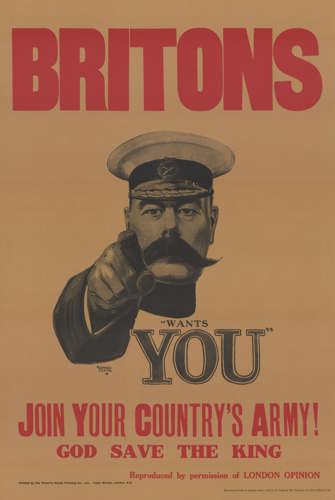
A wave of recruitment swept over the UK, spurred on by the now iconic “Lord Kitchener Wants You” poster designed by Alfred Leete.
Ordinary men and women signed up to either fight or support the war effort by the million.
While this allowed the British Empire to eventually field the largest armies it have wielded up to that stage, the “New Armies” were not without their drawbacks.
One problem was the Pals Battalions. These were units made up of young men from close local communities, be they towns, villages, or even streets.
They may have been good for morale and creating tight-knit bonds among soldiers, but Great War battlefields were brutal. Entire communities were tragically wiped out, sometimes within the space of several minutes.
Despite his enormous popularity with the public, Kitchener was not without criticism.
His running of the war effort came under fire following costly setbacks in the Dardanelles at Gallipoli and Loos, Belgium, and his handling of the munitions crisis. Gradually, his powers were reduced as others took up the burden of steering the course of the war, but he would be relied on for more diplomatic purposes.
In 1916, Kitchener was appointed to lead a delegation to Tsarist Russia to discuss armament supplies and support for the beleaguered Russian Army.
Together with France and Britain, Russia was one of the Entente Powers opposing Imperial Germany and its allies.
On the 5th of June 1916, Kitchener and his delegation left Scapa Flow naval base, Scotland, aboard HMS Hampshire. The ship and its passengers were headed for the Russian port of Arkhangelsk.
A misreading of weather reports, and intelligence indicating German submarine activity in the North Sea, spelled trouble for Hampshire from the off.
Conditions were harsh with Hampshire battling its way through a force 9 gale.
Suddenly, the steamship hit a mine laid by the newly launched U-75. Terrible damage was caused to the ship’s hull.
HMS Hampshire and 737 souls sank beneath the waves in rough seas west of the Orkney Islands. Earl Kitchener was one of Hampshire’s casualties. Only 12 men survived.
Eyewitnesses spotted Kitchener stoically standing on the ship’s quarterdeck for the 20 minutes it took Hampshire to sink. His body was never found.
Kitchener’s death rocked the British Empire. He was an exceptionally popular figure with the British public.
Upon hearing the news, one sergeant on the Western Front is recorded to have said: “Now we’ve lost the war.”
Field Marshal Douglas Haig, who would go on to become overall commander of the British Army, said: “How shall we get on without him?”
The Entente Powers would go on to win a costly victory, but the death of Kitchener was a massive blow to British morale.
Herbert Kitchener, 1st Earl Kitchener, is commemorated on the Hollybrook Memorial in Southampton, UK.
Brigadier-General John Gough VC
Upon his death on 22nd February 1915, many in British high command were absolutely devastated when John Gough, Johnnie to his friends, passed away.
Gough was known as a fighting general, a man of great determination and grit but also tempered by realism and pragmatism.
His contemporary General Sir George Barrow described Gough as “a twentieth-century Chevalier Bayard”, referencing the 15th-century French knight Pierre Terrail. Terrail was known as a paragon of virtue and duty, something which, according to his friends and colleagues, Gough embodied.
Gough is famous for a remark made in November 1914 during a German attack.
“As he watched the enemy swarming over a low ridge one of his staff said the fight was decided,” historian Ian F.W. Beckett reports in his book Johnnie Gough V.C. “Gough turned with his eyes ablaze and exclaimed: ‘God will never let those devils win’”.
It’s said this quote completely summed up Gough’s character and attitude.
Further reinforcing his reputation was how Gough earned the Victoria Cross as a 31-year-old Major in the Rifle Brigade while serving in Somaliland.
On 22nd April 1903, Gough and his column of troops were attacked during the Third Somaliland expedition.
The British managed to conduct a solid defence and a fighting withdrawal but some men were left behind. Gough returned to the front to aid Captains William George Walker and George Murray Rolland in transporting a mortally wounded officer out of the firing line.
The wounded man was hoisted aboard a camel but was tragically, fatally wounded and died.
Rolland and Walker were given Victoria Crosses for their actions. Gough downplayed his role in the incident, but it was later revealed the then Major was also worthy of the Commonwealth’s highest military honour.
The Brigadier-General was often used as a sounding board for Field Marshal Douglas Haig, having travelled to France with I Corps of the BEF of which Haig was commander. He continued to be Haig’s number two when Haig took up greater command responsibilities as the war progressed.
Gough was considered a constructive yet not uncritical voice and had a good understanding of how Haig’s mind worked.
Many of his contemporaries believed that if Gough had gone on to command a division, he would have reached even higher rank. Indeed, he was poised to take command of one of Kitchener’s New Armies in February 1915.
At this time, Gough was preparing for the attack on Neuve Chapelle. This action would result in small territorial gains for the Entente but incur just shy of 13,000 British and Indian casualties.
Gough was expected to take full command of one of the New Army divisions in March 1915. He would have achieved the rank of Major-General had this come to pass. Sadly, it was not to be.
On 20th February 1915, Gough headed to the front to visit the 2nd Battalion of the Rifle Brigade at Fauquissart, some 3 km north of Neuve Chappelle. His plan was to take lunch at the HQ Officers’ Mess there, before travelling back to the UK to take command of his new division.
While inspecting the line, Gough was hit in the chest by a ricocheting German bullet. The Brigadier-General was mortally wounded.
While it was not unusual for senior officers to get hit by sniper’s bullets, this particular incident was essentially down to massive bad luck. It’s thought that the bullet came from a single shot at a distance of 1,000 yards from the British front line, deep within German territory. It’s only by chance Gough was hit.
A field ambulance unit ferried Gough to Estaires, around 7 km from the frontline, where Gough succumbed to his wounds. He died on the morning of 22nd February 1915.
He was posthumously knighted and gazetted as a Knight Bachelor. This added to a long list of honours Gough had acquired over his highly distinguished military career.
I am looking forward to watching this Wwe Documentary on the Wwe Network sometime. I also have it on dvd it is also on the Wwe Network it is on for 1 hour and 57 minutes just under 2 hours. It is Wwe The True Story Of Wrestlemania it is a Wrestlemania Documentary about how Wrestlemania was created and how it all got started by Vince McMahon. The Documentary was filmed and released on the 15th March 2011 when I was twenty four when I was in my mid twenties when I was younger.
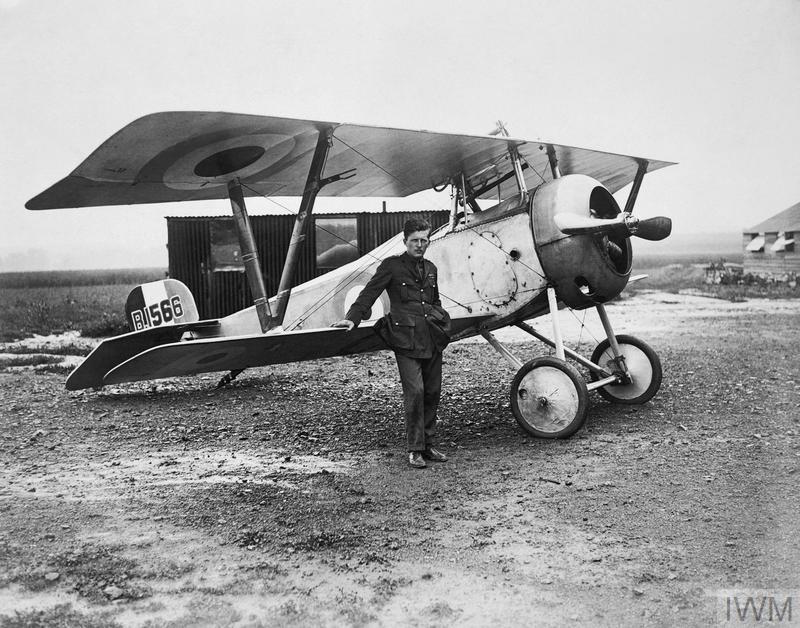
Albert Ball was one of the United Kingdom’s highest-scoring air aces.
Albert Ball (1896-1917) was a British fighter pilot and, with 44 official victories, was one of the United Kingdom’s highest-scoring air aces. In 1914 Ball enlisted in the British Army before transferring to the Royal Flying Corps in 1915. Following an intense aerial fight over the Western Front in May 1917, Ball crashed and died. He was posthumously awarded the Victoria Cross, Britain’s highest military award for bravery in the face of the enemy.
Andrew Beauchamp-Proctor VC
Andrew Beauchamp-Proctor was South Africa’s top flying ace during the First World War.
Andrew Beauchamp-Proctor (1894-1921) was South Africa’s top flying ace during the First World War. Following the outbreak of war in 1914, Beauchamp-Proctor served with the Duke of Edinburgh’s Own Rifles in the German South-West Africa campaign. Following an honourable discharge in 1915, he returned to university before enlisting with the Royal Flying Corps in March 1917. He won all of his 54 victories in 1918 and was awarded the Victoria Cross the next year. He was killed in a flight training accident in 1921.
William ‘Billy’ Bishop VC
William ‘Billy’ Bishop was Canada’s highest-scoring fighter pilot and one of the war’s top flying aces.
William ‘Billy’ Bishop (1894-1956) was Canada’s highest-scoring fighter pilot and one of the war’s top flying aces. Bishop served with the Canadian Expeditionary Force before transferring to the Royal Flying Corps in December 1915. He is credited with 72 victories and was awarded the Victoria Cross for a solo attack on a German aerodrome on 2 June 1917. Bishop survived the war and went on to become an Air Marshal in charge of recruitment during the Second World War.
Georges Guynemer
Georges Guynemer was a French fighter pilot and air ace credited with over 50 victories over the course of his service.
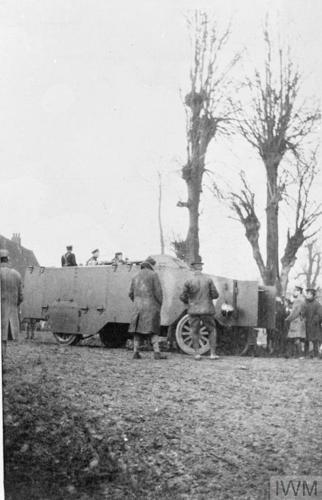
Georges Guynemer (1894-1917, pictured in the car) was a French fighter pilot and air ace credited with over 50 victories over the course of his service. He started out as a mechanic before becoming a pilot in April 1915. He died on the Western Front in September 1917. Although not his country’s top flying ace, he became France’s most popular and revered ace of the First World War.
Max Immelmann
Max Immelmann was the first German air ace of the First World War.
Max Immelmann (1890-1916) was the first German air ace of the First World War. His death in June 1916 caused such shock that another German air ace, Oswald Boelcke, was temporarily grounded for fear of the effect successive pilots’ deaths would have on home morale. Immelmann developed an aerial loop-and-roll manoeuvre that allowed pilots to dive behind a pursuing fighter. This became a standard technique throughout the war and is still known as the ‘Immelmann Turn’.
Edward ‘Mick’ Mannock VC
Edward ‘Mick’ Mannock was Britain’s highest scoring fighter pilot of the First World War.
Edward ‘Mick’ Mannock (1887-1918) was Britain’s highest scoring fighter pilot of the First World War. He served in the Royal Engineers before transferring to the Royal Flying Corps. Mannock was killed over the Western Front in July 1918 and posthumously awarded the Victoria Cross the following year. He was originally credited with 73 victories, but this figure has since been debated. Regardless, Mannock was one of the most successful air aces of the First World War.
James McCudden VC
With 57 victories, James McCudden was one of the highest scoring British fighter pilots of the First World War.
James McCudden (1895-1918) joined the Royal Flying Corps as a mechanic in 1913. With 57 victories he went on to become one of the highest scoring British fighter pilots of the First World War. McCudden was awarded the Victoria Cross in the spring of 1918 and after a brief rest was posted back to the Western Front to take control of his own squadron. He was killed in a flying accident on 9 July.
Manfred von Richthofen aka ‘The Red Baron’
Manfred von Richthofen, also known as the ‘Red Baron’, is perhaps the most famous air ace of the First World War.
Manfred von Richthofen (1892-1918), also known as the ‘Red Baron’, is perhaps the most famous air ace of the First World War. He was the highest-scoring ace of the war with 80 official victories. After serving in the German Army on the Western Front, Richthofen transferred to the air service in May 1915 and was later given command of the ‘Flying Circus’, a unit comprised of Germany’s elite fighter pilots. He was killed in action in April 1918 and buried by the British with full military honours.
I think Julia Sawalha is really good in Jonathan Creek she is in Season 4 of Jonathan Creek and she came in the series after Caroline Quentin left the series. I think she plays the part well she is in the later series which like I say is series 4 from March 2003 to February 04. Which was her last series in it and the last series and last Season of Jonathan Creek from then and before he made a new series with new people in it.
I am looking forward to catching up with Wwe NXT Halloween Havoc from this past Sunday on the Wwe Network. I will be watching it in the next week or so it is on for 2 hours and 28 minutes just under 2 and a half hours.
I am looking forward to watching Wwe NXT New Year’s Evil 2024 on the Wwe Network from earlier this year it was on this past January. It is on for 1 hour and 37 minutes just over an hour and a half. I thought it was that good I am going to watch it again it was that good.
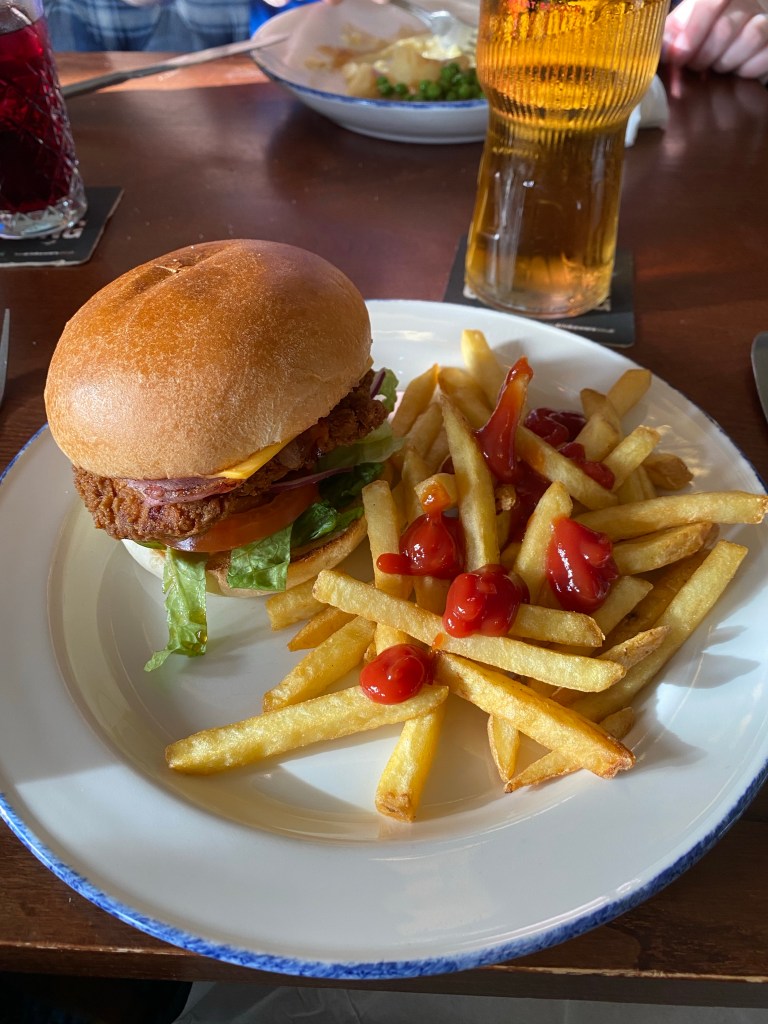
I really enjoyed my Buttermilk Chicken Burger and Chips at The Hunting Lodge on Saturday again with Carl. It is the single Fried Buttermilk Chicken Burger I always get everytime I have it at The Hunting Lodge.