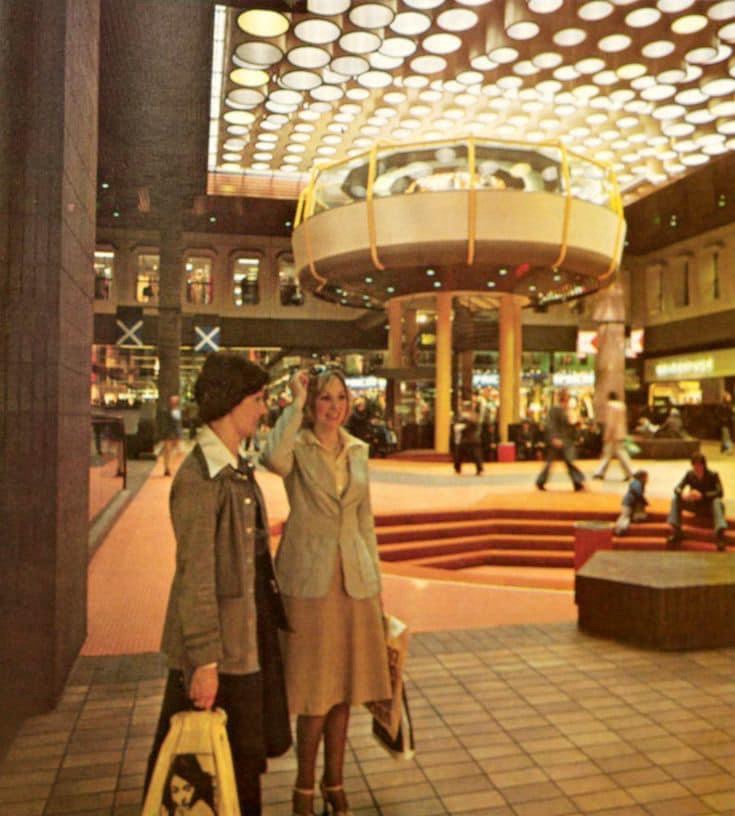
This is Newcastle Eldon Square was like back in the 1970s before I was born as you can see it was a lot different then to how it looks like now. It was like this for years in the 70’s.

Weevles Updates Disabled Bloggers Team
Weevl Bloggers Corner
For all blog posts without a category
This is Newcastle Eldon Square was like back in the 1970s before I was born as you can see it was a lot different then to how it looks like now. It was like this for years in the 70’s.
Dorothy Field was one of the first women who volunteered to work overseas as a Voluntary Aid Detachment (VAD) nurse. She tended the wounded throughout the Battle of the Somme.
Dorothy was a member of the Voluntary Aid Detachments of the British Red Cross Society during the First World War. In spring 1915, she went to France and was posted first to No.4 General Hospital at Versailles and then to No.10 General Hospital in Rouen.
Private papers

Dorothy Field photographed in her Red Cross uniform after the end of the war. She is wearing the medal ribbons of the 1914-15 Star, the British War Medal and the Victory Medal, and has four chevrons on her arm indicating four years service overseas.
In small pocket diaries, Dorothy recorded brief details of what she saw and heard. On 24 June 1916, the great artillery bombardment on the Somme began, marking the start of the battle. Although she was many miles away at the time, in Rouen, Dorothy noted in her diary that she could hear the guns firing ‘very distinctly’. When the sound finally stopped on 1 July, casualties began to pour into No.10 General Hospital.
Private papers

Pocket diaries kept by Dorothy Field during the First World War.
The first convoy of 170 men arrived at 4am on 2 July. ‘The “going over the top” results’, Dorothy wrote. ‘Practically all surgicals.’ Over the next 48 hours, four convoys of wounded arrived, while two convoys of stabilised patients left for other hospitals in France or Britain. Such was the intensity of the work at the hospital, it was 13 July before Dorothy was able to take a rest from her duties.
Over the following weeks the steady arrival of wounded men charted the course of the battle. In July, Dorothy nursed her first Australian casualties. A few weeks later she met soldiers from New Zealand and towards the end of September men from Canada.
With patients frequently dying from wounds, it was a tiring and, at times, depressing experience. But like the soldiers at the front, the hospital staff took their mind off the war with theatrical entertainments during quiet periods. Among Dorothy’s possessions is a concert programme from 2 September 1916.
Dorothy later served for a year in Italy, where she was stationed at Genoa, Turin, Arquata and Cremona. During the Second World War, she worked for the London Volunteer Ambulance Service.

With the outbreak of war with Nazi Germany, Britain needed manpower and in October 1939 the ‘colour bar’ was again lifted. The RAF began recruiting for aircrew in the Black colonies in November 1940, but despite the formal end of discrimination Black people still found it difficult to enlist. Some therefore travelled at their own expense to join the RAF in Britain while others joined the Royal Canadian Air Force (RCAF).
In 1939, the population of the Caribbean stood at less than three million people. From this, some 6,000 Black Caribbean men volunteered for the RAF, 5,500 as ground staff and some 450 as aircrew. Another 80 women joined the Women’s Auxiliary Air Force (WAAF). The largest Caribbean contingent came from Jamaica, and in February 1945 there were over 3,700 Jamaicans in air force blue. In Africa, the colonial authorities obstructed enlistment and only 60 volunteers were accepted. A further 5,200 entered the West African Air Corps, a local auxiliary force supporting RAF units based in Nigeria, Gold Coast (Ghana), Sierra Leone and Gambia. A number of Black Britons are also known to have served.

Once the volunteers arrived in Britain, they found that the RAF took the issue of racism seriously. An Air Ministry Confidential Order of June 1944 stated:
“All ranks should clearly understand that there is no colour bar in the Royal Air Force…any instant of discrimination on grounds of colour by white officers or airmen or any attitude of hostility towards personnel of non-European descent should be immediately and severely checked.”
Having abandoned the ‘colour bar’, the RAF was now more advanced regarding race than civilian employers of the day.
Flying Officer Jellicoe Scoon later flew Spitfires with 41 Squadron and Typhoons with 198 Squadron.


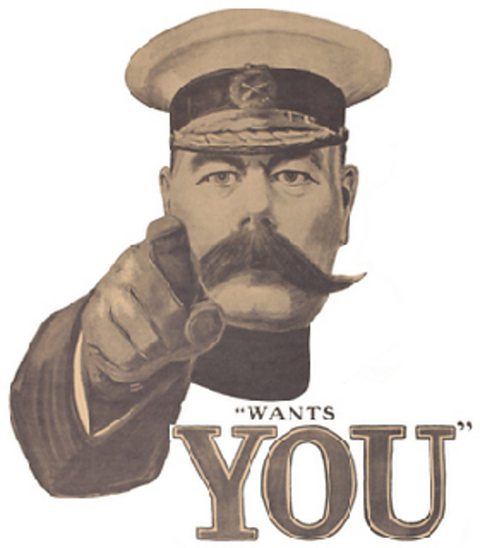
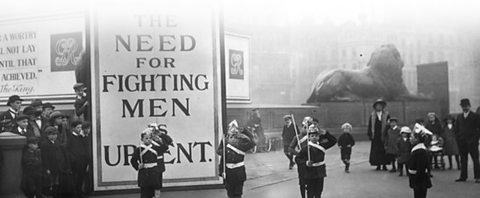
In August 1914, Lord Kitchener, the Secretary of State for War, realised Britain needed a bigger army.
He made a direct appeal to the men of Britain. Posters showed him pointing his finger at anyone passing by.
Men felt proud to fight for their country.
In the first weekend of the war, 100 men an hour (3,000 a day) signed up to join the armed forces.
By the end of 1914 1,186,337 men had enlisted.
Recruitment drives were held in places like Trafalgar Square
Only men aged between 18 and 41 could become soldiers. (The age limit was increased to 51 in April 1918 because so many men and boys had been killed by the end of the war in 1918)
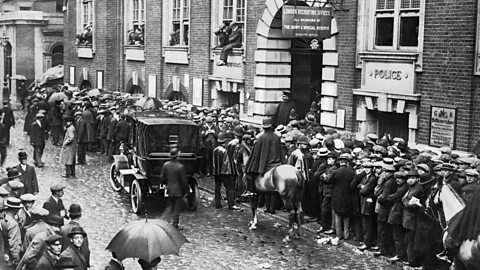
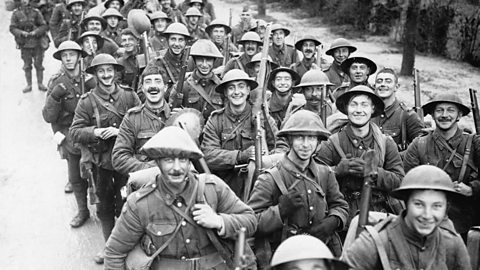
Photograph of a man giving his name to an officer at a recruitment drive in Trafalgar Square during World War One, Recruitment drives were held in places like Trafalgar Square Only men aged between 18 and 41 could become soldiers. (The age limit was increased to 51 in April 1918.)
The Government wanted as many men as possible to join the forces willingly.
But in 1916 a law was passed to say men had to join whether they wanted to or not. This was called conscription.
Watch our video to find out more about men from workplaces, churches and villages who joined the army together.
Lord Derby, a politician, encouraged men to join up with their friends as a way to recruit more soldiers.
People who already knew each other would be good for the army. They would keep each others’ spirits up. These groups became known as ‘Pals Battalions’.
One famous Pals Battalion was a group of around 700 men from Lancashire.
When the Pals left the small town of Accrington over 15,000 people crowded the streets, waving flags and cheering.
1 July 1916 was the first day of a battle near the river Somme. In just 20 minutes, 235 of the Accrington Pals were killed and over 350 were wounded.
Everyone in Accrington was shocked and sad. In some families all the men died on the same day.

Some men refused to fight for moral or religious reasons. They said their consciences would not allow them to kill.
There were about 16,000 conscientious objectors.
Some were allowed to do non-fighting work, such as farming or as stretcher-bearers on the battlefields.
Thousands more were sent to prison. They were often treated harshly there.
A white feather was used as a symbol to mean a man was a coward. They were presented to men in the street or on the bus if they weren’t wearing uniform.
The idea was to shame the man and make him join the army. This was unfair. There were many good reasons why a man might not be in uniform.
Millions of British men were injured or died in the war. The government needed to replace them so recruitment became a part of everyday life.
By the end of the war almost one quarter of all the men in Britain had been in the armed forces.

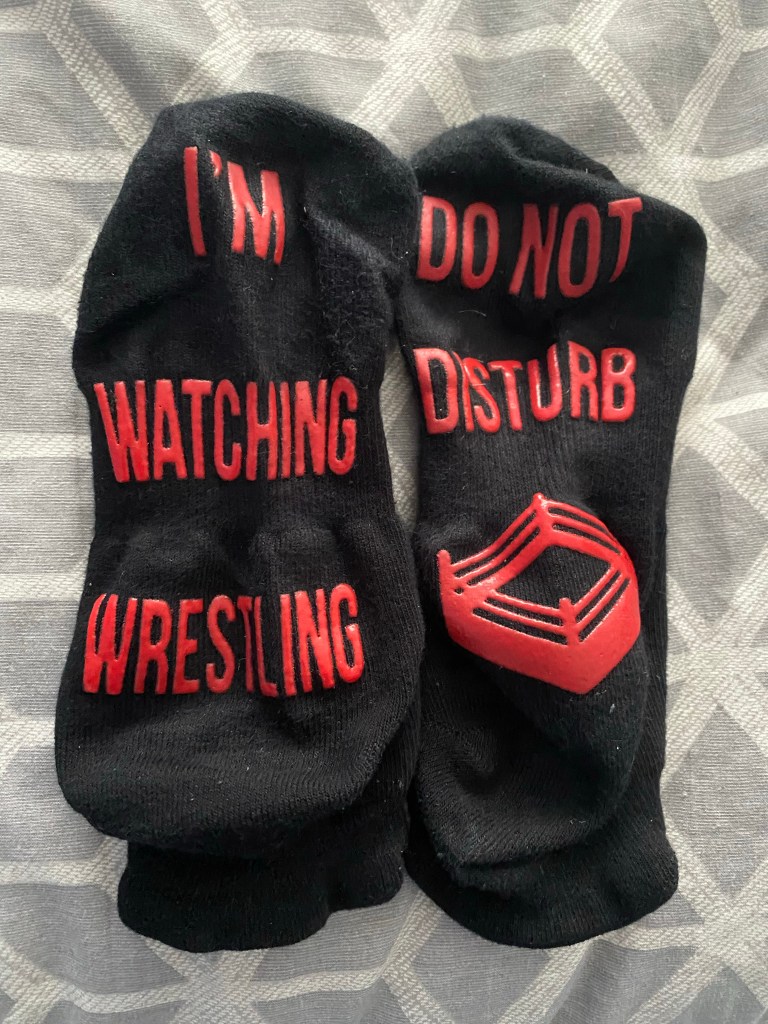
I love my new T Shirt and my new wrestling socks my Dad and Bern got me for my Birthday. I’m going to wear the wrestling socks everytime I’m having a couple of pints🍻watching my wrestling in the afternoon. I’m going to wear them when I am watching RAW Smackdown AEW Dynamite AEW Collision AEW Rampage and things on the WWE Network.
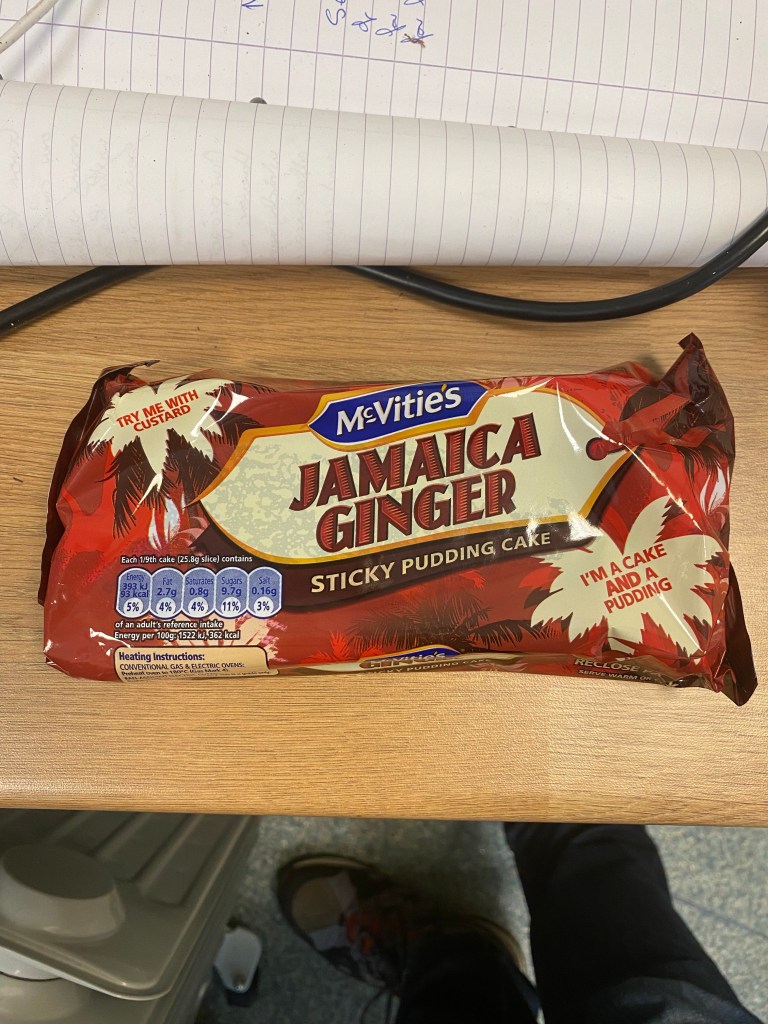
This is my Sticky Pudding Cake Karen Oxnard gave me for my birthday tomorrow. I really appreciate her giving me it for my birthday.
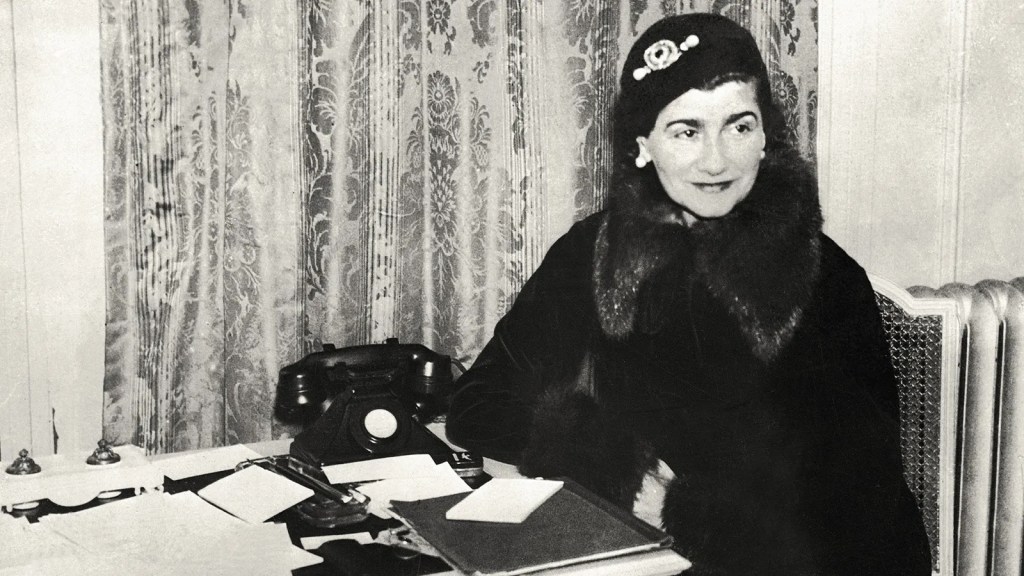
Thanks to her introduction of the little black dress, trademark suits and Chanel No. 5 perfume, Coco Chanel is credited with transforming sartorial tastes for the modern woman of the 20th century, her name becoming synonymous with impeccable fashion sense.
In recent years, however, the availability of declassified French government documents has revealed her covert work for Nazi military intelligence during World War II.
Born into poverty in 1883 and sent off to a convent-orphanage at age 12, Chanel overcame her rough beginnings to debut her visionary women’s wear by World War I.
Her meteoric rise thrust her into the stratosphere of Europe’s most powerful and influential figures. Along with hobnobbing with artistic luminaries like Pablo Picasso and Serge Diaghilev, she became friends with Winston Churchill and mistress of Hugh Richard Arthur Grosvenor, the Duke of Westminster.
Chanel’s prominent standing and connections helped her regain control over her life at a crucial time, as Adolf Hitler’s forces began closing in on Germany’s neighbors in the late 1930s.
After the Nazis took over Paris in 1940, Chanel cozied up to Baron Hans Günther von Dincklage, an officer in Abwehr, the German military intelligence. Their romance enabled Chanel to move into comfortable living quarters at Paris’ Hôtel Ritz, then doubling as a German headquarters, and kept her firmly entrenched in high society, which also had been infiltrated by German officers.
Chanel’s relations with Dincklage also allowed her to deal with important personal matters. Most pressing was her need to see to the release of her nephew André Palasse, who was imprisoned in a German stalag in 1940.
Then there were her business interests: Since 1924, when the Jewish Wertheimer family had backed the launch of her perfume line in exchange for most of the profits, the fashion maven had sought to renegotiate things on more favorable terms. Now, with “Aryanization” laws forcing Jews to give up their businesses, Chanel saw the opportunity to reclaim a lucrative branch of her empire.
Dincklage introduced his lover to another prominent Abwehr agent, Baron Louis de Vaufreland, who allegedly promised to help Chanel free her nephew in exchange for her service to Berlin. Sometime in 1941, Chanel was registered as Agent F-7124, with the code name of “Westminster,” after her former flame.
Tasked with obtaining “political information” from colleagues in Madrid, Chanel traveled to the Spanish city for a few months in mid-1941 with Vaufreland, under the guise of business dealings. According to Hal Vaughn’s book Sleeping with the Enemy, there is a record of her dinner with British diplomat Brian Wallace, during which she casually discussed life in occupied Paris and the animosity the French and Germans held toward each other.
It’s unclear whether Chanel’s interactions in Madrid moved the needle in any way, but they were apparently enough to impress Abwehr supervisors and earn the release of Palasse.
However, her desire to reclaim her perfume profits reached a dead end, as she learned that the Wertheimers had transferred control of the company to a non-Jewish Frenchman named Félix Amiot before fleeing to the United States.
Sometime between late 1943 and early 1944, with the tide turning against Germany, Chanel was tapped for another mission by General Walter Schellenberg of the SS. Named Operation Modellhut, German for “model hat,” she was to use her personal connection to Churchill, now England’s prime minister, to relay word that many SS senior officers were seeking an end to the bloodshed.
Chanel arranged for the release of Vera Lombardi, a mutual friend of hers and Churchill’s, from an Italian prison. They traveled to Madrid with Dincklage, where Lombardi was instructed to hand over Chanel’s letter to Churchill at the British Embassy.
However, this plan was blown up when Lombardi denounced Chanel and her associates as German spies. Lombardi was taken back into custody, though Chanel managed to safely return to Paris.
In August 1944, a few months after the Madrid fiasco, French forces reclaimed Paris from the Germans. With her reputation as a “horizontal collaborator,” Chanel was taken in for questioning before the Free French Purge Committee, though she was released in short order and promptly fled to Switzerland.
After the war’s conclusion, Chanel appeared in a French court to account for sworn testimony from arrested German officers that tied her to Abwehr. She managed to wriggle her way out of trouble, confirming that Vaufreland had promised to get her nephew out of prison but otherwise denying the extent of their interactions.
According to Sleeping with the Enemy, Chanel also took care to erase evidence of her actions, where possible. Upon learning that an ailing Schellenberg was planning to publish his memoir, Chanel paid his medical bills and ensured his family was on sound financial footing; the subsequent memoir had no mention of her involvement as an agent.
Ultimately, Chanel never endured any ramifications for her wartime dealings with the Nazis. She made a celebrated return to the fashion world in 1954, aided by the very same Wertheimer family she had fought for so many years, and lived out her years as a celebrity, before her death at the Hôtel Ritz in 1971.
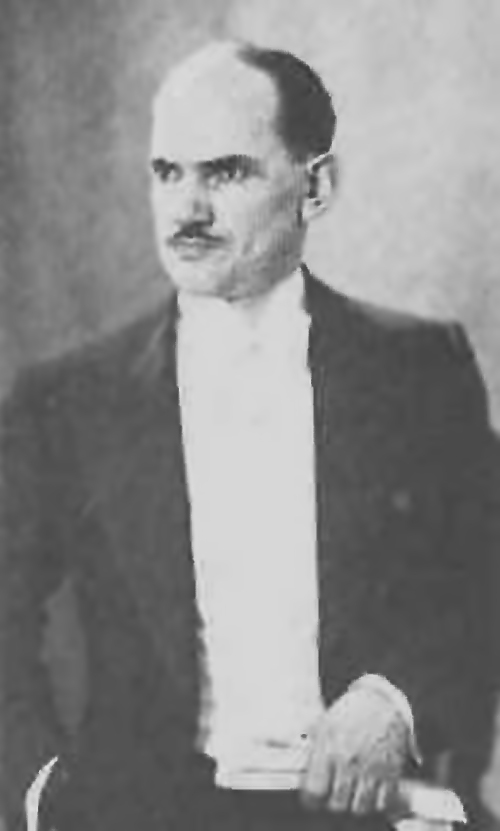
Cicero (born 1904, Pristina, Ottoman Empire [now in Kosovo]—died December 21, 1970, Munich, West Germany) was one of the most famous spies of World War II, who worked for Nazi Germany in 1943–44 while he was employed as valet to Sir Hughe Montgomery Knatchbull-Hugessen, British ambassador to neutral Turkey from 1939. He photographed secret documents from the embassy safe and turned the films over to the former German chancellor Franz von Papen, at that time German ambassador in Ankara. For this service the Hitler government paid Cicero large sums in British money, most of it counterfeited in Germany. Despite the evident authenticity of the films, the Nazi officials in Berlin mistrusted Cicero and are said to have disregarded his information (some of which dealt with plans for the Allied invasion of Normandy on D-Day, June 6, 1944).
He spent his last years as a night watchman in Munich. Der Fall Cicero (1950; Operation Cicero) was written by L.C. Moyzisch, who transmitted all communications between Cicero and Papen. A motion picture, Five Fingers (1952), was based on this book. Ich war Cicero (1962; I Was Cicero) was written by Bazna himself (under his real name) in collaboration with Hans Nogly.
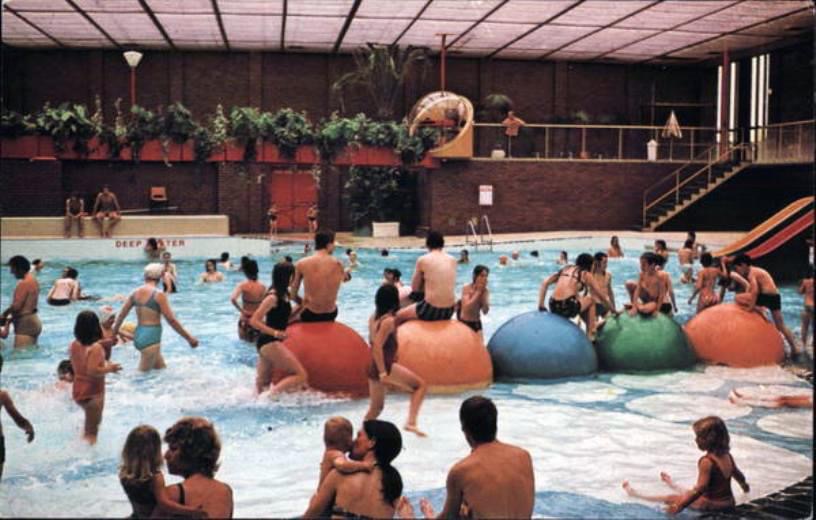
This is The Leisure Pool back in the 90’s when I was little. I use to love going to The Leisure Pool all the time when I was really young. I also use to love going down the red slide all the time and jumping off the long blue diving board in to the big round pool too.

Minimum Digital Living Standards Project (rural areas) Dr Emma stone, Good Things Foundation):
Over the summer of 2023 Good Things Foundation hosted five stakeholder workshops to discuss rural digital exclusion. Please click on link for access to their website. There is also a list of useful resources relating to digital inequalities in rural areas of the uk.