At the beginning of 1917, the British and French were still searching for a way to achieve a strategic breakthrough on the Western Front. The previous year had been marked by the costly success of the Anglo-French offensive astride the River Somme, while the French had been unable to take the initiative because of intense German pressure at Verdun until after August 1916.The battles consumed enormous quantities of resources while achieving virtually no strategic gains on the battlefield. The cost to Germany of containing the Anglo-French attacks had been enormous and given that the material preponderance of the Entente and its allies could only be expected to increase in 1917, Field Marshal Paul von Hindenburg and General Erich Ludendorff decided on a defensive strategy on the Western Front for that year. This impasse reinforced the French and British commanders’ belief that to end the stalemate they needed a breakthrough; while this desire may have been the main impetus behind the offensive, the timing and location were influenced by political and tactical considerations.
The Battle of Arras (also known as the Second Battle of Arras) was a British offensive on the Western Front during the First World War. From 9 April to 16 May 1917, British troops attacked German defences near the French city of Arras on the Western Front. The British achieved the longest advance since trench warfare had begun, surpassing the record set by the French Sixth Army on 1 July 1916. The British advance slowed in the next few days and the German defence recovered. The battle became a costly stalemate for both sides and by the end of the battle, the British Third Army and the First Army had suffered about 160,000 casualties and the German 6th Army about 125,000.
For much of the war, the opposing armies on the Western Front were at stalemate, with a continuous line of trenches from the Belgian coast to the Swiss border. The Allied objective from early 1915 was to break through the German defences into the open ground beyond and engage the numerically inferior German Army (Westheer) in a war of movement. The British attack at Arras was part of the Anglo-French Nivelle Offensive, the main part of which was the Second Battle of the Aisne 50 mi (80 km) to the south. The aim of the French offensive was to break through the German defences in forty-eight hours. At Arras the Canadians were to capture Vimy Ridge, dominating the Douai Plain to the east, advance towards Cambrai and divert German reserves from the French front.
The British effort was an assault on a relatively broad front between Vimy in the north-west and Bullecourt to the south-east. After a long preparatory bombardment, the Canadian Corps of the First Army in the north fought the Battle of Vimy Ridge, capturing the ridge. The Third Army in the centre advanced astride the Scarpe River and in the south, the Fifth Army attacked the Hindenburg Line (Siegfriedstellung) but made few gains. The British armies then conducted smaller attacks to consolidate the new positions. Although these battles were generally successful in achieving limited aims, they came at considerable cost.
When the battle officially ended on 16 May, the British had made significant advances but had been unable to achieve a breakthrough. New tactics and the equipment to exploit them had been used, showing that the British had absorbed the lessons of the Battle of the Somme and could mount set-piece attacks against fortified field defences. After the Second Battle of Bullecourt (3–17 May), the Arras sector became a quiet front, that typified most of the war in the west, except for attacks on the Hindenburg Line and around Lens, culminating in the Canadian Battle of Hill 70 (15–25 August).
This battle was fought from 15th February 1915 to 9th January 1916 on the peninsular in Turkey. The Ottoman empire was in control and Britain, France and Russia sought to weaken the control by taking control of the Turkish straits. With Turkey defeated it would make the Suez canal safe and the year round Allied supply route could be opened via the Black Sea to warm water ports in Russia.
The attempt by the allies to overcome the forces failed and a sea attempt was made in February 1915. After 8 months fighting, with approxiamatly 250,000 casualties on both sides the land campaign ended and the invasion force abandoned.It was a costly campaign on both sided with Winston Churchill heading the British involvement and their sponsership as First Lord of the Admiralty. This was considered a great victory by the Ottomans.
This led to the Turkish war of Independance which took 8 years to be successful.
Australia and New Zealand were heavily involved also in the fighting and Anzac day was established as a national holiday.
On 29 October 1914, two former German warships, the Ottoman Yavûz Sultân Selîm and Midilli, still under the command of German officers, conducted the Black Sea Raid, in which they bombarded the Russian port of Odessa and sank several ships. On 31 October, the Ottomans entered the war and began the Caucasus campaign against Russia. The British briefly bombarded forts in Gallipoli, invaded Mesopotamia and studied the possibility of forcing the Dardanelles.
The Russian cruiser Askold and the French cruiserRequin were also there. Kitchener was working on the plan as late as March 1915 and was the beginning of the British attempt to incite an Arab Revolt. The Alexandretta landing was abandoned because militarily it would have required more resources than France could allocate and politically France did not want the British operating in their sphere of influence, a position to which Britain had agreed in 1912.
By late 1914, on the Western Front, the Franco-British counter-offensive of the First Battle of the Marne had ended and the Belgians, British and French had suffered many casualties in the First Battle of Ypres in Flanders. The war of manoeuvre had ended and been replaced by trench warfare. The German Empire and Austria-Hungary closed the overland trade routes between Britain and France in the west and Russia in the east. The White Sea in the arctic north and the Sea of Okhotsk in the Far East were icebound in winter and distant from the Eastern Front; the Baltic Sea was blockaded by the Kaiserliche Marine (Imperial German Navy) and the entrance to the Black Sea through the Dardanelles was controlled by the Ottoman Empire. While the Ottomans remained neutral, supplies could still be sent to Russia through the Dardanelles but prior to the Ottoman entry into the war, the straits had been closed; in November the Ottomans began to mine the waterway.
The French Minister of Justice, Aristide Briand, proposed in November to attack the Ottoman Empire but this was rejected and an attempt by the British to bribe the Ottomans to join the Allied side also failed. Later that month, Winston Churchill, First Lord of the Admiralty, proposed a naval attack on the Dardanelles, based in part on erroneous reports of Ottoman troop strength. Churchill wanted to use a large number of obsolete battleships, which could not operate against the German High Seas Fleet, in a Dardanelles operation, with a small occupation force provided by the army. It was hoped that an attack on the Ottomans would also draw Bulgaria and Greece (formerly Ottoman possessions) into the war on the Allied side. On 2 January 1915, Grand Duke Nicholas of Russia appealed to Britain for assistance against the Ottomans, who were conducting the Caucasus campaign. Planning began for a naval demonstration in the Dardanelles, to divert Ottoman troops from Caucasia.
Attempt to force the Straits
On 17 February 1915, a British seaplane from HMS Ark Royal flew a reconnaissance sortie over the Straits. Two days later, the first attack on the Dardanelles began when a strong Anglo-French task force, including the British dreadnought HMS Queen Elizabeth, began a long-range bombardment of Ottoman coastal artillery batteries. The British had intended to use eight aircraft from Ark Royal to spot for the bombardment but harsh conditions rendered all but one of these, a Short Type 136, unserviceable. A period of bad weather slowed the initial phase but by 25 February the outer forts had been reduced and the entrance cleared of mines. After this, Royal Marines were landed to destroy guns at Kum Kale
also Seddülbahir, while the naval bombardment shifted to batteries between Kum Kale and Kephez.
Frustrated by the mobility of the Ottoman batteries, which evaded the Allied bombardments and threatened the minesweepers sent to clear the Straits, Churchill began pressuring the naval commander, Admiral Sackville Carden, to increase the fleet’s efforts. Carden drew up fresh plans and on 4 March sent a cable to Churchill, stating that the fleet could expect to arrive in Istanbul within 14 days. A sense of impending victory was heightened by the interception of a German wireless message that revealed the Ottoman Dardanelles forts were running out of ammunition. When the message was relayed to Carden, it was agreed the main attack would be launched on or around 17 March. Carden, suffering from stress, was placed on the sick list by the medical officer and command was taken over by Admiral John de Robeck.
18 March 1915
Panoramic view of the Allied fleet in the Dardanelles
On the morning of 18 March 1915, the Allied fleet, comprising 18 battleships with an array of cruisers and destroyers began the main attack against the narrowest point of the Dardanelles, where the straits are 1 mile (1.6 km) wide. Despite some damage to the Allied ships engaging the forts by Otterman return fire minesweepers were ordered along the straights.
In the Ottoman official account, by 2:00 p.m. “all telephone wires were cut, all communications with the forts were interrupted, some of the guns had been knocked out … in consequence the artillery fire of the defence had slackened considerably”. The French battleship Bouvet struck a mine, causing her to capsize in two minutes, with just 75 survivors out of a total crew of 718. Minesweepers, manned by civilians, retreated under Ottoman artillery fire, leaving the minefields largely intact. HMS Irresistible and HMS Inflexible struck mines and Irresistible was sunk, with most of her surviving crew rescued; Inflexible was badly damaged and withdrawn. There was confusion during the battle about the cause of the damage; some participants blamed torpedoes. HMS Ocean was sent to rescue Irresistible but was disabled from an artillery shell, struck a mine, and was evacuated, eventually sinking.
The French battleships Suffren and Gaulois sailed through a new line of mines placed secretly by the Ottoman minelayer Nusret ten days before and were also damaged. The losses forced de Robeck to sound the “general recall” to protect what remained of his force. During the planning of the campaign, naval losses had been anticipated and mainly obsolete battleships, unfit to face the German fleet, had been sent. Some of the senior naval officers like the commander of Queen Elizabeth, Commodore Roger Keyes, felt that they had come close to victory, believing that the Ottoman guns had almost run out of ammunition but the views of de Robeck, the First Sea LordJackie Fisher and others prevailed. Allied attempts to force the straits using naval power were terminated, due to the losses and bad weather. Planning to capture the Turkish defences by land, to open the way for the ships began. Two Allied submarines tried to traverse the Dardanelles but were lost to mines and the strong currents.
Over the following month, Hamilton prepared his plan and the British and French divisions joined the Australians in Egypt. Hamilton chose to concentrate on the southern part of the Gallipoli peninsula at Cape Helles and Seddülbahir, where an unopposed landing was expected. The Allies initially discounted the fighting ability of the Ottoman soldiers. The naïveté of the Allied planners was illustrated by a leaflet that was issued to the British and Australians while they were still in Egypt,
The underestimation of Ottoman military potential stemmed from a “sense of superiority” among the Allies, because of the decline of the Ottoman Empire and its poor performance in Libya during the Italo-Turkish War of 1911–1912 and the Balkan Wars of 1912 and 1913. Allied intelligence failed to adequately prepare for the campaign, in some cases relying on information gained from Egyptian travel guides. The troops for the assault were loaded on transports in the order they were to disembark, causing a long delay which meant that many troops, including the French at Mudros, were forced to detour to Alexandria to embark on the ships that would take them into battle. A five-week delay until the end of April ensued, during which the Ottomans strengthened their defences on the peninsula; although bad weather during March and April might have delayed the landings anyway, preventing supply and reinforcement. Following preparations in Egypt, Hamilton and his headquarters staff arrived at Mudros on 10 April. The ANZAC Corps departed Egypt in early April and assembled on the island of Lemnos in Greece on 12 April, where a small garrison had been established in early March and practice landings were undertaken. The British 29th Division departed for Mudros on 7 April and the Royal Naval Division rehearsed on the island of Skyros, after arriving there on 17 April. That day, the British submarine HMS E15 tried to run the straits but hit a submarine net, ran aground and was shelled by a Turkish fort, killing its commander, Lieutenant Commander Theodore S. Brodie and six of his crew; the survivors were forced to surrender. The Allied fleet and British and French troops assembled at Mudros, ready for the landings but poor weather from 19 March grounded Allied aircraft for nine days and on 24 days only a partial programme of reconnaissance flights were possible.
Aftermath
The Allied campaign was plagued by poor planning, untrained troops, poor maps, poor intelligence, poor artillary,logistical inequalities, tactics were none existent.
Geography of the area was misunderstood so men were directed to the wrong beaches and ended up locked into a narrow area where they could not fight efficiently. The Ottomans ie the enemy could keep control of the high ground therefore giving them an advantage.
The political repercussions were substansive. Many leaders resigned in the military. Winston Churchill decided to stay and this ended in Prime Minister Asquith ending his Liberal government and creating a co alition government. Asquith was largely blamed for the problems.
Casualties
Over 164,000 Ottomans killed
187,000 Allies killed
including 120,000 British killed.
Sickness
Many soldiers suffered typhoid and dysentry and some died of it because of the insanitary conditions in which they were forced to live.90,000 were evacuated to hospital to Egypt and Malta. Many who died on the hospital ships were buried at sea so therefore had no grave.
There are no cemetries for the Ottoman/Turkish dead only memorials.
Only a small section of the Australian and New Zealand fighting force input in the fight, but it did place the peoples in a state of a “baptism of fire” and a hard lesson learned. 50,000 Australians and 17,000 New Zealanders.
Germany was famous for making bicycle tyres in that era and with the shortages of rubber because of the war, they started making small coiled springs attached to the metal frame of the wheel, so people could still use their bikes.
During WW1 France built a smaller version of Paris with no one living there to confuse the German bombers.
During the War in USA, German was the mostly spoken language which the Government suppressed because of the World War. Most of the schools, governments and newspapers operated in German.
In 1964 Germany decided to reward the East African soldiers who served with them in WW1 but because no records were kept to prove who they were they got the people to write the manual they worked by regarding weapons they used during the war. All applicants passed the test.
A Hungarian called Paul Kern was shot in WW1 in the front temporal lobe and could never fall asleep again. He lived for years unable to sleep. No one knows why this happened.
King Albert !st of Belgium fought with his troups in WW1 and his wife was a nurse during that time.
The famous comedy brothers called ‘Marx brothers’ to get out of the draft, their Mother bought a farm and got them to work on the farm. This was because farm workers and owners were exempt from the draft to fight in the war.
During the war a lone Portugese soldier covinced German soldiers he was an entire unit. He did not eat or sleep for hours
The ocean liner Olypic, sister ship to the Titanic,became the only merchant vessel in WW1 to sink an enemy warship when she sank a U boat number 103
In WW1 US navy warships painted complex geo metric stripes on battleships to confuse the enemy
16 Days before the RMS Lusitania set sail, Germany published a warning in the New York Times they would destroy any ship leaving for Britain. The warning was ignored and 1198 people drowned.
In WW1 Canadians survived the first chemical, attack by urinating on their hankerchiefs and holding it to their faces as a mask.
There was a wounded pidgeon who saved the lives of 198 soldiers in WW1
Hitler fought in WW1 and had a full moustache. He was ordered to cut it down to a toothbrush size to accommodate wearing a gas mask.
During WW2 as Hitler rose to fame he would not allow gas to be used in WW2 because of his experience with it in WW1 as a lowly soldier.He was exposed to it himself and understood the devastating effects.
Britsh armed merchant cruiser named RMS Carmania engaged and sank the merchant ship SMS Trafalger German cruiser.Ironically they had been disguised as each other.
Sir Arthur Conan Doyle the writer of Sherlock Holmes tried to enlist at the start of WW1. He was 55 years old. He stated he was very robust and strong and had such a loud voice he could be heard over long distances
The Pharmaceutical company ‘Bayer’ discovered Heroin and used to use it as a cough treatment.
Over 90,000 Chinese labourers were used by British Army to dig trenches during WW1 on the Western Front.
Woodrow Wilson was the US president during WW1 and was a white supremacist and he resurected the Klu Klux Clan in 1915.
8 million horses were killed in WW1 the same as human beings
Due to steel shortages in WW1 ships were built using concrete. Only ten survive today and are based in British Columbia
Karl Von Muller was the captain of the German ship SMS Emden. He contacted an enemy merchant ship before he sunk it allowing all the passengers off with their belongings.
Because of the anti contraception laws in USA they band the use of condoms until 1972. This led to a rise in Sexually transmitted diseases among US soldiers in WW1
The deadliest non nuclear occurred in Germany killing 10 thousand people in WW1 in a mining asccident
Hugh Lofting not wishing to frighten his children about the terrible stories from WW1 wrote imaginary letters to them which later became the Dr Dolittle stories
Safety razors were invented in 18th century but Gillette arranged a deal with US Armed Forces in WW1 to provide Razors and blades to be part of the kit new soldiers were given on joining the army on his way to Europe.
WW1 planes had no guns on the planes so soldiers used to use pistols and carbines in air to air combat
Rudyard Kipling wanted his 18 year old son John to join the army. He kept being refused because he had such poor eye sight. Kipling used his connections with the Commander in Chief of the Army and his son was allowed to join and sent to war. An exploding shell ripped his face apart and he was killed.
Because metal became scarce during WW1 corsets stopped being made and bras became more popular
In WW1 hamburgers were renamed Liberty Sandwhiches to promote patriotism
I am so glad to be back after the horendous 18 months everyone has gone through because of the virus. I hope everyone is well and has not been too affected by all that has happened.
My time has been spent looking after an elderly relative who is 93 actually 94 in October. I have had to stay safe for her as I am the only relative left. So shopping and paying bills and going to doctors appointments has filled my life. My two little dogs have been a god send and kept me sane also the gardening as we have had a great summer. Lucky me to have a garden I guess.
Well stay safe eveyone, onward and upward, I wish you all luck for the future.
Like many veterans of the killing fields of World War I, Horace Pippin had a tough time shaking off the memories. So in the decade after the war he captured them, and tamed them, inside sketch-filled journals.
He had no dearth of stories to tell. There was the terrified young recruit who hauntingly foresaw his own death. The foul trenches, with their unending soundtrack of screaming artillery shells and staccato machine-gun fire. The gas clouds that suddenly appeared from the sky. The forays across fields littered with wounded and dead. And the trauma of being hit by a German sniper and then pinned in a foxhole, bleeding out.
Pippin poured out his war memories into a few small composition books, filling page after page with his tidy handwriting. The spelling and grammar are often makeshift. The humble drawings are rendered in pencil and crayon. But the stories—even in Pippin’s muted, matter-of-fact telling—offer a rare first-person account of the harrowing combat experience of the Harlem Hellfighters, the most celebrated U.S. regiment of African-American soldiers during WWI.
The Harlem Hellfighters were an African-American infantry unit in WWI who spent more time in combat than any other American unit. Despite their courage, sacrifice and dedication to their country, they returned home to face racism and segregation from their fellow countrymen.
Signing on for Uncle Sam
When the U.S. entered World War I in 1917, Horace Pippin was almost 30 years old. Born in West Chester, Pennsylvania and raised in Goshen, New York, he left school after the 7th grade to help support his family. He took an array of menial jobs (hotel porter, coal-wagon driver, feed-store helper); lived intermittently in New York City as a laborer; then moved to Patterson, New Jersey in 1912, to work as an iron molder. At this point, there was little evidence he would go on to become one of the most renowned African-American artists of the 20th century.
On June 1, 1917, not long after the U.S. entered the war, Pippen volunteered for the 15th New York National Guard, later christened the 369th regiment and nicknamed the Harlem Hellfighters. That November, during training, he earned his corporal stripes. They landed on the Atlantic coast of France the following month.
From the time the Hellfighters arrived in France late in December 1917, it was unclear if they would ever see combat at all. In the heyday of Jim Crow discrimination, the U.S. military’s all-white leadership questioned whether black soldiers had the intelligence or courage to fight, so most were relegated to support roles. Roughly 10 percent of the 380,000 African-Americans who served in the war actually fought, according the U.S. National Archives.
Eager to fight, hailed as heroes
Assigned to the infantry under General John J. “Black Jack” Pershing, commander of the American Expeditionary Force, the Hellfighters initially toiled as laborers, constructing a railroad yard, building roads and unloading ships. “It were slow work and wet work and you would go to bed wet, for there would be no fire to dry by,” Pippin wrote of the latter duty. But the black troops were eager to fight from the front-line trenches. “It were a place we all wanted to see,” he wrote. “We did not think it right to go there and not see it.”
They ultimately did see the trenches—and combat—in northern France, where they played a crucial role in helping to blunt the German advance across the Western front.
The 369th proved themselves able and fearless fighters. Serving 191 days on the front—more time in continuous combat than any other American unit—the Hellfighters never lost ground to the Germans or had a man captured. And they were the first unit of all the Allied armies to reach the River Rhine, a key strategic victory. “My men never retire, they go forward or they die,” said their commanding officer, Colonel William Hayward, to a French general who urged retreat after one particularly bruising battle. The French government honored the entire regiment with the Croix de Guerre; many individual members received medals of valor. Many didn’t.
Of his unit, Pippin wrote, “I never seen the time yet that…[they] were not ready. They were always ready to go and they did go to the last man….We were good. Good a nuff to go any place.”
Fighting for the French
But it wasn’t alongside American forces that the Hellfighters made their mark. With the French looking to the U.S. to help replenish their badly depleted armies, Pershing handed the 369th over to their allies.
Seeing the shoddy equipment given to America’s black troops, the French re-kitted the Hellfighters with French rifles, helmets, belts, gas masks and canteens (with wine). They also beefed up the 369th’s military training: in trench construction, machine-gun operation, the construction and use of grenades, and preparations for a gas attack.
“They proved apt pupils,” wrote journalist and educator Emmett J. Scott in Scott’s Official History of The American Negro in the World War, the first major chronicle of African-American contributions to WWI, published in 1919. “In grenade-throwing they easily outdid their instructors, and in bayonet work they demonstrated great skill.”
After months of training, the 369th first saw action in Bois d’Hauze, in the Champagne region, on March 12, 1918. The Hellfighters went on to fight major battles at Château-Thierry, Belleau Wood and Minancourt.
Dogfights above, vermin below
Life on the front, in what Pippin called “them lonely, cooty, muddy trenches,” was a miserable, terror-filled slog, where one day blurred into the next. Soldiers had to constantly bail out water with pails, he wrote, to keep their bottom bunks from being inundated. Rats and lice were constant companions. And the steady German barrage meant that death could arrive at any moment.
“We were all in the dugout when…the shells were dropeing all around our trench,” he wrote. “Soon as we came out of our dugout I could smell gas… I looked around me and I seen that they all had their gas mass on… Every step we took a shell would land somewhere near the trench.” He went on to describe how mortar shells caved in parts of the trench, forcing them to fall to their bellies and crawl like worms through the muck.
Clouds of poisonous gas drifted in without warning. They could be so thick, he wrote, “that it all looked blue… [The Germans] put so mutch gas in one place and it were so thick that it looked like fog.”
And hardly a day went by without a dogfight overhead. Once, Pippin witnessed a French plane score a direct hit on a German one: “All at once he were afire and came down to rise no more.” He ran to the crash site, where the cockpit’s two occupants looked “like mush.” Meanwhile, the victorious French pilot circled above “like a king over his great foe.”
Airborne gunners would also strafe the ground with bullets. Anywhere men were out in the open, on roads or in fields, “the Germens would come in a plain and would deel out Death to them,” Pippin wrote. “I never gave it a thought ontill one afternoon, it were a cloudy day… I were not thinking of anytheing in the line of danger at that time…when all at once I heard a sound like a gush of air… I fell to one side of the trench as he fired at me. I lade lo ontill he were gon. I said to myself he near had me this time.”
Not that there was ever time to recover from such close calls. Afterward, as Pippin sat on a box, smoking a cigarette to calm his nerves, the gas alarm sounded, alerting the platoon to an incoming cloud of strong mustard gas. Later that night, a runner arrived; soon after, Pippin and others were sent out into no man’s land in the pouring rain to root out a nest of German gunners; the mission failed.
Men as machine-gun fodder
Pippin vividly described the 369th’s hellish forays into the battlefield. When the artillery opened up, he wrote, “You would have thought the world was coming to an end… To see those shells bursting in the night…the gas, dust and smoke was terrible.”
Sometimes they would be out for days, without food, trying to advance as enemy machine-gunners targeted them continuously. “Men layeing all over wounded and dead, some was being carryed. We wished we could help the wounded by we couldn’t. We had to leave them there and keep advanceing, ducking from shell hole to shell hole all day.”
He described one afternoon in summer 1918 when virtually all of his platoon had been felled by heavy machine-gun crossfire. “It only left four unhirt in that pit,” he wrote. After one friend got killed right behind him while peeking up to spot the enemy position, Pippen creeped away. “The bullets were hitening in front of me and would throw dirt in my face. I knew that if I stayed there I would get it. So I said to my budy, when I say go be ready and make it for the little bridge and cross the swamp if we can. I said go and we made the bridge.” The whole way, he wrote, “the Germans were shelling the swamp with gas and scrapnel.”
A foreboding of death
While the 369th was renowned for its aggressiveness and bravery, soldiers naturally had moments of primal fear. Pippin wrote about a young fellow Hellfighter who, in July 1918, had gathered with other volunteers to join a raid: “He looked like every nerve was shakeing. I never saw a man like this before. I asked him what was wrong. His eyes all but bulged out of his head, he said I am not comeing back.” Pippin reminded the young man that he didn’t have to volunteer, that he could take a sick exemption. “He said no I am going through with it. But I am not comeing back.”
Pippin called it “the worse fifteen minutes I ever put in, watching this boy.” After the squad jumped into the enemy trench, and returned with two German prisoners, the boy wasn’t with them, he wrote: “A Germen had run him through. He fore told his end… I have seen men die in all forms and shapes, but never one who knew like he did.”
In 1933, Adolf Hitler became Chancellor of Germany. The philosophies of the Nazi party, of which he was head, were based on eugenics – a pseudoscience that had much traction around the world at the time.
Eugenics dictated that only the healthiest and fittest be allowed to procreate and to live. The Nazis’ racial policies, which divided human races into levels of fitness for life, synergised with eugenics to support programmes declaring certain people ‘life unworthy of life‘ or ‘useless feeders.’
Under such policies, people with mental illnesses, physical and intellectual disabilities, and conditions such as epilepsy, chronic alcoholism and a range of genetic diseases, were considered a burden on society and should be annihilated.
To this end, in 1939, Hitler, through his personal physician Dr Karl Brandt, set up the ‘T4′ programme – the systematic, state-sanctioned murder of the disabled and chronically ill. The first people to be killed were disabled children.
The main killing centres were hospitals and homes for the disabled. Parents and carers were encouraged to place their loved ones and children into institutions. They would then be moved to another institution a long way from home, and contact between child and parent ceased.
After some months, parents received a letter saying that their child had died of something like pneumonia or appendicitis and that the parents could come and collect their ashes and pay for the funeral.
Doctors would assess the patients and make a mark on a standard questionnaire that dictated whether the person was to be killed or allowed to live.
While doctors made the decisions about who should live or die, the nurses did the killing. The killings took place in hospitals. Who constitutes the largest proportion of the workforce in a hospital? It’s the nurses, and it was the nurses who killed.
They used intravenous injections, lethal doses of drugs such as phenobarbitone, or starvation or hypothermia from exposure.
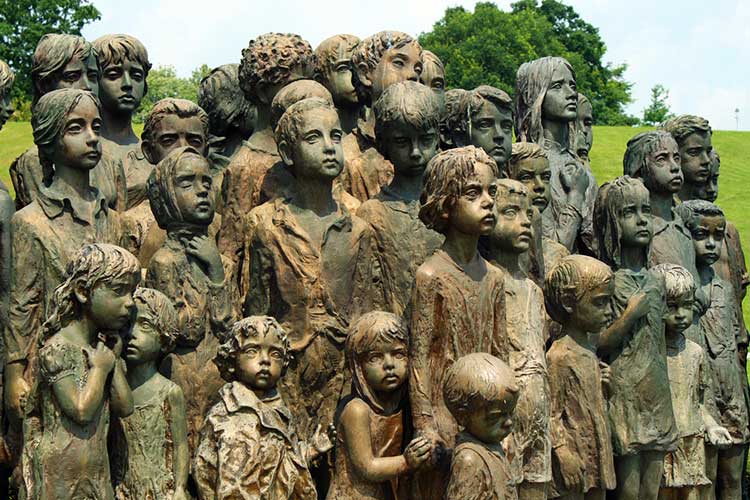
Memorial to the Children Victims of the War, Lidice, Czech Republic.
What made the nurses do this, surely they were there to care for patients?
In Hitler’s Germany, propaganda underpinned everything.
Propaganda about ‘life unworthy of life’ and ‘useless feeders’ was everywhere, even in arithmetic exercises for primary school children.
Many people genuinely believed that by removing these burdens on society, Germany would be a better place. Nurses, too, succumbed to the propaganda. Many believed that they were doing the right thing, that Germany would be a better place because of these policies.
Of course, there were many who disagreed and would not take part. These nurses were not punished, nor ostracised – they were moved to another hospital or another ward.
In other words, the nurses who participated in this murder did so willingly and voluntarily.
Eduard Wagner (1 April 1894 – 23 July 1944) was a general in the Army of Nazi Germany who served as quartermaster-general in World War II. He had the overall responsibility for security in the Army Group Rear Areas, and thus bore responsibility for the war crimes committed by the rear-security units in the occupied areas under the army’s jurisdiction.
On 24 July 1939 he drew up regulations that allowed German soldiers to take hostages from civilian population and execute them as response to resistance. He personally welcomed the idea of future invasion of Poland, writing that he looked to it “gladly”. He had a central role in the death sentences for ten Polish prisoners taken in the Defense of the Polish Post Office in Danzig. In May 1941, he drew up the regulations with Reinhard Heydrich that ensured that the Army and Einsatzgruppen would co-operate in murdering Soviet Jews. On the Eastern Front he had a role in ensuring that suitable winter clothing was supplied to the German forces and on 27 November 1941 he reported that “We are at the end of our resources in both personnel and material. We are about to be confronted with the dangers of deep winter.”
In the summer of 1942, before his visit to inspect the 6th Army during the Battle of Stalingrad, he informed Hitler of the “lack of sources of fuel.” By that time, “all the generals avoided contradicting Hitler” as “all feared the hysterical outbursts of this lofty dictator.”
Wagner even was well informed about planned war crimes of the future. In late February 1943, Otto Bräutigam of the Reich Ministry for the Occupied Eastern Territories had the opportunity to read a personal report by Wagner about a discussion with Heinrich Himmler, in which Himmler had expressed the intention to exterminate about 80% of the populations of France and England by special forces of the SS after the German victory. Before, Hitler had called the English lower classes “racially inferior”.
After the failure of the coup attempt, he feared that his arrest by the Gestapo was imminent and that he might be forced to implicate other plotters. He committed suicide by shooting himself in the head at noon on 23 July 1944.
On 18 October 1930, Kaltenbrunner joined the Nazi Party with NSDAP member number 300,179. In 1931, he was the Bezirksredner (district speaker) for the Nazi Party in Oberösterreich. Kaltenbrunner went on to join the SS on 31 August 1931, his SS number was 13,039. He first became a Rechtsberater (legal consultant) for the party in 1929 and later held this same position for SS Abschnitt (Section) VIII beginning in 1932. That same year, he began working at his father’s law practice and by 1933 was head of the National-Socialist Lawyers’ League in Linz.
In January 1934, Kaltenbrunner was briefly jailed at the Kaisersteinbruch detention camp with other National Socialists for conspiracy by the Engelbert Dollfuss government. While there he led a hunger strike which forced the government to release 490 of the party members. In 1935, he was jailed again on suspicion of high treason. This charge was dropped, but he was sentenced to six months imprisonment for conspiracy and he lost his license to practice law.
From mid-1935 Kaltenbrunner was head of the illegal SS Abschnitt VIII in Linz and was considered a leader of the Austrian SS. To provide Heinrich Himmler, Reinhard Heydrich and Heinz Jost with new information, Kaltenbrunner repeatedly made trips to Bavaria. Hiding on a train and on a ship that traveled to Passau, he would return with money and orders for Austrian comrades. Kaltenbrunner was arrested again in 1937, by Austrian authorities on charges of being head of the illegal Nazi Party organization in Oberösterreich. He was released in September.Kaltenbrunner (on the far left), Heinrich Himmler and August Eigruber inspect Mauthausen concentration camp in 1941, in the company of camp commander Franz Ziereis.
Acting on orders from Hermann Göring, Kaltenbrunner assisted in the Anschluss with Germany in March 1938, and was awarded the role as the state secretary for public security in the Seyss-Inquart cabinet. Controlled from behind the scenes by Himmler, Kaltenbrunner still led, albeit clandestinely, the Austrian SS as part of his duty to ‘coordinate’ and manage the Austrian population. Then on 21 March 1938, he was promoted to SS-Brigadeführer. He was a member of the Reichstag from 10 April 1938 until 8 May 1945. Amid this activity, he helped establish the Mauthausen-Gusen concentration camp near Linz. Mauthausen was the first Nazi concentration camp opened in Austria following the Anschluss. On 11 September 1938, Kaltenbrunner was promoted to the rank of SS-Gruppenführer, equivalent to a lieutenant general in the army while holding the position of Führer of SS-Oberabschnitt Österreich (re-designated SS-Oberabschnitt Donau in November 1938). Also in 1938, he was appointed High SS and police leader (Höherer SS- und Polizeiführer; HSSPF) for Donau, which was the primary SS command in Austria (he held that post until 30 January 1943).
World War II
In June 1940, Kaltenbrunner was appointed Police President of Vienna and held that additional post for a year. In July 1940, he was commissioned as a SS-Untersturmführer in the Waffen-SS Reserve. Throughout his many duties, Kaltenbrunner also developed an impressive intelligence network across Austria moving southeastwards, which eventually brought him to Himmler’s attention for the assignment as chief of the RSHA in January 1943. The RSHA was composed of the SiPo (Sicherheitspolizei; the combined forces of the Gestapo and Kripo) along with the SD (Sicherheitsdienst, Security Service). He replaced Heydrich, who was assassinated in June 1942. Kaltenbrunner held this position until the end of the war. Hardly anyone knew Kaltenbrunner and upon his appointment, Himmler transferred responsibility for both SS personnel and economics from the RSHA to the SS Main Economic and Administrative Office. Nonetheless, he was promoted to SS-Obergruppenführer und General der Polizei on 21 June 1943. He also replaced Heydrich as President of the International Criminal Police Commission (ICPC), the organization today known as Interpol.
Fear of a collapsing home-front due to the Allied bombing campaigns and that another “stab-in-the-back” at home could arise, as a result, caused Kaltenbrunner to immediately tighten the Nazi grip within Germany. From what historian Anthony Read relates, Kaltenbrunner’s appointment as RSHA chief came as a surprise given the other possible candidates like head of the Gestapo, Heinrich Müller, or even SD foreign intelligence chief, Walter Schellenberg. Historian Richard Grunberger also added the name of Dr. Wilhelm Stuckart, the future minister of the German Interior as another potential candidate for head of the RSHA; however, he suggests that Kaltenbrunner was most likely selected since he was a comparative “newcomer” who would be more “pliable” in Himmler’s hands.
Like many of the ideological fanatics in the regime, Kaltenbrunner was a committed anti-Semite. According to former SS-Sturmbannführer Hans Georg Mayer, Kaltenbrunner was present at a December 1940 meeting among Hitler, Goebbels, Himmler, and Heydrich where it was decided to gas all Jews incapable of heavy physical work. Under Kaltenbrunner’s command, the persecution of Jews picked up pace as “the process of extermination was to be expedited and the concentration of the Jews in the Reich itself and the occupied countries were to be liquidated as soon as possible.” Kaltenbrunner stayed constantly informed over the status of concentration camp activities, receiving periodic reports at his office in the RSHA.
To combat homosexuality across the greater Reich, Kaltenbrunner pushed the Ministry of Justice in July 1943 for an edict mandating compulsory castration for anyone found guilty of this offense. While this was rejected, he still took steps to get the army to review some 6,000 cases to prosecute homosexuals. Kaltenbrunner with Himmler and Ziereis at Mauthausen in April 1941
During the summer of 1943, Kaltenbrunner conducted his second inspection of the Mauthausen-Gusen concentration camp. While he was there, 15 prisoners were selected to demonstrate for Kaltenbrunner three methods of killing; by a gunshot to the neck, hanging, and gassing. After the killings were performed, Kaltenbrunner inspected the crematorium and later the quarry. In October 1943, he told Herbert Kappler, the head of German police and security services in Rome, that the “eradication of the Jews in Italy” was of “special interest” for “general security.” Four days later, Kappler’s SS and police units began rounding up and deporting Jews by train to Auschwitz concentration camp.
In 1944 when Hitler was in the process of strong-arming Admiral Horthy into submitting Hungary to the Nazis during an arranged meeting in Klessheim Castle in Salzburg, Kaltenbrunner was present for the negotiations and escorted him out once they were over. Accompanying Horthy and Kaltenbrunner on the journey back to Hungary was Adolf Eichmann, who brought with him a special Einsatzkommando unit to begin the process of “rounding up and deporting Hungary’s 750,000 Jews.”
It was said that even Himmler feared him, as Kaltenbrunner was an intimidating figure with his 1.94 metres (6 ft 4 in) height, facial scars, and volatile temper. Kaltenbrunner was also a longtime friend of Otto Skorzeny and recommended him for many secret missions, allowing Skorzeny to become one of Hitler’s favorite agents. Kaltenbrunner was also responsible for heading Operation Long Jump, a plan to assassinate Stalin, Churchill, and Roosevelt in Tehran.
Immediately in the wake of the 20 July Plot on Hitler’s life in 1944, Kaltenbrunner was summoned to Hitler’s wartime headquarters at the Wolfsschanze (Wolf’s Lair) in East Prussia to begin the investigation into who was responsible for the assassination attempt. Once it was revealed that an attempted military coup against Hitler had been launched, Himmler and Kaltenbrunner had to tread carefully, as the military was not under the jurisdiction of the Gestapo or the SD. Since the attempt failed, the conspirators were soon identified. An estimated 5,000 people were eventually executed, with many more sent to concentration camps.Kaltenbrunner (front row, second from left) as a spectator at a People’s Court show trial following the failed 20 July plot.
Historian Heinz Höhne counted Kaltenbrunner among fanatical Hitler loyalists and described him as being committed “to the bitter end.” Field reports from the SD in October 1944 about deteriorating morale in the military prompted Kaltenbrunner to urge the involvement of the RSHA in military court-martial proceedings, but this was rejected by Himmler who thought it unwise to interfere in Wehrmacht (army) affairs. In December 1944, Kaltenbrunner was granted the additional rank of General of the Waffen-SS. On 15 November 1944 he was awarded the Knights Cross of the War Merit Cross with Swords. In addition, he was awarded the NSDAP Golden Party Badge and the Blutorden (Blood Order) Using his authority as Chief of the RSHA, Kaltenbrunner issued a decree on 6 February 1945 that allowed policemen to shoot “disloyal” people at their discretion, without judicial review.
On 12 March 1945, a meeting took place in the Vorarlberg between Kaltenbrunner and Carl Jacob Burckhardt, president of the International Committee of the Red Cross (1945–48). Just over a month later, Himmler was informed that SS-Obergruppenführer (general) Karl Wolff had been negotiating with the Allies for the capitulation of Italy. When questioned by Himmler, Wolff explained that he was operating under Hitler’s orders and attempting to play the Allies against one another. Himmler believed him, but Kaltenbrunner did not and told Himmler that an informant claimed Wolff also negotiated with Cardinal Schuster of Milan and was about to surrender occupied Italy to the Allies. Himmler angrily repeated the allegations and Wolff, feigning offense, challenged Himmler to present these statements to Hitler. Unnerved by Wolff’s demands, Himmler backed down, and Hitler sent Wolff back to Italy to continue his purported disruption of the Allies.
In mid-April 1945, three weeks before the war ended, Himmler named Kaltenbrunner commander-in-chief of the remaining German forces in Southern Europe. Kaltenbrunner attempted to organize cells for post-war sabotage in the region and Germany but accomplished little. Hitler made one of his last appearances on 20 April 1945 outside the subterranean Führerbunker in Berlin, where he pinned medals on boys from the Hitler Youth for their bravery. Kaltenbrunner was among those present, but realizing the end was near, he then fled from Berlin.
Arrest
On 12 May 1945 Kaltenbrunner was apprehended along with his adjutant, Arthur Scheidler, and two SS guards in a remote cabin at the top of the Totes Gebirge mountains near Altaussee, Austria, by a search party initiated by the 80th Infantry Division, Third U.S. Army. Information had been gained from Johann Brandauer, the assistant burgermeister of Altaussee, that the party was hiding out with false papers in the cabin. This was supported by an eyewitness sighting by the Altaussee mountain ranger five days earlier. Special Agent Robert E. Matteson from the C.I.C. Detachment organized and led a patrol consisting of Brandauer, four ex-Wehrmacht soldiers, and a squad of US soldiers to effect the arrest. The party climbed over mountainous and glacial terrain for six hours in darkness before arriving at the cabin. After a short standoff, all four men exited the cabin and surrendered without a shot fired. Kaltenbrunner claimed to be a doctor and offered a false name. However, upon their arrival back to town his mistress, Countess Gisela von Westarp, and the wife (Iris) of his adjutant Arthur Scheidler chanced to spot the men being led away, the ladies called out to both men and embraced them. This action resulted in their identification and arrest by US troops.
In 2001, Ernst Kaltenbrunner’s personal Nazi security seal was found in an Alpine lake in Styria, Austria, 56 years after he had thrown it away to hide his identity. The seal was recovered by a Dutch citizen on holiday. The seal has the words “Chef der Sicherheitspolizei und des SD” (Chief of the Security Police and SD) engraved on it. Experts have examined the seal and believe it was discarded in the final days of the war in May 1945.
Nuremberg trials
Kaltenbrunner wheeled into court during the Nuremberg trials after a brain hemorrhage during interrogation.
At the Nuremberg trials, Kaltenbrunner was charged with conspiracy to commit crimes against peace, war crimes and crimes against humanity. Due to the areas over which he exercised responsibility as an SS general and as chief of the RSHA, he was acquitted of crimes against peace, but held responsible for war crimes and crimes against humanity.Kaltenbrunner as a defendant in the Nuremberg trials
During the initial stages of the Nuremberg trials, Kaltenbrunner was absent because of two episodes of subarachnoid hemorrhage, which required several weeks of recovery time. After his health improved, the tribunal denied his request for pardon. When he was released from a military hospital he pleaded not guilty to the charges of the indictment against him. Kaltenbrunner said all decrees and legal documents that bore his signature were “rubber-stamped” and filed by his adjutant(s). He also said Gestapo Chief Heinrich Müller had illegally affixed his signature to numerous documents in question.
Kaltenbrunner argued in his defense that his position as RSHA chief existed only theoretically and said he was only active in matters of espionage and intelligence. He maintained that Himmler, as his superior, was the person culpable for the atrocities committed during his tenure as chief of the RSHA. Kaltenbrunner also asserted that he had no knowledge of the Final Solution before 1943 and went on to claim that he protested against the ill-treatment of the Jews to Himmler and Hitler. Further denials from Kaltenbrunner included statements that he knew nothing of the Commissar Order and that he never visited Mauthausen concentration camp, despite documentation of his visit. At one point, Kaltenbrunner went so far as to avow that he was responsible for bringing the Final Solution to an end.
Conviction and execution
On 30 September 1946, the International Military Tribunal found Kaltenbrunner not guilty of crimes against peace, but guilty of war crimes and crimes against humanity (counts three and four). On 1 October 1946, the IMT sentenced him to death by hanging.
Kaltenbrunner was executed on 16 October 1946, around 1:15 a.m., in Nuremberg. His body, like those of the other nine executed men and that of Hermann Göring (who committed suicide the previous day), was cremated at the Eastern Cemetery in Munich and the ashes were scattered in a tributary of the River Isar.


 Weevles Updates Disabled Bloggers Team

