
This is the old Odeon Cinema in The Town in Newcastle in 73 this was took in November 1973 before I was born. This photo of The Odeon Cinema in Newcastle is from the 5th November 73.
Weevles Updates Disabled Bloggers Team
Weevl Bloggers Corner
This is the old Odeon Cinema in The Town in Newcastle in 73 this was took in November 1973 before I was born. This photo of The Odeon Cinema in Newcastle is from the 5th November 73.

This is my new watch my Grandma bought me for my birthday its my new Lumibrite watch I got for a late Birthday present from my Grandma.I think its better then the last one I had and better then some of the other watches I have in the past to.

This was all of Newcastle Eldon Square in the 1970s 1980s and 1990s before I was born and after I was born and when I was little. This is what it was like back then in those days and some of it was a lot different to what it is like now. I find it all very interesting of what Newcastle and Newcastle Eldon Square was like in all of those days before and after I was born and when I was little.

I use to love watching this comedy when I was younger it is really funny it is called My Wife And Kids. It use to be on the old Sky Channel Trouble for years but now it is on the Sky Channel Comedy Central sometimes.
One of the most notorious Nazi doctors of World War II, Josef Mengele performed gruesome medical experiments on thousands of prisoners at the Auschwitz concentration camp. Guided by an unwavering belief in the unscientific Nazi racial theory, Mengele justified countless inhumane tests and procedures on Jewish and Romani people.
From 1943 to 1945, Mengele built up a reputation as the “Angel of Death” at Auschwitz. Like other Nazi doctors on-site, Mengele was tasked with choosing which prisoners would be murdered immediately and which ones would be kept alive for grueling labor — or for human experiments. But many prisoners remembered Mengele as being particularly cruel.
Not only was Mengele known for his cold demeanor on the arrival platform of Auschwitz — where he sent about 400,000 people to their deaths in the gas chambers — but he was also infamous for his brutality during his human experiments. He saw his victims as mere “test subjects,” and gleefully embarked on some of the most monstrous “research” of the war.
But as World War II came to a close and it became clearer that Nazi Germany was losing, Mengele fled the camp, was briefly captured by American soldiers, attempted to take up work as a farmhand in Bavaria, and eventually escaped to South America — never facing justice for his crimes.
On June 6, 1985, Brazilian police in São Paulo dug up the grave of a man named “Wolfgang Gerhard.” Forensic and later genetic evidence conclusively proved that the remains actually belonged to Josef Mengele, who had apparently died in a swimming accident in Brazil a few years prior.
This is the horrific true story of Josef Mengele, the Nazi doctor who terrorized thousands of Holocaust victims — and got away with everything.
Josef Mengele lacks a terrible backstory to which one can point a finger when attempting to explain his vile acts. Born on March 16, 1911, in Günzburg, Germany, Mengele was a popular and rich child whose father ran a successful business at a time when the national economy was cratering.
Everybody at school seemed to like Mengele and he earned excellent grades. Upon graduating, it seemed natural that he would go on to university and that he would succeed at anything he put his mind to.
Mengele earned his first doctorate in anthropology from the University of Munich in 1935. According to the New York Times, he did his post-doctoral work at the Frankfurt Institute for Hereditary Biology and Racial Hygiene under Dr. Otmar Freiherr von Verschuer, who was a Nazi eugenicist.
The ideology of National Socialism had always held that individuals were the product of their heredity, and von Verschuer was one of the Nazi-aligned scientists whose work attempted to legitimize that assertion.
Von Verschuer’s work revolved around hereditary influences on congenital defects such as cleft palates. Mengele was an enthusiastic assistant to von Verschuer, and he left the lab in 1938 with both a glowing recommendation and a second doctorate in medicine. For his dissertation topic, Mengele wrote about racial influences on the formation of the lower jaw.
But before long, Josef Mengele would be doing far more than simply writing about topics like eugenics and Nazi racial theory.
According to the United States Holocaust Memorial Museum, Josef Mengele had joined the Nazi Party in 1937, at the age of 26, while working under his mentor in Frankfurt. In 1938, he joined the SS and a reserve unit of the Wehrmacht. His unit was called up in 1940, and he seems to have served willingly, even volunteering for the Waffen-SS medical service.
Between the fall of France and the invasion of the Soviet Union, Mengele practiced eugenics in Poland by evaluating Polish nationals for potential “Germanization,” or race-based citizenship in the Third Reich.
In 1941, his unit was deployed to Ukraine in a combat role. There, Josef Mengele quickly distinguished himself on the Eastern Front. He was decorated several times, once for dragging wounded men out of a burning tank, and was repeatedly commended for his dedication to service.
But then, in January 1943, a German army surrendered at Stalingrad. And that summer, another German army was eviscerated at Kursk. Between the two battles, during the meatgrinder offensive at Rostov, Mengele was severely wounded and rendered unfit for further action in a combat role.
Mengele was shipped back home to Germany, where he connected with his old mentor von Verschuer and received a wound badge, a promotion to captain, and the assignment that would make him infamous: In May 1943, Mengele reported for duty to the concentration camp at Auschwitz.
Mengele got to Auschwitz during a transitional period. The camp had long been the site of forced labor and POW internment, but the winter of 1942-1943 had seen the camp ramp up its killing machine, centered on the Birkenau sub-camp, where Mengele was assigned as a medical officer.
With the uprisings and shutdowns in the Treblinka and Sobibor camps, and with the increased tempo of the killing program across the East, Auschwitz was about to get very busy, and Mengele was going to be in the thick of it.
Accounts given later by both survivors and guards describe Josef Mengele as an enthusiastic member of the staff who volunteered for extra duties, managed operations that were technically above his pay grade, and seemed to be almost everywhere at the camp at once. There’s no question that Mengele was in his element in Auschwitz. His uniform was always pressed and neat, and he always seemed to have a faint smile on his face.
Every doctor in his part of the camp was required to take a turn as the selection officer — dividing incoming shipments of prisoners between those who were to work and those who were to be immediately gassed — and many found the work depressing. But Josef Mengele adored this task, and he was always willing to take other doctors’ shifts on the arrival ramp.
Other than determining who would be gassed, Mengele also managed an infirmary where the sick were executed, assisted other German doctors with their tasks, supervised inmate medical staff, and conducted his own research among the thousands of inmates whom he had personally selected for the human experiment program that he also started and managed.
The experiments Josef Mengele devised were ghoulish beyond belief. Motivated and energized by the seemingly bottomless pool of condemned human beings placed at his disposal, Mengele continued the work he had started at Frankfurt by studying the influence of heredity on various physical traits. According to the History Channel, he used thousands of prisoners — many of whom were still children — as fodder for his human experiments.
He favored identical twin children for his genetics research because they, of course, had identical genes. Any differences between them, therefore, must have been the result of environmental factors. In Mengele’s eyes, this made sets of twins the perfect “test subjects” for isolating genetic factors by comparing and contrasting their bodies and their behavior.
Mengele assembled hundreds of pairs of twins and sometimes spent hours measuring various parts of their bodies and taking careful notes on them. He often injected one twin with mysterious substances and monitored the illness that ensued. Mengele also applied painful clamps to children’s limbs to induce gangrene, injected dye into their eyes — which were then shipped back to a pathology lab in Germany — and gave them spinal taps.
Whenever a test subject died, the child’s twin would be immediately killed with an injection of chloroform to the heart and both would be dissected for comparison. On one occasion, Josef Mengele killed 14 pairs of twins this way and spent a sleepless night performing autopsies on his victims.
For all of his methodical work habits, Mengele could be impulsive. During one selection — between work and death — on the arrival platform, a middle-aged woman who had been selected for work refused to be separated from her 14-year-old daughter, who had been assigned death.
A guard who tried to pry them apart got a nasty scratch on the face and had to fall back. Mengele stepped in to resolve the matter by shooting both the girl and her mother right on the spot. After murdering them, he then cut short the selection process and sent everybody to the gas chamber.
On another occasion, the Birkenau doctors argued over whether a boy they had all grown fond of had tuberculosis. Mengele left the room and came back an hour or two later, apologizing for the argument and admitting that he had been wrong. During his absence, he had shot the boy and then dissected him for signs of the disease, which he hadn’t found.
In 1944, Mengele’s zest and enthusiasm for his gruesome work earned him a management position at the camp. In this capacity, he was responsible for public health measures at the camp in addition to his own personal research at Birkenau. Again, his impulsive streak surfaced when he made decisions for the tens of thousands of vulnerable inmates.
When typhus broke out among the women’s barracks, for example, Mengele solved the problem in his characteristic way: He ordered one block of 600 women gassed and their barracks fumigated, then he moved the next block of women over and fumigated their barracks. This was repeated for each women’s block until the last one was clean and ready for a new shipment of workers. He did it again a few months later during a scarlet fever outbreak.
And through it all, Josef Mengele’s experiments continued, becoming more and more barbaric as time went on. Mengele stitched pairs of twins together at the back, gouged out the eyes of people with different-colored irises, and vivisected children who once knew him as the kindly old “Uncle Papi.”
When a form of gangrene called noma broke out in a Romani camp, Mengele’s absurd focus on race led him to investigate the genetic causes he was sure were behind the epidemic. To study this, he sawed off the heads of infected prisoners and sent the preserved samples to Germany for study.
After most of the Hungarian prisoners were killed off during the summer of 1944, the transports of new prisoners to Auschwitz slowed down during the autumn and the winter and eventually stopped altogether.
By January 1945, the camp complex at Auschwitz had been mostly dismantled and the starving prisoners force-marched to — of all places — Dresden (which was about to be bombed by the Allies). Josef Mengele packed up his research notes and specimens, dropped them off with a trusted friend, and headed west to avoid capture by the Soviets.
Josef Mengele managed to avoid the victorious Allies until June — when he was picked up by an American patrol. He was traveling under his own name at the time, but the wanted criminal list hadn’t been efficiently distributed and so the Americans let him go. Mengele spent some time working as a farmhand in Bavaria before deciding to escape Germany in 1949.
Using a variety of aliases, and sometimes his own name again, Mengele managed to avoid capture for decades. It helps that almost nobody was looking for him and that the governments of Brazil, Argentina, and Paraguay were all highly sympathetic to the escaping Nazis who sought refuge there.
Even in exile, and with the world to lose if he got caught, Mengele just couldn’t lay low. In the 1950s, he opened an unlicensed medical practice in Buenos Aires, where he specialized in performing illegal abortions.
This actually got him arrested when one of his patients died, but according to one witness, a friend of his showed up in court with a bulging envelope full of cash for the judge, who subsequently dismissed the case.
Israeli efforts to capture him were diverted, first by the chance to capture SS lieutenant colonel Adolf Eichmann, then by the looming threat of war with Egypt, which drew the Mossad’s attention away from fugitive Nazis.
Finally, on February 7, 1979, the 67-year-old Josef Mengele went out for a swim in the Atlantic Ocean, near São Paulo, Brazil. He suffered a sudden stroke in the water and drowned. After Mengele’s death, his friends and family members gradually admitted that they had known all along where he had been hiding and that they had sheltered him from facing justice.
In March 2016, a Brazilian court awarded control over Mengele’s exhumed remains to the University of São Paulo. It was then decided that his remains would be used by student doctors for medical research.

I love watching Family Guy and American Dad when it is on the telly I think the two cartoon comedies are both really funny. I love watching both cartoon comedies I have loved them both since I was younger they on every night on Fox the Fox channel.
A point of fascination for many people and historians alike has been the role of women in the Holocaust, specifically female members of the SS and the Nazi party. Due to the stereotyping of women throughout history, many have been utterly shocked by the actions of female Nazi guards because, other than the actions being unspeakable, they were simply female. This, of course, is a pretty outdated view as evil has no gender and it is perfectly plausible for the perpetrators to be male or female.
Nevertheless, in this guide, we will be shedding light on some of the most notorious female Nazi guards and what role they played in the Holocaust.
Female Nazi Guards tended to be from lower to middle-class backgrounds and usually had no relevant work experience under their belt upon recruitment. It was also common for their professional backgrounds to heavily vary since there were no requirements other than simply being willing to carry out orders.
There was a feeder organisation known as The League of German Girls which acted as a means of indoctrination of young women to then push them into wanting to become part of the SS.
It has been documented that the SS men were told by Himmler to regard any female SS members as their equals and their comrades.
Female Nazi Guards tended to be from lower to middle-class backgrounds and usually had no relevant work experience under their belt upon recruitment. It was also common for their professional backgrounds to heavily vary since there were no requirements other than simply being willing to carry out orders.
There was a feeder organisation known as The League of German Girls which acted as a means of indoctrination of young women to then push them into wanting to become part of the SS.
It has been documented that the SS men were told by Himmler to regard any female SS members as their equals and their comrades.
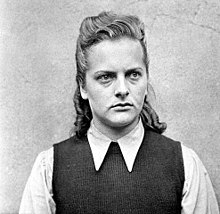
Irma Ida Ilse Grese was an SS guard serving at the concentration camps of Auschwitz and Ravensbrück. She also served as a warden on the women’s section of Bergen-Belsen.
After the liberation of the camps, Grese was convicted of crimes involving murder and ill-treatment of prisoners and was consequently sentenced to death at the age of 22 during the Belsen trial. She was famous for being the youngest woman to die under British Law in the 20th Century.
Grese is particularly notorious for her sexual violence against inmates and her frequent sexual relationships with other SS guards – she was regarded as a nymphomaniac.
One of her lovers was none only than Josef Mengele, Angel of Death. She was part of the gas chamber selection and often chose women based on whether she believed them to be more beautiful than she was. Grese had a thing for personal-grooming, expensive custom clothing and the overuse of perfume – which was believed to be a deliberate act of sadism against them female inmates who obviously had nothing.
During World War II Irma Grese was the most notorious of the female Nazi war criminals. She was born on October 7, 1923, to a agricultural family and left school in 1938 at the age of 15. She worked on a farm for six months, then in a shop and later for two years in a hospital. Then she was sent to work at the Ravensbrück Concentration Camp.
She became a camp guard at the age of 19, and, in March 1943, she was transferred to Auschwitz. She rose to the rank of Senior SS-Supervisor in the autumn of 1943, in charge of approximately 30,000 women prisoners, mainly Polish and Hungarian Jews. This was the second highest rank that SS female concentration camp pesonnel could attain.
After the war, survivors provided extensive details of murders, tortures, cruelties and sexual excesses engaged in by Irma Grese during her years at Auschwitz and Bergen-Belsen. They testified to her acts of pure sadism, beatings and arbitrary shooting of prisoners, savaging of prisoners by her trained and half starved dogs, to her selecting prisoners for the gas chambers.
She habitually wore heavy boots and carried a whip and a pistol. She used both physical and emotional methods to torture the camp’s inmates and enjoyed shooting prisoners in cold blood. She beat some of the women to death and whipped others mercilessly using a plaited whip.
The skins of three inmates that she had had made into lamp shades were found in her hut.
In January 1945, she returned to Ravensbrück Concentration Camp before being transferred to Bergen-Belsen in March.
After the Kommandant of Bergen-Belsen, Josef Kramer, Irma Grese was the most notorious defendant in the Belsen Trial, held between September 17 and November 17, 1945. Grese was convicted and sentenced to be hanged. She was executed on December 13, 1945.
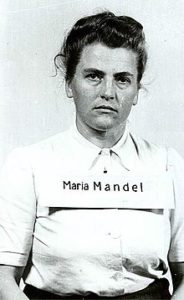
Maria Mandl was an Austrian SS guard working at Auschwitz, where she is believed to have been responsible for over 500,000 deaths of female inmates.
At the start of her career, Mandl oversaw things like daily roll calls as well as punishments such as beatings. She later progressed to being the top Female ranked guard with full control and say over the female Auschwitz camps and female subcamps.
Mandl earned herself the nickname “The Beast” after she was regularly known for partaking in the selection for the gas chambers and other forms of mass murder.
Mandl created the Women’s Orchestra of Auschwitz which was for the purposes of accompanying executions, selections, transportations and daily roll call. According to a Holocaust survivor, Lucia Adelsberger, the female inmates were made to march in time to the music, even after coming back exhausted from forced labour.
For her crimes against humanity, Mandl was executed at the age of 36
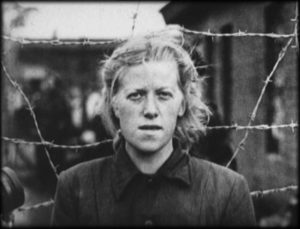
Herta Bothe was a Nazi concentration camp guard at Ravensbrück-stutthof and Bergen-Belsen. She was recorded to have been 6ft 3 and known as the “Sadist of Stutthof” due to her merciless beatings of female prisoners.
At the age of 24, she accompanied a death march of women from central Poland to Bergen-Belsen. At the Belsen trial, she claimed that she had stuck prisoners with her hand as a means of discipline but never used an instrument to do so, nor did she claim to have killed anyone. She was sentenced to ten years in prison and is still alive today. In a rare interview she said:
“Did I make a mistake? No. The mistake was that it was a concentration camp, but I had to go to it, otherwise, I would have been put into it myself. That was my mistake.”
She also outlined that when the camps were liberated, she was forced to bury rotting corpses in mass graves. She stated that those forces were not allowed to wear gloves and had to carry them themselves with no aid whatsoever.
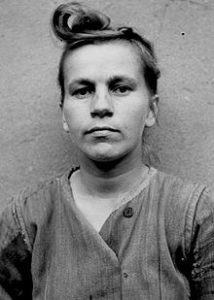
Elizabeth Volkenrath was a supervisor as a variety of Nazi Concentration camps during World War II. Volkenrath was in charge of selecting prisoners for the gas chambers and later became in charge of all camp selections for female prisoners.
She stood trial in the Belsen trial and was eventually sentenced to death after being found guilty of crimes against humanity.
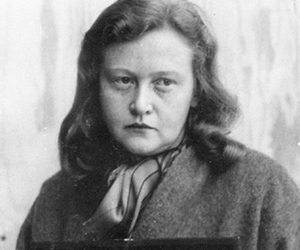
Strictly speaking, IIse was not an SS guard herself but her husband Karl Koch was the commander of Buchenwald. Using his power, he granted her a position in the camp where she earned a reputation and was called the “Witch of Buchenwald”.-
She was known to have often inspected prisoners upon arrival to see if they had any interesting tattoos on their skin. If she ever saw anything she liked, she would have the prisoners killed and use their skin to make items like lampshades or book covers.
Koch was actually acquitted in 1944 after the lack of evidence, whereas her husband was executed. Later, she was sentenced to life imprisonment and later committed suicide in 1967 at the age of 60 out of shame and desperation. It has been reported that she suffered from severe delusions where she became convinced that any concentration camp survivors would come and attack her in her cell.

Greetings everyone. I hope this finds everyone well and in good spirits. I want to let you know that I’m going on a short hiatus. It may be a week, two weeks, a month, or longer. As you all know, my blog has been attacked and WordPress still has a flag on it for reasons […]
Chateau Cherie is a prolific blogger about issues that affect us all. Lets hope her blogging is resumed soon.
Attention Fellow Bloggers and Readers: Upcoming Hiatus — Chateau Cherie
Here is our fully paid up member of train sim world 3 when it comes to the world of simulation simon is the man


I think Charlie Sheen and Alan Harper are both really funny in Two And A Half Men John Cryer plays Charlie Sheens brother and Jakes Dad in the series he plays Charlies younger brother Alan Harper and I think they are both very funny in Two And A Half Men.
 Weevles Updates Disabled Bloggers Team