This our Christmas drama which will be performed on Monday 13th of December

This blog was made by Simon Schofield
Weevles Updates Disabled Bloggers Team
Weevl Bloggers Corner
This our Christmas drama which will be performed on Monday 13th of December
This blog was made by Simon Schofield
The theoretical daily rations for a British soldier were:
This British Army issue biscuit was a key component of a soldier’s rations. The biscuits were produced under government contract by Huntley & Palmers, which in 1914 was the world’s largest biscuit manufacturer. The notoriously hard biscuits could crack teeth if not first soaked in tea or water. Tea was also part of the British soldier’s rations. It was a familiar comfort and concealed the taste of water, which was often transported to the front line in petrol tins.
An Australian NCO used to check a batch of bread before it is transferred to the bread store at an Australian Field Bakery in Rouen, France, September 1918.
Soldiers on and behind the front line ate their meals out of a British Army issue mess tin. It was an essential part of every soldier’s kit. If you lost it you had nothing to collect your food rations in.
Many soldiers said if it had not been for the Salvation Army giving them tins of corned beef they would have actually starved, as getting supplies through to the trenches was very difficult. German soldiers used to use dogs with special harnesses to carry the large tins of stew to be dished out to soldiers. as each had a tin to eat out of, whatever it was that day.
After the Crimean War, Army dietary reforms were undertaken. These focused on providing a high-energy diet for soldiers, but one that was often lacking in variety and sometimes almost indigestible.
Biscuits became a staple of soldiers’ diets during the Boer War (1899-1902) and were universally loathed. The notoriously hard biscuits could crack teeth if not first soaked in tea or water!
Tinned goods continued to be used to feed soldiers en masse at meal times. But the South African conflict also saw them used as ’emergency rations’, given to each soldier as part of their field kit. A typical emergency ration tin consisted of a meat ‘dinner’ in one end and cocoa in the other. It was designed to sustain a soldier for 36 hours while on active service.
By the First World War (1914-18), Army food was basic, but filling. Each soldier could expect around 4,000 calories a day, with tinned rations and hard biscuits staples once again. But their diet also included vegetables, bread and jam, and boiled plum puddings. This was all washed down by copious amounts of tea.
The mostly static nature of the war meant food supplies were generally reliable. And soldiers were able to supplement their rations with food parcels from home, with hot meals served behind the lines in canteens and kitchens, and with food obtained from local people.
Cooking in the front-line trenches was very difficult, so soldiers ate most of their rations cold. If cooking did occur, it was done on a small folding solid-fuel stove, known universally as a ‘Tommy Cooker’, that many men carried in their packs. Soldiers also cooked in pots over charcoal or wood.
Usually, the men would create a stew by adding tinned meat and biscuits into the pot. When the food was ready, it would be dished out individually for men to eat from their mess tins.
As well as the endless supply of ‘bully beef’, soldiers grew to hate another tinned item, Maconochie’s stew. Made with beef – or gristle, more commonly – and sliced vegetables, such as turnips and carrots, Maconochie was deemed edible warmed up, but revolting served cold.
On top of his regular ration issue of food, each soldier was given an emergency ration. This comprised a tin of beef, along with some biscuits and a tin of sugar and tea. This ‘iron ration’ was only supposed to be eaten as a last resort, when normal supplies were unavailable.
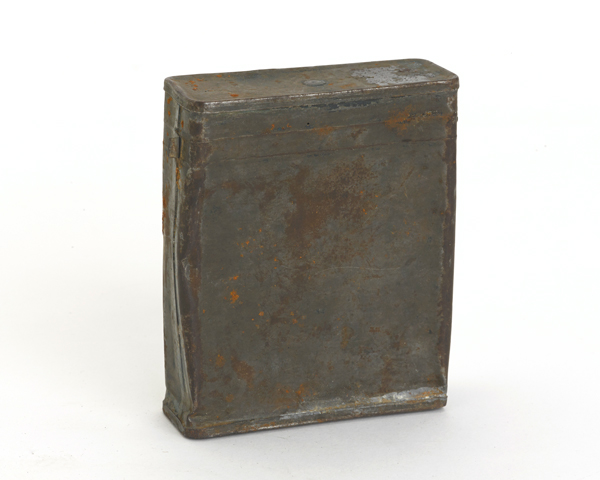
Iron ration in sealed tin, 1915
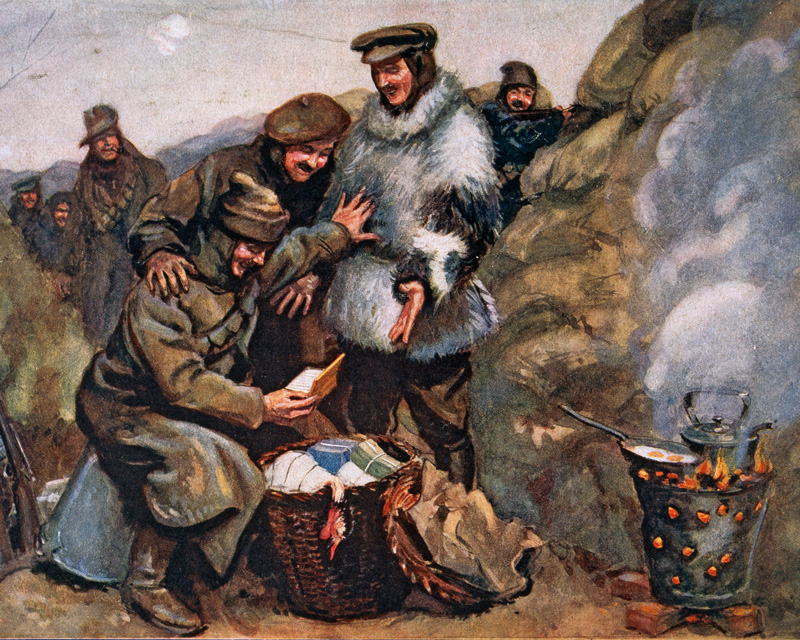
A food parcel from home, 1915
The British Army has long employed overseas recruits and soldiers of every faith, so its rations have had to take these factors into consideration.
The multi-faith British Indian Army also had strict dietary guidelines when it came to feeding its troops. Two cooks, or langris, were normally maintained in each company of a battalion. The composition of the company would determine if a cook was a Muslim, Sikh or Hindu, and of what caste if the latter. This ensured that the correct food was prepared for troops of different religions and in the right way.
The Army also provided stackable cooking pots for Indian soldiers for use on campaign. Each soldier could then cook their own food if necessary. For high-caste brahmins, these cooking pots were of considerable importance, since it was necessary for them to prepare their own food in order to preserve caste.
During the First World War, separate kitchens were set up so that the dietary requirements of Muslim, Sikh and Hindu soldiers were met. This happened on the Western Front, as well as back in Britain.
In particular, the Indian hospital at Brighton made an effort to cater for patients’ religious and cultural needs. Muslims and Hindus were provided with separate water supplies and nine different kitchens.
Today’s British Army rations continue this tradition and have a wide range of menus with halal and kosher options now available for soldiers.

The Collingwood Monument is a Grade II* listed[1][2] monument in Tynemouth, England, dedicated to Vice Admiral Lord Cuthbert Collingwood. A Napoleonic-eraadmiral noted for being second-in-command to Admiral Lord Nelson during the Battle of Trafalgar, Collingwood is sometimes referred to as the forgotten hero of Trafalgar.[3][4] The monument’s base is by John Dobson and the statue is a work of the sculptor John Graham Lough. It is situated just off of Front Street in Tynemouth and overlooks the mouth of the River Tyne.
Lord Collingwood was born in Newcastle upon Tyne, the son of a merchant.[5] He attended the Royal Grammar School[6] and joined the Royal Navy as a volunteer at the age of 12. From there he continued his nautical education under his cousin Captain Richard Brathwaite. After serving in the British Naval Brigade at the Battle of Bunker Hill, Collingwood was commissioned in 1775 as a lieutenant. His first command was HMS Badger, after succeeding Horatio Nelson, and his first major command was HMS Sampson. During the Battle of Trafalgar Collingwood assumed command of the British fleet after the death of Lord Nelson, transferring to HMS Euryalus. Collingwood then led the fleet and completed the battle plans that he and Nelson had created together.[3] For his role in the battle Collingwood was given the thanks of both houses of Parliament and awarded a pension of £2,000 per annum, as well as being promoted on 9 November 1805 to Vice-Admiral of the Red and raised to the peerage as Baron Collingwood, of Caldburne and Hethpool in the County of Northumberland.[7]
In 1805 Collingwood was appointed to the Commander-in-Chief, Mediterranean Fleet. After requesting to be relieved of his command the Government stated that it urgently required an admiral of his calibre to lead against the dangers of the French and her allies, and that his country could therefore not dispense of him. However, in 1809 his health declined and he was granted leave. In 1810 Collingwood died of cancer on board the HMS Ville de Paris as he sailed for England.[8] He was laid to rest beside Lord Nelson in St Paul’s Cathedral. During his career he had served in the American Revolutionary War, the French Revolutionary Wars and the Napoleonic Wars, and had been awarded three Naval Gold Medals, making him one of only three people to share the distinction of earning a total of three.[9]The inscription on the base of the plinth.
The monument was erected to commemorate Collingwood and his connection to North Shields; it was deliberately positioned so that it could be seen from the Tyne. It was erected by public subscription. The architect was John Dobson and John Graham Lough was responsible for the sculpture. The monument features a high wide base, with slit openings and a door in the rear. A flight of steps leads to the base of the plinth and side walls flank the steps. Upon the walls are four cannon from HMS Royal Sovereign, Collingwood’s flagship during the Battle of Trafalgar. The statue of Collingwood stands upon this plinth and the is draped in a cloak over Collingwood’s Royal Navy uniform.[clarification needed] The figure’s left hand rests on a bollard wrapped in rope.[2]
The monument was completed in 1845 except for the cannon, which were added in 1849.[2]
The inscription on the plinth.

I love watching this on channel 5 all the time when it is on. I think it is really good I record it on my sky plus box and watch it on record after it has been on I think it is very interesting.

This is what Newcastle Eldon Square was like in the 70s and 1980s before I was born and after I was born to. This what it was like back then in those days and this is how old it looks now I think it is very interesting.

I use to love Miss Piggy from The Muppets when I was little she was one of my favourite Muppets on The Muppets and The Muppet Show.

I use to love Kermit The Frog from The Muppets when I was little. I use to think he was cute and funny and he was one of my favourite muppets on The Muppet Babies.

Twelve years ago today in December 2009 when I was twenty three when I was younger. Lorna love you miss you and I’m thinking about you every now and again. This photo was took in January 2002 when I was fifteen years old when I was in year ten at Southlands School when I was younger. Back in early 2002 I really wish you were still here Lorna. X

Me and my mum had a nice winter walk round Whitley Bay this afternoon and I think the sea behind me looks lovely.

This is my early Christmas present I bought this week it’s the entire package boxset of The King Of Queens I love it it’s really funny. I’m half way through it and nearly finished watching it I’m really enjoying it and staying up really late at night watching it every night. It’s every single episode of every series in the boxset.
 Weevles Updates Disabled Bloggers Team
.jpg)