Food given to soldiers

Early Years of wars

During the late 18th and early 19th centuries, soldiers were given two meals a day. This was usually simple, slow-perishing food like salted pork or boiled beef, along with some bread. They also received a morale-boosting daily ration of a pint of wine or a third of a pint of rum or gin.

In 1811, the pioneering Donkin, Hall and Gamble company developed the vacuum tin can and the world’s first factory solely for canning food. From the Napoleonic Wars (1803-15) onwards, their invention had a major impact on how food could be delivered to troops engaged in conflict. Supplies, including meat, could be preserved and protected from damage prior to consumption.
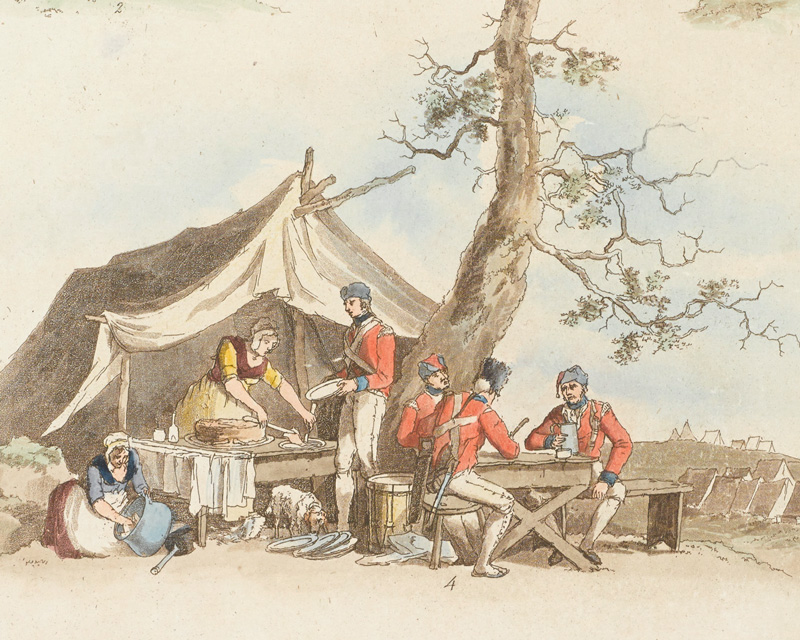
Soldiers eating in camp, c1803
View this object 

Soldiers eating in camp, c1803

Crimean disaster

However, by the mid-19th century, despite being one of the most successful armies of the time, the British Army was unable to maintain supplies to its troops. Its transport and logistics problems during the Crimean War (1854-56) became a national scandal.

Troops in the Crimea were regularly on half rations. Biscuits and salt meat were the staples, with the monthly vegetable ration often restricted to two potatoes and an onion per man. Many soldiers developed scurvy, which led to inflamed gums, making the hard biscuits difficult to eat. In fact, more soldiers were admitted to the hospital in Scutari for scurvy than for battle wounds.

Nearly 20,000 pounds (9 tonnes) of lime juice was provided, but the newly arrived cargo was ignored. Commissary-General William Filder (responsible for supplies) felt that it was not his job to tell the troops that it was there. As a result, all 278 cases sat untouched for two months.

After the Crimean War, Army dietary reforms were undertaken. These focused on providing a high-energy diet for soldiers, but one that was often lacking in variety and sometimes almost indigestible.

Early 20th Century

Hardtack biscuits became a staple of soldiers’ diets during the Boer War (1899-1902) and were universally loathed. The notoriously hard biscuits could crack teeth if not first soaked in tea or water!

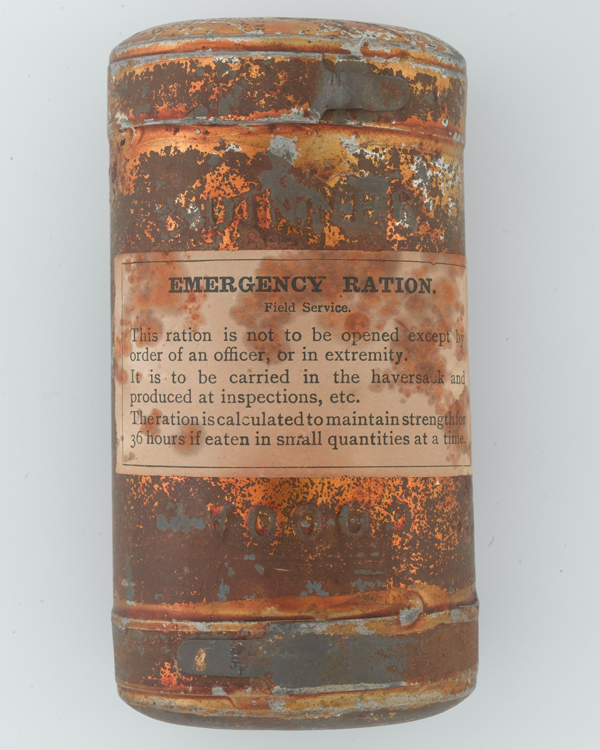
Tinned goods continued to be used to feed soldiers en masse at meal times. But the South African conflict also saw them used as ’emergency rations’, given to each soldier as part of their field kit. A typical emergency ration tin consisted of a meat ‘dinner’ in one end and cocoa in the other. It was designed to sustain a soldier for 36 hours while on active service.
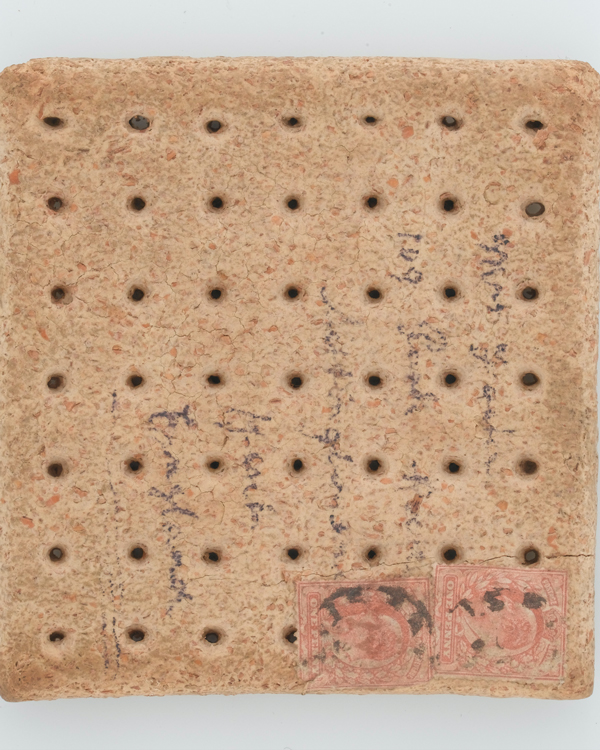
Army ration biscuit sent home from South Africa, 1902
View this object 

Army ration biscuit sent home from South Africa, 1902

Tin of field service emergency rations, c1900
View this object 

Tin of field service emergency rations, c1900

First World War

By the First World War (1914-18), Army food was basic, but filling. Each soldier could expect around 4,000 calories a day, with tinned rations and hard biscuits staples once again. But their diet also included vegetables, bread and jam, and boiled plum puddings. This was all washed down by copious amounts of tea.

The mostly static nature of the war meant food supplies were generally reliable. And soldiers were able to supplement their rations with food parcels from home, with hot meals served behind the lines in canteens and kitchens, and with food obtained from local people.

Cooking in the front-line trenches was very difficult, so soldiers ate most of their rations cold. If cooking did occur, it was done on a small folding solid-fuel stove, known universally as a ‘Tommy Cooker’, that many men carried in their packs. Soldiers also cooked in pots over charcoal or wood. 

Usually, the men would create a stew by adding tinned meat and biscuits into the pot. When the food was ready, it would be dished out individually for men to eat from their mess tins.

As well as the endless supply of ‘bully beef’, soldiers grew to hate another tinned item, Maconochie’s stew. Made with beef – or gristle, more commonly – and sliced vegetables, such as turnips and carrots, Maconochie was deemed edible warmed up, but revolting served cold.

On top of his regular ration issue of food, each soldier was given an emergency ration. This comprised a tin of beef, along with some biscuits and a tin of sugar and tea. This ‘iron ration’ was only supposed to be eaten as a last resort, when normal supplies were unavailable.

Second World War

During the Second World War (1939-45), British troops were fed freshly cooked food when in camp or barracks. On deployments, field kitchens were sometimes established. These also provided hot, fresh meals, considered vital both for nutrition and morale.

However, soldiers at the front still relied on preserved foods. These largely consisted of tinned items, but also dehydrated meats and oatmeal that were designed to be mixed with water. Morale-boosting items, such as chocolate and sweets, were also provided. And powdered milk was issued for use in tea. 

These items were packaged in 24-Hour Ration packs. They were supposed to be used by each soldier until field kitchens were set up or standard food supplies, known as composite rations, were delivered.

Also known as the 14-Man Ration, the ‘compo’ ration came in a wooden crate and contained tinned and packaged food. A typical crate might include tins of bully beef, spam, steak and kidney pudding, beans, cheese, jam, biscuits, soup, sausages, and margarine. Cookable items could be heated up on a variety of portable stoves.

As in the First World War, soldiers were also issued with an emergency iron ration, usually consisting of high-energy foods like chocolate.

Post War era

Tinned rations continued to be provided after the Second World War. But as time went on, these were supplemented with packets of freeze-dried foods and products in vacuum-sealed plastic. Soldiers were supposed to be issued different menus for each day, but often ended up with the same one over and over again.

A 24-hour ration pack would contain enough calories to sustain a soldier in the field for one day. It would contain breakfast, a main meal, the ingredients to make a hot drink, and a variety of snacks including chocolate bars.

Diversity

One of the more controversial changes to Army ration packs was the removal of the chocolate bars for service in Iraq and Afghanistan, as they frequently melted in the desert heat. They were replaced by sachets of peanut butter, which were significantly less popular.

By the mid-1990s, the few remaining tins were replaced with foil-packed boil-in-the-bag meals.

The British Army has long employed overseas recruits and soldiers of every faith, so its rations have had to take these factors into consideration.

The multi-faith British Indian Army also had strict dietary guidelines when it came to feeding its troops. Two cooks, or langris, were normally maintained in each company of a battalion. The composition of the company would determine if a cook was a Muslim, Sikh or Hindu, and of what caste if the latter. This ensured that the correct food was prepared for troops of different religions and in the right way.

The Army also provided stackable cooking pots for Indian soldiers for use on campaign. Each soldier could then cook their own food if necessary. For high-caste brahmins, these cooking pots were of considerable importance, since it was necessary for them to prepare their own food in order to preserve caste.

Kitchens

During the First World War, separate kitchens were set up so that the dietary requirements of Muslim, Sikh and Hindu soldiers were met. This happened on the Western Front, as well as back in Britain.

In particular, the Indian hospital at Brighton made an effort to cater for patients’ religious and cultural needs. Muslims and Hindus were provided with separate water supplies and nine different kitchens.

Today’s British Army rations continue this tradition and have a wide range of menus with halal and kosher options now available for soldiers.

Dion Dublin.

I think Dion Dublin is really good as one of the presenters on Homes Under The Hammer. I think he is very good on it and on some of the episode’s it is just him on the Homes Under The Hammer episode’s by himself and he is just as good on his own on The Show.

AEW Dynamite.

I am looking forward to watching AEW Dynamite from last week I have not even seen it yet. I will probably catch up with it tomorrow morning on watch wrestling on my iPad when I wake up tomorrow morning. I love watching AEW All Elite Wrestling Dynamite every week and I always think it is really good every week to.

Wwe Armageddon 1999.

This is one of my favourite Wwe Armageddon pay per view’s it is Wwe Armageddon 1999. It was on Sunday the 12th December 99 and it was on when I was thirteen years old when I was in year eight at Southlands School when I was in my second year at Southlands. It is from The Attitude Era 1999 I am going to watch it on the Wwe Network sometime and it is on for 2 hours and 49 minutes just under 3 hours and it is also the very first Wwe Armageddon pay per view. The main event is Triple H vs Vince McMahon in a No Holds Barred Match.

Autism and the internet: risks and benefits

Patrick Sims, a freelance autism writer examines the risks and benefits of the
internet for autistic people and their families. Patrick discusses issues such as
cyberbullying and hacking, before exploring the value of the internet in
developing friendships and support networks.
It is difficult to know where to start with this article. The majority of people
reading it will already have strong views regarding autism and the internet,
social media and online gaming. Some may see the “mouse” as a friendly pet hamster offering comfort and security to otherwise, lonely and isolated people. Researchers such as Begley (2014) and Kranjc (2011) expound the virtues of social media as the favoured and least anxiety provoking means of social communication for many autistic people.
However others envisage the internet as a dangerous rabid rat looking for an
opportunity to wreak havoc and mayhem onto communities and ruin lives
(Ledingham and Mills 2015; McCoogan 2016).
This article will explore the middle ground by raising awareness of the risks that social media and IT in general can pose to autistic people, whilst highlighting the advantages that technology can bring to the socially isolated if used appropriately.


Hacking
The names Gary McKinnon (Ledingham and Mills 2015) and Laurie Love
(McCoogan 2016) most famously exemplify the difficulties that arise when
autistic people get embroiled in accusations of hacking. Both men
respectively faced, and are facing, very long prison sentences in the USA
because of allegedly hacking into various secure computer systems e.g.
Federal Reserve, US Army and NASA.
In 2012, the then Home Secretary, Theresa May, intervened in the Gary
McKinnon case stating he was a “suicide risk” and not to be extradited
(McCoogan, 2016). Due to a change in law giving all extradition powers to
the justice system, Laurie Love has to convince a judge that he is not fit enough to be extradited (not achieved as of 12/2016). As a consequence,
Love faces extradition and a maximum of 99 years in an American jail
(McCoogan 2016; Joseph 2016, b). McKinnon and Love have both been diagnosed as autistic whilst being investigated for computer criminal activity (Ledingham and Mills 2016). Kushner (2011) refers to the term “Autism Defence” in which an autism diagnosis is utilised as a means of escaping trial or receiving a lenient sentence. The American legal system have made it clear that they feel this tactic is being used by Loves Defence Team (Joseph, 2016, a). Alternatively, the process of McKinnon, Love and others going through the criminal justice process has highlighted an otherwise unrecognised and undiagnosed condition. Ledingham and Mills (2016) suggest financial gain is not the hackers motivation. It is:
 attention
 adulation
 self-satisfaction
 recognition.
These factors suggest low confidence, something often found in young
autistic adults (Howlin, 1997). One approach is to concentrate on building
self-esteem through childhood, whilst another is to channel the person`s
computer skills into something positive (Begeley, 2014, Batey and Comer,
2013).


Cyberbullying
Being online can present a small risk to all of us; being autistic increases the
risk of exploitation (Arora 2014):
 Underage autistic children being tricked into sharing pornographic
images that are used to humiliate and bully (Levine 2013).
 Building friendships with who they think are teenagers with similar
worries and interests, but who are in reality mature adults (Levine 2013).

 Sending “personal and sexual photographs to a trusted and seemingly
committed person who turns the images into a “sick joke” (Levine
2013). Cyber bullying is potentially a huge problem for some autistic people
(Romano et al, Batey and Comer 2013), whether directly from on-line forums
or from people using social media to increase the scale of bullying (Arora
2014).


Parental roles
Initially the use of parental controls appears to solve many problems with
regard to protecting children from content deemed “unpleasant” or
“inappropriate”. However, does the “parental control” route work short-term
or long-term? Levine (2013) gives an example of a 10 year old boy being
able to bypass these safety measures. There is also a risk that parents
become complacent and stop taking an interest in their child’s PC or phone
activities. In the majority of cases the use of IT, video games and social media in moderation are positive activities, as long as sensible guidelines are set and
enforced by responsible adults. Be clear about what is acceptable, and
open about monitoring and checking websites (Arora (2014), Levine 2013).
Most parents want to know what their child has been doing, and with whom,
if they are out for the evening. They would often do safety checks
beforehand e.g. “where, who, how long?” Have the same openness
regarding computer friends and activities as you would with traditional
socialisation (Levine 2013). Sudden interest, due to concern, can be
misinterpreted as interference or a lack of trust. Levine (2013) broaches the issue of when is a person old enough to be trusted? This question can open up a can of worms regarding informed consent, particularly for parents who have autistic offspring who eighteen years are over. Should parents, in a position to do so, enforce this on adults because of a perceived need to protect them (Arora 2014)? Whilst not perfect there is sense to Levine`s (2013) suggestion of parents sharing internet experiences with their children and having regular open discussions with them about safety. As the internet means so much to many autistic children, parents taking an interest in it would appear natural, supportive and a way to develop the parent/child bond.

Addiction
Another concern for parents of autistic children and adults is that of
internet/gaming/social media dependency. Autistic people appear to be at
higher risk than others of addiction to, and compulsive use of, social media
(Finkenauer et.al. 2012). Clearly an autistic person facing daily challenges
understanding and communicating in the “real world”, may find sanctuary in
a world that appears safe and offers an opportunity to meet and
communicate comfortably with people (Shane-Simpson et al 2016).
Research suggests that a person with “autism traits” experiencing anxiety
and/or depression are more prone to internet addiction (Ramano 2014).
Mazurek and Wenstrup (2013) elaborate on this, warning that there is a risk
that pathological use of internet games can lead to anxiety, social phobia
and depression as well as impacting negatively on school attainment.

Benefits
Many autistic people report feelings of loneliness and isolation due to
difficulties in social interaction (Begley 2014). A number of autistic children
and adults find communicating via a computer much less stressful and a
more enjoyable experience than traditional ways of maintaining friendships
(Begley 2014). No two friendships are the same so why negatively judge ones
that occur on line? Levine (2013) argues that online friendships/relationships are hard for the pre-dawn internet era to understand. However, is it harder to comprehend thanfriendships/relationships maintained by letter often with weeks/months between each response. At least social media enables an almost instant response. If people who have been lonely and isolated suddenly find a way to have friends, what is the benefit of passing value judgements on the validity of those friendships? The internet is a vital tool in terms of communicating with autistic people and their families and carers. It enables people to realise that they are not alone, as well as offering support when no one else is able to (Begley 2014, Arora 2014). It enables organisations struggling with resources to reach more people in quicker timescales. Online support is available 24/7, not just office hours. Being able to send emails after the children are settled, when at a low ebb, and knowing that you will receive support from someone with similar experiences can enable you to cope!


Conclusion

This article has highlighted both positive and negative impacts that the
internet etc. can have on some autistic people and their families. It has
discussed issues that may arise for parents with autistic children and has
outlined some strategies. If used appropriately and in moderation computers
can be of great benefit to autistic people in terms of offering one form of
socialisation. It can be beneficial for parents and carers in terms of accessing information and support, and of being able to share their child`s interest. Yes negative things can happen, but there are risks in all aspects of life. Are social media risks actually harder to predict than being mugged in your street, attacked in town by a gang or bullied at school? If we stopped using all inventions because there are risks or because they are hijacked by people for crime or to hurt others, life would stagnate. The positive thing about computers is that serendipity has meant that theyare potentially the greatest ever asset for autistic people. They open up a new world of potential: friends, opportunity and employment. It is perhaps the non-autistic world who has concrete thinking and needs to accept change in terms of redefining friends and socialising to include social media. The internet will not disappear so everyone must work together to make it infinitely positive and beneficial for autistic people. This is their great opportunity for choice and a more level playing field!

Wwe Wrestlemania 40 2024.

I am really looking forward to watching Wwe Wrestlemania 40 over the weekend it is on this Saturday night and Sunday night. Night 1 will be on Saturday Wrestlemania Saturday and Night 2 will be on Sunday Night Wrestlemania Sunday both will be on the Wwe Network. I think it will be just as good as last year’s Wwe Wrestlemania was to.

Actor James Beck.

James Beck is one of my favourite actors on Dad’s Army I think he is one of the funny one’s in Dad’s Army. I really like him on Dad’s Army as Private Walker I think he played the part well as him on Dad’s Army I think he was one of the best one’s on the series.