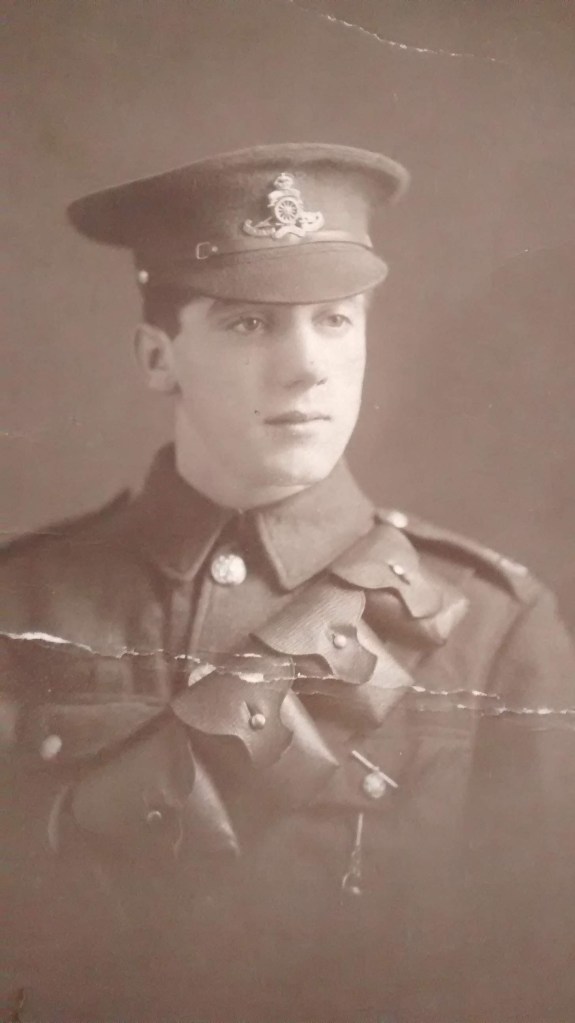
James Burns was born in Newcastle in 1897. He had 8 brothers and sisters and his eldest sister Mary who was 18 years old took care of the family as their parents had died very young. There was not alot of money as their was no welfare state then. They did have aunts and uncles who helped them.
James lied about his age to join the Army and said he was born in 1896 which made him 18 but he was actually only 16 because his birthday was not till the September. So when world war one came in August 1914 he could join up to the Army and not be a burden to his family. He would have somewhere to lay his head and be fed three times a day.
They were dark days and he was given the role of a gunner in the Northumbria Fuseliers. The big guns which were pulled by horses. So the gunners had to look after the horses as well feed them take care of them and get them water to drink.
The men had to created latrines for the men each time they decided their base for operations. Set up a food station and a medical tent. Alot of soldiers worked in wet mud most of the time and suffered from trench foot. Fleas had to be burned out the the seams in their uniform which came from the rats looking for food which lived in the trenches with them. A candle was run up the seams to kill the fleas but it was just as bad the nest day.
Many a time the food run out because of war supplies were often cut off from the front line. The red cross used to give the men tins of corned beef to survive on and many said they would have starved if the Red Cross had not been so brave and kind.
Dysentry was also a problem because of the filth not being able to wash your hand before eating or after going to the toilet. Germs passed from one person to another.
James was wounded and had a metal plate in his head after an explosion and was also gassed in the trenches. The guns were targetted by the Germans who tried to blow them up with mortar shells and bombs.
James met Agnes Elizabeth Todd born in August 1901 in Newcastle where she was in service to a Lord and Lady when he was 25 years old and she was 21 years old. They married in 1922 and had three children two girls and a boy. James first in 1925, Mary in 1927 and Agnes in 1928.
James died in 1953 of stomach cancer form the gassing but he did get to hold his grand daughter before he died. The only grandchild born from Mary his daughter. His son James died aged 47 years in 1975 after suffering for many years from Epilepsy endured in a fall as a trainee plumber by falling off a roof. He married but had no children.
Agnes died aged 60 years in 1989 from complications of medication for Rhematoid Arthritis which she developed in her 20’s. She married but had no children.
James wife Agnes died in 1988 aged 87 years of heart problems after a life of hard work and looking after a wounded husband.
Mary their daughter lived to a great age of 97 years she too worked hard as a tailoress and was widowed at 35 years. Her husband was a carpenter and was working away from home and died in a car crash.
Nothing is known of the 8 brothers and sisters James Burns had and nothing is known why his parents died so young, but the spanish influenza took many in the early days of the century. Many children did not live passed the age of 5 years as chicken pox, measles, whooping cough, influenza, was rife with no immunisations available in those days.
At the start of the First World War, with the assistance of the police, MI5 rounded up all the agents of any significance working for German naval intelligence. No remaining agent was able to pass on potentially crucial intelligence on the departure for the continent of the British Expeditionary Force. Gustav Steinhauer, the head of the British section of German Naval Intelligence, later acknowledged that the Kaiser had been beside himself with fury when told of the ‘wholesale round-up of our secret service agents’: ‘Apparently unable to believe his ears, [he] raved and stormed for the better part of two hours about the incompetence of his so-called intelligence officers, bellowing: “Am I surrounded by idiots? Why was I not told? Who is responsible?” and more in the same vein.’ Steinhauer is unlikely to have fabricated such a devastating denunciation of his own alleged incompetence.
German archives reveal that at least 120 spies were sent to Britain at some point during the First World War. MI5 caught 65 of them. There is no convincing evidence that any of the remainder sent back significant intelligence to Germany. Some appear to have been ‘reconnaissance agents’ on neutral shipping, able to report only on what they could observe when calling at British ports. A number of other agents broke contact with their case officers.
A post-war MI5 report concluded: ‘It is apparently a paradox, but it is none the less true, and a most important truth, that the efficiency of a counter espionage service is not to be measured chiefly by the number of spies caught by it.’ Though MI5 caught a record number of spies in 1915, it was probably less successful then than in 1918 when it caught none. Good ‘protective security’ (better developed during the First World War than ever before) and the deterrent effect of the executions of some captured spies had by then made it difficult for Germany either to recruit any spies for work in Britain or to carry out sabotage operations as effective as those in the United States (which included blowing up a huge arms dump in New Jersey in which 900 tonnes of explosives was detonated, killing seven people and damaging the Statue of Liberty).
Faced with the declining threat from German espionage, MI5 paid increasing attention during the second half of the War to counter-subversion. Like the government, it wrongly suspected that German and Communist subversion was inflaming British industrial disputes. Its New Year Card for 1918, correctly forecasting victory by the end of the year, showed MI5, depicted as a masked Britannia, impaling the beast of Subversion with her trident before it can stab the British fighting man in the back. The card was personally designed by Kell’s long-serving deputy, Eric Holt-Wilson.
In the course of the war MI5’s staff increased almost fiftyfold to reach a total of 844. Though the leadership remained overwhelmingly male, several female recruits achieved positions of greater significance than in any other British official agency or department. Miss A. W. Masterson became the first woman to manage the finances of a government office. Jane Sissmore, who joined MI5 as a sixteen-year-old secretary straight from school in 1916, progressed so rapidly that by 1924 she had qualified as a barrister and become MI5’s chief expert on Soviet affairs. Though the intelligence glass ceiling was not broken until Stella Rimington became Director General of MI5 in 1992, the first cracks began to appear in the First World War.
Of the many women who served in the OSS, field agent Virginia Hall was one of the most distinguished. Undaunted by her artificial leg, she created a spy network and helped organize and arm French commandos behind enemy lines. Posing as a dairy farmer, she scouted potential drop zones while herding cows. Later, she tapped out Morse code messages over wireless radio to officials in London. She radioed intelligence reports, coordinated parachute drops of supplies, oversaw sabotage missions, and planned ambushes of German soldiers. Virginia Hall was the only female civilian in WWII to receive the coveted Distinguished Service Cross. After the war, Hall became one of the CIA’s first female operations officers.
“She was the most highly decorated female civilian during World War II,” said Janelle Neises, the museum’s deputy director, who’s providing a tour.
So why haven’t more people heard about Hall? A quote from Hall on the agency display offers an explanation: “Many of my friends were killed for talking too much.”
British author Sonia Purnell wrote one a book, A Woman of No Importance, and she explains the irony in the biography’s title. “Through a lot of her life, the early life, she was constantly rejected and belittled,” said Purnell. “She was constantly just being dismissed as someone not very important or of no importance.”
Hall was born to a wealthy Baltimore family in 1906, and she was raised to marry into her own privileged circle. But she wanted adventure. She called herself “capricious and cantankerous.” She liked to hunt. She once went to school wearing a bracelet made of live snakes.
College in France
Sonia Purnell’s book about Virginia Hall is one of three that have been published this year. The others are Hall of Mirrors, a novel by Craig Gralley, and The Lady Is A Spy, a young adult book by Don Mitchell.
Hall briefly attended Radcliffe and Barnard colleges. Then she went to study in Paris and fell in love with France. She decided to become a diplomat, said Purnell.
“She wanted to be an ambassador. She got pushed back by the State Department. She applied several times,” Purnell said, noting that women accounted for only six of the 1,500 U.S. diplomats at the time.
Hall did land a clerical job at a U.S. consulate in Turkey. But while hunting birds, she accidentally shot herself in the foot. Gangrene set in, and her left leg was amputated below the knee.
Recovery was long and painful, as she learned to use a clunky wooden leg. Yet it was also a turning point, said Craig Gralley, a retired CIA officer who has written his own book about Hall — a novel, Hall of Mirrors.
“She had been given a second chance at life and wasn’t going to waste it. And her injury, in fact, might have kind of bolstered her or reawakened her resilience so that she was in fact able to do great things,” he said.
When World War II erupted and Nazi Germany invaded France, Hall volunteered to drive an ambulance for the French. France was soon overrun, forcing her to flee to Britain. A chance meeting with a spy put her in contact with British intelligence.
After limited training, this one-legged American woman was among the first British spies sent into Nazi-occupied France in 1941. She posed as a reporter for the New York Post.
There were failures, especially in the early days, when members of her network were arrested and killed.
The Germans came to realize that they were after a limping lady.
But Hall was a natural spy, keeping one step ahead of the German secret police, the Gestapo.
“Virginia Hall, to a certain extent, was invisible,” said Gralley. “She was able to play on the chauvinism of the Gestapo at the time. None of the Germans early in the war necessarily thought that a woman was capable of being a spy.”
Hall operated in the eastern French city of Lyon. She initially stayed at a convent and persuaded nuns to help her. She befriended a female brothel owner and received information that French prostitutes gathered from German troops.
Hall organized French resistance fighters, providing them with safe houses and intelligence. This didn’t go unnoticed, said Purnell.
“The Germans came to realize that they were after a limping lady,” she said.
Hall constantly changed her appearance.
“She could be four different women in the space of an afternoon, with four different code names,” said Purnell.Enlarge this image
This mannequin of World War II spy Virginia Hall is on display at the CIA Museum at the agency’s headquarters in Langley, Va. While her story is well recognized inside the intelligence community, it is only now coming to a wider audience in a series of books and planned movies.
Barbie ordered “wanted” posters of Hall that featured a drawing of her above the words “The Enemy’s Most Dangerous Spy — We Must Find And Destroy Her!”
The Nazis appeared to be closing in on Hall around the end of 1942. She narrowly escaped to Spain, embarking on a harrowing journey that included walking three days for 50 miles in heavy snow over the forbidding Pyrenees Mountains.
While researching his book, Gralley, a marathon runner, made a part of that walk and found it exhausting.
“I could only imagine the kind of will and the kind of perseverance that Virginia Hall had by making this trek,” he says, “not on a beautiful day, but in the dead of winter and with a prosthetic leg she had to drag behind her.”
When Hall reached Spain, she was arrested because she didn’t have an entrance stamp in her passport. She was released after six weeks and made her way back to Britain.
She soon grew restless and wanted to return to France. The British refused, fearing it was too dangerous.
William Donovan, head of the Office of Strategic Services, presents Virginia Hall with the Distinguished Service Cross in 1945. She was the only civilian woman so honored in World War II. President Harry Truman proposed a public ceremony at the White House, but Hall declined because she wanted to stay undercover. The event with Donovan was private. The only outsider attending was Hall’s mother.
Back to France
However, the Americans were ramping up their own intelligence service, the Office of Strategic Services, or OSS, which had virtually no presence in France.
The Americans needed Hall, yet the Nazis were everywhere, making it even more difficult for her to operate, said Purnell.
“She got some makeup artist to teach her how to draw wrinkles on her face,” she said. “She also got a fierce, a rather sort of scary London dentist to grind down her lovely, white American teeth so that she looked like a French milkmaid.”
Hall’s second tour in France, in 1944 and 1945, was even more successful than the first. She called in airdrops for the resistance fighters, who blew up bridges and sabotaged trains. They reclaimed villages well before Allied troops advanced deep into France.
At its peak, Hall’s network consisted of some 1,500 people, including a French-American soldier, Paul Goillot — who would later became her husband.
Hall’s niece, Lorna Catling, is now 89 and lives in Baltimore. She recalls meeting her aunt after the war.
“She came home when I was 16, and she was pale and had white hair and crappy clothes,” Catling said.
And what did Hall say about the war?
“She never talked about it,” Catling added.
A painting of Virginia Hall hangs in one of the main hallways near the entrance of CIA headquarters. The painting shows her making radio contact with London from an old barn in France to request supplies and personnel. Power for her radio was provided by a bicycle rigged to power an electric generator.
Courtesy of CIA
The British and the French both recognized Hall’s contributions — in private. President Harry Truman wanted to honor Hall at a public White House ceremony. Hall declined, saying she wanted to remain undercover.
William Donovan, the OSS chief, gave Hall the Distinguished Service Cross — making her the only civilian woman to receive one in World War II. Hall’s mother was the only outsider present at the ceremony.
“I do think that she became America’s greatest spy of World War II,” Gralley said of Hall.
Hall then joined the newly formed CIA, which succeeded the OSS, and worked there for 15 years, mostly at headquarters. These were not her happiest days. She thrived on the adrenaline of acting independently in the field during wartime. Now she was largely confined to a desk.
“As you get higher in rank, now it’s all about money and personnel and plans and policy and that sort of bureaucratic stuff,” said Randy Burkett, a historian at the CIA.
And Hall faced discrimination as a woman.
“Was she treated properly? Well, by today’s standards, absolutely not,” said Burkett.
Hall retired in 1966 and never spoke publicly. She died in 1982 in Maryland, her story still confined to the intelligence community.
William Donovan, head of the Office of Strategic Services, presents Virginia Hall with the Distinguished Service Cross in 1945. She was the only civilian woman so honored in World War II. President Harry Truman proposed a public ceremony at the White House, but Hall declined because she wanted to stay undercover. The event with Donovan was private. The only outsider attending was Hall’s mother.
Vittorio Emanuele Orlando (19 May 1860 – 1 December 1952) was an Italian statesman, who served as the Prime Minister of Italy from October 1917 to June 1919. Orlando is best known for representing Italy in the 1919 Paris Peace Conference with his foreign minister Sidney Sonnino. He was also known as “Premier of Victory” for defeating the Central Powers along with the Entente in World War I. He was also the provisional President of the Chamber of Deputies between 1943 and 1945, and a member of the Constituent Assembly that changed the Italian form of government into a republic. Aside from his prominent political role, Orlando was a professor of law and is known for his writings on legal and judicial issues, which number over a hundred works.
Early life and career
Orlando was born in Palermo, Sicily. His father, a landed gentleman, delayed venturing out to register his son’s birth for fear of Giuseppe Garibaldi‘s Expedition of the Thousand, who had just stormed into Sicily on the first leg of their march to build an Italian nation.
Orlando taught law at the University of Palermo and was recognized as an eminent jurist. In 1897, he was elected in the Italian Chamber of Deputies (Italian: Camera dei Deputati) for the district of Partinico for which he was constantly reelected until 1925.[6] He aligned himself with Giovanni Giolitti, who was Prime Minister of Italy five times between 1892 and 1921.
Prime Minister
A liberal, Orlando served in various roles as a minister. In 1903, he served as Minister of Education under Prime Minister Giolitti. In 1907, he was appointed Minister of Justice, a role he retained until 1909. He was re-appointed to the same ministry in November 1914 in the government of Antonio Salandra until his appointment as Minister of the Interior in June 1916 under Paolo Boselli.
After the Italian military disaster in World War I at Caporetto on 25 October 1917, which led to the fall of the Boselli government, Orlando became Prime Minister, and he continued in that role through the rest of the war. He had been a strong supporter of Italy’s entry in the war. He successfully led a patriotic national front government, the Unione Sacra, and reorganized the army. Orlando was encouraged in his support of the Allies because of secret incentives offered to Italy in the London Pact of 1915. Italy was promised significant territorial gains in Dalmatia.[5] Orlando’s first act as head of the government was to fire General Luigi Cadorna and appoint the well-respected General Armando Diaz in his place. He then reasserted civilian control over military affairs, which Cadorna had always resisted. His government instituted new policies that treated Italian troops less harshly and instilled a more efficient military system, which were enforced by Diaz. The Ministry for Military Assistance and War Pensions was established, soldiers received new life insurance policies to help their families in the case of their deaths, more funding was put into propaganda efforts aimed at glorifying the common soldier, and annual paid leave was increased from 15 to 25 days. On his own initiative Diaz also softened the harsh discipline practiced by Cadorna, increased rations, and adopted more modern military tactics which had been observed on the Western Front. All of these had the net effect of greatly increasing the formerly-crumbling army’s morale. Orlando’s government quickly proved popular among the general population and successfully reconstituted national morale after the disaster of Caporetto, with Orlando even publicly pledging to retreat to “my Sicily” if necessary and resist the Austrian invaders from there, though he was also assured that there would be no military collapse.
With the Austro-Hungarian offensive stopped by Diaz at the Second Battle of the Piave River, a lull in fighting ensued on the Italian front as both sides brought up their logistical elements. Orlando ordered an investigation into the causes of the defeat at Caporetto, which confirmed that it was the fault of the military leadership. While he continued to reform the military, he refused demands from both sides of the political aisle calling for mass trials of generals and ministers. The Italian front stabilized enough under his leadership that Italy was able to send hundreds of thousands of troops to the Western Front to buttress their allies while themselves preparing for a major offensive to knock Austria-Hungary out of the war. This offensive materialized in November 1918, the Italians launched the Battle of Vittorio Veneto and routed the Austro-Hungarians, a feat that coincided with the collapse of Austro-Hungarian Army and the end of the First World War on the Italian Front, as well as the end of the Austro-Hungarian Empire. The fact that Italy recovered and ended up on the winning side in 1918 earned for Orlando the title “Premier of Victory.”
Orlando was one of the Big Four, the main Allied leaders and participants at the Paris Peace Conference in 1919, along with U.S. President Woodrow Wilson, French Prime Minister Georges Clemenceau and Britain’s Prime Minister David Lloyd George. Although, as prime minister, he was the head of the Italian delegation, Orlando’s inability to speak English and his weak political position at home allowed the conservative foreign minister, the half-WelshSidney Sonnino, to play a dominant role.
Their differences proved to be disastrous during the negotiations. Orlando was prepared to renounce territorial claims for Dalmatia to annex Rijeka (or Fiume as the Italians called the town) — the principal seaport on the Adriatic Sea — while Sonnino was not prepared to give up Dalmatia. Italy ended up claiming both and received neither, running up against Wilson’s policy of national self-determination. Orlando supported the Racial Equality Proposal introduced by Japan at the conference.
Orlando dramatically left the conference early on April 24th 1919. He returned briefly the following month, but was forced to resign just days before the signing of the resultant Treaty of Versailles. The fact he was not a signatory to the treaty became a point of pride for him later in his life. French Prime Minister Georges Clemenceau dubbed him “The Weeper,” and Orlando himself recalled proudly: “When … I knew they would not give us what we were entitled to … I writhed on the floor. I knocked my head against the wall. I cried. I wanted to die.”
His political position was seriously undermined by his failure to secure Italian interests at the Paris Peace Conference. Orlando resigned on 23 June 1919, following his inability to acquire Fiume for Italy in the peace settlement. The so-called “Mutilated victory” was one of the causes of the rising of Benito Mussolini. In December 1919, he was elected president of the Italian Chamber of Deputies, but never again served as prime minister.
Fascism and final years
When Benito Mussolini seized power in 1922, Orlando initially tactically supported him, but broke with him over the murder of Giacomo Matteotti in 1924. After that, he abandoned politics and resigned from the Chamber of Deputies in 1925, until 1935, when Mussolini’s march into Ethiopia stirred Orlando’s nationalism. He reappeared briefly in the political spotlight when he wrote Mussolini a supportive letter.
When World War I began in July 1914, Italy was a partner in the Triple Alliance with Germany and Austria-Hungary, but decided to remain neutral. However, a strong sentiment existed within the general population and political factions to go to war against Austria-Hungary, Italy’s historical enemy.
Annexing territory along the two countries’ frontier stretching from the Trentino region in the Alps eastward to Trieste at the northern end of the Adriatic Sea was a primary goal and would “liberate” Italian speaking populations from the Austro-Hungarian Empire, while uniting them with their cultural homeland. During the immediate pre-war years, Italy started aligning itself closer to the Entente powers, France and Great Britain, for military and economic support.
On April 26, 1915, Italy negotiated the secret Pact of London by which Great Britain and France promised to support Italy annexing the frontier lands in return for entering the war on the Entente side. On May 3, Italy resigned from the Triple Alliance and later declared war against Austria-Hungary at midnight on May 23.
At the beginning of the war, the Italian army boasted less than 300,000 men, but mobilization greatly increased its size to more than 5 million by the war’s end in November 1918. Approximately 460,000 were killed and 955,000 were wounded in the conflict.
This service record is for Antonio Zanussi, who served in the 2nd Engineers. Zanussi was conscripted in February 1917, entered the service March 17, 1917 and fought in the campaign against Austria-Hungary in 1917-18. The record states that Zanussi served with good conduct and faithful service.
This postcard honors the memory of Captain Giuseppe Tagliamonte, commander of the 10th Infantry Company at the battle of Selz along the Italian/Austro-Hungarian frontier in northeastern Italy during the 2nd Isonzo Offensive. Tagliamonte was killed during the battle on July 19, 1915 and was awarded the Gold Medal of Military Valor, among Italy’s highest military decorations.
At the time of the First World War, most women were barred from voting or serving in military combat roles. Many saw the war as an opportunity to not only serve their countries but to gain more rights and independence. With millions of men away from home, women filled manufacturing and agricultural positions on the home front. Others provided support on the front lines as nurses, doctors, ambulance drivers, translators and, in rare cases, on the battlefield.
One observer wrote that American women “do anything they were given to do; that their hours are long; that their task is hard; that for them there is small hope of medals and citations and glittering homecoming parades.”
On The Homefront
The nations at war mobilized their entire populations. The side that could produce more weapons and supply more troops would prevail in the end. Women took on new roles in the work force, notably in war production and agriculture.
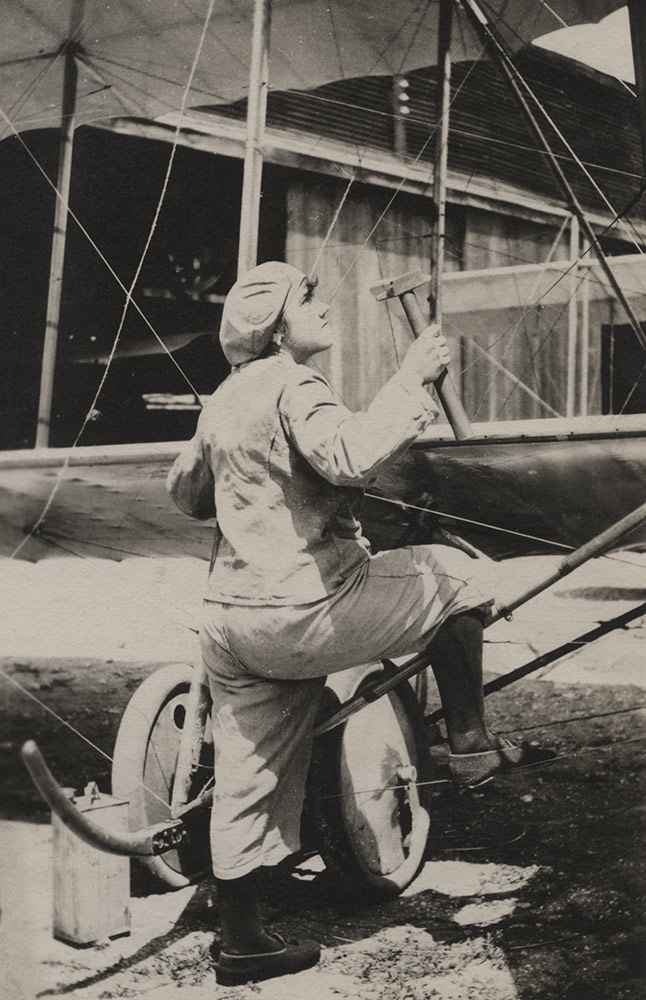
In 1914, the German armaments producer Krupp employed almost no women. By 1917, women made up nearly 30 percent of its 175,000 workers and a nationwide total of nearly 1.4 million German women were employed in the war labor force. Britain also stepped up its arms production by expanding the employment of women. In July 1914, 3.3 million women worked in paid employment in Britain. By July 1917, 4.7 million did. British women served in uniform as well in the Royal Navy and Royal Air Force. In fact, the last known surviving veteran of World War I was Florence Green of the RAF, who died in 2012.
A French woman working as an airplane mechanic.
As women took traditional male jobs in the United States, African American women were able to make their first major shift from domestic employment to work in offices and factories. Recent research also shows that a limited number of African American women served overseas as volunteers with the YMCA.
“The women worked as ammunition testers, switchboard operators, stock takers. They went into every kind of factory devoted to the production of war materials, from the most dangerous posts in munition plants to the delicate sewing in aeroplane factories.”
– Alice Dunbar Nelson, American Poet and Civil Rights Activist, on African American women’s efforts during the war, 1918
But even women in more traditional roles contributed to the war effort. Every housewife in the U.S. was asked to sign a pledge card stating that she would “carry out the directions and advice of the Food Administrator in the conduct of my household, in so far as my circumstances permit.” This meant canning food for future use, growing vegetables in the backyard and limiting consumption of meat, wheat and fats. Most of all, women were expected to bolster the morale of their families at home and loved ones overseas.
Doctors, Nurses and Ambulance Drivers
The Salvation Army, the Red Cross and many other organizations depended on thousands of female volunteers. The American Red Cross operated hospitals to care for war casualties, staffed by nurses, hundreds of whom died in service during the war. Thousands of women also served in the U.S. Army Nurse Corps and the Navy Nurse Corps. While the American Expeditionary Forces were still preparing to go overseas, U.S. Army nurses were sent ahead and assigned to the British Expeditionary Force. By June 1918, there were more than 3,000 American nurses in over 750 in British-run hospitals in France.
While nurses were accepted at the Front, women physicians faced obstacles putting their hard-earned skills to work. When these women were rejected from service in the U.S. Army Medical Corps, many sought other opportunities to serve the war effort: as civilian contract surgeons, with the Red Cross or other humanitarian relief organizations and even in the French Army.
The Medical Women’s National Association, for example, raised money to send their own doctors overseas to work in hospitals run by the American Red Cross. By the end of the war, nearly 80 women doctors from this organization were at work in the devastated regions of Europe, caring for civilians and soldiers and treating diseases such as influenza and typhoid.
During the last Allied offensive in the summer and fall of 1918, many woman doctors, nurses and aides operated near the front lines, providing medical care for soldiers wounded in combat.
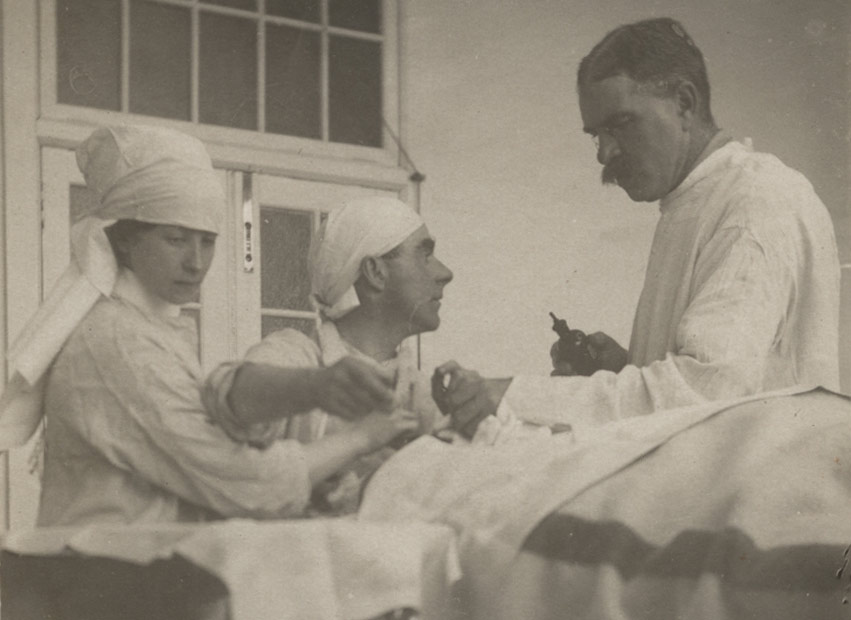
A nurse assisting doctor with an operation.
“I had just given this poor boy anesthesia when a bomb hit. We were supposed to hit the floor, but he was out and didn’t know what was going on. I took a tray and put it over our heads. It wasn’t because I was brave. I was just scared.”
– Medical Corps anesthetist Sophie Gran. Gran was one of the first woman anesthetists with the A.E.F. in France and the only woman anesthetist with Mobile Hospital Unit #1. She went on to become the first president of California Association of Nurse Anesthetists in 1931.
The automobile age was just getting underway in WWI, and motorized ambulances became key to medical treatment on the battlefield. Many women who knew how to drive volunteered to go overseas to serve as ambulance and truck drivers or mechanics. They delivered medical supplies, transported patients to hospitals and drove through artillery fire to retrieve the wounded.
Many of the women drivers of the Red Cross Motor Service and other ambulance groups used their own cars, including Marie Curie. Curie invented a mobile X-ray unit, radiological cars nicknamed “little Curies,” and ultimately trained 150 women to be X-ray operators on the battlefront, of which Curie herself was one – an act that she believed contributed to her later death from radiation exposure.
Female Yeoman
Despite thousands of new recruits, the U.S. Navy was short-handed at the beginning of World War I. Vague wording in a section of the Naval Act of 1916 outlining who could serve created a loophole: women were able to join the ranks as Yeomen, non-commissioned officers. Around 12,000 women enlisted in the Navy under the title, “Yeoman (F).”
Most women Yeomen served stateside on naval bases, replacing men who had deployed to Europe. While many female recruits performed clerical duties, some worked as truck drivers, mechanics, radio operators, telephone operators, translators, camouflage artists and munition workers. They had the same responsibilities as their male counterparts and received the same pay of $28.75 per month.
The “Hello Girls”
Aiming to improve communications on the Western front between the Allied Forces, General John J. Pershing called for the creation of the Signal Corps Female Telephone Operators Unit. The unit recruited women who were bilingual in French and English to serve as telephone switchboard operators on the Western front. The women received physical training, observed strict military protocol, wore identity discs and worked very close to the front lines. These female recruits were nicknamed the “Hello Girls” (a term which some of them felt disparaged their efforts) and became known for their bravery and focus under pressure. However, upon their return to the United States after the end of the war, the “Hello Girls” did not receive veteran status or benefits. It wasn’t until 1977, when President Jimmy Carter signed legislation, that the few surviving women telephone operators received recognition of their veteran status.
Women Soldiers
Though it would be years before many other countries allowed female soldiers, in Russia, Bulgaria, Romania and Serbia women did serve as combat troops. The best known of these soldiers was Maria Bochkareva, the founder of the Russian “Women’s Battalion of Death.” The first woman to lead a Russian military unit, Bochkareva went as far as to petition the Czar for permission to enlist in the Imperial Russian army in 1914 and was granted permission to join. Initially harassed and ostracized, Bochkareva persisted, overcoming battle injuries and becoming a decorated soldier and commander.
Her all-female battalion of shock troops, the 1st Russian Women’s Battalion of Death, was created in 1917 to shame men into continuing the fight. Though their training was rushed, the battalion was sent to the Russian western front to participate in the Kerensky Offensive in July 1917. Other female units were also formed for their propaganda value, but few saw combat outside of Bochkareva’s unit and the 1st Petrograd Women’s Battalion, which helped defend the Winter Palace in the October Revolution. Ultimately, Russia ended their involvement in WWI with the Treaty of Brest-Litovsk on March 3, 1918.
The home front during World War I covers the domestic, economic, social and political histories of countries involved in that conflict. It covers the mobilization of armed forces and war supplies, lives of others, but does not include the military history. For nonmilitary interactions among the major players see Diplomatic history of World War I.
About 10.9 million combatants and seven million civilians died during the entire war, including many weakened by years of malnutrition; they fell in the worldwide Spanish Flu pandemic, which struck late in 1918, just as the war was ending.
The Allies had much more potential wealth that they could spend on the war. One estimate (using 1913 US dollars), is that the Allies spent $147 billion ($4.5tr in 2023 USD) on the war and the Central Powers only $61 billion ($1.88tr in 2023 USD). Among the Allies, Britain and its Empire spent $47 billion and the US$27 billion; among the Central Powers, Germany spent $45 billion.
Total war demanded the total mobilization of all the nation’s resources for a common goal. Manpower had to be chanelled into the front lines (all the powers except the United States and Britain had large trained reserves designed for just that). Behind the lines labour power had to be redirected away from less necessary activities that were luxuries during a total war. In particular, vast munitions industries had to be built up to provide shells, guns, warships, uniforms, airplanes, and a hundred other weapons, both old and new. Agriculture had to be mobilized as well, to provide food for both civilians and for soldiers (many of whom had been farmers and needed to be replaced by old men, boys and women) and for horses to move supplies. Transportation in general was a challenge, especially when Britain and Germany each tried to intercept merchant ships headed for the enemy. Finance was a special challenge. Germany financed the Central Powers. Britain financed the Allies until 1916, when it ran out of money and had to borrow from the United States. The US took over the financing of the Allies in 1917 with loans that it insisted be repaid after the war. The victorious Allies looked to defeated Germany in 1919 to pay “reparations” that would cover some of their costs. Above all, it was essential to conduct the mobilization in such a way that the short term confidence of the people was maintained, the long-term power of the political establishment was upheld, and the long-term economic health of the nation was preserved. For more details on economics see Economic history of World War I.
World War I had a profound impact on woman suffrage across the belligerents. Women played a major role on the homefronts and many countries recognized their sacrifices with the vote during or shortly after the war, including the United States, Britain, Canada (except Quebec), Denmark, Austria, the Netherlands, Germany, Russia, Sweden and Ireland. France almost did so but stopped short.
The total direct cost of war, for all participants including those not listed here, was about $80 billion in 1913 US dollars. Since $1 billion in 1913 is approximately $46.32 billion in 2023 US dollars, the total cost comes to around $2.47 trillion in 2023 dollars. Direct cost is figured as actual expenditures during war minus normal prewar spending. It excludes postwar costs such as pensions, interest, and veteran hospitals. Loans to/from allies are not included in “direct cost”. Repayment of loans after 1918 is not included. The total direct cost of the war as a percent of wartime national income:
Allies: Britain, 37%; France, 26%; Italy, 19%; Russia, 24%; United States, 16%.
Central Powers: Austria-Hungary, 24%; Germany, 32%; Turkey unknown.
The amounts listed below are presented in terms of 1913 US dollars, where $1 billion then equals about $25 billion in 2017.
Britain had a direct war cost about $21.2 billion; it made loans to Allies and Dominions of $4.886 billion, and received loans from the United States of $2.909 billion.
France had a direct war cost about $10.1 billion; it made loans to Allies of $1.104 billion, and received loans from Allies (United States and Britain) of $2.909 billion.
Italy had a direct war cost about $4.5 billion; it received loans from Allies (United States and Britain) of $1.278 billion.
The United States had a direct war cost about $12.3 billion; it made loans to Allies of $5.041 billion.
Russia had a direct war cost about $7.7 billion; it received loans from Allies (United States and Britain) of $2.289 billion.
The two governments agreed that financially Britain would support the weaker Allies and that France would take care of itself. In August 1914, Henry Pomeroy Davison, a Morgan partner, traveled to London and made a deal with the Bank of England to make J.P. Morgan & Co. the sole underwriter of war bonds for Great Britain and France. The Bank of England became a fiscal agent of J.P. Morgan & Co., and vice versa. Over the course of the war, J.P. Morgan loaned about $1.5 billion (approximately $26 billion in today’s dollars) to the Allies to fight against the Germans.: Morgan also invested in the suppliers of war equipment to Britain and France, thus profiting from the financing and purchasing activities of the two European governments.
Britain made heavy loans to Tsarist Russia; the Lenin government after 1920 refused to honor them, causing long-term issues.
At the outbreak of war, patriotic feelings spread throughout the country, and many of the class barriers of Edwardian era faded during the years of combat. However, the Catholics in southern Ireland moved overnight to demands for complete immediate independence after the failed Easter Rebellion of 1916. Northern Ireland remained loyal to the crown.
In 1914 Britain had by far the largest and most efficient financial system in the world. Roger Lloyd-Jones and M. J. Lewis argue:To prosecute industrial war required the mobilization of economic resources for the mass production of weapons and munitions, which necessarily entitled fundamental changes in the relationship between the state (the procurer), business (the provider), labor (the key productive input), and the military (the consumer). In this context, the industrial battlefields of France and Flanders intertwined with the home front that produced the materials to sustain a war over four long and bloody years.
Economic sacrifices were made, however, in the name of defeating the enemy. In 1915 Liberal politician David Lloyd George took charge of the newly created Ministry of Munitions. He dramatically increased the output of artillery shells—the main weapon actually used in battle. In 1916 he became secretary for war. Prime Minister H. H. Asquith was a disappointment; he formed a coalition government in 1915 but it was also ineffective. Asquith was replaced by Lloyd George in late 1916. He had a strong hand in the managing of every affair, making many decisions himself. Historians credit Lloyd George with providing the driving energy and organisation that won the War.
Although Germans were using Zeppelins to bomb the cities, morale remained relatively high due in part to the propaganda churned out by the national newspapers. With a severe shortage of skilled workers, industry redesigned work so that it could be done by unskilled men and women (termed the “dilution of labour”) so that war-related industries grew rapidly. Lloyd George cut a deal with the trades unions—they approved the dilution (since it would be temporary) and threw their organizations into the war effort.
Historian Arthur Marwick saw a radical transformation of British society, a deluge that swept away many old attitudes and brought in a more equalitarian society. He also saw the famous literary pessimism of the 1920s as misplaced, for there were major positive long-term consequences of the war. He pointed to new job opportunities and self-consciousness among workers that quickly built up the Labour Party, to the coming of partial woman suffrage, and an acceleration of social reform and state control of the British economy. He found a decline of deference toward the aristocracy and established authority in general, and a weakening among youth of traditional restraints on individual moral behavior. Marwick concluded that class differentials softened, national cohesion increased, and British society became more equal. During the conflict, the various elements of the British Left created the War Emergency Workers’ National Committee, which played a crucial role in supporting the most vulnerable people on the Home Front during the war, and in ensuring the British Labour remained united in the years after the Armistice.
Scotland
Scotland played a major role in the British effort in the First World War. It especially provided manpower, ships, machinery, food (particularly fish) and money, engaging with the conflict with some enthusiasm. With a population of 4.8 million in 1911, Scotland sent 690,000 men to the war, of whom 74,000 died in combat or from disease, and 150,000 were seriously wounded. Scottish urban centres, with their poverty and unemployment were favourite recruiting grounds of the regular British army, and Dundee, where the female dominated jute industry limited male employment had one of the highest proportion of reservists and serving soldiers than almost any other British city. Concern for their families’ standard of living made men hesitate to enlist; voluntary enlistment rates went up after the government guaranteed a weekly stipend for life to the survivors of men who were killed or disabled. After the introduction of conscription from January 1916 every part of the country was affected. Occasionally Scottish troops made up large proportions of the active combatants, and suffered corresponding loses, as at the Battle of Loos, where there were three full Scots divisions and other Scottish units. Thus, although Scots were only 10 per cent of the British population, they made up 15 per cent of the national armed forces and eventually accounted for 20 per cent of the dead. Some areas, like the thinly populated Island of Lewis and Harris suffered some of the highest proportional losses of any part of Britain. Clydeside shipyards and the nearby engineering shops were the major centers of war industry in Scotland. In Glasgow, radical agitation led to industrial and political unrest that continued after the war ended.
In Glasgow, the heavy demand for munitions and warships strengthened union power. There emerged a radical movement called “Red Clydeside” led by militant trades unionists. Formerly a Liberal Party stronghold, the industrial districts switched to Labour by 1922, with a base among the Irish Catholic working class districts. Women were especially active in solidarity on housing issues. However, the “Reds” operated within the Labour Party and had little influence in Parliament; the mood changed to passive despair by the late 1920s.
David Lloyd George became prime minister in December 1916 and immediately transformed the British war effort, taking firm control of both military and domestic policy.
In rapid succession in spring 1918 came a series of military and political crises. The Germans, having moved troops from the Eastern front and retrained them in new tactics, now had more soldiers on the Western Front than the Allies. Germany launched a full scale Spring Offensive (Operation Michael), starting March 21 against the British and French lines, with the hope of victory on the battlefield before the American troops arrived in numbers. The Allied armies fell back 40 miles in confusion, and facing defeat, London realized it needed more troops to fight a mobile war. Lloyd George found a half million soldiers and rushed them to France, asked American President Woodrow Wilson for immediate help, and agreed to the appointment of French General Foch as commander-in-chief on the Western Front so that Allied forces could be coordinated to handle the German offensive.
Despite strong warnings it was a bad idea, the War Cabinet decided to impose conscription on Ireland. The main reason was that labour in Britain demanded it as the price for cutting back on exemptions for certain workers. Labour wanted the principle established that no one was exempt, but it did not demand that the draft actually take place in Ireland. The proposal was enacted but never enforced. The Catholic bishops for the first time entered the fray and called for open resistance to a draft. Many Irish Catholics and nationalists moved into the intransigent Sinn Féin movement. This proved a decisive moment, marking the end of Irish willingness to stay inside the UK.
When on May 7, 1918, a senior army general on active duty, Major-General Sir Frederick Maurice went public with allegations that Lloyd George had lied to Parliament on military matters, a crisis was at hand. The German spring offensive had made unexpected major gains, and a scapegoat was needed. Asquith, the Liberal leader in the House, took up the allegations and attacked Lloyd George (also a Liberal), which further split the Liberal Party. While Asquith’s presentation was poorly done, Lloyd George vigorously defended his position, treating the debate as a vote of confidence. He won over the House with a powerful refutation of Maurice’s allegations. The main results were to strengthen Lloyd George, weaken Asquith, end public criticism of overall strategy, and strengthen civilian control of the military.
Meanwhile, the German offensive stalled. By summer the Americans were sending 10,000 fresh men a day to the Western Front, a more rapid response made possible by leaving their equipment behind and using British and French munitions. The German army had used up its last reserves and was steadily shrinking in number and weakening in resolve. Victory came with the Armistice on November 11, 1918.
Women
Prime Minister David Lloyd George was clear about how important the women were:It would have been utterly impossible for us to have waged a successful war had it not been for the skill and ardour, enthusiasm and industry which the women of this country have thrown into the war.
The militant suffragette movement was suspended during the war, and at the time people credited the new patriotic roles women played as earning them the vote in 1918. However, British historians no longer emphasize the granting of woman suffrage as a reward for women’s participation in war work. Pugh (1974) argues that enfranchising soldiers primarily and women secondarily was decided by senior politicians in 1916. In the absence of major women’s groups demanding for equal suffrage, the government’s conference recommended limited, age-restricted women’s suffrage. The suffragettes had been weakened, Pugh argues, by repeated failures before 1914 and by the disorganizing effects of war mobilization; therefore they quietly accepted these restrictions, which were approved in 1918 by a majority of the War Ministry and each political party in Parliament. More generally, Searle (2004) argues that the British debate was essentially over by the 1890s, and that granting the suffrage in 1918 was mostly a byproduct of giving the vote to male soldiers. Women in Britain finally achieved suffrage on the same terms as men in 1928.
The Battle of Remagen was an 18-day battle during the Allied invasion of Germany in World War II from 7 to 25 March 1945 when American forces unexpectedly captured the Ludendorff Bridge over the Rhine intact. They were able to hold it against German opposition and build additional temporary crossings. The presence of a bridgehead across the Rhine advanced by three weeks the Western Allies’ planned crossing of the Rhine into the German interior.
After capturing the Siegfried Line, the 9th Armored Division of the U.S. First Army had advanced unexpectedly quickly towards the Rhine. They were very surprised to see one of the last bridges across the Rhine still standing.: The Germans had wired the bridge with about 2,800 kilograms (6,200 lb) of demolition charges. When they tried to blow it up, only a portion of the explosives detonated. U.S. forces captured the bridge and rapidly expanded their first bridgehead across the Rhine, two weeks before Field Marshal Bernard Montgomery‘s meticulously planned Operation Plunder. The GIs’ actions prevented the Germans from regrouping east of the Rhine and consolidating their positions.
The battle for control of the Ludendorff Bridge caused both the American and German forces to employ new weapons and tactics in combat for the first time. Over the next 10 days, after its capture on 7 March 1945 and until its failure on 17 March, the Germans used virtually every weapon at their disposal to try to destroy the bridge. This included infantry and armor, howitzers, mortars, floating mines, mined boats, a railroad gun, and the giant 600 mm Karl-Gerät super-heavy mortar. They also attacked the bridge using the newly developed Arado Ar 234B-2turbojet bombers. To protect the bridge against aircraft, the Americans positioned the largest concentration of anti-aircraft weapons during World War II according to “the greatest antiaircraft artillery battles in American history”. The Americans counted 367 different German Luftwaffe aircraft attacking the bridge over the next 10 days. The Americans claimed to have shot down nearly 30 percent of the aircraft dispatched against them. The German air offensive failed.
On 14 March, German Reich Chancellor Adolf Hitler ordered Schutzstaffel (SS) General Hans Kammler to fire V2 rockets to destroy the bridge. This marked the first time the missiles had been used against a tactical objective and the only time they were fired on a German target. The 11 missiles launched killed six Americans and a number of German citizens in nearby towns, but none landed closer than some 500 metres (1⁄4 mi) from the bridge. When the Germans sent a squad of seven navy demolition swimmers wearing Italian underwater-breathing apparatus, the Americans were ready. For the first time in combat, they had deployed the top-secret Canal Defence Lights: which successfully detected the frogmen in the dark, who were all killed or captured.
The sudden capture of a bridge across the Rhine was front-page news in American newspapers. The unexpected availability of a bridgehead on the eastern side of the Rhine more than two weeks in advance of Operation Plunder allowed Allied high commanderDwight Eisenhower to alter his plans to end the war. The Allies were able to rapidly transport five divisions across the Rhine into the Ruhr, Germany’s industrial heartland. The bridge had endured months of aircraft bombing, direct artillery hits, near misses, and deliberate demolition attempts. It finally collapsed at 3:00 pm on 17 March, killing 33 American engineers and wounding 63. But by then U.S. Army combat engineers had finished building a tactical steel treadway bridge and a heavy duty pontoon bridge followed by a Bailey bridge across the Rhine. Over 125,000 troops established a bridgehead of six divisions, with accompanying tanks, artillery pieces, and trucks, across the Rhine. The Americans broke out of the bridgehead on 25 March 1945, 18 days after the bridge was captured. Some German and American military authorities agreed that capturing the bridge shortened the war, although one German general disputed this. The Ludendorff Bridge was not rebuilt following World War II. In 2020, plans were initiated to build a replacement suspension bridge for pedestrians and cyclists. There is no other river crossing for 44 km (27 mi) and few ferries. Local communities indicated an interest to help fund the project and an engineer was commissioned to draw up plans.
Background
Romans originally built a settlement at Remagen in the first century AD.[14] Over that long period of time, it had been destroyed multiple times by invading armies from several nations. The town was rebuilt each time. In March 1945 about 5,000 people lived in the small resort town. The Rhine near Remagen was about 270 meters (890 ft) wide. The Ludendorff Bridge had been built by Russian prisoners of war during World War I to help transport supplies from Germany to France.
American troops cross the Ludendorff Bridge on 13 December 1918.
The bridge connected the village of Erpel on the eastern side with Remagen on the west bank. It had been named after the World War I German General Erich Ludendorff, who had been a key proponent for building this bridge. It carried two rail lines and pedestrian catwalks on either side across the Rhine. The total length was 400 metres (1,300 ft), while the main steel structure was 325 metres (1,066 ft) long. The arch spanned 156 metres (512 ft) and at its highest measured 28 metres (92 ft) above the water. Two trusses on either side of the central arch were both 85 metres (279 ft). An elevated overpass on each end of the span connected the approach to the bridge and allowed a rail line or roads to pass underneath, parallel to the river. The bridge was normally about 15 metres (49 ft) above the Rhine. Since it was built for military purposes, it had solidly built stone towers on either side of the rails on both banks, equipped with fighting loopholes and accommodations for up to a battalion of troops. On the eastern side, a 1,299-foot-long (396 m) tunnel was cut at almost 90° through Erpeler Ley, a steeply sided hill that overlooks the Rhine.
Demolition charges
The designers built cavities into the piers where demolition charges could be placed, but when the French occupied the Rhineland after World War I, they filled these cavities with concrete. After the Germans reacquired the Rhineland and control of the bridge, in 1938 they attached 60 zinc-lined boxes to the bridge girders, each capable of containing 3.66 kilograms (8.1 lb) of explosives. The system was designed to detonate all 60 charges at once, though by 7 March 1945, the charges had been removed and were stored nearby. They placed additional charges on the two piers. Within an inspection shaft in the west pier, the Germans placed 2,000 kilograms (4,400 lb) of explosives, and on the east pier they attached two charges of 300 kilograms (660 lb) to the girders connecting the bridge to the pier. The approximately 2,800 kilograms (6,200 lb) of charges were attached to an electric fuse and connected by electrical cables run through protective steel pipes to a control circuit located in the entrance to the tunnel under Erpeler Ley. As a backup, the Germans attached a primer cord to the charges under the eastern pier that could be manually ignited.
During the autumn of 1944, the Allies had repeatedly attempted to destroy the bridge to disrupt German efforts to reinforce their forces to the west. On 9 October 1944, a raid by 33 bombers damaged the bridge and it was reported as destroyed, but the bridge was back in use again on 9 November. A few weeks later on 28 December 1944, 71 B-24 Liberator bombers were dispatched to strike the bridge. They hit it with four bombs but the Germans quickly repaired it. The 446th Bombardment Group attacked the bridge again on the next four consecutive days from 28 to 31 December 1944. More bombers struck at the bridge during raids in January and February 1945. On 5 March 1945, B-24 bombers from the 491st Bombardment Group attempted one more time to destroy the bridge, but failed.
Operation Lumberjack was planned to prepare the way for Field Marshal Montgomery‘s massive Operation Plunder, an operation that rivaled the Normandy landings in size and complexity, eventually involving over a million troops and more than 30 divisions. Montgomery’s typically cautious plan was to cross the Rhine in late March and invade central Germany. It included a large array of transport aircraft to ferry paratroopers and glider-borne infantry across the Rhine to set up the river crossing.
Montgomery’s ground assault plan included the British 21st Army Group, consisting of the British Second Army, First Canadian Army and the attached US 9th Army. They were charged with crossing the Rhine north of the Ruhr following the airborne assault. To the south, Montgomery would be supported by Lt. Gen. Omar Bradley‘s 12th Army Group, including the First Army under the command of Lt. Gen. Courtney Hodges. Hodges was given the objective of capturing dams on the Rur River and then trapping the Germans in a pincer move west of the Rhine. Plans for Operation Plunder had begun in England in August 1944, almost since Operation Market Garden failed.
After pushing the Germans back during the Battle of the Bulge, the Allies quickly advanced into western Germany. General Eisenhower established a twofold mission. The first was to prevent German forces defending the west bank of the Rhine River from escaping to the east bank. The second was to allow the Allied forces to select a river crossing where they could concentrate the attack leaving minimum forces defending the remainder of the front. The Allies held little hope they would be able to capture a Rhine River bridge intact. Instead, they brought up huge amounts of bridging equipment to the front. But Eisenhower left a standing order that if any unit found a bridge intact, they were to “exploit its use to the fullest, and establish a bridgehead on the other side”.
The Armistice of 11 November 1918 was the armistice signed at Le Francport near Compiègne that ended fighting on land, sea, and air in World War I between the Entente and their last remaining opponent, Germany. Previous armistices had been agreed with Bulgaria, the Ottoman Empire and Austria-Hungary. It was concluded after the German government sent a message to American president Woodrow Wilson to negotiate terms on the basis of a recent speech of his and the earlier declared “Fourteen Points“, which later became the basis of the German surrender at the Paris Peace Conference, which took place the following year.
Also known as the Armistice of Compiègne (French: Armistice de Compiègne, German: Waffenstillstand von Compiègne) from the place where it was officially signed at 5:45 a.m. by the Allied Supreme Commander, FrenchMarshalFerdinand Foch, it came into force at 11:00 a.m. Central European Time (CET) on 11 November 1918 and marked a victory for the Allies and a defeat for Germany, although not formally a surrender.
The actual terms, which were largely written by Foch, included the cessation of hostilities on the Western Front, the withdrawal of German forces from west of the Rhine, Allied occupation of the Rhineland and bridgeheads further east, the preservation of infrastructure, the surrender of aircraft, warships, and military materiel, the release of Allied prisoners of war and interned civilians, eventual reparations, no release of German prisoners and no relaxation of the naval blockade of Germany. The armistice was extended three times while negotiations continued on a peace treaty. The Treaty of Versailles, which was officially signed on 28 June 1919, took effect on 10 January 1920.
Fighting continued up until 11 a.m. CET on 11 November 1918, with 2,738 men dying on the last day of the war.
Background
Deteriorating situation for the Germans
German prisoners of war captured near Amiens in late August 1918
Meanwhile, the Ottoman Empire was close to exhaustion, the Austro-Hungarian Empire was in chaos, and on the Macedonian front, resistance by the Bulgarian Army had collapsed, leading to the Armistice of Salonica on 29 September. In Germany, chronic food shortages caused by the Allied blockade were increasingly leading to discontent and disorder. Although morale on the German front line was reasonable, battlefield casualties, starvation rations and Spanish flu had caused a desperate shortage of manpower, and those recruits that were available were war-weary and disaffected.
The hospitals set up immediately behind the lines were often housed in tents during the First World War, including wards and operating theatres.
This was particularly true of Casualty Clearing Stations, with base hospitals further away from the fighting sometimes making use of existing or more permanent buildings.
A casualty then travelled by motor or horse ambulance to a Casualty Clearing Station. These were basic hospitals and were the closest point to the front where female nurses were allowed to serve. Patients were usually transferred to a stationary or general hospital at a base for further treatment. A network of ambulance trains and hospital barges provided transport between these facilities, while hospital ships carried casualties evacuated back home to ‘Blighty’.
As well as battle injuries inflicted by shells and bullets, the First World War saw the first use of poison gas. It also saw the first recognition of psychological trauma, initially known as ‘shell shock‘. In terms of physical injury, the heavily manured soil of the Western Front encouraged the growth of tetanus and gas gangrene, causing medical complications. Disease also flourished in unhygienic conditions, and the influenza epidemic of 1918 claimed many lives.
Roman Wound Care
Care of the injured soldier is as old as war. And war is as old as history. Perhaps older. People were fighting and hurting one another back into the old stone age, long before organized societies and armies. Military medicine goes back a very long way. In fact, to the very first civilizations. From around 4000 BCE to around 1500 BCE, organized civilization arose separately in Mesopotamia and Egypt; the Indus River valley, present-day Pakistan and India; the Yangtze River valley in China; and the Americas, meso-America and the Andes. All were agriculturally based, and featured organized governments and armies supported by hereditary ruling and military castes. Without exception, all were warlike.
Even in the ancient world, all armies had to care for their wounded. But the civilizations themselves varied widely in their underlying medical institutions. Some cultures had such rudimentary medical care that wounded soldiers were given hardly more than token care, others had fairly sophisticated treatment of wounds. Roman military medicine most closely approached what we have today. The Roman army had organized field sanitation, well-designed camps, and separate companies of what we would now call field engineers. They had a much better grasp of sanitation and supply than anyone else before, or for a long while after. They had medical corpsmen, called immunes. They practiced front-line treatment, with evacuation through well-organized supply and logistics chains. Because of their improved sanitation, their armies suffered somewhat less from the epidemics which swept military camps. But that was only by comparison with their opponents. Two-thirds of their casualties were still due to disease. Their world-view included no such thing as bacteria or protozoa. Immunizations were two millennia in their future. And, perhaps most important, their practices did not outlive their empire.
After the Romans, medical care on the battlefield became disorganized, almost an afterthought. In the Middle Ages and the Early Modern period, medical care was done by whoever was nearby. This meant local surgeons, camp followers, servants, and whoever else would volunteer or be conscripted. Armies were small. The famous battle of Crecy, for example, in 1346, was fought between an English army of 10,000 men, and a French army of 20,000. Camp sanitation was totally unheard of, and disease ravaged armies of the day. Until the 20th century, at least twice as many soldiers died from disease in camp than from wounds on the battlefield.
What is military medicine? Today’s military medicine is an amalgam of trauma care, infectious disease treatment, preventive medicine, and public health. All of these are important. Trauma care includes not only the treatment of wounds, but also the rescue of injured soldiers, their evacuation, and the provision of a graded system of care from the front line to hospitals far in the read.
Equally important is infectious disease care and preventive medicine. Anyone who has been in military service can testify to the large number of immunizations they received. These have controlled the diseases that caused most of the casualties in previous centuries. Those that cannot be controlled by immunizations can be treated. Today’s antibiotics and other treatments are vital in military medicine. Unhappily, antibiotics were not available in World War I, and diseases such as pneumonia, dysentery, and tuberculosis continued to claim victims.
Public health, including environmental medicine, is recognized as a crucial part of military medicine. Disease agents such as mosquitoes can be controlled. Water supplies are routinely treated. Human waste is controlled and not allowed to spread disease. Environmental medicine is a large part of this. Wars are not usually fought in nice places. Even when they are, as in Flanders and northeastern France, those places quickly become adverse environments.
French Soldier in a Trench
The First World War was fought largely in the trenches of the Western Front. That’s not the full story, but it was a dominant part of the war, and remains the public image. Trench conditions were miserable from a military standpoint, but a disaster for public health. Sanitation was so bad that after a week or two in the trenches, troops had to be rotated back of the lines to be deloused, thoroughly cleaned, and provided with fresh clothing and equipment. Even so, disease was common, and wound contamination universal.
Wounds were usually contaminated with the mud of the trenches. Tetanus immunization was available, and wounded soldiers were routinely given tetanus toxoid. Wound care was much better than during previous wars. It emphasized debridement of devitalized tissue and thorough cleaning with antiseptic solution (Dakin’s solution). Aseptic technique was (usually) used in operating rooms. General anesthesia was available. Bowel injuries could be routinely repaired. Intravenous fluids were available, as were blood transfusions (sometimes). Radiography had only been invented some 16 years before, but was deployed on the battlefields by 1914. As an index of how much things had changed, mortality following amputation had been 25% in the American Civil War, and was 5% in World War I. Deaths from wounds dropped, but deaths from disease dropped even further. Far fewer soldiers died of disease as a percentage of total deaths than ever before. And this was despite the influenza epidemic of 1918-19, which claimed many victims at the end of the war.
Aid Station in a Trench Dugout
Even acknowledging all of the difficulties imposed by trench conditions, the casualty care system was still much better than in any previous war. Specialized military units, called ambulances were charged with picking soldiers from the battlefield and transporting them to aid stations, and then to field hospitals. For further evacuation, hospital trains were staffed with nurses and orderlies, and equipped to care for even difficult wounds. There were base hospitals and convalescent facilities both on the French coast and in England. As the American Army deployed to Europe in 1917-18, hospitals, doctors, nurses, and ambulances went with them.
The First World War claimed 9 million soldiers, and 7-10 million civilian lives. Civilian casualty estimates vary widely, and the true figure is probably unknowable. In 1918-20, over the course of the influenza epidemic (misnamed the Spanish flu), some 20 to 40 million people died. Half of all American soldier deaths from disease were due to influenza, many in training camps in the United States. Did the war cause the flu epidemic? Perhaps so. Certainly, it created the conditions in which the epidemic began and spread. The question has been debated ever since. Whatever its cause, the flu epidemic killed more people than the war itself.




 Weevles Updates Disabled Bloggers Team