WW1 and the Red Cross who saved many lives with their support.

For weary refugees and prisoners of war, treasure was a bar of soap and a handkerchief.

Volunteer Ann Curtis, from Suffolk, knew a lot about this kind of treasure. She put in 88 hours of needlework to create individual treasure bags.

“About 1200 officers and men arriving in Switzerland for internment from Germany were provided with chintz treasure bags containing washing materials, handkerchiefs etc, which were very popular,” reported the Red Cross.

“Indeed, many of the bags were recognised three months later at the general repatriation doing duty as hand luggage.

“About 3,000 of these fitted bags were handed to the prisoners passing through Switzerland on their way home from Germany after the Armistice.

“Another 550 were given to civilian refugees passing through from Austria, Poland, Hungary, etc and were quite invaluable to the women, many of whom were accompanied by small children.”

The organisation relied on hundreds of volunteers like Ann to stitch, sew and knit products for prisoners of war and hospital and wards.

The Red Cross issued material and standard patterns to follow. Hour after hour, knitting needles clicked and scissors snipped in communities across the UK.

When she wasn’t sewing treasure bags, Ann Curtis made hot water bottle covers.

Eighty-three-year-old volunteer Martha Antobus in Cheshire knitted 40 pairs of woolly socks.

And Mr Stevenette, described as “an old gentleman of over 80, knitted 44 mufflers – his knitting exceeded all other workers.”

Pomeranian dog

There was such huge demand for these items that in 1915 the Red Cross set up the Central Work Rooms. Throughout the war over 1,200 women worked in these London offices. They produced 705,500 bandages and 75,530 garments ranging from hot water bottle covers, pyjamas, dressing gowns and kitbags to pants, surgeon’s gowns, socks and pillow cases.

They used flannel, sheep’s wool and even some dog’s wool made from long-haired breeds such as Pekinese and Pomeranians.

Sewing all these garments was not without its perils. VAD nurse Helen Beale wrote to her family:

“We are very pleased this evening as the pin that the girl swallowed on Wednesday last has just emerged safely – she has been having cotton wool sandwiches and suet pudding etc. It really is rather wonderful to think that it has travelled so far inside her without pricking!” 

Sometimes ‘doing your bit’ meant getting your feet wet.

During both world wars you could find children and adults doing their bit by getting muddy and wet in peat bogs. They were collecting sphagnum moss, a small, bright green plant that was often called ‘bog moss’. It was a time-consuming, cold and uncomfortable job.

The moss was harvested and dried on an industrial scale, particularly during the First World War. In those days, before antibiotics, this moss was mildly antiseptic and could soak up a lot of fluid.

In short, it was a brilliant wound dressing.

In Ireland, Red Cross sphagnum moss centres were set up in every county. Women volunteers collected enough sphagnum moss to make close to one million dressings.

Close up of someone walking barefoot through mud

Ethel Adams was one of these women. Volunteering in County Tyrone, Ethel gathered sphagnum moss almost full time. She picked, gathered and dried the moss, sending it off to the Red Cross depots in Belfast and Armagh. She paid for the postage herself as another way to support the cause.

“In County Tyrone, sphagnum moss depots did continuous work from 1916 to October 1918,” recorded the Red Cross journal.

“Sending their supplies to Derry and Belfast, they were manufactured into dressings, the moss from this county having been considered of exceptionally good quality.”

Ethel did not just collect moss on her own – she organised a local group to gather as much as possible.

As if that wasn’t enough, she then volunteered at the Belfast moss depot. Here she clocked up 100 hours of volunteering in just three months. Ethel received a war workers badge in recognition of her efforts.

If you think hospital food is bad today, spare a thought for patients during the First World War.

Hospital caterers had a budget of just 20 pence per day to cook up a varied diet for one patient. Anything more expensive was considered an extravagance.

Then food shortages began in 1917. By this time the Red Cross was running temporary hospitals across the UK. Known as auxiliary hospitals, they treated injured servicemen – but they also had to feed them. We worked with the Ministry of Food and the War Office to ensure our patients had enough to eat.

A meager meal
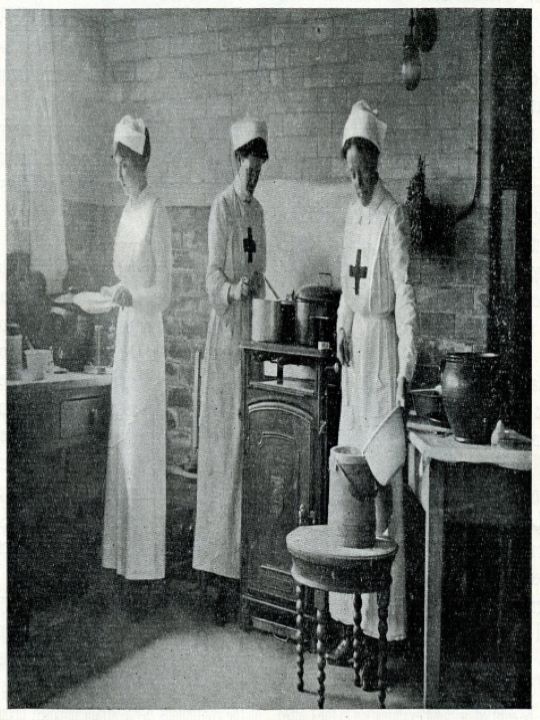
Three volunteers preparing a meal at a Red Cross hospital

Anne Auden was a Girl Guide who volunteered in the kitchens of Brookdale Red Cross hospital at Alderley Edge, Cheshire. For more than two years she popped in every week to roll up her sleeves and peel hundreds of potatoes.

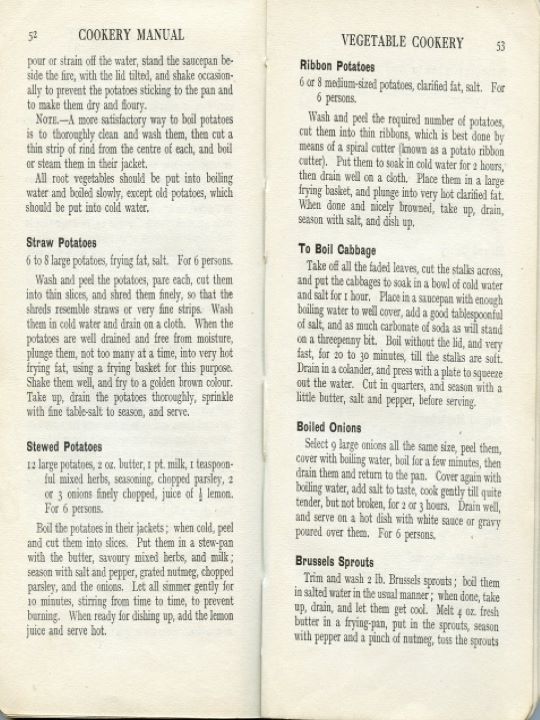
The Red Cross produced a cookery manual suggesting different ways to cook potatoes for patients (boil, stew, bake and fry in ‘ribbons or ‘straws’).

Many favourite foods – sugar, tea, meat, margarine, butter, cheese, fish, suet, golden syrup and jam – were all in limited supply. Bacon was off the menu as it was sold at double its pre-war price.

Breakfast in a Red Cross hospital was, therefore, porridge, cold boiled ham or fishcakes.

Dinner might be stewed tripe, boiled mutton, tapioca and savoury hash – no doubt made from some of Anne’s peeled potatoes.

For afters there were baked jam rolls, rhubarb and custard or bread and butter pudding. But some cooks struggled to get the recipes quite right…

One woman volunteered at a Red Cross hospital as a kitchen maid. In the topsy turvy world of the war, old class divides were often blurred. Women from rich families volunteered alongside working class women and girls.

This particular woman found herself serving as a kitchen maid to her own cook. But she did not share her cook’s expertise.

The Red Cross journal from 1916 reports that this woman “had been in trouble several times for her incompetence, and was passing a sleepless night of worry in connection with a lemon sponge.” It had not come right, and she knew what awaited her in the morning.

“Suddenly she had an idea. Rising from her bed, she crept to the kitchen… What exactly she did will never be known, but a message of thanks came down from the ward next day, with the comment that it was the best bread-and-butter pudding the patients had ever tasted.”

British Red Cross cookery manual excerpt on preparing vegetables

Whitley Bay Playhouse

We are starting to organise our show at Whitley Bay Playhouse which will be in June 2026. The show will be a big mash up of different songs from musicians, and each group can choose their own songs to perform. We are going to use Doctor Who’s Tardis to link each musical so you can choose any song you would like to do and we try to incorporate them all into the story line.

We are hoping to get initial ideas from groups about whether they would like to perform in the show and also which song or musical you would like to do. If your group would like to be part of the show please return this slip to Hilary in the next few weeks so we can make a start planning the script.

Contact NTDF on 01914661667 and ask for Ana.

Cross Country BR Class 220 Voyager (Deluxe Loco)

The wait is over – A massively famous sight across the UK, we’re finally welcoming in the Class 220 Voyager to your TSW collections!

Born to suit the growing needs of the longest and busiest services across the UK, the sleek BR Class 220 has travelled all across England and Scotland over the 20+ years of service it’s had on the rails.

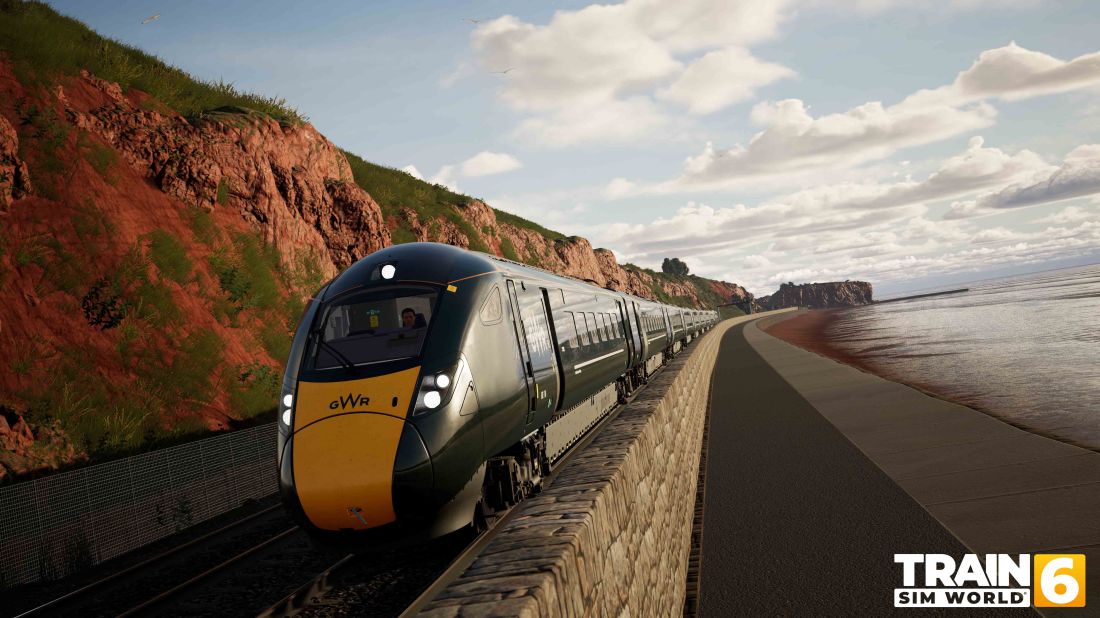
In Train Sim World 6, be a driver or conductor aboard busy CrossCountry services along the scenic Riviera Line. Accelerate out of Exeter and race by on express services to Plymouth, crest over the Devon Hills and hurry past the Dawlish Sea Wall.

Get ready for your own voyage across the UK with Free Roam, presenting many opportunities across a huge collection of UK routes available in TSW, being able to pick-up and bring the BR Class 220 Voyager on your journeys across the UK.

And of course, enjoy this selection of images, with many thanks to our wonderful beta team for helping us source the screenshots!

Here more about the Riviera Line and the XC Class 220 Voyager directly from our teams in the Train Sim World 6 UK Dev Diary:

Riviera Line: Exeter – Plymouth & Paignton

Who’s ready for a trip across the Dawlish Sea Wall? Bathe in the beauty of the South Devon Main Line between Exeter St Davids across the Plymouth, featuring the picturesque Riviera Line branch to Paignton in this new route coming with Train Sim World 6!

Famous for the red-coloured cliffs, this scenic adventure brings us to Devon for the first time in TSW, with wonderful views that will keep you locked in Photo Mode for hours capturing the best screenshots possible.

And what’s that we spot on the camera? It looks like the return of the beloved GWR license! We’ve very proud to officially represent the trains included on the Riviera line in their GWR liveries, for both the new, dual-powered BR Class 802 and the Class 150.


Tranquil hills, cliffs and ocean waves are a perfect setting for a brand new challenge, as this line will feature steep gradients, sharp up/downhill banks and constant winding tracks throughout, keeping you on your toes across the mainline.

This route is packed with history, originally built in the 1840s by Isambard Kingdom Brunel as an atmospheric railway, and later transformed to standard traction – it’s significance to the region is paramount.

Have a look at these fantastic screenshots!

Back with the release of the Class 170 from Rivet Games, we brought the Cross Country livery to TSW! Of course, with this new brand, we had to bring in the…

WW1 Changing role of women during the war and afterwards

Traditional attitudes

Before the Great War, a woman’s role was considered to be within the home. Public life, including politics was widely seen as for men only. It was believed that women involved in politics would neglect their responsibilities at home.

There had been progress towards a change in this attitude to women. A number of laws were passed to improve their standing. Women had increased rights over property and children within marriage, and divorce. They were also receiving more education and could be involved in local politics. All of these laws paved the way for further reform in favour of women’s position in society.

Women had become more involved in ‘white-collar’ (professional) jobs by the turn of the century.

Involvement in the war effort

Women working at Gretna munitions factory, Scotland in 1918
Image caption,Women working at the Gretna munitions factory

During the war the biggest increase in female employment was in factories, particularly in munitions. Previously, fewer than 4,000 women worked in heavy industry in Scotland.

  • By 1917 over 30,000 women were employed making munitions in Scotland.
  • Nationally, by late 1918, 90 per cent of the workers in the munitions industry were female.
  • Women also worked as conductors on trams and buses, and as typists and secretaries in offices and factories.
  • Thousands worked on farms in the ‘land army’.
  • Others filled more traditional jobs such as nursing, becoming important role models for women eager to feel they were ‘doing their bit’ for the war effort.

During World War One, the National Union of Women’s Suffrage Societies (NUWSS) stopped its political campaign and offered its full cooperation to the government.

Meanwhile, the Women’s Social and Political Union (WSPU) became a patriotic movement during the war. It promoted male enlistment and encouraged women to become involved in what was traditionally seen as male employment.

Impact of the war on the position of women

At first, men working in factories were worried about their loss of status and the threat to their wages. The problem was called ‘dilution’. It was seen as an issue because unskilled workers were being employed in skilled jobs.

Eventually an agreement was reached – women could only be trained to a semi-skilled level and had to work under supervision. This meant that the men would not feel that their status as skilled workers was undermined.

The Great War is often seen as a major turning point in the role of women in British society. However, when the war ended the majority did not keep their wartime jobs:

  • The Restoration of Pre-War Practices Act meant that returning soldiers were given their old jobs back
  • Closure of most munitions factories meant women workers were no longer needed.
  • Within a few years of the end of the war, over 25 per cent of all working women were back in domestic service.

WW1 Home Guard – taking care of Britain

The British home army in the First World War served the dual purpose of defending the country against invasion and training reinforcements for the army overseas. Initial responsibility for defending the nation lay with the Territorial Force, a part-time auxiliary designed in 1908 as a means of expanding the army in a major foreign conflict but, as a result of political compromise, implemented as a home defence army. It was supported in this role by 42,000 regular army troops, primarily belonging to the Royal Garrison Artillery and the Royal Engineers. The 14 infantry divisions and 14 mounted brigades of the Territorial Force were mainly allocated either to the Local Force, stationed near the coast and tasked with disrupting an invasion at the point of landing, or the Central Force, a mobile element tasked with defeating the invading force as it marched on London. The Local Force was augmented by units of the Special Reserve and Extra Reserve, which were the third battalions of the regular army line infantry regiments established to recruit and train replacements for their regiments’ two combat battalions. The home army was also largely responsible for guarding vulnerable points, such as the communications infrastructure, rail network and munitions works.

Although the territorials could not be compelled to serve outside the United Kingdom, they could volunteer to do so, and when large numbers did, units of the Territorial Force began to be posted overseas. By July 1915, the home army had been stripped of all its original territorial divisions, and their places in the home defences were taken by second-line territorial units. The new units competed for equipment with the ‘New Army‘ being raised to expand the army overseas, the reserves of which were also allocated to home defence while they trained, and suffered from severe shortages. The second line’s task in home defence was also complicated by having to supply replacement drafts to the first line and the need to train for their own eventual deployment overseas. Most of the second line divisions had departed the country by 1917, and the territorial brigades in those that remained were replaced by brigades of the Training Reserve, created in 1916 by a reorganisation of New Army reserve units.

To make up the losses, the duties of the home army were increasingly performed by personnel unsuitable for service at the front. The National Reserve, comprising men above military age with previous military experience, relieved territorials in guarding vulnerable points. It was re-organised in early 1916 as the Royal Defence Corps which, in 1917, also began to man coastal defences. Older members of the National Reserve played a leading role in the development of the Volunteer Training Corps. This was a spontaneous civilian movement which sprang into existence as soon as war was declared and assisted the home army in a variety of duties, including the digging of the London defences and the guarding of vulnerable points. The movement was initially met by the authorities with antipathy and censure, but it was formally recognised in 1916 as an official military auxiliary and incorporated, as the Volunteer Force, into the anti-invasion plans.

A shortage of manpower at the end of 1917 resulted in further significant reductions in the home army. Four of its eight divisions were disbanded, and the partially trained 19-year-olds in the remainder were replaced with raw 18-year-old recruits. The problem was exacerbated by the heavy losses suffered as a result of the German spring offensive in March 1918. The home army was stripped of all available personnel, leaving its ranks populated by under-aged, largely untrained recruits and low-category territorials, supported by part-time amateur auxiliaries recruited from men exempted from conscription, the medically unfit and the over-aged. Despite the military authorities’ belief that it was militarily worthless, the Volunteer Force was partially mobilised and deployed to augment the coastal defences. The crisis passed in August, and by the following the month the invasion threat was downgraded to no more than a raid not exceeding 5,000 troops. The home defences were wound down, and the home army was rationalised as a training organisation dedicated to the provision of replacements to the front-line units overseas. After the war, home defence forces were demobilised with scant recognition given for their services. The Territorial Force was reconstituted as the Territorial Army and the Royal Defence Corps reappeared as the National Defence Corps, but the National Reserve and the Volunteer Force were not revived.

Background

At the beginning of the 20th century, the British Army was a small, professional organisation designed to garrison the empire and maintain order at home. It was augmented in its home duties by three part-time volunteer institutions, the militia, the Volunteer Force and the yeomanryBattalions of the militia and Volunteer Force had been linked with regular army regiments since 1872. The militia was often used as a source of recruitment into the regular army. The terms of service for all three auxiliaries made service overseas voluntary. At the turn of the century, the Second Boer War had revealed a number of deficiencies with British military planning. The army lacked sufficient manpower to cope with a major conflict overseas; the government was forced to reinforce it in South Africa by denuding the regular home defences and relying on auxiliaries to volunteer for foreign service. At one stage, regular forces available for the defence of the homeland comprised just nine cavalry regiments, six infantry battalions and three guards battalions. In February 1900, George WyndhamUnder-Secretary of State for War, conceded in Parliament that instead of augmenting the regular army’s defence of the UK coast, the auxiliary forces were the main defence. There were doubts in both government and the military authorities about the auxiliaries’ ability to meet such a challenge; the volunteers’ performance in the war was questionable due to their poor standards of organisation, equipment and training.

In 1903, the Committee of Imperial Defence (CID) estimated that to succeed, an invasion would require 70,000 troops, over 200 transport ships and a 48-hour embarkation time to succeed. It concluded that this would give the Royal Navy enough time to intercept the invasion fleet and allow the regular and auxiliary forces to man coastal defences. Based on the CID’s findings, the government adopted the ‘blue water’ strategy of home defence, in which the navy was the prime agent in defeating any large-scale invasion. The auxiliary forces, assisted by elements of the regular army, were given responsibility for defending against smaller-scale raids that might evade the navy. The bulk of the regular army was absolved from home defence duties, allowing it to focus on foreign commitments.

Territorial Force

Main article: Territorial Force

A royal commission on auxiliary forces concluded in 1904 that they were not fit to defend the country unaided and that the only effective solution would be to introduce conscription. This option was regarded as political suicide by all parties and immediately rejected. Efforts to reform both the regular army and the auxiliaries stalled in the face of political opposition until, in December 1905, a Liberal government took office, bringing in Richard Haldane as the Secretary of State for War. His reforms created a regular army expeditionary force of one cavalry and six infantry divisions. To reinforce the army in times of crisis, the militia was converted into the Special Reserve and the Extra Reserve, comprising volunteers who would undergo military training in their civilian lives. The Volunteer Force and yeomanry were amalgamated to form the Territorial Force with an establishment of over 300,000 men.

Haldane’s purpose in establishing the Territorial Force was to create the means by which the regular army could be expanded in a major conflict overseas. The force was better organised and integrated than the previous auxiliaries. It was organised into 14 infantry divisions and 14 mounted brigades, structured along regular army lines with integral supporting arms of artillery, engineers and signals, along with supply, medical and veterinary services. Having designed what was in effect a second line to the regular expeditionary force, Haldane was forced to compromise by opposition from the existing auxiliaries to a liability for foreign service. Although he still hoped the Territorial Force would be the primary means of expanding the army in a major war overseas, at its creation on 1 April 1908 he was forced to present it as a primarily home defence force. Territorials could not be compelled to serve outside of the United Kingdom, though Haldane hoped they would volunteer for foreign service on mobilisation. In 1910, the Imperial Service Obligation was introduced to allow them to volunteer in advance. The force was financed, trained and commanded centrally by the War Office but raised, supplied and administered by local County Territorial Associations.

Invasion threat and conscription debate

Punch magazine cartoon of chaotic territorial manoeuvres captioned "Thank heavens we've got a navy"
“Thank heavens we’ve got a navy”. Contemporary perception of the Territorial Force’s ability to defend the nation against invasion as published in Punch less than three months before the start of the First World War.

A second CID study in 1908 reiterated the belief that an invasion would be defeated before it made landfall, rendering a large home army unnecessary in the eyes of the military authorities. The War Office considered two regular divisions and 40,000 auxiliaries would be enough to defeat any force that did manage to reach the nation’s shores. The military authorities begrudged the money spent on what they perceived to be an inefficient amateur auxiliary and believed it could have been better spent on the regular army. The relationship between the County Territorial Associations and the War Office was often difficult. The associations frequently complained about excessive bureaucracy and the inadequate finance with which they were expected to forge a force capable of defeating an invasion. Because they believed the Territorial Force was of questionable utility, the military authorities prioritised expenditure on the regular army, leaving the force armed with obsolete weapons.

Public perception was driven in the opposite direction of military thinking by articles in the press and invasion literature such as The Riddle of the Sands and The Invasion of 1910. These raised the spectre of a surprise ‘bolt out of the blue’ attack which could evade naval interception. Invasion fears were also stoked by the alarmist rhetoric of former Commander-in-Chief of the ForcesLord Roberts. He argued that reliance on a naval defence was complacent, and that Germany’s modern rail and sea facilities would allow it to land 20,000 troops within an hour. His cause was echoed in The Times by Colonel Charles à Court Repington, who called for an expansion of the Territorial Force to 800,000 men. International tension in 1909 inflamed fears further, and the play An Englishman’s Home generated 30,000 new recruits in seven weeks for the Territorial Force. It was a temporary boost, and from a peak of over 268,000 that year, the force declined to just under 246,000 men by September 1913, less than 80 per cent of establishment. As well as failing to attract sufficient new recruits, the force failed to retain large numbers of men after their initial enlistment expired. In 1910, Lord Esher, chairman of the London County Territorial Association, wrote in the National Review that the country would have to choose between an under-strength voluntary auxiliary and conscription.

Esher supported conscription; in his opinion the Territorial Force was the last chance for the volunteer tradition, and its failure would pave the way for the introduction of compulsory service. Advocacy for conscription was led by the National Service League (NSL), with Roberts as its president. A bill sponsored by the NSL in 1909 proposed using the Territorial Force as the framework of a conscripted home army. When that failed, the league became increasingly antagonistic towards the force. It was denigrated for its excessive youth, poor quality and consistently low numbers, and was ridiculed in the popular press as the “Territorial Farce”. Roberts enlisted the support of serving officers in his campaign against the force, and in 1913 the Army Council declared its support for conscription. Confidence in the nation’s security suffered another blow during naval exercises in 1912 when, despite an expansion of the Home Fleet, a ‘German’ fleet managed to evade the Royal Navy and land a force of 28,000 men in the Humber estuary. The navy again failed to stop a landing during exercises the following year. In April 1914, the Admiralty revised its previous “absolute guarantee” to stop a 70,000-strong invasion force to a “reasonable expectation”, although such an invasion was still considered unlikely.

Strategy

In 1912, defence priorities were re-aligned and resources re-allocated from the Channel to the east coast defences in anticipation of war with a ‘North Sea Power’. Defence planning was based on the assumption that Germany would land a 70,000-strong main force south of the Thames, in East Anglia or in Lincolnshire and then march on London. The possibility of smaller-scale raids as strong as 20,000 men on coastal and riverside facilities, and acts of sabotage against vulnerable points was also considered. Forces available for defence comprised the Territorial Force and some 42,000 soldiers of the regular army, primarily troops of the Royal Garrison Artillery and the Royal Engineers. Concerned about the ability of the Territorial Force to counter an invasion unaided, the CID recommended in 1908 and 1914 that two divisions of the Expeditionary Force be retained in the UK for home defence. In 1912, the military authorities considered invasion to be unlikely and assumed that the Expeditionary Force would proceed to the continent in its entirety. Defence plans were drawn up based on this assumption, but could assimilate the additional two divisions if it was decided that they would in fact remain.

Territorial units of the Royal Garrison Artillery were to augment the regular defenders of fortified ports. Additional coastal security was to be provided by the Local Force; seven territorial divisions numbering some 73,000 men, and the 101 battalions of the Special Reserve and Extra Reserve. Their task was to meet an invasion at the point of landing and, if not defeat it, at least delay and disrupt it. Wherever possible, territorial formations were to be kept intact and not dissipated as garrison troops, which were to be provided by the Special and Extra Reserves. Early warning of an enemy’s approach would be provided by 66 coastguard stations manned by the Royal Navy and the Royal Naval Volunteer Reserve, and by patrols of the territorial cyclist battalions. Their intelligence gathering activities would be augmented in some maritime counties by the Corps of Guides, formed in 1912 and comprising men over military age with local knowledge, such as hunters and farmers. To make up for a shortfall of territorial cyclists, a scheme was devised in 1913 whereby secret observers would remain in the area following a landing to pass on intelligence about enemy activities.

The other seven territorial divisions, numbering some 195,000 all ranks, were allocated to the Central Force. This was a mobile element designed to engage the enemy once the location of the invasion became known. On mobilisation, these divisions were to concentrate mainly north of London, in locations with good transport links and which would place them on the enemy’s approach to the capital. This force was organised into four commands: the Mounted Division, comprising four yeomanry brigades and two cyclist battalions, headquartered at Bury St. Edmunds, Suffolk; the First Army, comprising one infantry division and one mounted brigade, headquartered at Bedford, north of London; the Second Army, comprising two infantry divisions, two yeomanry brigades and three cyclist battalions, headquartered at Aldershot, south-west of London; and the Third Army, comprising four infantry divisions, two yeomanry brigades and one cyclist battalion, headquartered at Luton, north-west of London.

Both the police and the Territorial Force were to be responsible for guarding vulnerable points such as oil storage depots, munitions works and the communications network. Arrangements for the defence of less important sites, such as factories and commercial buildings, were to be made by their owners. The territorials were given specific responsibility for protecting the rail network, and the 1st London Brigade was to be dispersed by platoons to protect the lines between London and Southampton. The remainder of the 1st London Division was to concentrate with the London Mounted Brigade west and north-west of London, from where they were to conduct a fighting retreat of the capital, to the last man if necessary. Supplies for the Central Force were to be stockpiled in provincial centres so that resistance could be continued in the event that London fell. Two territorial divisions were to relieve the regular army’s 6th Infantry Division and 3rd Cavalry Brigade in Ireland.

It was anticipated that the approach of hostilities would be signalled by worsening international relations. During this ‘Precautionary Period’, some 1,500 territorials assigned to Special Service Sections would begin patrolling the east coast, and 45 battalions of the Special Reserve would be put on standby ready to replace the regular units scheduled for deployment abroad. On the outbreak of war, the remaining home defence units were to be at their wartime stations within 14 days of mobilisation. It was anticipated that if an invasion did come, it would be after the dispatch of the Expeditionary Force to the continent and during the six-month post-mobilisation training period required by the Territorial Force.

Mobilisation

Territorial company parading on mobilisation in August 1914
H Company, 8th Battalion (Territorial Force), Nottingham and Derbyshire Regiment, mobilising on 7 August 1914.

As international relations deteriorated in July 1914, the United Kingdom entered the Precautionary Period. The Royal Navy replaced its normal annual exercises with a test mobilisation, and its ships were at their war stations by the end of the month. Territorial Special Service Sections were ordered to their war stations on 28 July. By 2 August, strategic locations such as Harwich, the Tyne estuary, Thanet and Ipswich wireless stations, the cable landing point at Dumpton Gap, Grimsby docks, Kinghorn Fort and the Tay defences were manned. On 3 August, the 1st London Brigade entrained, and 18 hours before the declaration of war the stations, tunnels and signal boxes of the rail network between London and Southampton, the port of embarkation for the British Expeditionary Force (BEF), were under guard.

After the declaration of war on Tuesday 4 August 1914, coastal fortifications were placed on alert, reservists were called up and the Territorial Force embodied. The regular army was mobilised, and the decision was taken to retain two of the BEF’s six divisions in the UK, though they soon followed the rest of the BEF to France. The notification procedure had been well established, but for most territorials it was largely unnecessary because they had already gathered for annual camp the previous weekend. Returning to their depots, many under-strength battalions – some as low as 500 strong, or around half a normal infantry battalion – were soon brought up to establishment by a flood of ex-territorials re-enlisting and new recruits joining. Depots became swamped, and initially those territorials not immediately required to man war stations were issued with their equipment and then sent home. They were recalled after an invasion warning was issued on 7 August, and thereafter remained at or close to their drill halls.

Some territorial battalions marched immediately to nearby locations designated to be defended by the end of the first day of mobilisation. Elements of the Wessex Division were concentrated at Plymouth, those of the Northumbrian Division took up positions in the east coast defences, two battalions of the Highland Division occupied the Forth defences, and elements of the Welsh Division were gathered in the area of Pembroke Docks. Five days after mobilisation, units of the Special Reserve and Extra Reserve began to relieve them. Other territorial formations assembled close to their bases before moving on to their war stations; the Highland Division, for example, gathered at various locations north of Edinburgh before proceeding to Bedford, north of London. Defence duties resulted in some divisions being dispersed; a brigade of the West Riding Division, for example, was deployed to watch the east coast while the rest of the division guarded railways and munitions factories further inland, and the brigades of the East Anglian Division were widely scattered about East Anglia.

As a part-time institution with limited peacetime training, it was always intended that the territorials would undergo six months of training on mobilisation, and they faced a number of difficulties as they did so. It proved difficult for those formations that were widely dispersed as part of their defence duties, and was complicated for all by the need to reorganise the territorial battalions’ outdated eight-company structure to the army’s standard four-company battalion. Many of the regular-army training staff attached to territorial units were recalled to their parent regiments, and those professionals who still remained were transferred to territorial reserve units in January 1915. For some artillery units, their first opportunity to practise with live ammunition did not come until January 1915. Rifle practice, already complicated by the variety of weapons issued to the territorials, suffered due to lack of rifles, practice ammunition and ranges on which to use them. Shortages and the competing demands of the rest of the British land forces meant that territorials often began their duties without the necessary equipment. Uniforms were in short supply, and insufficient transport resulted in a motley collection of carts, private vehicles and lorries being pressed into service. The regular army took priority in the allocation of horses – to the point that the London Scottish were relieved of their entire complement by a regular battalion – and the animals used to pull the territorial non-motorised transport or mount the yeomanry ranged in pedigree from half-blind pit ponies to show horses.

Kitchener’s New Army

On 5 August, Lord Kitchener was appointed Secretary of State for War. Under the premiership of H. H. Asquith, he and Winston ChurchillFirst Lord of the Admiralty, directed the early war effort. Kitchener was one of the few leading figures who believed the war would be a long and protracted affair, and that the full British military strength could not be brought to bear until 1917. He regarded the existing military arrangements as suitable only for a limited war and immediately began the process of significantly expanding the army. Although the Territorial Force had been designed for precisely this purpose, Kitchener by-passed it and, with full approval from the army, raised instead a ‘New Army‘ of volunteers. The County Territorial Associations were initially invited to assist, but this was rescinded in September. The territorials found themselves competing for recruits, training staff and equipment, and the War Office prioritised the New Army over the Territorial Force.

Invasion scares

Fear of invasion persisted throughout the first months of the war, and Kitchener’s decision was motivated in part by his concern that the Territorial Force should not be diverted from what he regarded as its primary task of defending the homeland. German success on the continent in September and October opened up the prospect of the French channel ports being used to launch an invasion that could outflank the main British coastal defences north of the Thames. To allow rapid redeployment of the Central Force across the river, construction was begun on a pontoon bridge between Tilbury and Gravesend. There were fears that a German fleet protected by mines and submarines could land a 100,000-strong force before the British Grand Fleet could steam the 500 miles (800 km) south from its base at Scapa Flow. To counter this threat, the Admiralty redeployed pre-dreadnought battleships and submarines closer to vulnerable ports, expanded the coastwatch and increased patrolling of the North Sea. In October, Churchill responded to Kitchener’s call for the Royal Navy to take more specific precautions against invasion by insisting that the role of the Grand Fleet was to eliminate an invader’s covering fleet rather than defeat the invasion itself. Invasion fears peaked on 20 November, when tides and moon were considered most suitable for an attempt, and resulted in the deployment of 300,000 New Army and territorial troops along the east and south coasts. As winter set in and the training of both first-line territorials and the first of the New Army formations neared completion, invasion fears began to recede. Anxiety was renewed in December when the Imperial German Navy conducted a raid on Scarborough, Hartlepool and Whitby, followed at the turn of the year by the first Zeppelin raids.

Territorial re-deployments

Within a week of the war’s start, Kitchener signalled his willingness to deploy overseas those territorial units which accepted the Imperial Service Obligation en bloc. His intention was to use the Territorial Force to release regular units from the imperial garrison and line of communications duties in France. By 25 August, he had at his disposal more than 70 territorial battalions willing to go. On 10 September, the East Lancashire Division was reassigned from its originally planned posting to Ireland and sent to replace the garrison in Egypt. In October, the Wessex Division was sent to India. By January 1915, it had been joined by its second-line 2nd Wessex Division and the Home Counties Division in freeing up the regular garrison there. Territorial battalions relieved the garrisons at Gibraltar, Malta, Cyprus and Aden, while others were deployed to France.

Although Kitchener remained reluctant to deploy the territorials as reinforcements for the regular army, the heavy casualties sustained during the initial German offensive before the New Army divisions were ready forced him to use them to fill the gap. Despite the preference of General Ian Hamilton, commander-in-chief of the Home Forces, for the Territorial Force to be deployed to the Western Front in complete brigades and divisions, it was deployed piecemeal, and individual battalions were attached to regular brigades. By December, twenty-two infantry battalions, seven yeomanry regiments, one medical and three engineer units had been sent.

Because of the mix of home and foreign service personnel and the breaking up of its formations, there was considerable disarray in the Territorial Force which threatened its ability to successfully defend the homeland. In early October, Kitchener further complicated home defence plans by unilaterally abandoning the pre-war strategy. Instead of harassing an invasion at the point of landing and then defeating it as it marched on London, he ordered the territorials to concentrate on the coast and defeat any invasion as it landed. As invasion fears receded, more home defence units were released for service overseas. The first full territorial division, the North Midland Division, arrived in France in February 1915. By July, all fourteen of the first-line divisions had been deployed out of the country.

Territorial second and third lines

County Territorial Associations raised second-line units to replace those deployed abroad and to accommodate territorials who could not or would not volunteer for foreign service. The second-line battalions served the dual purpose of home defence and supplying replacement drafts to their first-line counterparts. There was also a widespread belief that the second line would eventually be deployed overseas; many units enlisted only those new recruits who were prepared to accept the Imperial Service Obligation. This belief was officially endorsed in March 1915, by which time third-line units were being raised to take over the responsibility for providing replacement drafts. Officially, a unit would not be sent overseas until its second line was ready to take its place at home, though the reality was different. In late September, Kitchener explained to the senior officers of the 2nd London Division that “not a man will leave…until your second battalions are fully equipped and ready to take your place”; the division’s London Scottish battalion had already been deployed to France, leaving in its place in the home defences a second-line battalion without uniforms or weapons.

Problems with the supply of equipment were acute. The experience of the 2nd South Midland Division, the first of the second-line divisions to see active service abroad, was indicative of the general situation facing the home defences. Its constituent units were raised in September and October 1914, and new recruits paraded initially without uniforms. They lived at home until January 1915, when the division assembled at its temporary war station in Northampton. In April, the division moved to its permanent station at Chelmsford to replace first-line South Midland Division which had deployed to France. The second-line infantry was equipped with old Japanese Arisaka rifles, antique Maxim and dummy Lewis machine-guns constructed from wood. The divisional artillery, having initially drilled with cart-mounted logs, was equipped first with obsolete French 90 mm cannons, then with outdated 15-pounder guns and 5-inch howitzers handed down from the first line. The division was not issued with modern weapons until it began intensive training in March 1916, in preparation for its deployment to France at the end of May.

Second-line units were required to continue providing replacement drafts to the first line until the third line became effective. Throughout its time as part of the home defences, battalion strengths in the 2nd South Midland Division fluctuated considerably. The division was still only at two-thirds strength when it fought in the Battle of Fromelles in July 1916. In May 1915, Kitchener informed the War Cabinet that the second line was so denuded of trained men as to render it unreliable for home defence. Promises made that month to General Sir Leslie Rundle, commander of the Central Force, that the second-line divisions under his command would not be required to provide further drafts could not actually begin to be kept until 1916. By that time, battalion establishments had been reduced in steps to 700 men, then 600 and finally 400, less than half the number normally serving in an infantry battalion at full establishment. It took on average 27 months for a second-line formation to complete its training up to operational standard, compared to eight months for the first-line.

Provisional Battalions

Until March 1915, territorial recruits retained the option to enlist for home service only. Provisional Battalions were established in the summer to separate home-service recruits from those preparing for foreign service. By 1916, there were 41 battalions organised into 10 Provisional Brigades. Relieved, at least in theory, from the need to provide drafts for front-line units, these battalions were deployed at the coastal defences and became the first line of resistance against invasion. In practice, they suffered from a high turnover of personnel; some men were passed medically fit for transfer back to the second or first lines, others came under pressure to volunteer for foreign service, and all fit men under the age of 41 became liable for posting overseas when conscription was introduced early in 1916. The battalions suffered from the same level of equipment shortages that afflicted the rest of the Territorial Force. By the very nature of the scheme, many territorials in the Provisional Battalions were of an age or physical condition that prevented them from becoming effective soldiers. Three brigades were allocated to Home Service Divisions in November 1916, but were replaced and disbanded in May 1917. The remaining seven were later renamed Mixed Brigades.

Augmenting the home defences

Overview of the various types of unit allocated to the home army during the First World War

In September 1914, the Territorial Force could devote to home defence some 120,000 trained men in eleven and a half infantry divisions, including the soon-to-depart Wessex Division, and thirteen yeomanry brigades. Between 75,000 and 100,000 were allocated to the Central Force, the remainder to local duties. Consideration was given to creating three Special Reserve divisions to augment the Central Force, but this idea was abandoned due to the high turnover of personnel passing through the reserve battalions.

The Special Reserve and Extra Reserve encountered difficulties meeting their dual obligations of defending the homeland and supplying trained troops to the regular army. As soon as they were mobilised, the reserves supplied drafts to bring their regular battalions up to strength and, once battle was joined in France, replace casualties. By September, they had provided 35,000 men. Because of the loss of so many men, the ability of the reserves to defend the coastal forts they garrisoned became doubtful. In an attempt to alleviate the reserves’ difficulties, less fit reservists were transferred into new Home Service Garrison companies in early 1915. By the end of the year, 21 companies had been formed and by the summer of 1916 there were 20 Home Service Garrison battalions.

National Reserve

Main article: National Reserve (United Kingdom)

The National Reserve was the only surviving feature of a failed attempt in 1910 to create a reserve for the Territorial Force. It was little more than a register of former regular or auxiliary personnel who would be prepared to volunteer should their services be needed. It had no clearly defined role. By 1914, some 200,000 men had registered, though 70 per cent would not or, due to their age, could not perform an active role in home defence. On the outbreak of war, several thousand of the younger reservists enlisted into regular or territorial units on their own initiative. It took three weeks for the government to decide how best to utilise the remainder and begin calling them up, though National Reservists were under no obligation to respond.

Younger reservists who had previously expressed a willingness to be recalled to active service were invited to enlist in the New Army, Special Reserve or Territorial Force. This still left a majority who were unwilling or too old to serve in combat units. Most County Territorial Associations, swamped in the first weeks of the war by the flood of new recruits, had no time to organise them or find uses for them. One of the few that did was Buckinghamshire Association; on 6 August, it anticipated official policy and organised its reservists into Protection Companies which could be deployed to relieve territorials guarding bridges, waterworks and other essential sites.

By September, National Reservists were deployed on protection duties at Dover harbour, the Manchester Ship Canal and points at Stowmarket and Lowestoft near or on the east coast in Suffolk, all on the initiative of local authorities. In October, the War Office instructed Buckinghamshire to provide a 120-strong railway protection company, while 2,000 reservists were on duty guarding strategic sites in London and 600 augmented the defences of the Tyneside shipyards and munitions works. The National Reservists were called “watchmen” by the army and came low in the list of priorities for equipment. Many lacked weapons and wore scarlet armbands inscribed with “National Reserve” for uniforms. In March 1915, the Protection Companies were re-designated as Supernumerary Companies of the Territorial Force. By December, those men under 44 years old and fit enough to march 10 miles with rifle and 150 rounds of ammunition who were willing to volunteer for garrison duties overseas had been transferred into seven new Provisional Battalions formed as part of the Rifle Brigade. The remaining older reservists for whom no employment could be found by the County Territorial Associations were released for service in the Volunteer Training Corps (VTC).

Volunteer Training Corps

Main article: Volunteer Training Corps

A member of the Volunteer Training Corps directing troops arriving on leave at Victoria Station

Members of the National Reserve without a place in the established home defence forces mounted patrols and guards on their own initiative and without official sanction. They were joined by civilian local defence groups which sprang up spontaneously as soon as war was declared. Discussions about the nature and role of the civilian movement ranged from simply drilling volunteers in preparation for their enlistment into the regular or home armies, through augmenting the home army’s defence of vulnerable points, to providing a force that would actively oppose an invasion with guerrilla warfare. The author H.G. Wells wrote letters to the press advocating for the civilian population to be prepared for guerrilla operations. Opponents argued that such activity would have little benefit and succeed only in inviting German reprisals against civilians. Concerned that the movement would undermine recruitment into the regular army and hinder more than help home defence, the government banned it.

Despite official antipathy civilians continued to organise themselves, and Harold Tennant, Under-Secretary of State for War, realised that the government could do little to prevent them. Rather than allow the movement to grow unchecked, he decided in September to allow the organising committee of the London volunteers, acting as the Central Association of Volunteer Training Corps (VTC), to become the coordinating body of the movement. The association accepted responsibility for drawing up national rules and regulations for the movement. Individual corps of volunteers remained without official recognition but were encouraged to affiliate with the association. In November, the association was officially recognised as the administrative body of the VTC and formally subjected to conditions which prevented interference with recruitment into the regular army, barred volunteers from holding military rank or wearing uniforms other than an armband while on duty and denied any state funding.

National Reservists played a leading role in the growth of the VTC, providing many of its recruits and lending the nascent organisation an element of martial respectability. Some 590,000 men had volunteered in 2,000 individual corps by June 1915. Members provided their own arms, and amid concerns of competition with the established forces for the limited supply of rifles then available, the government prohibited volunteers from buying service weapons. The VTC was employed in a variety of tasks, including digging trenches around London and assisting to bring in the harvest. They were employed as guards, by the Admiralty on the Scilly Isles, at the many new munitions works and on the rail network, where Motor Sections also conveyed soldiers on leave between stations.

private member’s bill introduced in the House of Lords in October 1915 sought to place the VTC on a more official footing by applying to it the provisions of the Volunteer Act of 1863. It was supported by General Sir Horace Smith-Dorrien, commander of the Central Force First Army, who, in a letter to The Times, wrote of “the most valuable aid the VTC are giving me”. The bill failed because of government fears that it would complicate the home rule issue in Ireland by recognising the Ulster Volunteers and the National Volunteers. The VTC remained officially unrecognised and outside of the nation’s home defence scheme, thus depriving members of legal protection in the performance of their duties. There was some doubt that the armband would be recognised as a uniform by the enemy, leaving members vulnerable to execution as francs-tireurs, and when it was suggested that the VTC might guard prisoners of war, it was pointed out that, technically, a volunteer could be hanged for murder if he shot an escapee.

New Army reinforcements

In 1915, it was decided that two New Army divisions would be made available to the home army should it be required. The home defences were further augmented by the conversion of the Fourth New Army’s six divisions into 2nd Reserve Battalions. The 76 battalions were organised into 18 Reserve Infantry Brigades, quartered in camps at Aldershot, Cannock Chase and on Salisbury Plain, and attached to the home army. The town committees and civic leaders who raised the Fifth New Army in late 1914 were instructed to recruit over establishment and form the surplus into Depot Companies. Where three or more such companies were concentrated together, they were amalgamated into Local Reserve Battalions. In this way, by June 1916 a further 69 battalions had been added to the Reserve Infantry Brigades.

Re-organisation

Field Marshal Sir John French, photographed in August 1915, less than five months before his appointment as Commander-in-Chief, Home Forces.

In January 1916, Field Marshal Sir John French, who until the previous month had been commander of the BEF on the Western Front, was appointed to the newly created position of Commander-in-Chief, Home Forces. He inherited “absolute chaos” and, although he regarded the prospect of invasion to be remote, felt that if one did come, “no-one would know what to do”. A report issued the same month concluded that a German invasion might involve a force of 160,000 men, though a more likely scenario would be a raid conducted by up to 20,000 troops on the east coast, north of the Wash. Considering an invasion of the south-east unlikely, French concentrated his forces on the east coast. The Central Force had by this time become little more than an administrative command through which territorial divisions passed on their way to being posted overseas, and in response to concerns that a coastal emphasis would degrade it further, French disbanded it.

The former Central Force armies were replaced by two new armies: the Northern Army, headquartered at Mundford in Suffolk and comprising a reinforced cyclist division, two second-line territorial infantry divisions, 13 Provisional Battalions organised in three brigades and another second-line territorial infantry division attached for training; and the Southern Army, headquartered at Brentwood in Essex and comprising a cyclist division, three second-line territorial infantry divisions, 24 Provisional Battalions organised in six brigades and a mounted division attached for training. Two more second-line territorial infantry divisions were available as emergency reserves. The Local Force remained, comprising in total two second-line territorial infantry divisions, two cyclist brigades, twelve cyclist battalions, three mounted brigades and some thirty battalions of the Special, Extra and Local Reserve. Additional home army forces comprised Special Reserve brigades defending seven ports, a further fifteen 2nd Reserve and eleven Local Reserve brigades located near the coast or at inland training centres, numerous third-line territorial units scattered about the country, and various cavalry and guards reserve battalions stationed in the London district.

Despite the protests of his subordinate army commanders about the constant loss of men to the field army overseas, French fully accepted his dual obligation to defend the homeland and train reinforcements for the field army. In November 1916, he could add three newly formed Home Service divisions, the 71st72nd and 73rd, to the 11 second-line territorial divisions under his command. The territorials were poorly equipped and under strength, and those five that were brought up to strength with conscripts had, by March 1917, been deployed to France. With the home army in a constant state of flux, French had early turned his attention to developing a more efficient, hybrid home defence force based on a mix of regulars, territorials, National Reservists and the VTC.

Royal Defence Corps

Main article: Royal Defence Corps

By early 1916, the Supernumerary Companies, comprising 39,000 men of the National Reserve, were in constant demand to provide guards for munitions works and railways. Managed by individual County Territorial Associations, they were proving difficult to co-ordinate, and their fluctuating strengths often rendered them of dubious quality. On the suggestion of French, the War Office re-organised them into the Royal Defence Corps (RDC) and centralised its administration under the City of London Territorial Association in March 1916. The RDC was organised into Protection Companies of between 150 and 250 all ranks, into which the men of the Supernumerary Companies were transferred. Further recruitment was open to men between the ages of 41 and 60 with previous military or VTC experience, and included soldiers with wounds or disabilities that precluded their return to front-line units. The RDC was, as with the Supernumerary Companies which preceded it, responsible for local defence, and on its formation the National Reserve was discontinued.

In the summer of 1917, the Home Service Garrison battalions were disbanded and their men re-deployed to release fitter troops currently stationed behind the lines overseas. Their places in the coastal defences were taken over by the RDC, which was re-organised to do so by the formation of 18 new battalions. An additional 78 Protection Companies continued to perform the original RDC function of defending vulnerable points. Difficulties in sourcing enough manpower for these companies prompted a further re-organisation in 1918. The RDC battalions were withdrawn from the coastal defences in January, and by the summer they had been disbanded and their men distributed to the Protection Companies. Establishment was set at 35,000, though actual strength was some 2,600 short of that figure.

Transformation of the Volunteer Training Corps into the Volunteer Force

The British Volunteer movement will be the turning point of the war, in as much as it will enable the last man and the last rifle and gun to be sent to the front.

Percy Harris
Honorary Assistant Director, Volunteer Services
December 1916

French supported the idea of giving the VTC a role in home defence, and the government came under sustained pressure from the movement’s supporters to allow it to be used. It finally acceded on 29 February 1916, when it announced that the VTC would be properly constituted as a part-time military auxiliary which could be called upon under the provisions of the Volunteer Act 1863 to help repel an invasion. Earlier concerns related to Ireland were resolved by the decision not to apply the act to that province. Volunteers gained legal protection along with the right to dispense with the armband and wear a uniform while on duty, but were still not permitted conventional military ranks and still had to fund themselves.

In July, the county territorial associations were given administrative responsibility for the VTC, which was reconstituted as the Volunteer Force and organised into county regiments numbering almost 230 battalions. The Central Association was retained in an advisory capacity, training became the responsibility of the home army commanders, and French was given authority to call out the volunteers for military service.Although it had gained official recognition, the practical value of the VF was questionable. Volunteers were untrained, poorly equipped and, because of a provision in the Volunteer Act that allowed them to resign on 14 days’ notice, could not be relied upon. It became practice for Military Service Tribunals, established to hear appeals against conscription, to require those they exempted from compulsory service to join the Volunteer Force. This generated an influx of younger men whose motivation was limited to attending only the minimum number of drills necessary to maintain their exemption, causing resentment among the original VTC men and prompting them to resign in significant numbers.

In an attempt to address these issues, new regulations were introduced at the end of 1916. Volunteers who enlisted in the VF for the duration of the war and who attended 40 training drills would be uniformed, armed and equipped at government expense. They would then be expected to attend 10 drills per month and be fit enough for garrison work in the home defences. The government would also pay for an adjutant and two senior non-commissioned officers to be attached to each volunteer battalion.Early in 1917, the VF was divided into sections based on age and occupation, the better to organise the disparate commitments accepted by the volunteers. The VF continued voluntarily to augment the RDC guarding vulnerable points, but were now also a military auxiliary, becoming a significant component in the mechanism by which French hoped both to defend the homeland and release as many men as possible for service in France.

Training Reserve

The flood of new recruits generated by conscription threatened to overwhelm the regimental system of reserves, and in the summer of 1916 it was centralised. The 145 2nd Reserve and Local Reserve Battalions were amalgamated into 112 battalions, organised into 24 Training Reserve brigades. The 194 territorial third-line battalions were amalgamated into 87 battalions, organised into 14 Territorial Force Reserve brigades. These were, along with the regular army’s Special and Extra Reserve, to continue to recruit, but when they were at full establishment, excess numbers were sent to the Training Reserve. The Training Reserve was further re-organised in May 1917. Recruits would undergo initial training in one of 23 Young Soldier battalions and then complete their training in one of 46 Graduated battalions, by which time they would reach the age of 19, the minimum age at which they could be posted to a front-line unit overseas. From July, the Provisional and Home Service Garrison battalions in the three Home Service divisions began to be disbanded and replaced by Graduated battalions.

Late war

Changes in the number and composition of the territorial divisions allocated to the home army between 1914 and 1918

In early 1917, the home army comprised five second-line territorial divisions, three Home Service divisions, six independent brigades, a mounted division, ten former-yeomanry cyclist brigades, twenty-one territorial cyclist battalions, three regiments of reserve cavalry, five reserve Guards battalions, one battalion of the Honourable Artillery Company and numerous ‘extemporised’ units of the Training, Territorial and Special Reserves. These formations were divided mainly between the Northern Army, concentrated in East Anglia, and the Southern Army, straddling the Thames estuary. The 1st Mounted65th (2nd Lowland) and 72nd Divisions were allocated to the General Reserve. A number of cyclist units and the extemporised units were distributed throughout the army as part of the Local Force. Total strength was 400,000 men, but only 150,000 were fully fit regular or territorial troops, and they were mainly yeomanry, cyclists and men of the Royal Garrison Artillery and Royal Engineers. The main fighting component, the infantry, numbered 230,000 troops, but 180,000 were in the early stages of training or under 19 years old.

French regarded a considerable proportion of his divisions to be of poor quality, leaving him 60,000 troops short of the number he believed necessary to conduct a successful defence. In the event of invasion, infantry numbers would be boosted by the mobilisation of the VF, and he planned to attach one or two volunteer battalions to each brigade of the home army. In September, he allocated 84 battalions to line of communication duties, 71 to mobile defence, 70 to the reserve, 45 to garrisons and 42 to the defence of London. However, of the 293,000 volunteers in March, little more than 136,000 belonged to those sections able to respond immediately to the call, and only 10,000 of those had, by July, reached a satisfactory standard of musketry. French was pessimistic about the ability of the home army to defeat an invasion, going so far as to inform the War Office in February that the loss of so many of his troops to the field army overseas absolved him of the responsibility for home defence.

Admiral John Fisher, a former First Sea Lord, was concerned about the increasing U-boat menace, and believed that the German war leader, Field Marshal Paul von Hindenburg, would be willing to risk the High Seas Fleet in an invasion attempt. The Admiralty regarded the risk as possible rather than probable, and guaranteed to be able to disrupt an enemy fleet within 32 to 36 hours of its sighting. The area between Aldeburgh and Lowestoft on the Suffolk coastline was considered at most risk to an invasion force up to 160,000 strong. Raids of up to 20,000 men were considered possible anywhere from north of the Wash to Cromarty in the Scottish highlands. The War Office, on the other hand, believed that while Germany was heavily engaged on the Western Front it did not have the resources to pose a serious threat.

Based on its assessment and regarding the volunteers as inefficient, expensive and of no military value, the War Office recommended in September that the VF be reduced from its existing 312 battalions to 117 and the savings re-allocated to training the remainder to a better standard. With the VF enjoying considerable political support, a compromise figure of 274 infantry battalions, totalling some 267,000 all ranks, plus supporting engineer, fortress and signals units, was reached in December. It remained, however, an auxiliary of suspect reliability, poorly trained and insufficiently equipped. Even French, long an advocate of giving the volunteer movement a role in home defence, doubted its utility. In January 1918, at the same time as recognising improvements to training, efficiency and equipment, he characterised the VF as still essentially a body of amateurs and echoed the War Office’s earlier call for a smaller, better trained auxiliary.

At the end of 1917, the huge losses suffered by the BEF during the Third Battle of Ypres, the implications of the October Revolution in Russia, the Austro-German success in the Battle of Caporetto on the Italian Front and the anticipated German spring offensive generated a surge in demand for manpower. In December, the army was prioritised below the navy, the Royal Flying Corps, the shipbuilding, aircraft and tank manufacturing industries, and food and timber production for the allocation of personnel. At the same time, the military authorities downgraded their assessment of the scale of any German attack on the UK to no more than a raid by a force of up to 30,000 troops. As a result, in January 1918 the home army was again scoured for drafts to be sent overseas, losing around 50,000 of its 400,000 troops.The territorial 65th (Lowland) Division and the 71st, 72nd and 73rd Home Service Divisions were disbanded. With the exception of a single brigade, the 19-year-old troops with four months’ training in the four territorial divisions which remained were replaced by raw 18-year-old recruits of the Training Reserve’s Graduated battalions. The mobile component lost 24 cyclist regiments, four cyclist battalions and two artillery batteries, and the fixed port defences and Mixed Battalions were reduced, leaving the latter at about 50 per cent strength and largely untrained.

Crisis

General Sir William Robertson succeeded Field Marshal Viscount French as Commander-in Chief, Home Forces, in May 1918.

The onslaught of the German offensive in March 1918 significantly accelerated the transfer of home army troops to the continent, and by the end of the month plans were in place to send 20,000 troops per day. The minimum age limit was relaxed, and the Graduated Battalions were denuded of both young recruits and experienced instructors. French suggested the mobilisation of the VF as a means of filling the gaps in the home army, but before that issue was settled General Sir William Robertson replaced him as the home forces commander-in-chief in May 1918. Robertson found the home army on the verge of crisis. Communications, organisation and leadership were poor. Defences were neglected, guns were worn and small arms were in short supply. Logistics systems failed and facilities were inadequate. Morale was low, discipline lax and the troops, many of whom were in poor physical shape, lacked motivation. His suggested remedies met with negative responses from the Admiralty and War Office. Although he was able to identify improvements when he revisited some units in July, he regarded the Australian Overseas Training Brigade as “the best material we are likely to have”. The strength of the home army was about a fifth of that considered necessary in 1914. It relied on under-aged, largely untrained regular troops and low-category territorials, supported by part-time amateur auxiliaries recruited from tribunal men, the medically unfit and the over-aged.

In July, relatively fit members of the VF over 35 years old and not employed in key industries were asked to volunteer for two or three months permanent service in Special Service Companies. The War Office hoped to mobilise 15,000 volunteers to reinforce the depleted ranks of the territorial cyclist battalions, but fewer than 10,000 answered the call. Most were deployed to East Anglia, while some were attached to the Humber and Tyne garrisons and others were stationed in Scotland. By August, recruitment difficulties had eased and the military situation in France improved to the extent that, on 3 August, General Sir Henry Wilson, the Chief of the Imperial General Staff, declared that there was no longer any threat of invasion. The volunteers were released with a letter of thanks and a free pair of boots. The Director-General of the Territorial Force, Lord Scarbrough, claimed that they had “enabled the government to meet a critical situation”, but the War Office regarded the volunteers’ lacklustre response as proof of their long-held view that the organisation was militarily worthless.

With the threat to the homeland now assessed at a raid of no more than 5,000 troops, the War Office produced plans in September for winding down the home defences to concentrate on training reinforcements for the field army. The RDC, coastal defence artillery, Royal Engineers, anti-aircraft units and some of the Mixed Brigades were to be retained. The training system was to be rationalised into two elements, the Training Reserve’s Young and Graduated battalions, whose young recruits formed the mobile component of the home defences, and the Special Reserve battalions of the army’s 76 line regiments. The latter would, in the event of a raid, reinforce the mobile element, as would contingents of Dominion forces then in-country. The only specific role allocated to the VF was for the 52 battalions already assigned to the defence of London. The remainder, reflecting the military authorities’ assessment of their worth, were simply to be pooled and used if necessary as reinforcements. Most of the forces now allocated to home defence were organised into two concentrations: XXIII Corps, headquartered at Brentwood and comprising three second-line territorial divisions (now composed almost entirely of Graduated battalions), five Mixed Brigades, one cyclist brigade, six cyclist battalions, six batteries of heavy artillery and an armoured train; and the Independent Force, headquartered at Canterbury and comprising one cyclist division, three cyclist brigades, one cyclist battalion, two Mixed Brigades and four batteries of artillery. The Special Reserve and Dominion reinforcements would, if called upon, be organised into 22 Composite brigades, 15 of infantry and seven artillery.

Post-war

The Territorial Force began to demobilise in December 1918, and an extended debate about its future was started. In the absence of any invasion threat, there was no requirement to maintain a significant force for home defence, and with conscription established as the means of expanding the regular army in a major conflict, there was no need to maintain a body of volunteers for this role. The only purpose military authorities could find for the Territorial Force was to reinforce the army in medium-scale conflicts within the empire. Accordingly, the War Office recommended in March 1919 that the force should be liable for service overseas, a condition of service that territorial representatives recognised as necessary. It was officially reconstituted in 1921 by the Territorial Army and Militia Act 1921 and renamed in October as the Territorial Army. The same legislation resurrected the militia as a replacement for the Special Reserve. The latter was only some 9,000 strong when a committee chaired by General Alexander Hamilton-Gordon recommended in July 1919 that it should be abolished, and it effectively ceased to exist by the end of the year.

Having been absorbed into the RDC during the war, the National Reserve was not revived. The RDC continued to guard German prisoners of war into 1919, and was gradually disbanded as the prison camps were closed. It was reconstituted in 1922 as the National Defence Corps, which became Home Defence Battalions on the outbreak of the Second World War, with the same role of guarding vulnerable points as its First World War predecessor. For the VF, drills became optional within a week of the cessation of hostilities in France, and by the end of 1918 most VF battalions had abandoned them. There was some hope within the movement that it would be continued after the war, possibly as a reserve to the Territorial Army, but in September 1919 the War Office announced that all but the motor units, regarded as useful in the event of transport strikes, would be disbanded.

In the absence of any invasion, the practical benefit provided by the volunteers to the home defence effort is difficult to quantify. The government invested in the volunteer movement less for its military potential and more as a political gesture, designed to appease, contain and direct the traditional Edwardian middle-class sense of patriotism and duty. Volunteers spent over a million man-hours digging the defences of London and millions more guarding vulnerable points around the country, all unpaid. But if the volunteers had been called upon in 1914, they would likely have clogged the roads and hampered the deployment of the regular and territorial forces, and risked execution as franc-tireurs while inflicting limited damage on the invader.

The military authorities remained entirely unconvinced of the volunteers’ military value throughout, and caused great resentment by their lack of sufficient recognition after the war for the services rendered. The 4,000 volunteers who served the full three months in the Special Service Companies in 1918 were granted enlisted soldier status, entitling them to veteran’s financial support, and National Reservists who served in the RDC or the Provisional Rifle Brigade battalions received a gratuity. For the vast majority of volunteers, however, there was little official recognition. Those who enrolled after May 1916 and completed the minimum standards of training were awarded a certificate signed by the king – a “printed letter of lukewarm thanks, signed with a facsimile of an indecipherable signature”, according to one recipient – but the War Office refused to grant any home defence medal, a grievance felt also by those territorials who had been held back as training staff against their wishes.

Vietnam War Conflict ongoing

At the heart of the conflict was the desire of North Vietnam, which had defeated the French colonial administration of Vietnam in 1954, to unify the entire country under a single communist regime modeled after those of the Soviet Union and China. The South Vietnamese government, on the other hand, fought to preserve a Vietnam more closely aligned with the West. U.S. military advisers, present in small numbers throughout the 1950s, were introduced on a large scale beginning in 1961, and active combat units were introduced in 1965. By 1969 more than 500,000 U.S. military personnel were stationed in Vietnam. Meanwhile, the Soviet Union and China poured weapons, supplies, and advisers into the North, which in turn provided support, political direction, and regular combat troops for the campaign in the South. The costs and casualties of the growing war proved too much for the United States to bear, and U.S. combat units were withdrawn by 1973. In 1975 South Vietnam fell to a full-scale invasion by the North.

The human costs of the long conflict were harsh for all involved. Not until 1995 did Vietnam release its official estimate of war dead: as many as 2 million civilians on both sides and some 1.1 million North Vietnamese and Viet Cong fighters. The U.S. military has estimated that between 200,000 and 250,000 South Vietnamese soldiers died in the war. In 1982 the Vietnam Veterans Memorial was dedicated in Washington, D.C., inscribed with the names of 57,939 members of U.S. armed forces who had died or were missing as a result of the war. Over the following years, additions to the list have brought the total past 58,200. (At least 100 names on the memorial are those of servicemen who were actually Canadian citizens.) Among other countries that fought for South Vietnam on a smaller scale, South Korea suffered more than 4,000 dead, Thailand about 350, Australia more than 500, and New Zealand some three dozen.

Vietnamese boat people
Vietnamese boat peopleVietnamese refugees waiting to be taken aboard the USS Blue Ridge during a rescue operation 350 miles (563 km) northeast of Cam Ranh Bay, Vietnam, 1984.

Vietnam emerged from the war as a potent military power within Southeast Asia, but its agriculture, business, and industry were disrupted, large parts of its countryside were scarred by bombs and defoliation and laced with land mines, and its cities and towns were heavily damaged. A mass exodus in 1975 of people loyal to the South Vietnamese cause was followed by another wave in 1978 of “boat people,” refugees fleeing the economic restructuring imposed by the communist regime. Meanwhile, the United States, its military demoralized and its civilian electorate deeply divided, began a process of coming to terms with defeat in what had been its longest and most controversial war. The two countries finally resumed formal diplomatic relations in 1995.

The Editors of Encyclopaedia Britannica

French rule ended, Vietnam divided

Vietnam (1954–76)
Vietnam (1954–76)

The Vietnam War had its origins in the broader Indochina wars of the 1940s and ’50s, when nationalist groups such as Ho Chi Minh’s Viet Minh, inspired by Chinese and Soviet communism, fought the colonial rule first of Japan and then of France. The French Indochina War broke out in 1946 and went on for eight years, with France’s war effort largely funded and supplied by the United States. Finally, with their shattering defeat by the Viet Minh at the Battle of Dien Bien Phu in May 1954, the French came to the end of their rule in Indochina. The battle prodded negotiators at the Geneva Conference to produce the final Geneva Accords in July 1954. The accords established the 17th parallel (latitude 17° N) as a temporary demarcation line separating the military forces of the French and the Viet Minh. North of the line was the Democratic Republic of Vietnam, or North Vietnam, which had waged a successful eight-year struggle against the French. The North was under the full control of the Worker’s Party, or Vietnamese Communist Party, led by Ho Chi Minh; its capital was Hanoi. In the South the French transferred most of their authority to the State of Vietnam, which had its capital at Saigon and was nominally under the authority of the former Vietnamese emperor, Bao Dai. Within 300 days of the signing of the accords, a demilitarized zone, or DMZ, was to be created by mutual withdrawal of forces north and south of the 17th parallel, and the transfer of any civilians who wished to leave either side was to be completed. Nationwide elections to decide the future of Vietnam, North and South, were to be held in 1956.

Ngo Dinh Diem
Ngo Dinh Diem

Accepting the de facto partition of Vietnam as unavoidable but still pledging to halt the spread of communism in Asia, U.S. Pres. Dwight D. Eisenhower began a crash program of assistance to the State of Vietnam—or South Vietnam, as it was invariably called. The Saigon Military Mission, a covert operation to conduct psychological warfare and paramilitary activities in South Vietnam, was launched on June 1, 1954, under the command of U.S. Air Force Col. Edward Lansdale. At the same time, Viet Minh leaders, confidently expecting political disarray and unrest in the South, retained many of their political operatives and propagandists below the 17th parallel even as they withdrew their military forces to the North. Ngo Dinh Diem, the newly installed premier of South Vietnam, thus faced opposition not only from the communist regime in the North but also from the Viet Minh’s stay-behind political agents, armed religious sects in the South, and even subversive elements in his own army. Yet Diem had the full support of U.S. military advisers, who trained and reequipped his army along American lines and foiled coup plots by dissident officers. Operatives of the U.S. Central Intelligence Agency (CIA) bought off or intimidated Diem’s domestic opposition, and U.S. aid agencies helped him to keep his economy afloat and to resettle some 900,000 refugees who had fled the communist North.

By late 1955 Diem had consolidated his power in the South, defeating the remaining sect forces and arresting communist operatives who had surfaced in considerable numbers to prepare for the anticipated elections. Publicly opposed to the elections, Diem called for a referendum only in the South, and in October 1955 he declared himself president of the Republic of Vietnam. The North, not ready to start a new war and unable to induce its Chinese or Russian allies to act, could do little.

The Diem regime and the Viet Cong

Leaders in the U.S. capital, Washington, D.C., were surprised and delighted by Diem’s success. American military and economic aid continued to pour into South Vietnam while American military and police advisers helped train and equip Diem’s army and security forces. Beneath the outward success of the Diem regime, however, lay fatal problems. Diem was a poor administrator who refused to delegate authority, and he was pathologically suspicious of anyone who was not a member of his family. His brother and close confidant, Ngo Dinh Nhu, controlled an extensive system of extortion, payoffs, and influence peddling through a secret network called the Can Lao, which had clandestine members in all government bureaus and military units as well as schools, newspapers, and businesses. In the countryside, ambitious programs of social and economic reform had been allowed to languish while many local officials and police engaged in extortion, bribery, and theft of government property. That many of these officials were, like Diem himself, northerners and Roman Catholics further alienated them from the local people.

Watch the Viet Cong's guerrilla communist forces move down the Ho Chi Minh Trail through Laos and Cambodia
Watch the Viet Cong’s guerrilla communist forces move down the Ho Chi Minh Trail through Laos and CambodiaAfter South Vietnamese Premier Ngo Dinh Diem canceled reunification elections scheduled for 1956, the communist Viet Minh decided on war. From Vietnam Perspective (1985), a documentary by Encyclopædia Britannica Educational Corporation.See all videos for this article

Diem’s unexpected offensive against communist political organizers and propagandists in the countryside in 1955 had resulted in the arrest of thousands and in the temporary disorganization of the communists’ infrastructure. By 1957, however, the communists, now called the Viet Cong (VC), had begun a program of terrorism and assassination against government officials and functionaries. The Viet Cong’s ranks were soon swelled by many noncommunist Vietnamese who had been alienated by the corruption and intimidation of local officials. Beginning in the spring of 1959, armed bands of Viet Cong were occasionally engaging units of the South Vietnamese army in regular firefights. By that time the Central Committee of the Vietnamese Communist Party, meeting in Hanoi, had endorsed a resolution calling for the use of armed force to overthrow the Diem government. Southerners specially trained in the North as insurgents were infiltrated back into the South along with arms and equipment. A new war had begun.

Viet Cong
Viet CongA Viet Cong soldier crouching in a bunker during the Vietnam War.

Despite its American training and weapons, the Army of the Republic of Vietnam, usually called the ARVN, was in many ways ill-adapted to meet the insurgency of the Viet Cong. Higher-ranking officers, appointed on the basis of their family connections and political reliability, were often apathetic, incompetent, or corrupt—and sometimes all three. The higher ranks of the army were also thoroughly penetrated by Viet Cong agents, who held positions varying from drivers, clerks, and radio operators to senior headquarters officers. With its heavy American-style equipment, the ARVN was principally a road-bound force not well configured to pursuing VC units in swamps or jungles. U.S. military advisers responsible for helping to develop and improve the force usually lacked knowledge of the Vietnamese language, and in any case they routinely spent less than 12 months in the country.

At the end of 1960 the communists in the South announced the formation of the National Liberation Front (NLF), which was designed to serve as the political arm of the Viet Cong and also as a broad-based organization for all those who desired an end to the Diem regime. The Front’s regular army, usually referred to as the “main force” by the Americans, was much smaller than Diem’s army, but it was only one component of the Viet Cong’s so-called People’s Liberation Armed Forces (PLAF). At the base of the PLAF were village guerrilla units, made up of part-time combatants who lived at home and worked at their regular occupations during the day. Their function was to persuade or intimidate their neighbours into supporting the NLF, to protect its political apparatus, and to harass the government, police, and security forces with booby traps, raids, kidnappings, and murders. The guerrilla forces also served as a recruiting agency and source of manpower for the other echelons of the PLAF. Above the guerrillas were the local or regional forces, full-time soldiers organized in platoon- or company-sized units who operated within the bounds of a province or region. As members of the guerrilla militia gained experience, they might be upgraded to the regional or main forces. These forces were better-equipped and acted as full-time soldiers. Based in remote jungles, swamps, or mountainous areas, they could operate throughout a province (in the case of regional forces) or even the country (in the case of the main force). When necessary, the full-time forces might also reinforce a guerrilla unit or several units for some special operation.

The U.S. role grows

By the middle of 1960 it was apparent that the South Vietnamese army and security forces could not cope with the new threat. During the last half of 1959, VC-initiated ambushes and attacks on posts averaged well over 100 a month. In the next year 2,500 government functionaries and other real and imagined enemies of the Viet Cong were assassinated. It took some time for the new situation to be recognized in Saigon and Washington. Only after four VC companies had attacked and overrun an ARVN regimental headquarters northeast of Saigon in January 1960 did Americans in Vietnam begin to plan for increased U.S. aid to Diem. They also began to search for ways to persuade Diem to reform and reorganize his government—a search that would prove futile.

Track the rapid escalation of the Vietnam War under Pres. John F. Kennedy's administration
Track the rapid escalation of the Vietnam War under Pres. John F. Kennedy’s administrationUnder U.S. Pres. John F. Kennedy, the number of U.S. advisers to the South Vietnamese military rose from 1,500 to 15,000. From Vietnam Perspective (1985), a documentary by Encyclopædia Britannica Educational Corporation.See all videos for this article

To the new administration of U.S. Pres. John F. Kennedy, who took office in 1961, Vietnam represented both a challenge and an opportunity. The Viet Cong’s armed struggle against Diem seemed to be a prime example of the new Chinese and Soviet strategy of encouraging and aiding “wars of national liberation” in newly independent nations of Asia and Africa—in other words, helping communist-led insurgencies to subvert and overthrow the shaky new governments of emerging nations. Kennedy and some of his close advisers believed that Vietnam presented an opportunity to test the United States’ ability to conduct a “counterinsurgency” against communist subversion and guerrilla warfare. Kennedy accepted without serious question the so-called domino theory, which held that the fates of all Southeast Asian countries were closely linked and that a communist success in one must necessarily lead to the fatal weakening of the others. A successful effort in Vietnam—in Kennedy’s words, “the cornerstone of the free world in Southeast Asia”—would provide to both allies and adversaries evidence of U.S. determination to meet the challenge of communist expansion in the Third World.

Kennedy, John F.: presidential address on the Pathet Lao
Kennedy, John F.: presidential address on the Pathet LaoU.S. Pres. John F. Kennedy addressing the press about communist military action in Laos, March 23, 1961.

Though never doubting Vietnam’s importance, the new president was obliged, during much of his first year in office, to deal with far more pressing issues—the construction of the Berlin Wall, conflicts between the Laotian government and the communist-led Pathet Lao, and the humiliating failure of the Bay of Pigs invasion of Cuba. Because of these other, more widely known crises, it seemed to some of Kennedy’s advisers all the more important to score some sort of success in Vietnam. Success seemed urgently needed as membership in the NLF continued to climb, military setbacks to the ARVN continued, and the rate of infiltration from the North increased. U.S. intelligence estimated that in 1960 about 4,000 communist cadres infiltrated from the North; by 1962 the total had risen to some 12,900. Most of these men were natives of South Vietnam who had been regrouped to the North after Geneva. More than half were Communist Party members. Hardened and experienced leaders, they provided a framework around which the PLAF could be organized. To arm and equip their growing forces in the South, Hanoi leaders sent crew-served weapons and ammunition in steel-hulled motor junks down the coast of Vietnam and also through Laos via a network of tracks known as the Ho Chi Minh Trail. Most of the firearms for PLAF soldiers actually came from the United States: large quantities of American rifles, carbines, machine guns, and mortars were captured from Saigon’s armed forces or simply sold to the Viet Cong by Diem’s corrupt officers and functionaries.

Many of the South’s problems could be attributed to the continuing incompetence, rigidity, and corruption of the Diem regime, but the South Vietnamese president had few American critics in Saigon or Washington. Instead, the U.S. administration made great efforts to reassure Diem of its support, dispatching Vice Pres. Lyndon B. Johnson to Saigon in May 1961 and boosting economic and military aid.

Montagnards in the Vietnam War
Montagnards in the Vietnam WarU.S. adviser training Montagnards (indigenous central highlanders) at a fortified camp near Buon Me Thuot in central Vietnam, July 1962.

As the situation continued to deteriorate, Kennedy sent two key advisers, economist Walt W. Rostow and former army chief of staff Maxwell Taylor, to Vietnam in the fall of 1961 to assess conditions. The two concluded that the South Vietnamese government was losing the war with the Viet Cong and had neither the will nor the ability to turn the tide on its own. They recommended a greatly expanded program of military assistance, including such items as helicopters and armoured personnel carriers, and an ambitious plan to place American advisers and technical experts at all levels and in all agencies of the Vietnamese government and military. They also recommended the introduction of a limited number of U.S. combat troops, a measure the Joint Chiefs of Staff had been urging as well.More From BritannicaUnited States: The Vietnam War

Well aware of the domestic political consequences of “losing” another country to the communists, Kennedy could see no viable exit from Vietnam, but he also was reluctant to commit combat troops to a war in Southeast Asia. Instead, the administration proceeded with vigour and enthusiasm to carry out the expansive program of aid and guidance proposed in the Rostow-Taylor report. A new four-star general’s position—commander, U.S. Military Assistance Command Vietnam (USMACV)—was established in Saigon to guide the military assistance effort. The number of U.S. military personnel in Vietnam, less than 800 throughout the 1950s, rose to about 9,000 by the middle of 1962.

The conflict deepens

Buoyed by its new American weapons and encouraged by its aggressive and confident American advisers, the South Vietnamese army took the offensive against the Viet Cong. At the same time, the Diem government undertook an extensive security campaign called the Strategic Hamlet Program. The object of the program was to concentrate rural populations into more defensible positions where they could be more easily protected and segregated from the Viet Cong. The hamlet project was inspired by a similar program in Malaya, where local farmers had been moved into so-called New Villages during a rebellion by Chinese Malayan communists in 1948–60. In the case of Vietnam, however, it proved virtually impossible to tell which Vietnamese were to be protected and which excluded. Because of popular discontent with the compulsory labour and frequent dislocations involved in establishing the villages, many strategic hamlets soon had as many VC recruits inside their walls as outside.

Examine the state of the U.S.-backed and Diem-led South Vietnamese army against the communist Viet Cong
Examine the state of the U.S.-backed and Diem-led South Vietnamese army against the communist Viet CongThe Army of the Republic of Vietnam (ARVN), though well-equipped and trained by U.S. advisers, was poorly motivated and poorly led in its fight against the Viet Cong. From Vietnam Perspective (1985), a documentary by Encyclopædia Britannica Educational Corporation.See all videos for this article

Meanwhile, the Viet Cong learned to cope with the ARVN’s new array of American weapons. Helicopters proved vulnerable to small-arms fire, while armoured personnel carriers could be stopped or disoriented if their exposed drivers or machine gunners were hit. The communists’ survival of many military encounters was helped by the fact that the leadership of the South Vietnamese army was as incompetent, faction-ridden, and poorly trained as it had been in the 1950s. In January 1963 a Viet Cong battalion near the village of Ap Bac in the Mekong delta, south of Saigon, though surrounded and outnumbered by ARVN forces, successfully fought its way out of its encirclement, destroying five helicopters and killing about 80 South Vietnamese soldiers and three American advisers. By now some aggressive American newsmen were beginning to report on serious deficiencies in the U.S. advisory and support programs in Vietnam (see Sidebar: The Vietnam War and the Media), and some advisers at lower levels were beginning to agree with them, but there was also a large and powerful bureaucracy in Saigon that had a deep stake in ensuring that U.S. programs appeared successful. The USMACV commander Paul Harkins and U.S. Ambassador Frederick Nolting in particular continued to assure Washington that all was going well.

self-immolation of Buddhist monk Thich Quang Duc in protest during the Vietnam War
self-immolation of Buddhist monk Thich Quang Duc in protest during the Vietnam WarBuddhist monk Thich Quang Duc, doused in gasoline, burning himself to death to protest the policies of Vietnamese Pres. Ngo Dinh Diem, Saigon, Vietnam, June 11, 1963.

By the summer of 1963, however, there were growing doubts about the ability of the Diem government to prosecute the war. The behaviour of the Ngo family, always odd, had now become bizarre. Diem’s brother Nhu was known to smoke opium daily and was suspected by U.S. intelligence of secretly negotiating with the North. Nhu’s wife, known to the world as Madame Nhuwielded enormous influence, which she used to promote Roman Catholic social causes and ridicule the country’s Buddhist majority. In May 1963 the Ngos became embroiled in a fatal quarrel with the Buddhist leadership. Strikes and demonstrations by Buddhists in Saigon and Hue were met with violence by the army and Nhu’s security forces and resulted in numerous arrests. The following month a Buddhist monk, Thich Quang Duc, publicly doused himself with gasoline and set himself ablaze as a protest against Diem’s repression. Sensational photographs of that event were on the front pages of major American newspapers the following morning.

Learn about the U.S. government's prior knowledge of the military coup against and assassination of Ngo Dinh Diem
Learn about the U.S. government’s prior knowledge of the military coup against and assassination of Ngo Dinh DiemOn November 1, 1963, South Vietnamese Pres. Ngo Dinh Diem was overthrown and killed in a coup mounted by his own military with the prior knowledge of the U.S. government. From Vietnam Perspective (1985), a documentary by Encyclopædia Britannica Educational Corporation.See all videos for this article

By now many students and members of the professional classes in South Vietnamese cities had joined the Buddhists. After a series of brutal raids by government forces on Buddhist pagodas in August, a group of South Vietnamese generals secretly approached the U.S. government to determine how Washington might react to a coup to remove Diem. The U.S. reply was far from discouraging, but it was not until November, after further deterioration in Diem’s relations with Washington, that the generals felt ready to move. On November 1, ARVN units seized control of Saigon, disarmed Nhu’s security forces, and occupied the presidential palace. The American attitude was officially neutral, but the U.S. embassy maintained contact with the dissident generals while making no move to aid the Ngos, who were captured and murdered by the army.

William Westmoreland; Lyndon B. Johnson
William Westmoreland; Lyndon B. JohnsonWilliam Westmoreland meeting with U.S. Pres. Lyndon B. Johnson in the White House, Washington, D.C., 1968.

Diem’s death was followed by Kennedy’s less than three weeks later. With respect to Vietnam, the assassinated president left his successor, Lyndon B. Johnson, a legacy of indecision, half-measures, and gradually increasing involvement. Kennedy had relished Cold War challenges; Johnson did not. A veteran politician and one of the ablest men ever to serve in the U.S. Senate, he had an ambitious domestic legislative agenda that he was determined to fight through Congress. Foreign policy crises would be at best a distraction and at worst a threat to his domestic reforms. Yet Johnson, like Kennedy, was also well aware of the high political costs of “losing” another country to communism. He shared the view of most of his advisers, many of them holdovers from the Kennedy administration, that Vietnam was also a key test of U.S. credibility and ability to keep its commitments to its allies. Consequently, Johnson was determined to do everything necessary to carry on the American commitment to South Vietnam. He replaced Harkins with Gen. William Westmoreland, a former superintendent of the U.S. Military Academy at West Point, and increased the number of U.S. military personnel still further—from 16,000 at the time of Kennedy’s death in November 1963 to 23,000 by the end of 1964.

The Gulf of Tonkin

While Kennedy had at least the comforting illusion of progress in Vietnam (manufactured by Harkins and Diem), Johnson faced a starker picture of confusion, disunity, and muddle in Saigon and of a rapidly growing Viet Cong in the countryside. Those who had expected that the removal of the unpopular Ngos would lead to unity and a more vigorous prosecution of the war were swiftly disillusioned. A short-lived military junta was followed by a shaky dictatorship under Gen. Nguyen Khanh in January 1964.

In Hanoi, communist leaders, believing that victory was near, decided to make a major military commitment to winning the South. Troops and then entire units of the North Vietnamese Army (NVA) were sent south through Laos along the Ho Chi Minh Trail, which was by that time becoming a network of modern roads capable of handling truck traffic. Chinese communist leader Mao Zedong strongly supported the North Vietnamese offensive and promised to supply weapons and technical and logistical personnel. The Soviets, though now openly hostile to China, also decided to send aid to the North.

With the South Vietnamese government in disarray, striking a blow against the North seemed to the Americans to be the only option. U.S. advisers were already working with the South Vietnamese to carry out small maritime raids and parachute drops of agents, saboteurs, and commandos into North Vietnam. These achieved mixed success and in any case were too feeble to have any real impact. By the summer of 1964 the Pentagon had developed a plan for air strikes against selected targets in North Vietnam designed to inflict pain on the North and perhaps retard its support of the war in the South. To make clear the U.S. commitment to South Vietnam, some of Johnson’s advisers urged him to seek a congressional resolution granting him broad authority to take action to safeguard U.S. interests in Southeast Asia. Johnson, however, preferred to shelve the controversial issue of Vietnam until after the November election.

Analyze the effects of the Gulf of Tonkin Resolution passed under the Lyndon Johnson administration during the Vietnam War
Analyze the effects of the Gulf of Tonkin Resolution passed under the Lyndon Johnson administration during the Vietnam WarIn August 1964, in response to an alleged attack by North Vietnamese patrol boats on U.S. destroyers in the Gulf of Tonkin, the U.S. Congress authorized Pres. Lyndon B. Johnson to take any action necessary to deal with threats against U.S. forces and allies in Southeast Asia. From Vietnam Perspective (1985), a documentary by Encyclopædia Britannica Educational Corporation.See all videos for this article

An unexpected development in August 1964 altered that timetable. On August 2 the destroyer USS Maddox was attacked by North Vietnamese torpedo boats while on electronic surveillance patrol in the Gulf of Tonkin. The preceding day, patrol boats of the South Vietnamese navy had carried out clandestine raids on the islands of Hon Me and Hon Nieu just off the coast of North Vietnam, and the North Vietnamese may have assumed that the Maddox was involved. In any case, the U.S. destroyer suffered no damage, and the North Vietnamese boats were driven off by gunfire from the Maddox and from aircraft based on a nearby carrier.

President Johnson reacted to news of the attack by announcing that the U.S. Navy would continue patrols in the gulf and by sending a second destroyer, the Turner Joy, to join the Maddox. On the night of August 4 the two ships reported a second attack by torpedo boats. Although the captain of the Maddox soon cautioned that evidence for the second incident was inconclusive, Johnson and his advisers chose to believe those who insisted that a second attack had indeed taken place. The president ordered retaliatory air strikes against North Vietnamese naval bases, and he requested congressional support for a broad resolution authorizing him to take whatever action he deemed necessary to deal with future threats to U.S. forces or U.S. allies in Southeast Asia. The measure, soon dubbed the Gulf of Tonkin Resolution, passed the Senate and House overwhelmingly on August 7. Few who voted for the resolution were aware of the doubts concerning the second attack, and even fewer knew of the connection between the North Vietnamese attacks and U.S.-sponsored raids in the North or that the Maddox was on an intelligence mission. Although what many came to see as Johnson’s deceptions would cause problems later, the immediate result of the president’s actions was to remove Vietnam as an issue from the election campaign. In November Johnson was reelected by a landslide.

The United States enters the war

Between the Gulf of Tonkin Resolution and the U.S. presidential election in November 1964, the situation in Vietnam had changed for the worse. Beginning in September, the Khanh government was succeeded by a bewildering array of cliques and coalitions, some of which stayed in power less than a month. In the countryside even the best ARVN units seemed incapable of defeating the main forces of the Viet Cong. The communists were now deliberately targeting U.S. military personnel and bases, beginning with a mortar attack on the U.S. air base at Bien Hoa near Saigon in November.

See how the Viet Cong's successful guerrilla warfare pushed Lyndon Johnson toward the path of total war
See how the Viet Cong’s successful guerrilla warfare pushed Lyndon Johnson toward the path of total warBy the summer of 1964, the successes of the Viet Cong on the battlefield led the U.S. government to conclude that only massive military intervention could save South Vietnam. From Vietnam Perspective (1985), a documentary by Encyclopædia Britannica Educational Corporation.See all videos for this article

Many of Johnson’s advisers now began to argue for some sort of retaliation against the North. Air attacks against North Vietnam, they argued, would boost the morale of the shaky South Vietnamese and reassure them of continuing American commitment. They would also make Hanoi “pay a price” for its war against Saigon, and they might actually reduce the ability of the North to supply men and matériel for the military effort in the South. Except for Undersecretary of State George Ball, all the president’s civilian aides and principal military advisers believed in the efficacy of a bombing campaign; they differed only as to how it should be conducted. The military favoured a short and sharp campaign intended to cripple the North’s war-making capabilities. On the other hand, National Security Adviser McGeorge Bundy and Assistant Secretary of Defense John McNaughton argued for a series of graduated air attacks that would become progressively more damaging until the North Vietnamese decided that the cost of waging war in the South was too high. Within the administration, both Ball and Vice Pres. Hubert H. Humphrey warned the president that a major bombing campaign would likely lead only to further American commitment and political problems at home. But Johnson was more concerned with the immediate need to take action in order to halt the slide in Saigon. In mid-February, without public announcement, the United States began a campaign of sustained air strikes against the North that were code-named Rolling Thunder.

Witness U.S. marines land at Da Nang and North Vietnamese troops infiltrate South Vietnam from Laos
Witness U.S. marines land at Da Nang and North Vietnamese troops infiltrate South Vietnam from LaosIn March 1965 U.S. Marines landed at Da Nang, South Vietnam, and regular troops of the North Vietnamese Army continued to infiltrate into the South. From Vietnam Perspective (1985), a documentary by Encyclopædia Britannica Educational Corporation.See all videos for this article

The bombing campaign followed the graduated path outlined by Bundy but was steadily expanded to include more targets and more frequent attacks. It was closely directed from the White House in order to avoid provoking the Chinese or Soviets through such actions as attacking ports where Soviet ships might be docked or hitting targets near the Chinese border. Yet it was soon apparent that the bombing would have little direct impact on the struggle in South Vietnam, where the communists appeared to be gaining ground inexorably. By mid-March Westmoreland and the Joint Chiefs of Staff were advising the White House that the United States would have to commit its own troops for combat if it wished to forestall a communist victory. Unhappy memories of the Korean War, where U.S. troops had been bogged down in costly indecisive fighting for three years, had made Johnson and his predecessors reluctant to send soldiers to fight in Asia, but the choice now confronting the president appeared to be between committing troops or enduring outright defeat.

U.S. Marines; Da Nang Air Base
U.S. Marines; Da Nang Air BaseU.S. Marines wading ashore near Da Nang Air Base, South Vietnam, April 1965.

By June 1965 Westmoreland was predicting the likely collapse of the South Vietnamese army, and he recommended the rapid dispatch of U.S. troops to undertake offensive missions against the Viet Cong and North Vietnamese anywhere in South Vietnam. Secretary of Defense Robert S. McNamara, on a mission to Vietnam in early July, confirmed the need for additional forces. In late July Johnson took the final steps that would commit the United States to full-scale war in Vietnam: he authorized the dispatch of 100,000 troops immediately and an additional 100,000 in 1966. The president publicly announced his decisions at a news conference at the end of July. There was no declaration of war—not even an address to Congress—and no attempt to put the country on a war footing economically. The National Guard and military reserves were not called to active service, even though such a measure had long been part of the military’s mobilization plans.

Firepower comes to naught

Vietnam War, 1965
Vietnam War, 1965A South Vietnamese farmer passing a U.S. Marine on patrol, 1965.

Although Johnson and his advisers had painstakingly examined the question of committing military forces to Vietnam—how many should be sent and when—they had given little thought to the question of what the troops might do once they arrived. In contrast to the tightly controlled air war in the North, conduct of the ground war in the South was largely left to the leadership of General Westmoreland. Westmoreland commanded all U.S. operations in the South, but he was reluctant to press for a unified U.S. and South Vietnamese command despite the questionable capabilities of many South Vietnamese generals. Instead, the two allies depended on “coordination” and a continuation of the existing advisory relationship, with every South Vietnamese army unit larger than a company having its complement of U.S. advisers. At the top of the hierarchy, Westmoreland himself served as senior adviser to the chief of the Vietnamese Joint General Staff, Gen. Cao Van Vien. The chronic political instability in Saigon seemed finally to have abated with the installation in February 1965 of a government headed by the army general Nguyen Van Thieu as head of state and air force general Nguyen Cao Ky as prime minister. This arrangement, backed by most of the top military commanders, lasted until 1968, when Ky was eased out of power, leaving Thieu in sole control.

Johnson, Lyndon B.
Johnson, Lyndon B.U.S. Pres. Lyndon B. Johnson watching a helicopter flight exercise at Fort Campbell, Kentucky, July 23, 1966.

Whatever the status of the South Vietnamese forces, they were clearly relegated to a secondary role as U.S. troops and equipment poured into the country. To support these forces, the Americans constructed an enormous logistical infrastructure that included four new jet-capable air bases with 10,000-foot (3,000-metre) runways, six new deepwater ports, 75 tactical air bases, 26 hospitals, and more than 10,000,000 square feet (900,000 square metres) of warehousing. By the fall of 1965, U.S. Marines and soldiers had clashed with NVA and VC main-force troops in bloody battles on Cape Ba Lang An (also called the Batangan Peninsula), southeast of Da Nang, and in the Ia Drang valley in the central highlands. The U.S. forces employed their full panoply of firepower, including air strikes, artillery, armed helicopters, and even B-52 bombers, to inflict enormous losses on the enemy. Yet the communists believed they had more than held their own in these battles, and they were encouraged by the fact that they could easily reoccupy any areas they might have lost once the Americans pulled out.

U.S. marines; Vietnam War
U.S. marines; Vietnam WarU.S. marines wading through a marsh during the Vietnam War, November 1965.

Westmoreland’s basic assumption was that U.S. forces, with their enormous and superior firepower, could best be employed in fighting the enemy’s strongest units in the jungles and mountains, away from heavily populated areas. Behind this “shield” provided by the Americans, the South Vietnamese army and security forces could take on local Viet Cong elements and proceed with the job of reasserting government control in the countryside. Meanwhile, the regular forces of the Viet Cong and the NVA would continue to suffer enormous casualties at the hands of massive U.S. firepower. Eventually, went the argument, the communists would reach the point where they would no longer be able to replace their losses on the battlefield. Having been ground down on the battlefield, they would presumably agree to a favourable peace settlement.

search-and-destroy patrol in the Vietnam War, Phuoc Tuy province, South Vietnam
search-and-destroy patrol in the Vietnam War, Phuoc Tuy province, South VietnamU.S. soldiers on a search-and-destroy patrol in Phuoc Tuy province, South Vietnam, June 1966.

That point seemed very distant to most Americans as the war continued into 1966 and 1967. Washington declared that the war was being won, but American casualties continued to mount, and much of what the public could see of the war on television appeared confusing if not futile. Because Westmoreland’s strategy was based on attrition, one of the ways to measure progress was to track the number of enemy killed. The resultant “body count,” which was supposed to be carried out by troops during or immediately after combat, soon became notorious for inaccuracy and for the tendency of U.S. commanders to exaggerate the figures. A Program for the Pacification and Long-Term Development of Vietnam (PROVN), a study commissioned by U.S. Army Chief of Staff Harold K. Johnson and published in 1966, raised serious questions about Westmoreland’s approach. It proposed that U.S. efforts should be concentrated on providing security and stability for the rural population in South Vietnam and suggested that attrition would not work as an effective counterinsurgency strategy. At the time of its publication, PROVN was largely dismissed by military commanders, and the continued emphasis on overwhelming firepower and “search-and-destroy” missions amounted to an almost wholesale rejection of its recommendations.

U.S. wartime use of defoliant in Vietnam
U.S. wartime use of defoliant in VietnamU.S. helicopter spraying defoliant in dense jungle during the Vietnam War, 1969.

In the provinces just north and east of Saigon, some large-scale operations such as Cedar Falls and Junction City, involving up to a thousand U.S. troops supported by hundreds of sorties by helicopters and fighter-bombers, were mounted to destroy communist base areas and supplies. Though yielding large quantities of captured weapons and supplies, they were ultimately indecisive, because the U.S. forces would invariably withdraw when they had completed their sweeps and in due course the Viet Cong and NVA would return. In order to deny the NVA and Viet Cong the use of dense forest to conceal their movements and to hide their supply lines and bases, the U.S. Air Force sprayed millions of gallons of a herbicide called Agent Orange along the Vietnamese border with Laos and Cambodia, in areas northwest of Saigon, and along major waterways. Agent Orange was effective in killing vegetation—but only at the price of causing considerable ecological damage to Vietnam and of exposing thousands of people to potentially toxic chemicals that would later cause serious and sometimes fatal health problems.

Along the DMZ separating North and South Vietnam, the Americans established a string of fortified bases extending from just north of Quang Tri on the South China Sea westward to the Laotian border. These bases were part of a system that also included electronic warning devices, minefields, and infrared detectors designed to check infiltration or outright invasion from the North. The North Vietnamese, pleased to find that the strong-point obstacle system was within range of their artillery, carried out periodic attacks by fire and ground forces against U.S. outposts at Con Thien, Gio Linh, Camp Carroll, and Khe Sanh.

Examine the failure of U.S. Gen. William Westmoreland's strategy against the Viet Cong's guerrilla warfare
Examine the failure of U.S. Gen. William Westmoreland’s strategy against the Viet Cong’s guerrilla warfareThe search-and-destroy tactics of U.S. ground troops proved ineffective in the fluid guerrilla war waged by the Viet Cong. From Vietnam Perspective (1985), a documentary by Encyclopædia Britannica Educational Corporation.See all videos for this article

These larger engagements attracted most of the public’s attention, but they were not in fact typical of the war in South Vietnam. Most “battles” of the war were sharp, very brief engagements between units of fewer than 200 men. Many of these lasted only a few hours, often only a few minutes, but nevertheless could result in heavy casualties. Overall, communist casualties far outnumbered U.S. casualties, but the North Vietnamese never came close to depleting their manpower. In any case, the communists could, when necessary, ease the pressure on themselves by withdrawing their forces to sanctuaries in nearby Laos, Cambodia, and North Vietnam. Hanoi, not Washington, largely controlled the tempo of the ground war.

B-52 bombing during the Vietnam War
B-52 bombing during the Vietnam WarBoeing B-52 Stratofortress, a U.S. high-altitude bomber, dropping a stream of bombs over Vietnam.

Like the ground war in the South, the air campaign against the North continued to grow in scope and destructiveness but remained indecisive. By the end of 1966, the United States had dropped more bombs on North Vietnam than it had dropped on Japan during World War II and more than it had dropped during the entire Korean War. Yet the bombing seemed to have little impact on the communists’ ability to carry on the war. North Vietnam was primarily an agricultural country with few industries to destroy. Many of the necessities of Hanoi’s war effort came directly from China and the Soviet Union, which competed with each other to demonstrate support for Ho Chi Minh’s “heroic” war against U.S. imperialism. The Soviets provided an estimated 1.8 billion rubles in military and economic aid and sent 3,000 military advisers and technicians along with sophisticated weapons to the North. China spent an estimated two billion dollars in assisting Hanoi; at the height of its effort, it had more than 300,000 engineering, medical, and anti-aircraft artillery troops in the Democratic Republic of Vietnam. Even when bombing knocked out more than 80 percent of the North’s petroleum-storage facilities during the summer of 1966, the CIA reported no discernible shortages of petroleum or disruption of transportation. While the air raids continued, North Vietnam progressively strengthened its air defenses with the help of the latest radars, anti-aircraft guns, missiles, and modern jet fighters supplied by the Soviets and Chinese. By the end of 1966 the United States had already lost almost 500 aircraft and hundreds of air crewmen killed or held as prisoners of war.

Vietnam War

1955-1975

The Vietnam War was a long, costly, and divisive conflict that pitted the communist government of North Vietnam against South Vietnam and its principal ally, the United States. The conflict was intensified by the ongoing Cold War between the United States and the Soviet Union. More than 3 million people, including over 58,000 Americans, were killed in the Vietnam War, and more than half of the dead were Vietnamese civilians. Opposition to the war in the United States bitterly divided Americans, even after President Richard Nixon ordered the withdrawal of U.S. forces in 1973. Communist forces ended the war by seizing control of South Vietnam in 1975, and the country was unified as the Socialist Republic of Vietnam the following year.

1954-1964

With the Cold War intensifying worldwide, the United States hardened its policies against any allies of the Soviet Union, and by 1955 President Dwight D. Eisenhower had pledged firm support to South Vietnam. With training and equipment from the American military and the CIA, South Vietnam’s security forces cracked down on North Korean sympathizers in the south. President John F. Kennedy, working under the “domino theory,” which held that if one Southeast Asian country fell to communism, many other countries would follow, increased U.S. aid, though he stopped short of committing to a large-scale military intervention. By 1962, the U.S. military presence in South Vietnam had reached some 9,000 troops, compared with fewer than 800 during the 1950s.

Waving to the city populace, joyous Viet Minh troops enjoy a parade of victory through the streets of Hanoi on October 9, 1954.

Kenneth Conboy: War in Laos 1954-1975

Waving to the city populace, joyous Viet Minh troops enjoy a parade of victory through the streets of Hanoi on October 9, 1954.

August 15, 1963

The USS High Point was a PCH-1 (Patrol Craft Hydrofoil) ship in service with the United States Navy. The ship was commissioned on August 15, 1963. The USS High Point was named after High Point. The ship was assigned to the Puget Sound and was mainly used for testing. The testing done would lead to development and testing of several other ships through the U.S. Coast Guard and commercially.

August 5, 1964

After North Vietnamese torpedo boats alledgedly attacked the U.S.S. Maddox and U.S.S. Turner Joy in the Gulf of Tonkin, President Johnson ordered the retaliatory bombing of military targets in North Vietnam. Congress soon passed the Gulf of Tonkin Resolution, which gave Johnson broad war-making powers.

March 2, 1965- October 31, 1968

Operation Rolling Thunder was a bombing campaign begun on March 2, 1965, partly in response to a Viet Cong attack on a U.S. air base at Pleiku. President Lyndon B. Johnson’s administration believed that heavy and sustained bombing might encourage North Vietnamese leaders to accept the non-Communist government in South Vietnam, and they wanted to reduce North Vietnam’s ability to produce and transport supplies to aid the Viet Cong insurgency.

Arrival of U.S. ground troops

April 1, 1965

Shortly after Operation Rolling Thunder began in 1965, President Johnson committed the first U.S. ground troops to the Vietnam War. Although their initial mission was to defend air bases in South Vietnam that were being used in the bombing campaign, the troops’ roles soon expanded to include engaging the Viet Cong in active combat.

The Tet Offensive

January 30- March 28, 1968

The Tet Offensive was a coordinated series of North Vietnamese attacks on more than 100 cities and outposts in South Vietnam. The offensive was an attempt to incite rebellion among the South Vietnamese population and encourage the United States to scale back its involvement in the Vietnam War. Though U.S. and South Vietnamese forces managed to hold off the attacks, news coverage of the massive offensive shocked the American public and eroded support for the war effort. Despite heavy casualties, North Vietnam achieved a strategic victory with the Tet Offensive, as the attacks marked a turning point in the Vietnam War and the beginning of the slow, painful American withdrawal from the region.

My Lai Massacre

March 16, 1968

A company of American soldiers brutally killed more than 500 women, children, and elderly men, in the village of My Lai on March 16, 1968. U.S. Army officers covered up the carnage for a year before it was reported in the American press, sparking a firestorm of international outrage. The brutality of the My Lai killings and the official cover-up fueled anti-war sentiment and further divided the United States over the Vietnam War.

Ronald Craven

July 1968-July 1969

Sergeant Major Ronald Craven was drafted in 1958 and served in the Army for 28 years. During his service, Sergeant Major Craven served two tours in Vietnam (July 1968-July 1969 and July 1971-July 1972). He received fifteen Good Conduct Medals, two Vietnam Service Medals, two National Defense Service Medals, and the Vietnam Cross of Gallantry, among other awards.

Jerry Thomas

1969

Thomas enlisted in the Marines before he had even graduated high school. Thomas went to Vietnam in 1969 and served a 12-month tour in the 1st Battalion, 4th Marines. Thomas conducted patrols and ambushes and was in the rifle squad. After Vietnam he returned to the states and served in South Carolina at Goose Creek Naval Weapons Station performing security functions. Once out of the military Thomas joined the High Point Fire Department where he worked for 31 years before retiring in 2003.

Donald Belton

1969-1971

High Point native Donald Belton served in the U.S. Army after being drafted in 1969. He was a Conscientious Objector, meaning he did not want to have to shoot anyone. This gave him the option of several non-combat roles such as being a cook or becoming a medic. He was assigned to be a medic and served in Germany for a year before going to Vietnam. He was awarded a Purple Heart and Bronze Star for his service. After his service in the military, he returned to High Point and had a long career in the medical field.

Operation Menu

March 18, 1969- May 26, 1970

Operation Menu was the codename of a covert United States Strategic Air Command (SAC) bombing campaign conducted in eastern Cambodia. The bombing began on the night of March 18th 1969 with a raid by 60 B-52 Stratofortress bombers. Although the aircrews were briefed that their mission was to take place in South Vietnam, 48 of the bombers were diverted across the Cambodian border and dropped 2,400 tons of bombs. In all, SAC flew 3,800 B-52 sorties and dropped 108,823 tons of ordnance during Operation Menu.

Willis Earl Moss

1970-1971

Moss spent fourteen months in Vietnam serving with the 39th Engineering Division in the U.S. Army. Moss was a cook who had trained at Fort Knox, KY.

Paris Peace Accords

January 27, 1973

The United States, South Vietnam, Viet Cong, and North Vietnam formally signed “An Agreement Ending the War and Restoring Peace in Vietnam” in Paris. The settlement included a cease-fire throughout Vietnam. In addition, the United States agreed to the withdrawal of all U.S. troops and advisors (totaling about 23,700 personnel) and the dismantling of all U.S. bases within 60 days. In return, the North Vietnamese agreed to release all prisoners of war, including U.S. POWs. Both sides agreed to the withdrawal of all foreign troops from Laos and Cambodia and the prohibition of bases in and troop movements through these countries. It was agreed that the DMZ (demilitarized zone) at the 17th Parallel would remain a provisional dividing line, with eventual reunification of the country through peaceful means.

Last U.S. troop units leave

March 29, 1973

Two months after the signing of the Vietnam peace agreement, the last U.S. combat troops left South Vietnam as Hanoi freed the remaining American prisoners of war held in North Vietnam. America’s direct eight-year intervention in the Vietnam War was at an end. In Saigon, some 7,000 U.S. Department of Defense civilian employees remained behind to aid South Vietnam in conducting what looked to be a fierce and ongoing war with Communist North Vietnam.

Operation Frequent Wind

April 29 – 30 1975

Operation Frequent Wind was the final phase in the evacuation of American civilians and “at-risk” Vietnamese from Saigon, South Vietnam prior to the takeover of the city by the North Vietnamese Army in the Fall of Saigon. It was carried out on April 29-30,1975. More than 7,000 people were evacuated by helicopter.

World War 2 The Worlds deadliest conflict

WW2 was the deadliest military conflict in history. An estimated total of 70–85 million deaths were caused by the conflict, representing about 3% of the estimated global population of 2.3 billion in 1940. Deaths directly caused by the war (including military and civilian fatalities) are estimated at 50–56 million, with an additional estimated 19–28 million deaths from war-related disease and famine. Civilian deaths totaled 50–55 million. Military deaths from all causes totaled 21–25 million, including deaths in captivity of about 5 million prisoners of war. More than half of the total number of casualties are accounted for by the dead of the Republic of China and of the Soviet Union. The following tables give a detailed country-by-country count of human losses. Statistics on the number of military wounded are included whenever available.

Recent historical scholarship has shed new light on the topic of Second World War casualties. Research in Russia since the collapse of the Soviet Union has caused a revision of estimates of Soviet World War II fatalities. According to Russian government figures, USSR losses within postwar borders now stand at 26.6 million, including 8 to 9 million due to famine and disease. In August 2009 the Polish Institute of National Remembrance (IPN) researchers estimated Poland’s dead at between 5.6 and 5.8 million. Historian Rüdiger Overmans of the Military History Research Office (Germany) published a study in 2000 estimating the German military dead and missing at 5.3 million, including 900,000 men conscripted from outside of Germany’s 1937 borders, in Austria, and in east-central Europe. The Red Army claimed responsibility for the majority of Wehrmacht casualties during World War II. The People’s Republic of China puts its war dead at 20 million, while the Japanese government puts its casualties due to the war at 3.1 million. An estimated 7–10 million people died in the DutchBritishFrench and US colonies in South and Southeast Asia, mostly from war-related famine.

Classification of casualties

Bodies of U.S. Marines on the beach of Tarawa. The Marines secured the island after 76 hours of intense fighting. Over 1,000 American and ~4600 Japanese troops died in the fighting.

Compiling or estimating the numbers of deaths and wounded caused during wars and other violent conflicts is a controversial subject. Historians often put forward many different estimates of the numbers killed and wounded during World War II. The authors of the Oxford Companion to World War II maintain that “casualty statistics are notoriously unreliable”. The table below gives data on the number of dead and military wounded for each country, along with population information to show the relative impact of losses. When scholarly sources differ on the number of deaths in a country, a range of war losses is given, in order to inform readers that the death toll is disputed. Since casualty statistics are sometimes disputed the footnotes to this article present the different estimates by official governmental sources as well as historians. Military figures include battle deaths (KIA) and personnel missing in action (MIA), as well as fatalities due to accidents, disease and deaths of prisoners of war in captivity. Civilian casualties include deaths caused by strategic bombingHolocaust victimsGerman war crimesJapanese war crimespopulation transfers in the Soviet UnionAllied war crimes, and deaths due to war-related famine and disease.

The sources for the casualties of the individual countries do not use the same methods, and civilian deaths due to starvation and disease make up a large proportion of the civilian deaths in China and the Soviet Union. The losses listed here are actual deaths; hypothetical losses due to a decline in births are not included with the total dead. The distinction between military and civilian casualties caused directly by warfare and collateral damage is not always clear-cut. For states that suffered huge losses such as the Soviet Union, China, Poland, Germany, and Yugoslavia, sources can give only the total estimated population loss caused by the war and a rough estimate of the breakdown of deaths caused by military activity, crimes against humanity and war-related famine. The casualties listed here include 19 to 25 million war-related famine deaths in the USSR, China, Indonesia, Vietnam, the Philippines, and India that are often omitted from other compilations of World War II casualties.

The footnotes give a detailed breakdown of the casualties and their sources, including data on the number of wounded where reliable sources are available. Several categories are used to classify World War II casualties, mainly to separate between military people and civilians. Due of the broad effects of war-induced famines, genocides like the Holocaust, and strategic bombings, civilians casualties frequently outnumbered military fatalities.

Human losses by country

Total deaths by country

  • Figures are rounded to the nearest hundredth place.
  • Military casualties include deaths of regular military forces from combat as well as non-combat causes. Partisan and resistance fighter deaths are included with military losses. The deaths of prisoners of war in captivity and personnel missing in action are also included with military deaths. Whenever possible the details are given in the footnotes.
  • The armed forces of the various states are treated as single entities, for example the deaths of Austrians, French and foreign nationals of German ancestry in eastern Europe in the Wehrmacht are included with German military losses. For example, Michael Strank is included in the American, not Czechoslovak, war dead total.
    • The bare minimum amount of military deaths from all causes is 21,124,905.
  • Civilian war dead are included with the territories where they resided. For example, German Jewish refugees in France who were deported to the death camps are included with French casualties in the published sources on the Holocaust.
  • The official casualty statistics published by the governments of the United States, France, and the United Kingdom do not give the details of the national origin, ethnic background, and religion of the losses.
  • Civilian casualties include deaths caused by strategic bombingHolocaust victimsGerman war crimesJapanese war crimespopulation transfers in the Soviet UnionAllied war crimes, and deaths due to war related famine and disease. The exact breakdown is not always provided in the sources cited.

Soviet Union

Main article: World War II casualties of the Soviet Union

The estimated breakdown for each Soviet republic of total war dead[8]^AY4

Soviet RepublicPopulation 1940
(within 1946–91 borders)
Military deathsCivilian deaths due to
military activity and
crimes against humanity
Civilian deaths due to war
related famine and disease
TotalDeaths as % of
1940 population
 Armenia1,320,000150,00030,000180,00013.6%
 Azerbaijan3,270,000210,00090,000300,0009.1%
 Belarus9,050,000620,0001,360,000310,0002,290,00025.3%
 Estonia1,050,00030,00050,00080,0007.6%
 Georgia3,610,000190,000110,000300,0008.3%
 Kazakhstan6,150,000310,000350,000660,00010.7%
 Kyrgyzstan1,530,00070,00050,000120,0007.8%
 Latvia1,890,00030,000190,00040,000260,00013.7%
 Lithuania2,930,00025,000275,00075,000375,00012.7%
 Moldova2,470,00050,00075,00045,000170,0006.9%
 Russia110,100,0006,750,0004,100,0003,100,00013,950,00012.7%
 Tajikistan1,530,00050,00070,000120,0007.8%
 Turkmenistan1,300,00070,00030,000100,0007.7%
 Ukraine41,340,0001,650,0003,700,0001,500,0006,850,00016.3%
 Uzbekistan6,550,000330,000220,000550,0008.4%
Unidentified165,000130,000295,000
Total USSR194,090,00010,600,00010,000,0006,000,00026,600,00013.7%

The source of the figures is Vadim Erlikman [ru].Erlikman, a Russian historian, notes that these figures are his estimates.

Nazi Germany

Main article: German casualties in World War II

CountryPopulation
1939
Military
deaths
Civilian deaths due to
Allied Strategic Bombing
Civilian deaths due to
Nazi persecution
Civilian deaths due to Expulsion of GermansTotal
deaths
Deaths as
% of 1939
population
Austria6,653,000250,000 to 261,00024,000100,000370,0005.56
Germany (within 1937 borders)69,300,0003,760,000 to 4,456,000353,000 (1942 borders)[ to 410,000300,000to 500,000400,000 to 1,225,0005,700,0008.23
Foreign nationals of German ancestry in Eastern Europe]7,423,000430,000 to 538,000200,000 to 886,000738,000 to 1,316,0009.96 to 17.76
Foreign nationals in Western Europe215,00063,00063,00029.3
Approx. Totals83,500,0004,440,000to 5,318,000353,000 to 434,000400,000[to 600,000600,000 to 2,111,0006,900,000 to 7,400,0008.26 to 8.86
  • German sources do not provide figures for Soviet citizens conscripted by Germany. Russian historian Grigoriy Krivosheyev puts the losses of the “Vlasovites, Balts and Muslims etc.” in German service at 215,000.

United States

Estimated breakdown for each US state and territory of total war dead

This table displays the number of people who are believed to have died in the United States by state and territory. In 1939 when World War 2 began, the Census Bureau estimated the population to be 130,879,718 people (excluding the population of Hawaii and Alaska). This list includes those who died at sea.

USA StatePopulation 1940Military deathsCivilian deathsTotalDeaths as % of
1940 population
 Alabama2,832,9615,1145,1140.180%
 Alaska72,52491101010.139%
 Arizona499,2611,6131,6130.323%
 Arkansas1,949,3873,8143,8140.195%
 California6,907,39717,02217,0220.246%
 Colorado1,123,2962,6972,6970.240%
 Connecticut1,709,2424,3474,3470.254%
 Delaware246,5055795790.234%
 District of Columbia663,0913,0293,0290.456%
 Florida1,897,4143,5403,5400.186%
 Georgia3,123,7235,7015,7010.182%
 Hawaii422,770689687570.179%
 Idaho524,8731,4191,4190.270%
 Illinois7,897,24118,60118,6010.235%
 Indiana3,427,7968,1318,1310.237%
 Iowa2,538,2685,6335,6330.221%
 Kansas1,801,0284,5264,5260.251%
 Kentucky2,845,6276,8026,8020.239%
 Louisiana2,363,5163,9643,9640.167%
 Maine847,2262,1562,1560.254%
 Maryland1,821,2444,3754,3750.240%
 Massachusetts4,316,72110,03310,0330.232%
 Michigan5,256,10612,88512,8850.245%
 Minnesota2,792,3006,4626,4620.231%
 Mississippi2,183,7963,5553,5550.162%
 Missouri3,784,6648,0038,0030.211%
 Montana559,4561,5531,5530.277%
 Nebraska1,315,8342,9762,9760.226%
 Nevada110,2475455450.494%
 New Hampshire491,5241,2031,2030.244%
 New Jersey4,160,16510,37210,3720.249%
 New Mexico531,8182,0322,3490.382%
 New York13,479,14231,21531,2150.231%
 North Carolina3,571,6237,1097,1090.199%
 North Dakota641,9351,6261,6260.253%
 Ohio6,907,61216,82816,8280.243%
 Oklahoma2,336,4345,4745,4740.234%
 Oregon1,089,6842,83562,8410.260%
 Pennsylvania9,900,18026,55426,5540.268%
 Rhode Island713,3461,6691,6690.233%
 South Carolina1,899,8043,4233,4230.180%
 South Dakota642,9611,4261,4260.221%
 Tennessee2,915,8416,5286,5280.223%
 Texas6,414,82415,76415,7640.245%
 Utah550,3101,4501,4500.263%
 Vermont359,2318748740.243%
 Virginia2,677,7736,0076,0070.224%
 Washington1,736,1913,9413,9410.226%
 West Virginia1,901,9744,8654,8650.255%
 Wisconsin3,137,5877,0387,0380.224%
 Wyoming250,7426526520.260%
 Puerto Rico1,869,2553683680.019%
 Panama Canal Zone51,82721210.040%
Unidentified11,0722,587
Total US132,164,569405,000 to 416,800[11,200 to 15,000418,500 to 420,0000.32%

Japanese Empire

CountryPopulation1939MilitarydeathsCivilian deaths due toAllied attacksCivilian deaths due toJapanese persecutionTotaldeathsDeaths as% of 1939 population
Philippines16,000,303489,600500,000
Japan71,900,000103,900330,000 to 900,0002,600,000 to 3,100,000
China200,000,000455,7007,500,00020,000,000
Pacific127,000247,200
Burma and India393,919,000164,500250,000 to 1,000,0001,500,000 to 2,500,000
New Guinea1,292,000127,60015,000
Smaller fronts404,800
Other444,878
Approx. Totals304,119,0002,500,00730,0007,750,000 to 8,500,0003,100,000

Holocaust deaths

Further information: The Holocaust and Holocaust victims

Einsatzgruppen murder Jewish civilians outside Ivanhorod, Ukraine, 1942. Around 6 million Jews were murdered by the Nazis and their collaborators in the Holocaust.

Included in the figures of total war dead for each country are victims of the Holocaust.

Jewish deaths

The Holocaust is the term generally used to describe the genocide of approximately six million European Jews during World War II. Martin Gilbert estimates 5.7 million (78%) of the 7.3 million Jews in German-occupied Europe were Holocaust victims. Estimates of Holocaust deaths range between 4.9 and 5.9 million Jews.Statistical breakdown of Jewish dead

The figures for the pre-war Jewish population and deaths in the table below are from The Columbia Guide to the Holocaust. The low, high and average percentage figures for deaths of the pre-war population have been added.

CountryPre-war Jewish population in 1933Low estimate deathsHigh estimate deathsLow %High %Average %
 Austria191,000 (see footnote)50,00065,00026.2%34.0%30.1%
 Belgium60,000 (see footnote)25,00029,00041.7%48.3%45.0%
 Czech Republic[206]92,00077,00078,30083.7%85.1%84.4%
 Denmark8,000601160.8%1.5%1.1%
 Estonia4,6001,5002,00032.6%43.5%38.0%
 France260,000 (see footnote)75,00077,00028.8%29.6%29.2%
 Germany566,000 (see footnote)135,000142,00023.9%25.1%24.5%
 Greece73,00059,00067,00080.8%91.8%86.3%
 Hungary (borders 1940)[207]725,000502,000569,00069.2%78.5%73.9%
 Italy48,0006,5009,00013.5%18.8%16.1%
 Latvia95,00070,00072,00073.7%75.8%74.7%
 Lithuania155,000130,000143,00083.9%92.3%88.1%
 Luxembourg3,5001,0002,00028.6%57.1%42.9%
 Netherlands140,000 (see footnote)100,000105,00072.8%74.3%71.0%
 Norway1,70080080047.1%47.1%47.1%
 Poland (borders 1939)3,250,0002,700,0003,000,00083.1%92.3%87.7%
 Romania (borders 1940)441,000121,000287,00027.4%65.1%46.3%
 Slovakia89,00060,00071,00067.4%79.8%73.6%
 Soviet Union (borders 1939)2,825,000700,0001,100,00024.8%38.9%31.9%
 Yugoslavia68,00056,00065,00082.4%95.6%89.0%
Total9,067,0004,869,8605,894,71650.4% (avg.)59.7% (avg.)55.1% (avg.)
  • The total population figures from 1933 listed here are taken from The Columbia Guide to the Holocaust. From 1933 to 1939 about 400,000 Jews fled Germany, Austria, and Czechoslovakia. Some of these refugees were in western Europe when Germany occupied these countries in 1940. In 1940 there were 30,000 Jewish refugees in the Netherlands, 12,000 in Belgium, 30,000 in France, 2,000 in Denmark, 5,000 in Italy, and 2,000 in Norway.
  • Hungarian Jewish losses of 569,000 presented here include the territories annexed in 1939–41. The number of Holocaust dead in 1938 Hungarian borders were 220,000.According to Martin Gilbert, the Jewish population inside Hungary’s 1941 borders was 764,000 (445,000 in the 1938 borders and 319,000 in the annexed territories). Holocaust deaths from inside the 1938 borders was 200,000, not including 20,000 men conscripted as forced labor for the military.
  • Netherlands figure listed in the table of 112,000 Jews taken from The Columbia Guide to the Holocaust includes those Jews who were resident in Holland in 1933. By 1940, the Jewish population had increased to 140,000 with the inclusion of 30,000 Jewish refugees. In the Netherlands, 8,000 Jews in mixed marriages were not subject to deportation. However, an article in the Dutch periodical De Groene Amsterdammer maintains that some Jews in mixed marriages were deported before the practice was ended by Hitler.
  • Hungarian Jewish Holocaust victims within the 1939 borders were 200,000.
  • Romanian Jewish Holocaust victims totalled 469,000 within the 1939 borders, which includes 300,000 in Bessarabia and Bukovina occupied by the USSR in 1940.
  • According to Martin Gilbert, Jewish Holocaust victims totaled 8,000 in Italy, and 562 in the Italian colony of Libya.

Non-Jews persecuted and killed by Nazi and Nazi-affiliated forces

See also: The Holocaust in Ukraine

Soviet soldiers killed during the Toropets–Kholm Offensive, January 1942. Officially, roughly 8.6 million Soviet soldiers died in the course of the war, including millions of POWs.

Some scholars maintain that the definition of the Holocaust should also include the other victims persecuted and killed by the Nazis.

  • Donald L. Niewyk, professor of history at Southern Methodist University, maintains that the Holocaust can be defined in four ways: first, that it was the genocide of the Jews alone; second, that there were several parallel Holocausts, one for each of the several groups; third, the Holocaust would include Roma and the handicapped along with the Jews; fourth, it would include all racially motivated German crimes, such as the murder of Soviet prisoners of war, Polish and Soviet civilians, as well as political prisoners, religious dissenters, and homosexuals. Using this definition, the total number of Holocaust victims is between 11 million and 17 million people.
  • According to the College of Education of the University of South Florida “Approximately 11 million people were killed because of Nazi genocidal policy”.
  • R.J. Rummel estimated the death toll due to Nazi Democide at 20.9 million persons.
  • Timothy Snyder put the number of victims of the Nazis killed as a result of “deliberate policies of mass murder” only, such as executions, deliberate famine and in death camps, at 10.4 million persons including 5.4 million Jews.
  • German scholar Hellmuth Auerbach puts the death toll in the Hitler era at 6 million Jews killed in the Holocaust and 7 million other victims of the Nazis.
  • Dieter Pohl puts the total number of victims of the Nazi era at between 12 and 14 million persons, including 5.6–5.7 million Jews.
  • Roma Included in the figures of total war dead are the Roma victims of the Nazi persecution; some scholars include the Roma deaths with the Holocaust. Most estimates of Roma (Gypsies) victims range from 130,000 to 500,000. Ian Hancock, Director of the Program of Romani Studies and the Romani Archives and Documentation Center at the University of Texas at Austin, has argued in favour of a higher figure of between 500,000 and 1,500,000 Roma dead. Hancock writes that, proportionately, the death toll equaled “and almost certainly exceed[ed], that of Jewish victims”. In a 2010 publication, Ian Hancock stated that he agrees with the view that the number of Romanis killed has been underestimated as a result of being grouped with others in Nazi records under headings such as “remainder to be liquidated”, “hangers-on” and “partisans”.
  • In 2018, the United States Holocaust museum had the number of murdered during the time period of the holocaust at 17 million – 6 million Jews and 11 million others.

The following figures are from The Columbia Guide to the Holocaust, the authors maintain that “statistics on Gypsy losses are especially unreliable and controversial. These figures (cited below) are based on necessarily rough estimates”.

CountryPre-war Roma populationLow estimate victimsHigh estimate victims
Austria11,2006,8008,250
Belgium600350500
Czech Republic[206]13,0005,0006,500
Estonia1,0005001,000
France40,00015,15015,150
Germany20,00015,00015,000
Greece?5050
Hungary100,0001,00028,000
Italy25,0001,0001,000
Latvia5,0001,5002,500
Lithuania1,0005001,000
Luxembourg200100200
Netherlands500215500
Poland50,0008,00035,000
Romania300,00019,00036,000
Slovakia80,00040010,000
Soviet Union (borders 1939)200,00030,00035,000
Yugoslavia100,00026,00090,000
Total947,500130,565285,650
  • Handicapped persons: 200,000 to 250,000 handicapped persons were killed. A 2003 report by the German Federal Archive put the total murdered during the Action T4 and Action 14f13 programs at 200,000.
  • Prisoners of War: POW deaths in Nazi captivity totalled 3.1 million including 2.6 to 3.0 million Soviet prisoners of war.
  • Ethnic Poles: According to the United States Holocaust Memorial Museum “It is estimated that the Germans killed at least 1.9 million non-Jewish Polish civilians during World War II.” They maintain that “Documentation remains fragmentary, but today scholars of independent Poland believe that 1.8 to 1.9 million Polish civilians (non-Jews) were victims of German Occupation policies and the war.” However, the Polish government affiliated Institute of National Remembrance (IPN) in 2009 estimated 2,770,000 ethnic Polish deaths due to the German occupation (see World War II casualties of Poland).
  • RussiansUkrainians and Belarusians: According to Nazi ideology, Slavs were useless sub-humans. As such, their leaders, the Soviet elite, were to be killed and the remainder of the population enslaved, starved to death, or expelled further eastward. As a result, millions of civilians in the Soviet Union were deliberately killed, starved, or worked to death.Contemporary Russian sources use the terms “genocide” and “premeditated extermination” when referring to civilian losses in the occupied USSR.[citation needed] Civilians killed in reprisals during the Soviet partisan war and wartime-related famine account for a major part of the huge toll. The Cambridge History of Russia puts overall civilian deaths in the Nazi-occupied USSR at 13.7 million persons including 2 million Jews. There were an additional 2.6 million deaths in the interior regions of the Soviet Union. The authors maintain “scope for error in this number is very wide”. At least 1 million perished in the wartime GULAG camps or in deportations. Other deaths occurred in the wartime evacuations and due to war related malnutrition and disease in the interior. The authors maintain that both Stalin and Hitler “were both responsible but in different ways for these deaths”, and “In short the general picture of Soviet wartime losses suggests a jigsaw puzzle. The general outline is clear: people died in colossal numbers but in many different miserable and terrible circumstances. But individual pieces of the puzzle do not fit well; some overlap and others are yet to be found”. Bohdan Wytwycky maintained that civilian losses of 3.0 million Ukrainians and 1.4 million Belarusians “were racially motivated”.[241]According to Paul Robert Magocsi, between 1941 and 1945, approximately 3,000,000 Ukrainian and other non-Jewish victims were killed as part of Nazi extermination policies in the territory of modern UkraineDieter Pohl puts the total number of victims of the Nazi policies in the USSR at 500,000 civilians killed in the repression of partisans, 1.0 million victims of the Nazi Hunger Plan, c. 3.0 million Soviet POW and 1.0 million Jews (in pre-war borders). Soviet author Georgiy A. Kumanev put the civilian death toll in the Nazi-occupied USSR at 8.2 million (4.0 million Ukrainians, 2.5 million Belarusians, and 1.7 million Russians). A report published by the Russian Academy of Sciences in 1995 put the death toll due to the German occupation at 13.7 million civilians (including Jews): 7.4 million victims of Nazi genocide and reprisals; 2.2 million persons deported to Germany for forced labor; and 4.1 million famine and disease deaths in occupied territory. Sources published in the Soviet Union were cited to support these figures.
  • Homosexuals: According to the United States Holocaust Memorial Museum “Between 1933 and 1945 the police arrested an estimated 100,000 men as homosexuals. Most of the 50,000 men sentenced by the courts spent time in regular prisons, and between 5,000 and 15,000 were interned in concentration camps.” They also noted that there are no known statistics for the number of homosexuals who died in the camps.
  • Other victims of Nazi persecution: Between 1,000 and 2,000 Roman Catholic clergy, about 1,000 Jehovah’s Witnesses, and an unknown number of Freemasons perished in Nazi prisons and camps. “The fate of black people from 1933 to 1945 in Nazi Germany and in German-occupied territories ranged from isolation to persecution, sterilization, medical experimentation, incarceration, brutality, and murder.” During the Nazi era Communists, Socialists, Social Democrats, and trade union leaders were victims of Nazi persecution.
  • Serbs: The numbers of Serbs murdered by the Ustaše is the subject of debate and estimates vary widely. Yad Vashem estimates over 500,000 murdered, 250,000 expelled and 200,000 forcibly converted to Catholicism. The estimate of the United States Holocaust Memorial Museum is that the Ustaše murdered between 320,000 and 340,000 ethnic Serbs in the Independent State of Croatia between 1941 and 1945, with roughly 45,000 to 52,000 murdered at the Jasenovac concentration camp alone. According to the Wiesenthal Center at least 90,000 Serbs, Jews, Gypsies and anti-fascist Croatians perished at the hands of the Ustashe at the camp at Jasenovac.According to Yugoslav sources published in the Tito era the estimates of the number of Serb victims range from 200,000 to at least 600,000 persons.See also World War II persecution of Serbs.

German war crimes

Main articles: War crimes of the Wehrmacht and German war crimes

See also: Nazi crimes against the Polish nationGeneralplan Ost, and German mistreatment of Soviet prisoners of war

See also: The Holocaust

During World War II, the German military helped fulfill Nazism’s racial, political, and territorial ambitions. Long after the war, a myth persisted claiming the German military (or Wehrmacht) was not involved in the Holocaust and other crimes associated with Nazi genocidal policy. This belief is untrue. The German military participated in many aspects of the Holocaust: in supporting Hitler, in the use of forced labor, and in the mass murder of Jews and other groups targeted by the Nazis.

The military’s complicity extended not only to the generals and upper leadership but also to the rank and file. In addition, the war and genocidal policy were inextricably linked. The German army (or Heer) was the most complicit as a result of being on the ground in Germany’s eastern campaigns, but all branches participated.

— United States Holocaust Memorial Museum

Soviet POWs held by the Nazis in Mauthausen concentration camp. It is estimated that at least 3.3 million Soviet POWs died in German custody.[258]

Nazi Germany ordered, organized and condoned a substantial number of war crimes in World War II. The most notable of these is the Holocaust in which millions of JewsPoles, and Romani were systematically murdered or died from abuse and mistreatment. Millions also died as a result of other German actions.

While the Nazi Party‘s own SS forces (in particular the SS-TotenkopfverbändeEinsatzgruppen and Waffen-SS) of Nazi Germany was the organization most responsible for the genocidal killing of the Holocaust, the regular armed forces represented by the Wehrmacht committed war crimes of their own, particularly on the Eastern Front in the war against the Soviet Union.

Japanese war crimes

Main article: Japanese war crimes

Included with total war dead are victims of Japanese war crimes.

R. J. Rummel

R. J. Rummel estimates the civilian victims of Japanese democide at 5,964,000. Detailed by country:

  • China: 3,695,000
  • Indochina: 457,000
  • Korea: 378,000
  • Indonesia: 375,000
  • Malaya-Singapore: 283,000
  • Philippines: 119,000
  • Burma: 60,000
  • Pacific Islands: 57,000

Rummel estimates POW deaths in Japanese custody at 539,000. Detailed by country:

  • China: 400,000
  • French Indochina: 30,000
  • Philippines: 27,300
  • Netherlands: 25,000
  • France: 14,000
  • Britain: 13,000
  • British Colonies: 11,000
  • U.S.: 10,700
  • Australia: 8,000

Werner Gruhl

Werner Gruhl estimates the civilian deaths at 20,365,000.Detailed by country

  • China: 12,392,000
  • Indochina: 1,500,000
  • Korea: 500,000
  • Dutch East Indies: 3,000,000
  • Malaya and Singapore: 100,000
  • Philippines: 500,000
  • Burma: 170,000
  • Forced laborers in Southeast Asia: 70,000, 30,000 interned non-Asian civilians
  • Timor: 60,000
  • Thailand and Pacific Islands: 60,000.

Gruhl estimates POW deaths in Japanese captivity at 331,584.Detailed by country

  • China: 270,000
  • Netherlands: 8,500
  • Britain: 12,433
  • Canada: 273
  • Philippines: 20,000
  • Australia: 7,412
  • New Zealand: 31
  • United States: 12,935

Out of 60,000 Indian Army POWs taken at the Fall of Singapore, 11,000 died in captivity.There were 14,657 deaths among the total 130,895 western civilians interned by the Japanese due to famine and disease.