Nurses in WW1 changed ideas about what women could accomplish in life

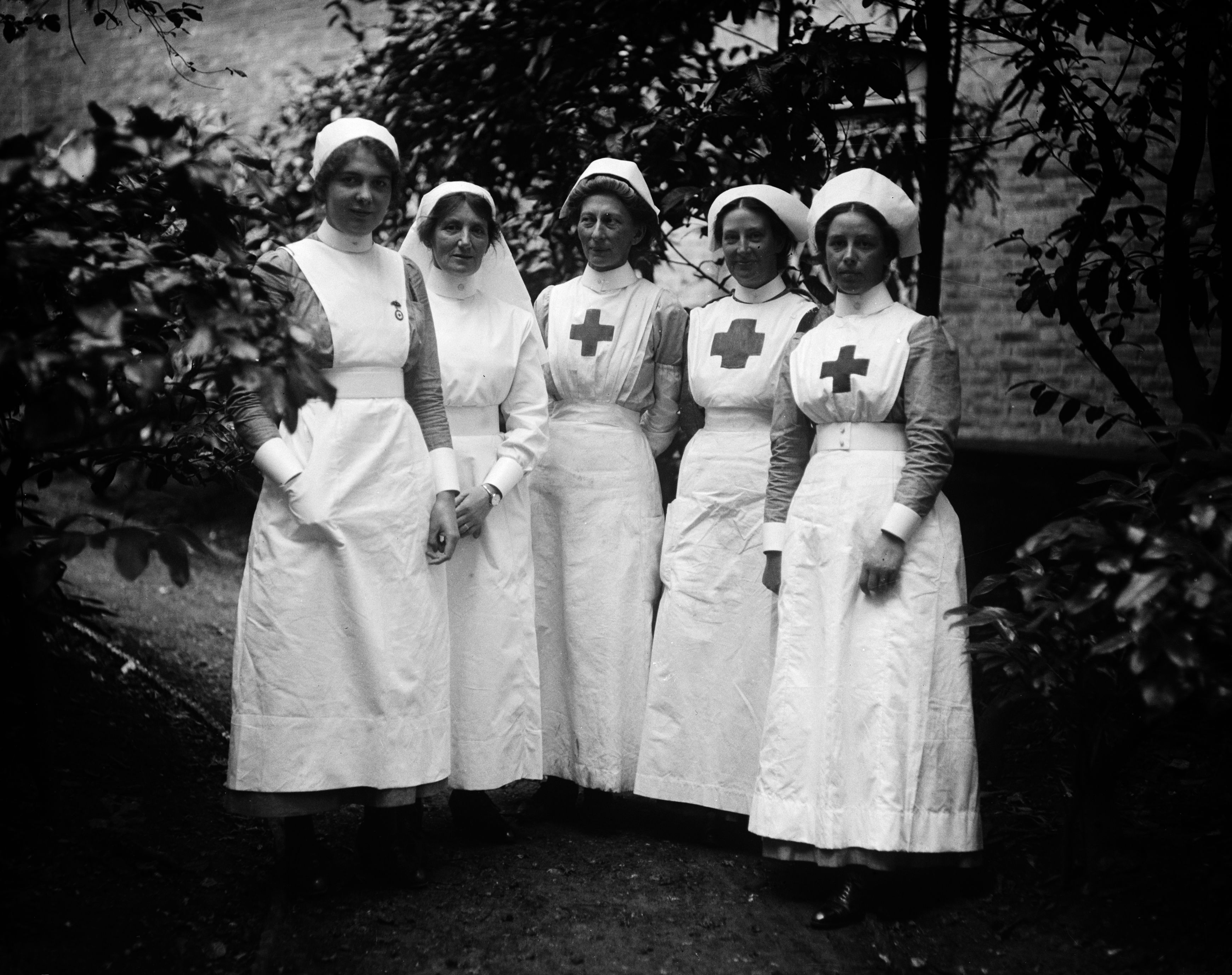
September 1915:  A group of nurses at Hamworth Hall in the U.K., which was serving as a Red Cross Hospital during WWI. (Topical Press Agency/Getty Images)

September 1915: A group of nurses at Hamworth Hall in the U.K., which was serving as a Red Cross Hospital during WWI.

Before Florence Nightingale reorganized the care of wounded soldiers during the Crimean War in 1854, it had been the task of camp followers — wives and prostitutes — to treat them with whatever primitive medical help was available. Nightingale insisted that conditions for the wounded were killing men as fast as the enemy. She demanded clean bandages and bedding, fresh air, nourishing food and decent trained care. A few years later and across the world, Clara Barton fought for the same principles in the American Civil War. Both women, and those they inspired to serve, saved countless lives. They attended to the wounded while there was still a chance of treating them, and forever changed how the war-wounded were perceived by the military — no longer as collateral damage in battle, but as lives that could be saved.

And yet, though both are remembered today as heroes, they were often at loggerheads with their governments before they got their way. And even years later, well into the First World War, which came to an end a century ago on Nov. 11, 1918, some officers still felt that women didn’t belong on the battlefield. As I learned while researching a novel with a battlefield nurse protagonist, many women had to prove themselves all over again as competent assets to the army, able to fend for themselves and provide skilled care that returned wounded men to regiments hungry to replace casualties. They were not just a higher class of camp followers.

By 1914, medical care had come a long way. The various combatants approached medical care in different ways. The French were far behind, their mindsets still almost medieval. Some accounts of the cellars and barns and railway cars where the wounded were housed are harrowing. Indeed, decades earlier, they’d decided, as part of a program separating church and state, to prevent nuns, historically the healers in war and peace, from serving with the Army hospitals. A few nuns did work independently of the Army to open hospitals wherever they could. There is also the story of French noblewomen who rushed to sign up for French hospital nursing, only to discover that they must treat the ranks as well as officers. Conversely, the Germans had decent male-only hospitals in their deep, multilayered trenches, so unlike the shallow ones the Allies dug. Even surgery could be done in some of these facilities. Meanwhile, St. Louis sent a unit of nurses and doctors — and an early X-ray machine — to Rouen, long before the U.S. entered the war.

For the British, the declaration of war in 1914 meant that women took over the work of men wherever possible. Postmasters became postmistresses. Women learned to drive omnibuses or to take over desks wherever men could be spared. Others dug up gardens and fallow land to grow needed foodstuffs for the home front, after U-boats attacked convoys coming in from the Empire and the U.S. British farmers were desperate for help. Many women went into factories, and were very good at setting fuses in shells and bullets. It was dangerous work, and the chemicals they dealt with made many ill.

And, on the battlefield, the nurses stepped in. What they would experience over nearly five years of war was horror, privation, exhaustion and danger. Their reward was the satisfaction of saving lives.

You can unsubscribe at any time. By signing up you are agreeing to our Terms of Service and Privacy Policy.

For our fictional take on the nurse’s situation, we made protagonist Bess Crawford the daughter of an officer in the British Army, giving her a less Victorian upbringing as well as parents who were more likely to agree that she could train, but it was not uncommon for families to refuse permission, feeling that this would be too shocking.

The women who did volunteer went through several layers of medical training as well. For the Queen Alexandra’s Imperial Military Nursing Service, training was mandatory. There were other volunteer nursing groups, like the VADs (Voluntary Aid Detachments) — with whom Agatha Christie trained — with less strict training, who helped in the wards at secondary nursing tasks.

The regulated nursing groups like the Queen Alexandra’s were given the rank of officer in order to protect them and give them some standing when dealing with doctors, other ranks and high command. These women were expected to uphold the integrity of their service. Their relationships with the men under their care had to be completely professional. They could be expelled if they had affairs or even became engaged. And yet these young women who had never seen a man in his underclothes were expected to work with the mutilated bodies of wounded fresh from the trenches. All of which they did with great courage and dedication, often staying with their patients as the Germans overran a sector. Indeed, the British nurse Edith Cavell not only stayed with her wounded in Belgium, but was accused by the Germans of helping the local underground. She was executed by firing squad on Oct. 12, 1915.

How did a grateful nation reward all those women who had come to its defense? Rather stingily, considering their service and the losses they’d suffered as a generation of fathers, husbands, and sons died for King and Country.

Some women finally gained the vote in 1918 — at war’s end — as promised earlier in the war when the Suffragettes had agreed to halt their civil protests for the duration. But the franchise was only extended to women who were 35, the head of household or the owner of property. The war nurses were not eligible unless they fit into one of these categories. Nor were those who worked on the land or drove the buses or set the fuse in all those shells. Even so, there were men who went on record predicting dire consequences to the nation arising from women being allowed to vote or stand for Parliament, because they were as a sex emotionally unsteady.

Britain didn’t collapse. Still, it was not until 1928 that all women over 21 received the same rights as men, in the Representation of the People (Equal Franchise) Act. American women were granted that right in 1920, in the 19th Amendment.

Less than a hundred years ago… I wonder sometimes how many women today understand what a hard-won right that was. Certainly nursing was a high-profile example of what women could achieve, although their sisters in other positions were the backbone of England’s work force and clearly visible on an almost daily basis. This was repeated in WWII and, in both instances, these women were expected to quietly return home and resume their places as wives and mothers.

After World War I, however, that wasn’t always possible. Britain had lost a generation of men, and many women had to find work to support themselves and their children. At the same time, many employers had to swallow their feelings about hiring women, and fill vacancies where they could. Still, in the hundred years since the Armistice, we have really not made a hundred years of progress in how women are viewed in many workplaces. The nursing profession is thus perhaps the best example of one in which the work of women in the Great War had a proud and lasting impact on the future. Contrary to what some hoped at the time, that war did not end all wars — and in those that followed, nurses carried on the tradition of duty and service begun by Florence Nightingale and so faithfully embodied by the courageous women of World War I.

Blue Lights.

I am looking forward to catching up with Blue Lights on BBC One on catch up. I have never seen it before they are six episodes of it so I am really looking forward to watching them and catching up on them on BBC iPlayer on catch up on my Sky Plus box every episode is on for an hour.

Wwe Drew Mcintyre Moving To AEW All Elite Wresting.

I really hope this happens Drew Mcintyre’s Wwe contract with Wwe expires in July. They are roomers that this could happen and he could be moving to AEW in the summer after being one of the top baby faces in Wwe. A lot of people might really hope it dose not happen but I hope it dose because it means AEW will just keeping getting just as good as Wwe and as Wwe is at the minute to. It will also mean that both Wwe and AEW will keep getting just as good but Wwe will lose one of they top Wwe top good guy stars. Drew Mcintyre has not signed a contract with AEW yet but he might or he could in August when AEW All Elite Wrestling goes to London on the 27th August 2023 of this year.

Emmerdale Chris Tates Death September 2003.

I really enjoyed watching the Thursday the 18th September 2003 Classic Emmerdale episode from when I was seventeen years old when I was younger when I was in my first year at College. It was on three months after I left Southlands School when I was younger. It was on the other night on Monday night on itv3 it was Chris Tates death After wasting all of his money to ensure that Charity would be left with nothing, Chris committed suicide to frame her for his murder”with the character making his final appearance as a corpse following his death an episode earlier it is also one of my favourite very old Emmerdale episodes.

The last casualties of ww1

The 31st August 1921 marks the date when the First World War officially ended. It is also the date that the last casualties who died during or as a result of the conflict are commemorated by the Imperial War Graves Commission (IWGC). Ian Coyne, a tour guide with Anglia Tours, Product Development Manager at Next Generation Travel Group and a CWGF Eyes On Hands On Volunteer, uncovers the stories of some of these casualties.

Notwithstanding the Armistice of 11 November 1918, today marks the centenary of the date on which the First World War actually ended. When the Termination of the Present War (Definition) Act 1918 was passed by Parliament, it gave discretion to His Majesty in Council to declare the date of the termination of the war. Consequently, war with each of the Central Powers ended close to the date of the ratification of the various peace treaties. Although a treaty with Turkey had yet to be ratified, it was decided that 31 August 1921 ‘should be treated as the date of the termination of the present War’. As the Imperial War Graves Commission (IWGC) was charged with responsibility for the graves of service personnel who died between the outbreak and end of the War, this meant that those casualties of the First World War who died after 31 August 1921 fell outside the remit of the Commission.

As this centenary approached, Gareth Davies a member of the Anglia Guide Team came up with the idea of visiting the cemetery in which each of the servicemen who died, in the UK, on 31 August 1921 is buried. Aided by the efforts of Emrys Jones, one of Anglia Tours’ original guides, and with the support of an enthusiastic group of friends and colleagues, we not only managed to visit each cemetery, and take a photograph of each headstone or WW1 memorial, we also managed to unearth information which has subsequently enabled the CWGC to update their war records a hundred years on.

A good example is Private William Jones, 12th Bn Loyal (North Lancs) Regiment who is buried in Ashton-in-Makerfield (St Thomas) Churchyard.

The son of Ellis Hugh & Margaret Jones, 12 Flora St, Ashton in Makerfield, Private Jones saw service in the Machine Gun Corps and 5th King’s Own Yorkshire Light Infantry, before joining the Loyals. In November 1919 he was discharged from the Army suffering from pulmonary TB.

Although Private Jones’ headstone records his date of death as 31 August 1921 his pension records and the Graves Registration Report showed he actually died twelve months earlier, on 31 August 1920.

The good news is that having been made aware of this CWGC were able to update the database and arrange for a new headstone with the correct date.

Then there is Private 2nd Class, Thomas Shepherd of the Royal Air Force. Pte Shepherd is one of sixty Great War casualties commemorated on a screen wall in Bacup (Fairwell) and who do not have individual headstones.

Interestingly during his enquiries, the cemetery authorities informed Emrys that Shepherd is in fact buried in a different plot to that identified on the Screen Wall.

A manual amendment to the Graves Registration Report, indicates he may have been buried in a private grave together with James Henry Turner and Mary Ann Shepherd. However, when Emrys visited the cemetery he found there was neither a gravestone nor grave marker in place.

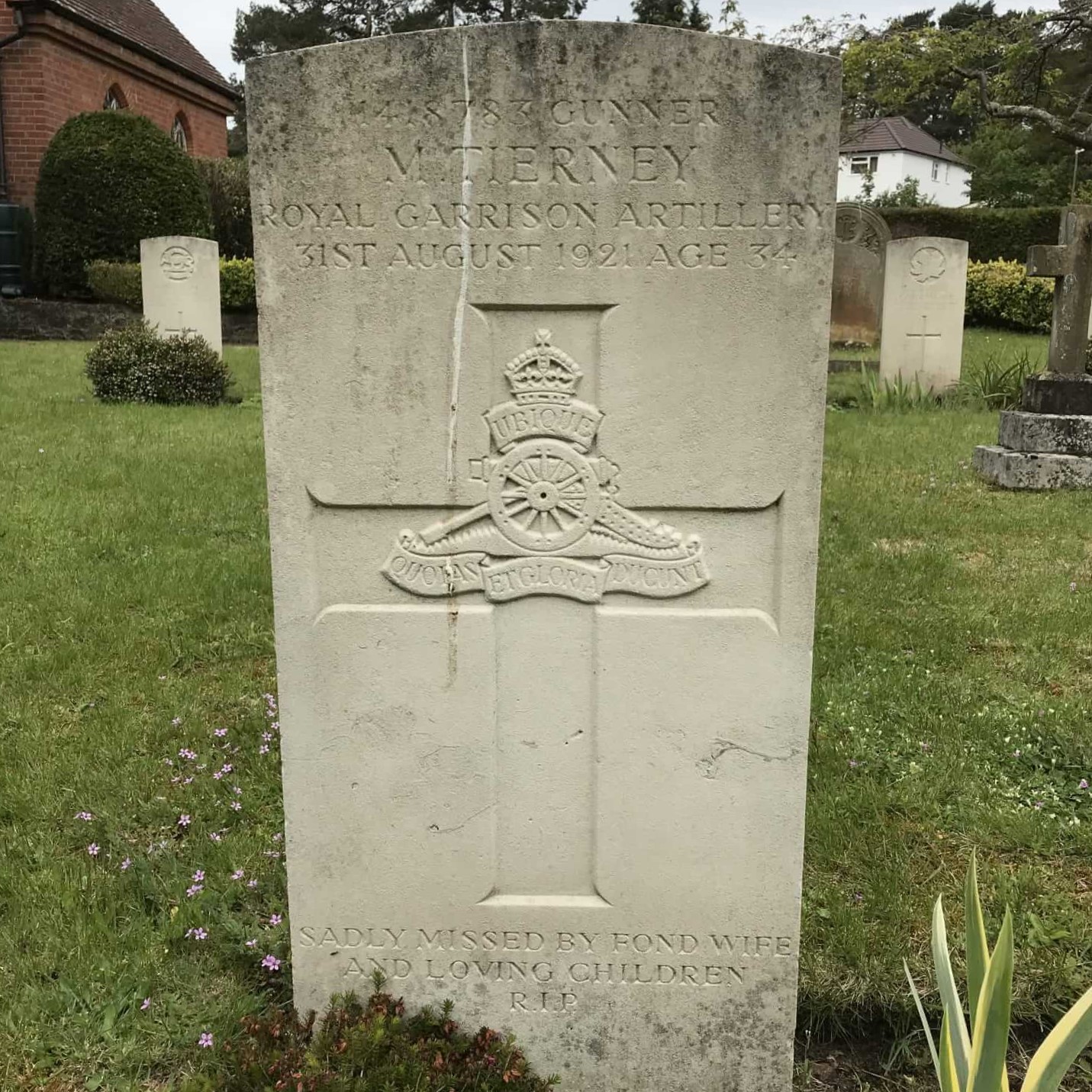
Gunner Michael Tierney

GUNNER MICHAEL TIERNEY

Although most of the men who died on 31 August 1921 succumbed to illnesses or injuries suffered during the First World War, that was not the case with Gunner Michael Tierney. Gunner Tierney was killed in an accident at Bordon Camp, the circumstances of which are set out in this article from the Sunday Post, dated 4 September 1921:

The opinion of Colonel M’Cleary was that deceased exhibited excessive zeal in the competition and the Coroner agreed.

Gunner Tierney’s wife Mary was amongst the crowd that witnessed the fatal accident. His headstone in Bordon Military Cemetery bears the personal inscription ‘Sadly missed by fond wife and loving children RIP’

These are just three of the servicemen who died on the last day of the First World War – our aim at the start of this project was to remember each of those who died, in the UK, on 31 August 1921 and who are buried in the UK.

Starting from 08.00 on 31 August 2021, we will post a profile of one of these men on the Anglia Tours’ Facebook page and Twitter feed, on the hour each hour. You will also be able to read their profiles on the Anglia Tours website.

We Will Remember Them.

Airplanes In The 1950s.

These are what the Airplanes were like back in the 50s and throughout the 1950s years before I was born these were what the Airplanes were like back in those days. As you can see they are a lot different to what the Airplanes are like now these days. They also have different curtains back then on the planes to what they have now on the Planes to. The red seats are a lot different to what they are like now the blue seats are just the same as the other seats on other Airplanes as you see them now on Planes

The Metro Centre In 1992.

This is what The Metro Centre Shopping Centre and Metro Centre Car Park was like and use to like in 1992 when I was five and six years old when I was little. This is what it was like back then in 92 thirty one years ago and this is one of the shops they had back then back in those days and they was also a C and A shop in Whitley Bay when I was little to. It was where BNMs is now it was C and A then it was Woolworths and now it is BNMs the ones in Whitley Bay I am talking about. This is also The Metro Centre Car Park with all the cars parked that is also how bust The Metro Centre use to get back then in those days to.

Shiremoor In 1979.

This is Shiremoor what Shiremoor looked like in 79 this is what it was like back then years before I was born. I think it just looks a little bit different to how it looks like now I think most of it pretty much looks the same as how it looks now it was all like this back in the late 70s and at the end of the 1970s and in 1979 before I was born.

Stan Laurel Statue In North Shields.

This is The Stan Laurel statue in North Shields I have always loved going past the Stan Laurel statue in North Shields and having a look at it for a while. I also use to love going past it sometimes when I was with Eric walking past it to I have also always loved Laurel And Hardy since I was younger and that why I also use to love walking past the Stan Laurel statue in North Shields to.