Why WW1 started assassination of Archduke Franz Ferdinand of Austria

Archduke Franz Ferdinand
Archduke of Austria-Este
Franz Ferdinand c. 1914
BornFranz Ferdinand Carl Ludwig Joseph Maria
18 December 1863
Graz, Duchy of Styria, Austrian Empire
Died28 June 1914 (aged 50)
Sarajevo, Condominium of Bosnia and Herzegovina, Austria-Hungary
Burial4 July 1914
Artstetten Castle
SpouseSophie, Duchess of Hohenberg​​(m.1900; died 1914)​[1]
IssuePrincess Sophie of HohenbergMaximilian, Duke of HohenbergPrince Ernst of Hohenberg
NamesFranz Ferdinand Karl Ludwig Joseph Maria
HouseHabsburg-Lorraine
FatherArchduke Karl Ludwig of Austria
MotherPrincess Maria Annunciata of Bourbon-Two Sicilies
ReligionRoman Catholicism
OccupationArchduke of Austria
Signature

Archduke Franz Ferdinand Carl Ludwig Joseph Maria of Austria (18 December 1863 – 28 June 1914) was the heir presumptive to the throne of Austria-Hungary. His assassination in Sarajevo was the most immediate cause of World War I.

Franz Ferdinand was the eldest son of Archduke Karl Ludwig of Austria, the younger brother of Emperor Franz Joseph I of Austria. Following the death of Crown Prince Rudolf in 1889 and the death of Karl Ludwig in 1896, Franz Ferdinand became the heir presumptive to the Austro-Hungarian throne. His courtship of Sophie Chotek, a lady-in-waiting, caused conflict within the imperial household, and their morganatic marriage in 1900 was only allowed after he renounced his descendants’ rights to the throne. Franz Ferdinand held significant influence over the military, and in 1913 he was appointed inspector general of the Austro-Hungarian armed forces.

On 28 June 1914, Franz Ferdinand and his wife were assassinated in Sarajevo by the 19-year-old Gavrilo Princip, a member of Young Bosnia. Franz Ferdinand’s assassination led to the July Crisis and precipitated Austria-Hungary’s declaration of war against Serbia, which in turn triggered a series of events that eventually led – four weeks after his death – to Austria-Hungary’s allies and Serbia’s allies declaring war on each other, starting World War I.

Biography

Early life

Franz Ferdinand was born in Graz, Austria, the eldest son of Archduke Karl Ludwig of Austria (the younger brother of Franz Joseph and Maximilian) and of his second wife, Princess Maria Annunciata of Bourbon-Two Sicilies. In 1875, when he was eleven years old, his cousin Francis V, Duke of Modena, died, naming Franz Ferdinand his heir on condition that he add the name “Este” to his own. Franz Ferdinand thus became one of the wealthiest men in Austria.

Heir presumptive

In 1889, Franz Ferdinand’s life changed dramatically. His cousin Crown Prince Rudolf committed suicide at his hunting lodge in Mayerling This left Franz Ferdinand’s father, Karl Ludwig, as first in line to the throne. Karl Ludwig died of typhoid fever in 1896. Henceforth, Franz Ferdinand was groomed to succeed to the throne.

Despite this burden, he did manage to find time for travel and personal pursuits, such as his circumnavigation of the world between 1892 and 1893. After visiting India he spent time hunting kangaroos and emus in Australia in 1893, then travelled on to Nouméa, New Hebrides, Solomon Islands, New Guinea, Sarawak, Hong Kong and Japan. After sailing across the Pacific on the RMS Empress of China from Yokohama to Vancouver he crossed the United States, arriving at the World’s Columbian Exposition 1893 on the Chicago, Burlington, and Quincy Railroad on a private Pullman car named Mascotte, and staying at the Lexington Hotel, before continuing through to New York and returning to Europe.

Franz Ferdinand posing in front of a killed elephant, 1893

Franz Ferdinand had a fondness for trophy hunting that was excessive even by the standards of European nobility of this time. In his diaries he kept track of 272,511 game kills, 5,000 of which were deer. About 100,000 trophies were on exhibit at his Bohemian castle at Konopiště which he also stuffed with various antiquities, his other great passion.

Military career

Franz Ferdinand, like most males in the ruling Habsburg line, entered the Austro-Hungarian Army at a young age. He was frequently and rapidly promoted, given the rank of lieutenant at age fourteen, captain at twenty-two, colonel at twenty-seven, and major general at thirty-one. While never receiving formal staff training, he was considered eligible for command and at one point briefly led the primarily Hungarian 9th Hussar Regiment. In 1898 he was given a commission “at the special disposition of His Majesty” to make inquiries into all aspects of the military services and military agencies were commanded to share their papers with him.

He also held honorary ranks in the Austro-Hungarian Navy, and received the rank of Admiral at the close of the Austro-Hungarian naval maneuvers in September 1902.

Franz Ferdinand exerted influence on the armed forces even when he did not hold a specific command through a military chancery that produced and received documents and papers on military affairs. This was headed by Alexander Brosch von Aarenau [de] and eventually employed a staff of sixteen. His authority was reinforced in 1907 when he secured the retirement of the Emperor’s confidant Friedrich von Beck-Rzikowsky as Chief of the General Staff. Beck’s successor, Franz Conrad von Hötzendorf, was personally selected by Franz Ferdinand.

Franz in 1913, as heir-presumptive to the elderly emperor, had been appointed inspector general of all the armed forces of Austria-Hungary (Generalinspektor der gesamten bewaffneten Macht), a position superior to that previously held by Archduke Albrecht and including presumed command in wartime.

Marriage and family

Archduke Franz Ferdinand with his wife Sophie, Duchess of Hohenberg, and their three children (from left), Prince Ernst von Hohenberg, Princess Sophie, and Maximilian, Duke of Hohenberg, in 1910

In 1894, Franz Ferdinand met Countess Sophie Chotek, a lady-in-waiting to Archduchess Isabella, wife of Archduke Friedrich, Duke of Teschen. Franz began to visit Archduke Friedrich’s villa in Pressburg (now Bratislava), and in turn Sophie wrote to Franz Ferdinand during his convalescence from tuberculosis on the island of Lošinj in the Adriatic. They kept their relationship a secret, until it was discovered by Isabella herself.

To be eligible to marry a member of the imperial House of Habsburg, one had to be a member of one of the reigning or formerly reigning dynasties of Europe. The Choteks were not one of these families. Deeply in love, Franz Ferdinand refused to consider marrying anyone else. Finally, in 1899, Emperor Franz Joseph agreed to permit Franz Ferdinand to marry Sophie, on the condition that the marriage would be morganatic and that their descendants would not have succession rights to the throne. Sophie would not share her husband’s rank, title, precedence, or privileges; as such, she would not normally appear in public beside him. She would not be allowed to ride in the royal carriage or sit in the royal box in theaters.

The wedding took place on 1 July 1900, at Reichstadt (now Zákupy) in Bohemia; Franz Joseph did not attend the affair, nor did any archduke including Franz Ferdinand’s brothers. The only members of the imperial family who were present were Franz Ferdinand’s stepmother, Princess Maria Theresa of Braganza; and her two daughters. Upon the marriage, Sophie was given the title “Princess of Hohenberg” (Fürstin von Hohenberg) with the style “Her Serene Highness” (Ihre Durchlaucht). In 1909, she was given the more senior title “Duchess of Hohenberg” (Herzogin von Hohenberg) with the style “Her Highness” (Ihre Hoheit). This raised her status considerably, but she was still required to yield precedence at court to all the archduchesses. Whenever a function required the couple to assemble with the other members of the imperial family, Sophie was forced to stand far down the line, separated from her husband.

Franz Ferdinand’s children were:

Franz Ferdinand and Sophie visited England in the autumn of 1913, spending a week with George V and Queen Mary at Windsor Castle before going to stay for another week with the Duke of Portland at Welbeck Abbey, Nottinghamshire, where they arrived on 22 November. He attended a service at the local Catholic church in Worksop. Franz Ferdinand and the Duke of Portland went game shooting on the Welbeck estate when, according to Portland’s memoirs, Men, Women and Things:

One of the loaders fell down. This caused both barrels of the gun he was carrying to be discharged, the shot passing within a few feet of the archduke and myself. I have often wondered whether the Great War might not have been averted, or at least postponed, had the archduke met his death there and not in Sarajevo the following year.

Assassination

Main article: Assassination of Archduke Franz Ferdinand

As described by contemporary Spanish magazine El Mundo Gráfico: “The moment when the Austrian archdukes, following the first attempt against their lives, arrived at the City Council (of Sarajevo), where they were received by the mayor and the municipal corporation.”
Franz Ferdinand’s blood-stained uniform
The 1910 Gräf & Stift Bois de Boulogne phaeton automobile in which Archduke Franz Ferdinand and his wife were assassinated. It is now displayed in the Museum of Military History in Vienna
Latin bridge (prev. Princip bridge) in Sarajevo. Across the bridge is a street of several grayish houses not more than four stories high.
The Latin Bridge near the assassination site

On Sunday, 28 June 1914, at about 10:45 am, Franz Ferdinand and his wife were assassinated in Sarajevo, the capital of the Austro-Hungarian province of Bosnia and Herzegovina. The perpetrator was 19-year-old Gavrilo Princip, a member of Young Bosnia and one of a group of assassins organized and armed by the Black Hand.

Earlier in the day, the couple had been attacked by Nedeljko Čabrinović, also a Young Bosnia conspirator, who had thrown a grenade at their car. However, the bomb detonated behind them, injuring the occupants in the following car. On arriving at the Governor’s residence, Franz asked “So you welcome your guests with bombs!”

After a short rest at the Governor’s residence, the royal couple insisted on seeing all those who had been injured by the bomb at the local hospital. However, no one told the drivers that the itinerary had been changed. When the error was discovered, the drivers had to turn around. As the cars backed down the street and onto a side street, the line of cars stalled. At this time, Princip was sitting at a cafe across the street. He instantly seized his opportunity and walked across the street and shot the royal couple. He first shot Sophie in the abdomen and then shot Franz Ferdinand in the neck. Franz leaned over his crying wife. He was still alive when witnesses arrived to render aid. His dying words to Sophie were, “Don’t die darling, live for our children.” Princip’s weapon was the pocket-sized FN Model 1910 pistol chambered for the .380 ACP cartridge provided him by Serbian Army Military Intelligence Lieutenant-Colonel and Black Hand leader Dragutin Dimitrijević. Franz Ferdinand’s aides attempted to undo his coat but realized they needed scissors to cut it open: the outer lapel had been sewn to the inner front of the jacket for a smoother fit to improve his appearance to the public. Whether or not as a result of this obstacle, his wound could not be attended to in time to save him, and he died within minutes. Sophie also died en route to the hospital.

A detailed account of the shooting can be found in Sarajevo by Joachim Remak:

One bullet pierced Franz Ferdinand’s neck while the other pierced Sophie’s abdomen. … As the car was reversing (to go back to the Governor’s residence because the entourage thought the Imperial couple were unhurt) a thin streak of blood shot from the Archduke’s mouth onto Count Harrach’s right cheek (he was standing on the car’s running board). Harrach drew out a handkerchief to still the gushing blood. The Duchess, seeing this, called: “For Heaven’s sake! What happened to you?” and sank from her seat, her face falling between her husband’s knees.

Harrach and Potoriek … thought she had fainted … only her husband seemed to have an instinct for what was happening. Turning to his wife despite the bullet in his neck, Franz Ferdinand pleaded: “Sopherl! Sopherl! Sterbe nicht! Bleibe am Leben für unsere Kinder! – Sophie dear! Don’t die! Stay alive for our children!” Having said this, he seemed to sag down himself. His plumed hat … fell off; many of its green feathers were found all over the car floor. Count Harrach seized the Archduke by the uniform collar to hold him up. He asked “Leiden Eure Kaiserliche Hoheit sehr? – Is Your Imperial Highness suffering very badly?” “Es ist nichts. – It is nothing.” said the Archduke in a weak but audible voice. He seemed to be losing consciousness during his last few minutes, but, his voice growing steadily weaker, he repeated the phrase perhaps six or seven times more.

A rattle began to issue from his throat, which subsided as the car drew in front of the Konak bersibin (Town Hall). Despite several doctors’ efforts, the Archduke died shortly after being carried into the building while his beloved wife was almost certainly dead from internal bleeding before the motorcade reached the Konak.

The assassinations, along with the arms race, nationalism, imperialism, militarism of Imperial Germany and the alliance system all contributed to the origins of World War I, which began a month after Franz Ferdinand’s death, with Austria-Hungary’s declaration of war against Serbia. The assassination of Franz Ferdinand is considered the most immediate cause of World War I.

After his death, Archduke Karl became the heir presumptive of Austria-Hungary. Franz Ferdinand was buried with his wife Sophie in Artstetten Castle, Austria.

Character

The German historian Michael Freund described Franz Ferdinand as “a man of uninspired energy, dark in appearance and emotion, who radiated an aura of strangeness and cast a shadow of violence and recklessness … a true personality amidst the amiable inanity that characterized Austrian society at this time.” As his sometime admirer Karl Kraus put it, “he was not one who would greet you … he felt no compulsion to reach out for the unexplored region which the Viennese call their heart.” His relations with Emperor Franz Joseph were tense; the emperor’s personal servant recalled in his memoirs that “thunder and lightning always raged when they had their discussions.” The commentaries and orders which the heir to the throne wrote as margin notes to the documents of the Imperial central commission for architectural conservation (where he was Protector) reveal what can be described as “choleric conservatism.” The Italian historian Leo Valiani provided the following description.

Francis Ferdinand was a prince of absolutist inclinations, but he had certain intellectual gifts and undoubted moral earnestness. One of his projects – though because of his impatient, suspicious, almost hysterical temperament, his commitment to it, and the methods by which he proposed to bring it about, often changed – was to consolidate the structure of the state and the authority and popularity of the Crown, on which he saw clearly that the fate of the dynasty depended, by abolishing, if not the dominance of the German Austrians, which he wished to maintain for military reasons, though he wanted to diminish it in the civil administration, certainly the far more burdensome sway of the Magyars over the Slav and Romanian nationalities which in 1848–49 had saved the dynasty in armed combat with the Hungarian revolution. Baron Margutti (de), Francis Joseph’s aide-de-camp, was told by Francis Ferdinand in 1895 and – with a remarkable consistency in view of the changes that took place in the intervening years – again in 1913, that the introduction of the dual system in 1867 had been disastrous and that, when he ascended the throne, he intended to re-establish strong central government: this objective, he believed, could be attained only by the simultaneous granting of far-reaching administrative autonomy to all the nationalities of the monarchy. In a letter of February 1, 1913, to Berchtold, the Foreign Minister, in which he gave his reasons for not wanting war with Serbia, Franz Ferdinand said that “irredentism in our country … will cease immediately if our Slavs are given a comfortable, fair and good life” instead of being trampled on (as they were being trampled on by the Hungarians). It must have been this which caused Berchtold, in a character sketch of Francis Ferdinand written ten years after his death, to say that, if he had succeeded to the throne, he would have tried to replace the dual system by a supranational federation.

WW1 President of France Raymond Poincare

On 28 June 1914, Poincaré was at the Longchamps racetrack when he received news of the assassination of the Archduke Franz Ferdinand in Sarajevo. Poincaré was fascinated by the report but stayed on to watch the race.

In 1913, it had been announced that Poincaré would visit St. Petersburg in July 1914 to meet Tsar Nicholas II. Accompanied by Premier René Viviani, Poincaré went to Russia for the second time (but for the first time as president) to reinforce the Franco-Russian Alliance. On 15 July, the Austro-Hungarian Foreign Minister, Count Leopold von Berchtold, used a back channel to informed foreign countries of Austria-Hungary‘s intention to present an ultimatum to Serbia. When Poincaré arrived in St. Petersburg on 20 July, the Russians told him by 21 July of the Austrian ultimatum and German support for Austria. Although Prime Minister Viviani was supposed to be in charge of French foreign policy, Poincaré promised the Tsar unconditional French military backing for Russia against Austria-Hungary and Germany. In his discussions with Nicholas II, Poincaré talked openly of winning an eventual war, not avoiding one. Later, he attempted to hide his role in the outbreak of military conflict and denied having promised Russia anything.

Poincaré arrived back in Paris on 29 July and at 7 am on 30 July, with Poincaré’s full approval, Viviani sent a telegram to Nicholas affirming that:

in the precautionary measures and defensive measures to which Russia believes herself obliged to resort, she should not immediately proceed to any measure which might offer Germany a pretext for a total or partial mobilization of her forces.

In his diary entry for the day, Poincaré wrote that the purpose of the message was not to prevent war from breaking out but to deny Germany a pretext and thereby obtain British support for the Franco-Russian alliance. He approved of Russian mobilization. A French covering force, five army corps strong, was deployed on the German border at 4:55 pm, as per normal premobilization procedure. Poincaré and Viviani demanded that the covering force be installed ten kilometers from the border, for the sole reason that France would look innocent in the eyes of Britain.A note was immediately sent to London to tell the British about the maneuver and gain their sympathy against Germany.

On 31 July the German ambassador in Paris, Count Wilhelm von Schoen, presented to Viviani a quasi-ultimatum warning that, if Russia did not end its mobilization within twelve hours, Germany would mobilize. Mobilization meant war. That same day, the Chief of the General Staff of the French Army, General Joseph Joffre appealed for general mobilization, falsely claiming that Germany had been secretly mobilizing for two or three days. Poincaré backed Joffre’s request. French general mobilization was decreed at 1600 hours on 1 August.On 1 August, Poincaré lied to Francis Bertie, the British ambassador to France, claiming that Russian mobilization had only been decreed after Austria’s.

Poincaré with Woodrow Wilson (1918)

After Germany declared war on France on 3 August, Poincaré said: “Never was a declaration of war received with such satisfaction”. He appeared before the National Assembly at 3 pm on 4 August to announce that France was now at war forming the doctrine of the union sacrée in which he announced that: “nothing will break the union sacrée in the face of the enemy. “Dans la guerre qui s’engage, la France […] sera héroïquement défendue par tous ses fils, dont rien ne brisera devant l’ennemi l’union sacrée” (“In the coming war, France will be heroically defended by all its sons, whose sacred union will not break in the face of the enemy”). During the meeting, Poincaré and Viviani were silent on Russia’s mobilization, claiming instead that Russia had been negotiating to the end.

Later war

Poincaré became increasingly sidelined after the accession to power of Georges Clemenceau as Prime Minister in 1917. He believed the Armistice happened too soon and that the French Army should have penetrated far deeper into Germany. At the Paris Peace Conference of 1919, negotiating the Treaty of Versailles, he wanted France to wrest the Rhineland from Germany to put it under Allied military control.

Ferdinand Foch urged Poincaré to invoke his powers as laid down in the constitution and take over the negotiations of the treaty due to worries that Clemenceau was not achieving France’s aims. He did not, and when the French Cabinet approved of the terms which Clemenceau obtained, Poincaré considered resigning, although again he refrained.

WW1 and Italy’s involvement

When World War I began in July 1914, Italy was a partner in the Triple Alliance with Germany and Austria-Hungary, but decided to remain neutral. However, a strong sentiment existed within the general population and political factions to go to war against Austria-Hungary, Italy’s historical enemy.

Annexing territory along the two countries’ frontier stretching from the Trentino region in the Alps eastward to Trieste at the northern end of the Adriatic Sea was a primary goal and would “liberate” Italian speaking populations from the Austro-Hungarian Empire, while uniting them with their cultural homeland. During the immediate pre-war years, Italy started aligning itself closer to the Entente powers, France and Great Britain, for military and economic support.

On April 26, 1915, Italy negotiated the secret Pact of London by which Great Britain and France promised to support Italy annexing the frontier lands in return for entering the war on the Entente side. On May 3, Italy resigned from the Triple Alliance and later declared war against Austria-Hungary at midnight on May 23.

At the beginning of the war, the Italian army boasted less than 300,000 men, but mobilization greatly increased its size to more than 5 million by the war’s end in November 1918. Approximately 460,000 were killed and 955,000 were wounded in the conflict.

Objects from the Museum’s Collection

Scan of a service record document. The edges are printed with an elaborate engraved printing of a female figure dressed in a toga and armor amidst olive branches and various symbols of Italy. The text is written in elaborate calligraphy. Text: 'Regio Esercito Italiado. Foglio Di Congedo Illimitato'. The blanks in the document are filled in with even cursive handwriting.
Click to enlarge.

This service record is for Antonio Zanussi, who served in the 2nd Engineers. Zanussi was conscripted in February 1917, entered the service March 17, 1917 and fought in the campaign against Austria-Hungary in 1917-18. The record states that Zanussi served with good conduct and faithful service.

Scan of a postcard printed with a painting of four men dressed in military combat gear charging forward with weapons ready.
Click to enlarge.

This postcard honors the memory of Captain Giuseppe Tagliamonte, commander of the 10th Infantry Company at the battle of Selz along the Italian/Austro-Hungarian frontier in northeastern Italy during the 2nd Isonzo Offensive. Tagliamonte was killed during the battle on July 19, 1915 and was awarded the Gold Medal of Military Valor, among Italy’s highest military decorations.

Women in WW1 and the important jobs they did.

At the time of the First World War, most women were barred from voting or serving in military combat roles. Many saw the war as an opportunity to not only serve their countries but to gain more rights and independence. With millions of men away from home, women filled manufacturing and agricultural positions on the home front. Others provided support on the front lines as nurses, doctors, ambulance drivers, translators and, in rare cases, on the battlefield.

One observer wrote that American women “do anything they were given to do; that their hours are long; that their task is hard; that for them there is small hope of medals and citations and glittering homecoming parades.”

On The Homefront

The nations at war mobilized their entire populations. The side that could produce more weapons and supply more troops would prevail in the end. Women took on new roles in the work force, notably in war production and agriculture.

In 1914, the German armaments producer Krupp employed almost no women. By 1917, women made up nearly 30 percent of its 175,000 workers and a nationwide total of nearly 1.4 million German women were employed in the war labor force. Britain also stepped up its arms production by expanding the employment of women. In July 1914, 3.3 million women worked in paid employment in Britain. By July 1917, 4.7 million did. British women served in uniform as well in the Royal Navy and Royal Air Force. In fact, the last known surviving veteran of World War I was Florence Green of the RAF, who died in 2012.

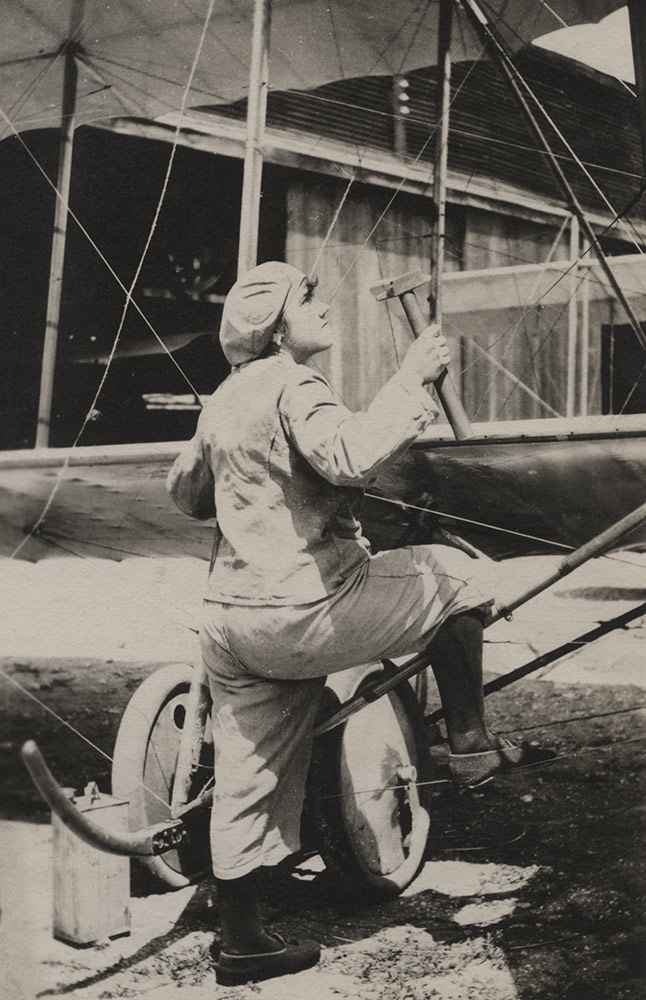
A French woman working as an airplane mechanic.

As women took traditional male jobs in the United States, African American women were able to make their first major shift from domestic employment to work in offices and factories. Recent research also shows that a limited number of African American women served overseas as volunteers with the YMCA.

“The women worked as ammunition testers, switchboard operators, stock takers. They went into every kind of factory devoted to the production of war materials, from the most dangerous posts in munition plants to the delicate sewing in aeroplane factories.”

– Alice Dunbar Nelson, American Poet and Civil Rights Activist, on African American women’s efforts during the war, 1918

But even women in more traditional roles contributed to the war effort. Every housewife in the U.S. was asked to sign a pledge card stating that she would “carry out the directions and advice of the Food Administrator in the conduct of my household, in so far as my circumstances permit.” This meant canning food for future use, growing vegetables in the backyard and limiting consumption of meat, wheat and fats. Most of all, women were expected to bolster the morale of their families at home and loved ones overseas.

Doctors, Nurses and Ambulance Drivers

The Salvation Army, the Red Cross and many other organizations depended on thousands of female volunteers. The American Red Cross operated hospitals to care for war casualties, staffed by nurses, hundreds of whom died in service during the war. Thousands of women also served in the U.S. Army Nurse Corps and the Navy Nurse Corps. While the American Expeditionary Forces were still preparing to go overseas, U.S. Army nurses were sent ahead and assigned to the British Expeditionary Force. By June 1918, there were more than 3,000 American nurses in over 750 in British-run hospitals in France.

While nurses were accepted at the Front, women physicians faced obstacles putting their hard-earned skills to work. When these women were rejected from service in the U.S. Army Medical Corps, many sought other opportunities to serve the war effort: as civilian contract surgeons, with the Red Cross or other humanitarian relief organizations and even in the French Army.

The Medical Women’s National Association, for example, raised money to send their own doctors overseas to work in hospitals run by the American Red Cross. By the end of the war, nearly 80 women doctors from this organization were at work in the devastated regions of Europe, caring for civilians and soldiers and treating diseases such as influenza and typhoid.

During the last Allied offensive in the summer and fall of 1918, many woman doctors, nurses and aides operated near the front lines, providing medical care for soldiers wounded in combat.

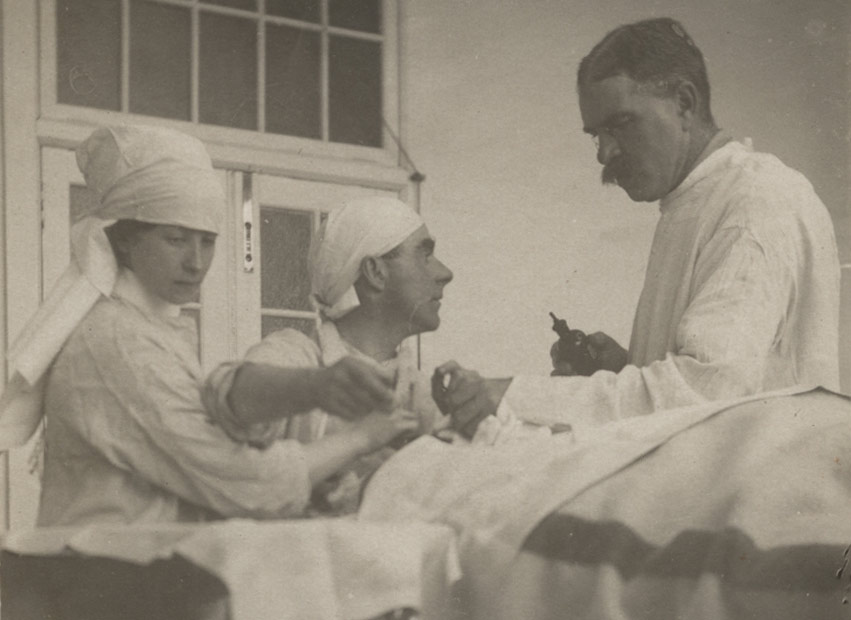
A nurse assisting doctor with an operation.

“I had just given this poor boy anesthesia when a bomb hit. We were supposed to hit the floor, but he was out and didn’t know what was going on. I took a tray and put it over our heads. It wasn’t because I was brave. I was just scared.”

– Medical Corps anesthetist Sophie Gran. Gran was one of the first woman anesthetists with the A.E.F. in France and the only woman anesthetist with Mobile Hospital Unit #1. She went on to become the first president of California Association of Nurse Anesthetists in 1931.

The automobile age was just getting underway in WWI, and motorized ambulances became key to medical treatment on the battlefield. Many women who knew how to drive volunteered to go overseas to serve as ambulance and truck drivers or mechanics. They delivered medical supplies, transported patients to hospitals and drove through artillery fire to retrieve the wounded.

Many of the women drivers of the Red Cross Motor Service and other ambulance groups used their own cars, including Marie Curie. Curie invented a mobile X-ray unit, radiological cars nicknamed “little Curies,” and ultimately trained 150 women to be X-ray operators on the battlefront, of which Curie herself was one – an act that she believed contributed to her later death from radiation exposure.

Female Yeoman

Despite thousands of new recruits, the U.S. Navy was short-handed at the beginning of World War I. Vague wording in a section of the Naval Act of 1916 outlining who could serve created a loophole: women were able to join the ranks as Yeomen, non-commissioned officers. Around 12,000 women enlisted in the Navy under the title, “Yeoman (F).”

Most women Yeomen served stateside on naval bases, replacing men who had deployed to Europe. While many female recruits performed clerical duties, some worked as truck drivers, mechanics, radio operators, telephone operators, translators, camouflage artists and munition workers. They had the same responsibilities as their male counterparts and received the same pay of $28.75 per month.

The “Hello Girls”

Aiming to improve communications on the Western front between the Allied Forces, General John J. Pershing called for the creation of the Signal Corps Female Telephone Operators Unit. The unit recruited women who were bilingual in French and English to serve as telephone switchboard operators on the Western front. The women received physical training, observed strict military protocol, wore identity discs and worked very close to the front lines. These female recruits were nicknamed the “Hello Girls” (a term which some of them felt disparaged their efforts) and became known for their bravery and focus under pressure. However, upon their return to the United States after the end of the war, the “Hello Girls” did not receive veteran status or benefits. It wasn’t until 1977, when President Jimmy Carter signed legislation, that the few surviving women telephone operators received recognition of their veteran status.

Women Soldiers

Though it would be years before many other countries allowed female soldiers, in Russia, Bulgaria, Romania and Serbia women did serve as combat troops. The best known of these soldiers was Maria Bochkareva, the founder of the Russian “Women’s Battalion of Death.” The first woman to lead a Russian military unit, Bochkareva went as far as to petition the Czar for permission to enlist in the Imperial Russian army in 1914 and was granted permission to join. Initially harassed and ostracized, Bochkareva persisted, overcoming battle injuries and becoming a decorated soldier and commander.

Her all-female battalion of shock troops, the 1st Russian Women’s Battalion of Death, was created in 1917 to shame men into continuing the fight. Though their training was rushed, the battalion was sent to the Russian western front to participate in the Kerensky Offensive in July 1917. Other female units were also formed for their propaganda value, but few saw combat outside of Bochkareva’s unit and the 1st Petrograd Women’s Battalion, which helped defend the Winter Palace in the October Revolution. Ultimately, Russia ended their involvement in WWI with the Treaty of Brest-Litovsk on March 3, 1918.

Home front in WW1

The home front during World War I covers the domestic, economic, social and political histories of countries involved in that conflict. It covers the mobilization of armed forces and war supplies, lives of others, but does not include the military history. For nonmilitary interactions among the major players see Diplomatic history of World War I.

About 10.9 million combatants and seven million civilians died during the entire war, including many weakened by years of malnutrition; they fell in the worldwide Spanish Flu pandemic, which struck late in 1918, just as the war was ending.

The Allies had much more potential wealth that they could spend on the war. One estimate (using 1913 US dollars), is that the Allies spent $147 billion ($4.5tr in 2023 USD) on the war and the Central Powers only $61 billion ($1.88tr in 2023 USD). Among the Allies, Britain and its Empire spent $47 billion and the US$27 billion; among the Central Powers, Germany spent $45 billion.

Total war demanded the total mobilization of all the nation’s resources for a common goal. Manpower had to be chanelled into the front lines (all the powers except the United States and Britain had large trained reserves designed for just that). Behind the lines labour power had to be redirected away from less necessary activities that were luxuries during a total war. In particular, vast munitions industries had to be built up to provide shells, guns, warships, uniforms, airplanes, and a hundred other weapons, both old and new. Agriculture had to be mobilized as well, to provide food for both civilians and for soldiers (many of whom had been farmers and needed to be replaced by old men, boys and women) and for horses to move supplies. Transportation in general was a challenge, especially when Britain and Germany each tried to intercept merchant ships headed for the enemy. Finance was a special challenge. Germany financed the Central Powers. Britain financed the Allies until 1916, when it ran out of money and had to borrow from the United States. The US took over the financing of the Allies in 1917 with loans that it insisted be repaid after the war. The victorious Allies looked to defeated Germany in 1919 to pay “reparations” that would cover some of their costs. Above all, it was essential to conduct the mobilization in such a way that the short term confidence of the people was maintained, the long-term power of the political establishment was upheld, and the long-term economic health of the nation was preserved. For more details on economics see Economic history of World War I.

World War I had a profound impact on woman suffrage across the belligerents. Women played a major role on the homefronts and many countries recognized their sacrifices with the vote during or shortly after the war, including the United States, Britain, Canada (except Quebec), Denmark, Austria, the Netherlands, Germany, Russia, Sweden and Ireland. France almost did so but stopped short.

Financial costs

Further information: Economic history of World War I

The total direct cost of war, for all participants including those not listed here, was about $80 billion in 1913 US dollars. Since $1 billion in 1913 is approximately $46.32 billion in 2023 US dollars, the total cost comes to around $2.47 trillion in 2023 dollars. Direct cost is figured as actual expenditures during war minus normal prewar spending. It excludes postwar costs such as pensions, interest, and veteran hospitals. Loans to/from allies are not included in “direct cost”. Repayment of loans after 1918 is not included. The total direct cost of the war as a percent of wartime national income:

  • Allies: Britain, 37%; France, 26%; Italy, 19%; Russia, 24%; United States, 16%.
  • Central Powers: Austria-Hungary, 24%; Germany, 32%; Turkey unknown.

The amounts listed below are presented in terms of 1913 US dollars, where $1 billion then equals about $25 billion in 2017.

  • Britain had a direct war cost about $21.2 billion; it made loans to Allies and Dominions of $4.886 billion, and received loans from the United States of $2.909 billion.
  • France had a direct war cost about $10.1 billion; it made loans to Allies of $1.104 billion, and received loans from Allies (United States and Britain) of $2.909 billion.
  • Italy had a direct war cost about $4.5 billion; it received loans from Allies (United States and Britain) of $1.278 billion.
  • The United States had a direct war cost about $12.3 billion; it made loans to Allies of $5.041 billion.
  • Russia had a direct war cost about $7.7 billion; it received loans from Allies (United States and Britain) of $2.289 billion.

The two governments agreed that financially Britain would support the weaker Allies and that France would take care of itself. In August 1914, Henry Pomeroy Davison, a Morgan partner, traveled to London and made a deal with the Bank of England to make J.P. Morgan & Co. the sole underwriter of war bonds for Great Britain and France. The Bank of England became a fiscal agent of J.P. Morgan & Co., and vice versa. Over the course of the war, J.P. Morgan loaned about $1.5 billion (approximately $26 billion in today’s dollars) to the Allies to fight against the Germans.:   Morgan also invested in the suppliers of war equipment to Britain and France, thus profiting from the financing and purchasing activities of the two European governments.

Britain made heavy loans to Tsarist Russia; the Lenin government after 1920 refused to honor them, causing long-term issues.

Britain

Main articles: History of the United Kingdom during World War I and British entry into World War

See also: Timeline of the United Kingdom home front during World War I

At the outbreak of war, patriotic feelings spread throughout the country, and many of the class barriers of Edwardian era faded during the years of combat. However, the Catholics in southern Ireland moved overnight to demands for complete immediate independence after the failed Easter Rebellion of 1916. Northern Ireland remained loyal to the crown.

In 1914 Britain had by far the largest and most efficient financial system in the world. Roger Lloyd-Jones and M. J. Lewis argue:To prosecute industrial war required the mobilization of economic resources for the mass production of weapons and munitions, which necessarily entitled fundamental changes in the relationship between the state (the procurer), business (the provider), labor (the key productive input), and the military (the consumer). In this context, the industrial battlefields of France and Flanders intertwined with the home front that produced the materials to sustain a war over four long and bloody years.

Economic sacrifices were made, however, in the name of defeating the enemy. In 1915 Liberal politician David Lloyd George took charge of the newly created Ministry of Munitions. He dramatically increased the output of artillery shells—the main weapon actually used in battle. In 1916 he became secretary for war. Prime Minister H. H. Asquith was a disappointment; he formed a coalition government in 1915 but it was also ineffective. Asquith was replaced by Lloyd George in late 1916. He had a strong hand in the managing of every affair, making many decisions himself. Historians credit Lloyd George with providing the driving energy and organisation that won the War.

Although Germans were using Zeppelins to bomb the cities, morale remained relatively high due in part to the propaganda churned out by the national newspapers. With a severe shortage of skilled workers, industry redesigned work so that it could be done by unskilled men and women (termed the “dilution of labour”) so that war-related industries grew rapidly. Lloyd George cut a deal with the trades unions—they approved the dilution (since it would be temporary) and threw their organizations into the war effort.

Historian Arthur Marwick saw a radical transformation of British society, a deluge that swept away many old attitudes and brought in a more equalitarian society. He also saw the famous literary pessimism of the 1920s as misplaced, for there were major positive long-term consequences of the war. He pointed to new job opportunities and self-consciousness among workers that quickly built up the Labour Party, to the coming of partial woman suffrage, and an acceleration of social reform and state control of the British economy. He found a decline of deference toward the aristocracy and established authority in general, and a weakening among youth of traditional restraints on individual moral behavior. Marwick concluded that class differentials softened, national cohesion increased, and British society became more equal. During the conflict, the various elements of the British Left created the War Emergency Workers’ National Committee, which played a crucial role in supporting the most vulnerable people on the Home Front during the war, and in ensuring the British Labour remained united in the years after the Armistice.

Scotland

Scotland played a major role in the British effort in the First World War. It especially provided manpower, ships, machinery, food (particularly fish) and money, engaging with the conflict with some enthusiasm. With a population of 4.8 million in 1911, Scotland sent 690,000 men to the war, of whom 74,000 died in combat or from disease, and 150,000 were seriously wounded. Scottish urban centres, with their poverty and unemployment were favourite recruiting grounds of the regular British army, and Dundee, where the female dominated jute industry limited male employment had one of the highest proportion of reservists and serving soldiers than almost any other British city. Concern for their families’ standard of living made men hesitate to enlist; voluntary enlistment rates went up after the government guaranteed a weekly stipend for life to the survivors of men who were killed or disabled. After the introduction of conscription from January 1916 every part of the country was affected. Occasionally Scottish troops made up large proportions of the active combatants, and suffered corresponding loses, as at the Battle of Loos, where there were three full Scots divisions and other Scottish units. Thus, although Scots were only 10 per cent of the British population, they made up 15 per cent of the national armed forces and eventually accounted for 20 per cent of the dead. Some areas, like the thinly populated Island of Lewis and Harris suffered some of the highest proportional losses of any part of Britain. Clydeside shipyards and the nearby engineering shops were the major centers of war industry in Scotland. In Glasgow, radical agitation led to industrial and political unrest that continued after the war ended.

In Glasgow, the heavy demand for munitions and warships strengthened union power. There emerged a radical movement called “Red Clydeside” led by militant trades unionists. Formerly a Liberal Party stronghold, the industrial districts switched to Labour by 1922, with a base among the Irish Catholic working class districts. Women were especially active in solidarity on housing issues. However, the “Reds” operated within the Labour Party and had little influence in Parliament; the mood changed to passive despair by the late 1920s.

Politics

See also: David Lloyd George

David Lloyd George became prime minister in December 1916 and immediately transformed the British war effort, taking firm control of both military and domestic policy.

In rapid succession in spring 1918 came a series of military and political crises. The Germans, having moved troops from the Eastern front and retrained them in new tactics, now had more soldiers on the Western Front than the Allies. Germany launched a full scale Spring Offensive (Operation Michael), starting March 21 against the British and French lines, with the hope of victory on the battlefield before the American troops arrived in numbers. The Allied armies fell back 40 miles in confusion, and facing defeat, London realized it needed more troops to fight a mobile war. Lloyd George found a half million soldiers and rushed them to France, asked American President Woodrow Wilson for immediate help, and agreed to the appointment of French General Foch as commander-in-chief on the Western Front so that Allied forces could be coordinated to handle the German offensive.

Despite strong warnings it was a bad idea, the War Cabinet decided to impose conscription on Ireland. The main reason was that labour in Britain demanded it as the price for cutting back on exemptions for certain workers. Labour wanted the principle established that no one was exempt, but it did not demand that the draft actually take place in Ireland. The proposal was enacted but never enforced. The Catholic bishops for the first time entered the fray and called for open resistance to a draft. Many Irish Catholics and nationalists moved into the intransigent Sinn Féin movement. This proved a decisive moment, marking the end of Irish willingness to stay inside the UK.

When on May 7, 1918, a senior army general on active duty, Major-General Sir Frederick Maurice went public with allegations that Lloyd George had lied to Parliament on military matters, a crisis was at hand. The German spring offensive had made unexpected major gains, and a scapegoat was needed. Asquith, the Liberal leader in the House, took up the allegations and attacked Lloyd George (also a Liberal), which further split the Liberal Party. While Asquith’s presentation was poorly done, Lloyd George vigorously defended his position, treating the debate as a vote of confidence. He won over the House with a powerful refutation of Maurice’s allegations. The main results were to strengthen Lloyd George, weaken Asquith, end public criticism of overall strategy, and strengthen civilian control of the military.

Meanwhile, the German offensive stalled. By summer the Americans were sending 10,000 fresh men a day to the Western Front, a more rapid response made possible by leaving their equipment behind and using British and French munitions. The German army had used up its last reserves and was steadily shrinking in number and weakening in resolve. Victory came with the Armistice on November 11, 1918.

Women

Prime Minister David Lloyd George was clear about how important the women were:It would have been utterly impossible for us to have waged a successful war had it not been for the skill and ardour, enthusiasm and industry which the women of this country have thrown into the war.

The militant suffragette movement was suspended during the war, and at the time people credited the new patriotic roles women played as earning them the vote in 1918. However, British historians no longer emphasize the granting of woman suffrage as a reward for women’s participation in war work. Pugh (1974) argues that enfranchising soldiers primarily and women secondarily was decided by senior politicians in 1916. In the absence of major women’s groups demanding for equal suffrage, the government’s conference recommended limited, age-restricted women’s suffrage. The suffragettes had been weakened, Pugh argues, by repeated failures before 1914 and by the disorganizing effects of war mobilization; therefore they quietly accepted these restrictions, which were approved in 1918 by a majority of the War Ministry and each political party in Parliament. More generally, Searle (2004) argues that the British debate was essentially over by the 1890s, and that granting the suffrage in 1918 was mostly a byproduct of giving the vote to male soldiers. Women in Britain finally achieved suffrage on the same terms as men in 1928.