Stolen Artifacts in World War two

Introduction

World War II was, undoubtedly a very chaotic time. The looting that took place all around the world, as well as nations wanting to secure their national treasures, meant that steps were taken to secure and transport their most valuable artefacts and repositories. In this list, we are examining some of the most famous artefacts of World War II that have never been recovered.

The Just Judges—1934

The Just Judges (or The Righteous Judges as it was also known) was the lower left panel of the Ghent Altarpiece, painted by Jan van Eyck or his brother Hubert van Eyck around 1430–32. The Altarpiece itself was a very large and complex early 15th century Early Flemish polyptych panel painting. The 12 panels fit together on hinges and could be opened and closed. They would give the viewer different views because they had images on both the back and front.

The panel in question supposedly showed portraits of several contemporary figures such as Philip the Good (Duke of Burgundy), and allegedly showed the artists themselves. In 1934, the panel was stolen and has never been located.

Before its theft, the panel was displayed at the Saint Bavo Cathedral in Ghent, Belgium along with the rest of the Ghent Altarpiece. On the night of April 10, 1934, it was stolen—allegedly—by the Belgian Arsène Goedertier. At the time, the Altarpiece was the most sought after artwork by the Nazis; Göring desired the piece for his private collection and Hitler wanted it at the forefront of his citywide super-museum.
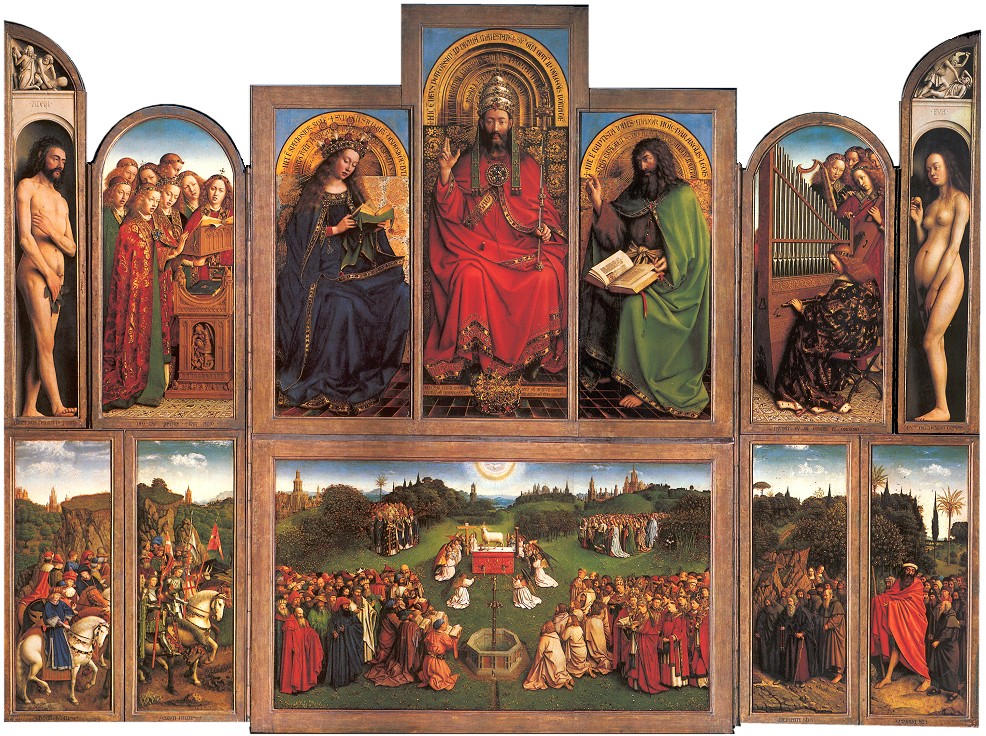
Open view; when opened the altarpiece measures 11ft x 15ft (3.5m x 4.6m). Jan van Eyck (circa 1390–1441) [Public domain]

When the panel was stolen, the other panels were left undamaged. In its empty space, there was left a note, in French, that said: “Taken from Germany by the Treaty of Versaile”. Before arriving in Belgium, the Ghent Altarpiece had previously been at Ghent, before being moved to Berlin during World War I.

Twenty days later, on April 30, the Bishop of Ghent received a ransom demand to the value of one million Belgian francs. The Belgian minister refused to meet the demands. Then, in May, a second letter arrived, which opened negotiations with the thief. Authorities argued that because the lost panel was a national treasure, it went far beyond the diocese wanting it back—the nation wanted it back.

These series of negotiations between the thief and the government lasted all the way through to October of that years, with at least 11 letters exchanged. As an act of good faith, the thief returned one of the panel’s two parts: a grisaille painting of St John the Baptist.

Copy of the Just Judges. Jan van Eyck (circa 1390–1441) [Public domain]

Just a month later on November 25, Arsène Goedertier, the self-proclaimed thief, revealed on his deathbed that he was the only person who knew the location of the masterpiece. His lawyer found a series of ransom note copies and an unsent that read “[it] rests in a place where neither I, nor anybody else, can take it away without arousing the attention of the public.” The police, ultimately, concluded that he was the thief.

However, there has been speculation that Goedertier could not have acted alone. Even speculating that he must have had inside help, possibly from one of the custodians of the cathedral. While others have claimed to know its whereabouts and extensive searches of the cathedral itself have been conducted—even going so far as to x-ray the building—the panel has never been recovered. Even now, there is a detective assigned to the case.

Royal Casket—1939

The Royal Casket was a memorial that contained 73 precious Polish relics. It was created in 1800 by Izabela Czartoryska and was once stored in the Temple of the Sibyl at Puławy. On the casket was inscribed “Polish mementos assembled in 1800 by Izabela Czartoryska”.

The casket itself contained numerous artefacts, including a gold watch of Queen Marie Casimire, a silver rosary of Queen Marie Leszczyńska, and a portrait of Queen Constance of Austria in a silver dress made by King Sigismund III Vasa. The casket had previously survived all of its confiscations after the collapses of the Polish national uprisings because it was housed to Kraków.

The Royal Casket. By Jannasch, Warsaw

When World II happened, the casket was transported along with a rich collection of the Czartoryski Museum to Sieniawa, where it was hidden in a repository located in a palace outbuilding that was later bricked up. However, there was a German mill owner working for the Czartoryski family who betrayed the secret location to Wehrmacht soldiers once they had entered Sieniawa on 14 September 1939. These soldiers broke into the palace and stole the collection, distributing the contents of casket amongst themselves. It is assumed that all its precious items have since been destroyed.

Peking Man—1941–45

Peking Man (Homo erectus pekinensis) is an example of Homo erectus. The skull was discovered in 1923–27 during excavations at Zhoukoudian near Beijing, China. In 2009, the finds were dated from around 750,000 years ago. The skull was part of a larger discovery consisting of 15 partial crania, 11 mandibles, many teeth, some skeletal bones and large numbers of stone tools. All these remains were discovered Lower Cave at Locality 1 of the Peking Man.
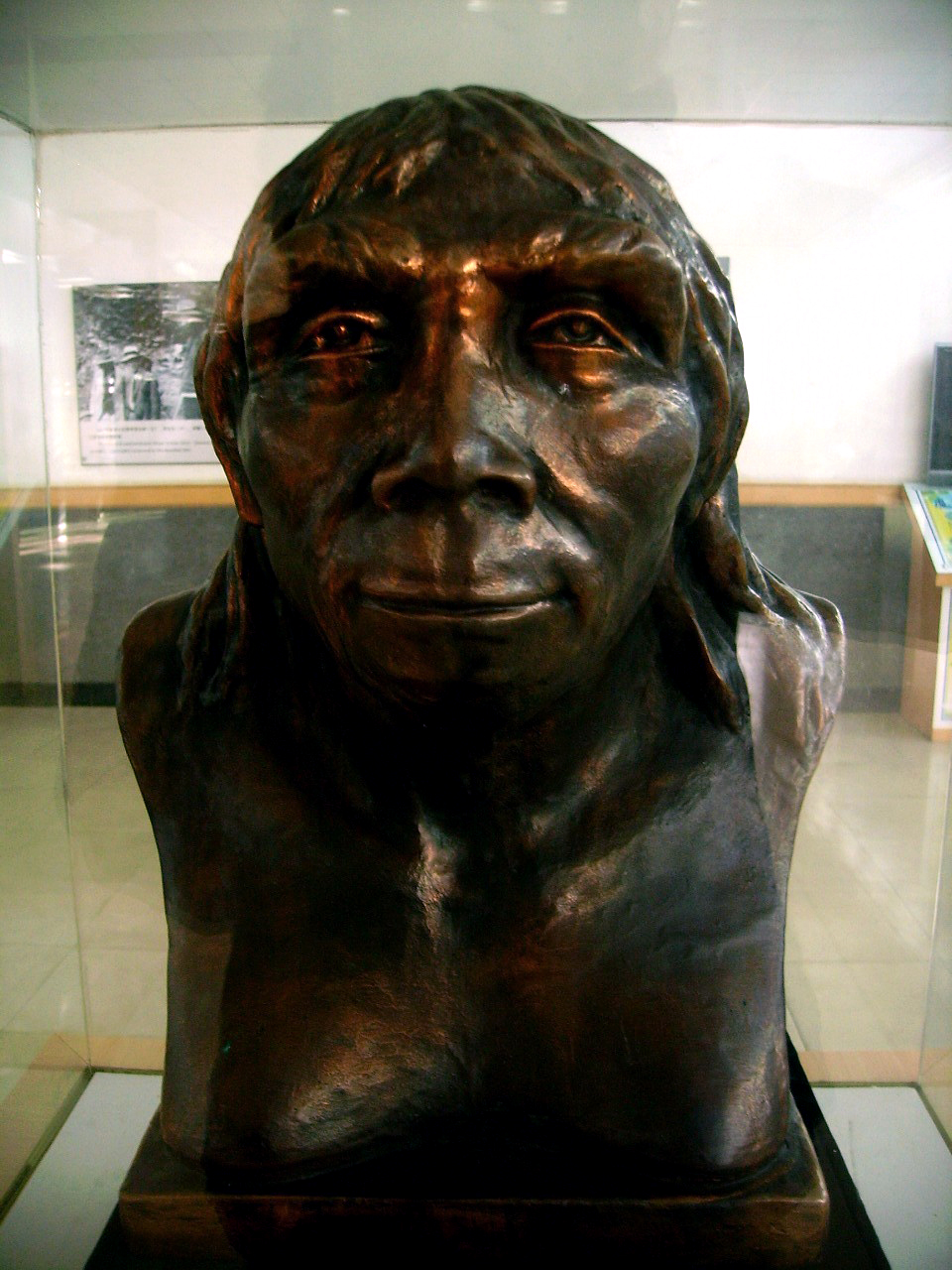
Bust of Peking Man on permanent display at Zhoukoudian, China. By Mutt (Own work)

Prior to their theft, the fossils of the Peking Man were kept at the Union Medical College in Peking. Witnesses have stated that, while under Japanese occupation in 1941, but before the eruption of fighting between Japanese and Allied Forces, the fossils were put in two large crates and loaded onto a US Marine vehicle bound for the port of Qinhuangdao in northern China. This location was near to the Marine base at Camp Halcomb. The plan was to then send them to the American Museum of Natural History in New York. However, the fossils never made it.

There are numerous theories concerning where the fossils disappeared to, including being aboard the Japanese ship Awa Maru (we’ll get to that shortly), or a sunken American vessels, or being ground up for medicinal usage. While the original fossils vanished in 1941, excellent casts and descriptions remain for further analysis.

Amber Room—1945

The Amber Room is a famous chamber that is decorated in amber panels backed with gold leafs and mirrors, located in the Catherine Palace of Tsarskoye Selo close to Saint Petersburg. It was originally constructed in the 18th century in Prussia, the Amber Room vanished in World War II. Before the room’s disappearance, it was considered an “Eighth Wonder of the World”.

The Amber Room’s construction first began in 1701 in Prussia, and was designed by the German baroque sculptor Andreas Schlüter and Danish amber craftsman Gottfried Wolfram. The amber cabinet stayed in the Berlin City Palace until 1716 when it was gifted by the Prussian King Frederick William I, who was his ally. In Russia, after the room’s expansion, it covered more than 55 square meters (590 sq ft) and contained over 6 tons of amber.
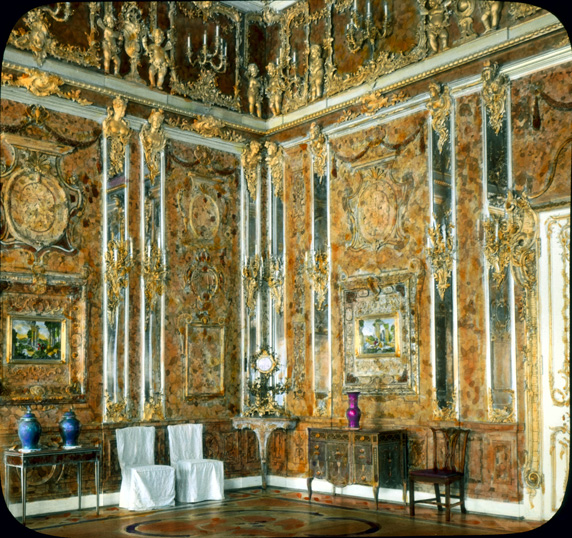
Pushkin (Tsarskoe Selo). Catherine Palace: Amber Room. By Branson DeCou

When World War II broke out and the German invasion of the Soviet Union was taking place, the room’s curators, who were responsible for removing the treasures in Leningrad, tried to disassemble and remove the Amber Room. But over the years, the amber had dried out and become brittle, which meant that if they had tried to remove the amber, it would have broken. To combat this, the Amber Room was hidden behind wallpaper, in the hopes of stopping German forces.

This plan, ultimately, failed. The Army Group North of Nazi Germany took only 36 hours to disassemble the room, supervised by two experts. It was brought to Königsberg on October 1941, to be displayed in the town’s castle. However, orders were given by Hitler on January 21–24 1945 ordered the movement of looted possessions from Königsberg. The man in charge of its removal, Erick Koch, fled the city, leaving General Otto Lasch in command. Then, in August 1944, Königsberg was heavily fire bombed by the Royal Air Force, supposedly destroying the room.
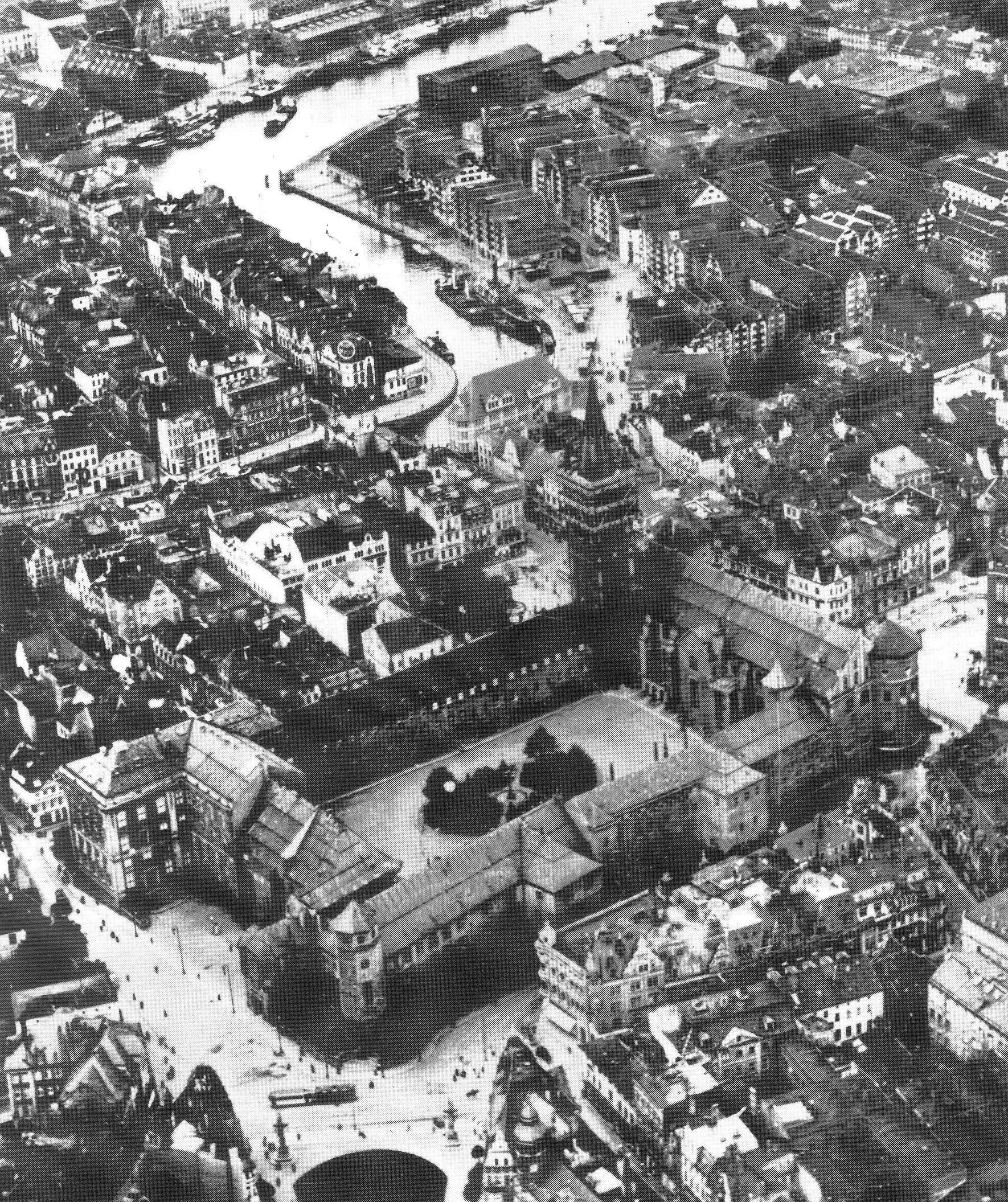
Luftaufnahme von Königsberg, 1925. G. v. Glinski, P. Wörster: Königsberg. Die ostpreußische Hauptstadt in Geschichte und Gegenwart. Berlin/Bonn 1992

Despite the Amber Room allegedly not surviving the war and the fact that the room was never seen in public again, there have been several eyewitness reports that claimed to have seen the room being loaded aboard Wilhelm Gustloff, which left Gdynia on 30 January 1945. Then, in 1997, an Italian stone mosaic believed to be a part of the Amber Room was found in West Germany, possessed by the family of a soldier who claimed to have helped disassemble the room. It was subsequently used to help rebuild the room.

A year later, a German and a Lithuanian team announced that they had both located the room. The German team believed it to be in a silver mine, while the Lithuanian team believed it to be in a lagoon. However, neither were correct. And, over time, there were several more investigations into the room’s fate.

In 1979, rebuilding of the Amber Room began at Tsarskoye Selo. In 2003, decades of work later, by Russian craftsmen and donations from Germany, the reconstructed Amber Room was inaugurated at the Catherine Palace near Saint Petersburg.

Awa Maru Treasure—1945

The Awa Maru was a Japanese ocean liner built in 1941–43. The ship was designed to hold passengers, but when the war broke out, she was requisitioned by the Japanese Navy.

In 1945, the vessel was used as a relief ship for the Red Cross, carrying supplies to American and Allied POWs in Japanese custody. After the Awa Maru had delivered her supplies, several hundred stranded merchant marine officers, military personnel, diplomats and civilians at Singapore boarded the vessel.

Drawing of the Awa Maru. By Sea Classics

Stories also circulated that she carried a horde of treasure worth around US$5 billion. This supposedly included 40 metric tons of gold, 12 metric tons of platinum and 150,000 carats (30 kg) of diamonds and other strategic materials. However, more credible sources have said that it was most probably nickel and rubber. As mentioned earlier, the ship’s location also corresponded with the last recorded location of the Peking Man fossils.

On March 28, the ship departed Singapore, but was intercepted at night in the Taiwan Strait by the American submarine USS Queenfish. The U.S. vessel mistook the Awa Maru for a destroyer and sunk her. Only one of the 2,004 passengers survived: Kantora Shimoda, the captain’s personal steward.

USA entry into World War 1, 1917

On April 2, 1917, President Woodrow Wilson went before a joint session of Congress to request a declaration of war against Germany. Wilson cited Germany’s violation of its pledge to suspend unrestricted submarine warfare in the North Atlantic and the Mediterranean, as well as its attempts to entice Mexico into an alliance against the United States, as his reasons for declaring war. On April 4, 1917, the U.S. Senate voted in support of the measure to declare war on Germany. The House concurred two days later. The United States later declared war on German ally Austria-Hungary on December 7, 1917.

World War I Trenches in France

Germany’s resumption of submarine attacks on passenger and merchant ships in 1917 became the primary motivation behind Wilson’s decision to lead the United States into World War I. Following the sinking of an unarmed French boat, the Sussex, in the English Channel in March 1916, Wilson threatened to sever diplomatic relations with Germany unless the German Government refrained from attacking all passenger ships and allowed the crews of enemy merchant vessels to abandon their ships prior to any attack. On May 4, 1916, the German Government accepted these terms and conditions in what came to be known as the “Sussex pledge.”

By January 1917, however, the situation in Germany had changed. During a wartime conference that month, representatives from the German Navy convinced the military leadership and Kaiser Wilhelm II that a resumption of unrestricted submarine warfare could help defeat Great Britain within five months. German policymakers argued that they could violate the “Sussex pledge” since the United States could no longer be considered a neutral party after supplying munitions and financial assistance to the Allies. Germany also believed that the United States had jeopardized its neutrality by acquiescing to the Allied blockade of Germany.

German Chancellor Theobald von Bethmann-Hollweg protested this decision, believing that resuming submarine warfare would draw the United States into the war on behalf of the Allies. This, he argued, would lead to the defeat of Germany. Despite these warnings, the German Government decided to resume unrestricted submarine attacks on all Allied and neutral shipping within prescribed war zones, reckoning that German submarines would end the war long before the first U.S. troopships landed in Europe. Accordingly, on January 31, 1917, German Ambassador to the United States Count Johann von Bernstorff presented U.S. Secretary of State Robert Lansing a note declaring Germany’s intention to restart unrestricted submarine warfare the following day.

German Chancellor Theobald von Bethmann-Hollweg

Stunned by the news, President Wilson went before Congress on February 3 to announce that he had severed diplomatic relations with Germany. However, he refrained from asking for a declaration of war because he doubted that the U.S. public would support him unless he provided ample proof that Germany intended to attack U.S. ships without warning. Wilson left open the possibility of negotiating with Germany if its submarines refrained from attacking U.S. shipping. Nevertheless, throughout February and March 1917, German submarines targeted and sank several U.S. ships, resulting in the deaths of numerous U.S. seamen and citizens.

On February 26, Wilson asked Congress for the authority to arm U.S. merchant ships with U.S. naval personnel and equipment. While the measure would probably have passed in a vote, several anti-war Senators led a successful filibuster that consumed the remainder of the congressional session. As a result of this setback, President Wilson decided to arm U.S. merchant ships by executive order, citing an old anti-piracy law that gave him the authority to do so.

While Wilson weighed his options regarding the submarine issue, he also had to address the question of Germany’s attempts to cement a secret alliance with Mexico. On January 19, 1917, British naval intelligence intercepted and decrypted a telegram sent by German Foreign Minister Arthur Zimmermann to the German Ambassador in Mexico City. The “Zimmermann Telegram” promised the Mexican Government that Germany would help Mexico recover the territory it had ceded to the United States following the Mexican-American War. In return for this assistance, Germany asked for Mexican support in the war.

The “Zimmermann Telegram”

Initially, the British had not shared the news of the Zimmermann Telegram with U.S. officials because they did not want the Germans to discover that British code breakers had cracked the German code. However, following Germany’s resumption of unrestricted submarine warfare in February, the British decided to use the note to help sway U.S. official and public opinion in favor of joining the war. The British finally forwarded the intercepted telegram to President Wilson on February 24. The U.S. press carried the story the following week.

Despite the shocking news of the Zimmermann Telegram, Wilson still hesitated asking for a declaration of war. He waited until March 20 before convening a Cabinet meeting to broach the matter—almost a month after he had first seen the telegram. The precise reasons for Wilson’s decision to choose war in 1917 remain the subject of debate among historians, especially in light of his efforts to avoid war in 1915 after the sinking of the British passenger liners Lusitania and Arabic, which had led to the deaths of 131 U.S. citizens.

However, by 1917, the continued submarine attacks on U.S. merchant and passenger ships, and the “Zimmermann Telegram’s” implied threat of a German attack on the United States, swayed U.S. public opinion in support of a declaration of war. Furthermore, international law stipulated that the placing of U.S. naval personnel on civilian ships to protect them from German submarines already constituted an act of war against Germany. Finally, the Germans, by their actions, had demonstrated that they had no interest in seeking a peaceful end to the conflict. These reasons all contributed to President Wilson’s decision to ask Congress for a declaration of war against Germany. They also encouraged Congress to grant Wilson’s request and formally declare war on Germany.

15 Amazing WW1 Facts

Remembering the fallen who fought for our future, I thought I would share with you these 15 amazing facts about WW1.

1. A British Solider had to be a minimum of 19 years old to serve overseas, however many soldiers lied about their ages. As young as 12, a quarter of a million soldiers were underage.

2. The life expectancy of the trenches was around 6 weeks. The people most at risk were stretcher bearers and junior officers.

3. When soldiers returned home, there was an increase in babies by 45 percent. However, the 1918 influenza pandemic killed more people from around the world than the actual war.

4. Before gas masks, the soldiers only protection against the gas attacks was a rag soaked in their own urine. Edward Harrison saved thousands of people’s lives by inventing the first practical Gas Mask.

5. While in the trenches it was known that soldiers could become highly superstitious, and some believed angels appeared over the trenches to save them from death.

6. German Trenches were much more advanced than those of their allies. They were built to last, and some were known to even have doorbells.

7. 65 million men worldwide from 30 countries fought.

8. A third of deaths in the war were caused by a disease. 150,000 of these were venereal, caused by the brothels that were set up behind the front-lines.

9. 25,000,000 tons of supplies were shipped to British forces on the Western Front. This included 3,000,000 tons of food, and 5,000,000 tons of oats, and hay for the horses.

10. The Government banned the use of rice at weddings in 1917 because of the food shortages.

WW1 Remember

11. Dead horses were melted down for their fat, this was used in explosives. At the very height of the war, the British Army had nearly a million horses.

12. In 1918 we were spending £6,000,000 a day on the war. The total cost was believed to be around 9 thousand million pounds.

13. Lord Kitchener was the male who posed pointing his finger for the “Your country needs you” posters. He died when the ship he was on hit a German mine in 1916.

14. 346 British soldiers were killed by their own army. Mainly for deserting. Some were strapped to a post, or gun wheel within the range of enemy fire.

15. The top British Ace was Major Edward Mannock who shot down 61 enemy planes. The top German Ace was Baron von Richthofen who shot down 80.

If you know some more interesting, amazing facts about the war then please add them in the comments section below!

Women on the front line in WW1

At the start of the First World War many people harboured the view that war was ‘man’s business’. Front-line roles had, after all, always been undertaken by men.

Between 1914 and 1918 opinion changed when women – invigorated by years of struggle for female emancipation – stepped out from their traditional roles and placed themselves at the heart of the action.

Taking on key medical roles, they emerged from the conflict with newfound respect and observers heralded the war as ‘a revelation of woman’.

Trained nurses had been part of the military establishment since the 19th century. Thousands of untrained women now stepped forward to help support the care of the wounded.

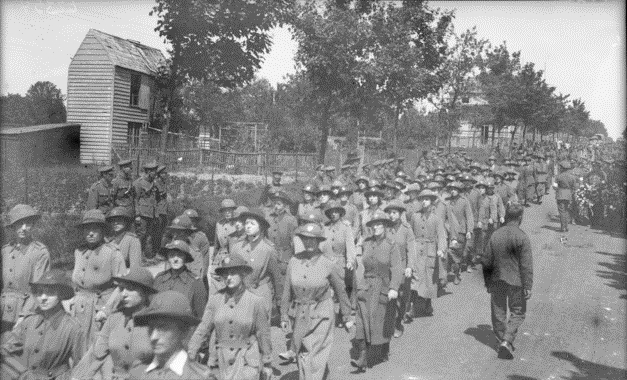
Members of Queen Mary’s Army Auxiliary Corps marching in the funeral procession of comrades who were killed in an enemy air raid near Abbeville on the night of 29 May 1918. © Australian War Memorial

Within the Wounded exhibition we hear the voice of Sophie Hoerner, who was stationed at No. 1 Canadian general hospital near Étaples. She paints a vivid picture of the scale and severity of the task faced by nurses as they cared for the wounded at the Western Front.

In a letter home she wrote:

‘No one could imagine the horrors of a war like this unless they are here and could see for themselves. I have never seen such awful wounds.’

The job of the war nurse was both varied and hectic. Some administered pain relief and redressed wounds. Others assisted the surgical teams in the operating theatres of casualty clearing stations, acting as anaesthetists or carrying out minor procedures when surgeons were rushed off their feet.

Female surgeons found it far harder to offer their services. The army was initially reluctant to make use of their skills, telling them ‘to go home and sit still’.

Undeterred, they set up voluntary hospitals on the Western and Eastern fronts – many staffed exclusively by women. One such volunteer was Dr Phoebe Chapple, who became one of the first at the front line and the first to be awarded a medal for gallantry.

On 29 May 1918, while she was visiting the Queen Mary’s Army Auxiliary Corps near Abbeville, the camp came under enemy attack. One bomb hit a trench where 40 staff had taken cover. In near darkness and with further risk of attack, Chapple worked her way along the trench, tending to the wounded.

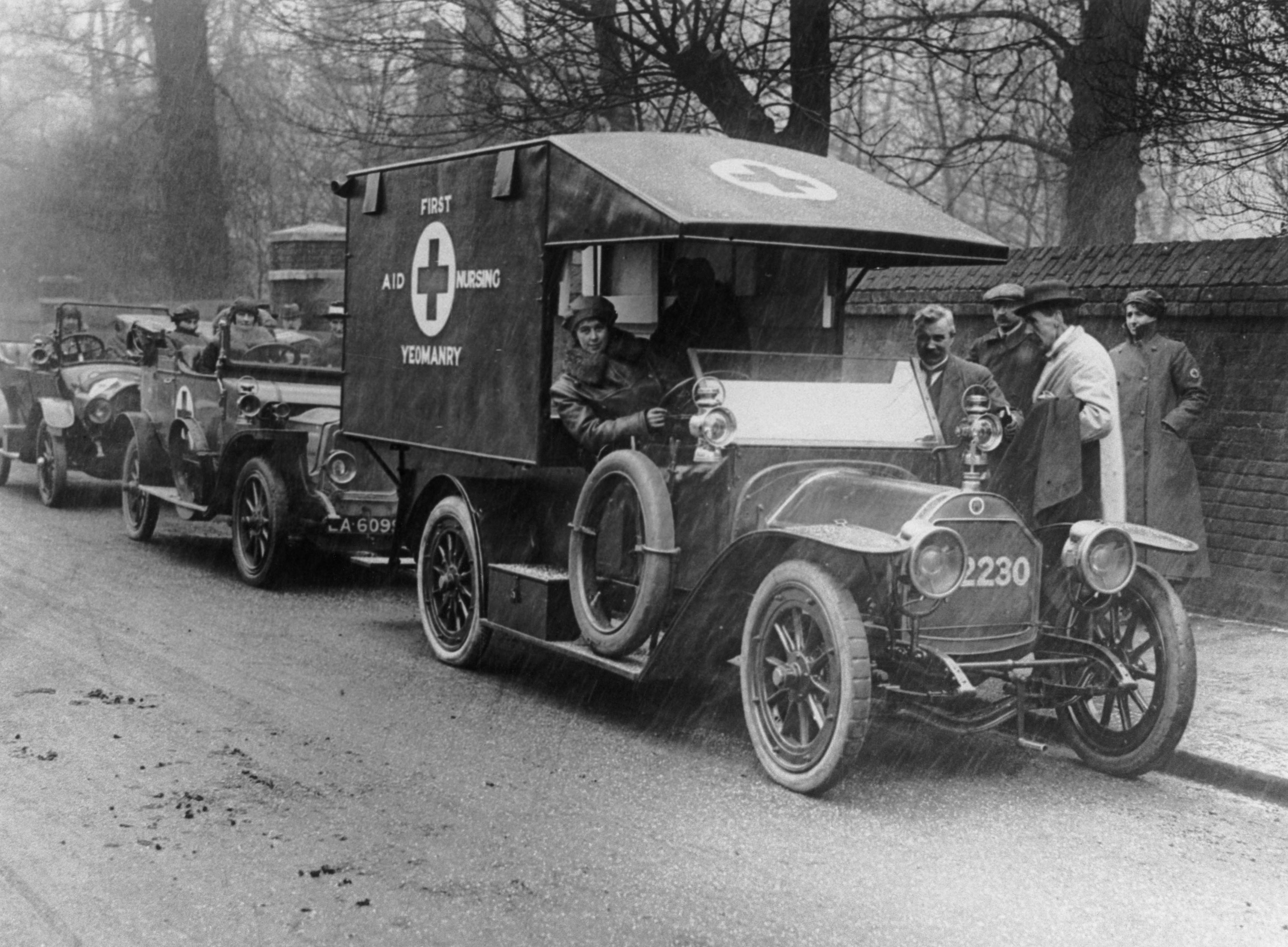
Women also provided a vital link between the battlefield and medical units. The First Aid Nursing Yeomanry (FANY) ran field hospitals and drove ambulances, often in extremely dangerous conditions.

First Aid Nursing Yeomanry (FANYs) in ambulances. © NMeM/Daily Herald Archive/ SSPL

Pat Waddell, an accomplished violinist, acted as an ambulance driver from 1916 onwards, having learned to drive in London by cajoling taxi drivers to let her take control of their vehicles. The FANYs challenged the traditional view of women drivers. One sergeant wrote:

‘When the cars are full of wounded no-one could be more patient, gentle or considerate, but when the cars are empty they drive like bats out of hell.’

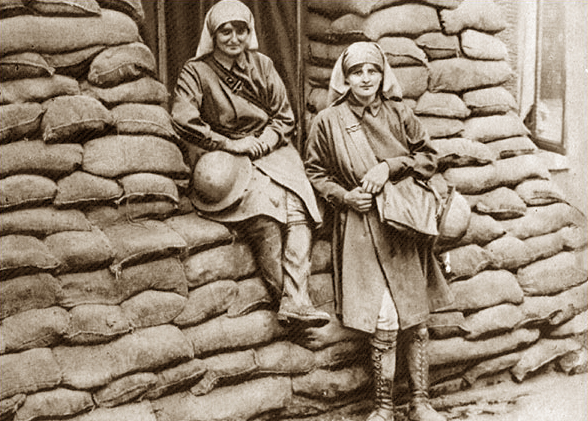
Mairi Chisholm and Elsie Knocker travelled to Belgium as part of the Munro Ambulance Corps designed to support the Belgian Red Cross and transport the injured to hospitals away from the battlefield. They quickly decided that they could be of greater help to the wounded by treating them closer to the front line.

They set up their own dressing station in Pervyse near Ypres – only 90 metres from the action. Earning 17 medals for their bravery they became celebrated in the press as the ‘Angels’ of Pervyse, having saved hundreds of soldiers’ lives.

Elsie Knocker and Mairi Chisholm outside their advanced dressing station. © Illustrated London News Ltd
Elsie Knocker and Mairi Chisholm outside their advanced dressing station.© Illustrated London News Ltd
Marie Curie and her daughter Irène at Hoogstade hospital in northern Belgium.
Marie Curie and her daughter Irène at Hoogstade hospital in northern Belgium.© Musée Curie (ACJC collection).

Perhaps the most famous woman to work at the front line was Marie Curie. By the time war broke out she was already a double Nobel prizewinner – one for physics (the first Nobel Prize to be awarded to a women), the other for chemistry.

Curie was shocked to see how soldiers’ lives were being lost because they had to be transported long distances for examination.

So she set about bringing diagnostic equipment to the battlefield.

Twenty vehicles were fitted out with X-ray units, darkrooms and technical personnel. Curie learned to drive so she could operate one of the mobile cars herself.

She also set up 200 stationary X-ray stations, helping train 150 women as radiology technicians to help run them.

Over 1 million wounded soldiers were examined thanks to her efforts, with Curie herself declaring:

‘The use of X-rays during the war saved the lives of many wounded men and saved many more from long suffering and lasting infirmity.’

Women’s front-line activity did not end there.

They acted in many other important roles, from telegraphist and cook to war correspondent and spy. Added to the vital work being carried out by female workers back at home, these varied roles show that the First World War was not just a conflict that made heroes, but many heroines as well.

Medics in the frontline WW1

Medical care throughout the First World War was largely the responsibility of the Royal Army Medical Corps (RAMC). The RAMC’s job was both to maintain the health and fighting strength of the forces in the field and ensure that in the event of sickness or wounding they were treated and evacuated as quickly as possible.

Every battalion had a medical officer, assisted by at least 16 stretcher-bearers. The medical officer was tasked with establishing a Regimental Aid Post near the front line. From here, the wounded were evacuated and cared for by men of a Field Ambulance in an Advanced Dressing Station.

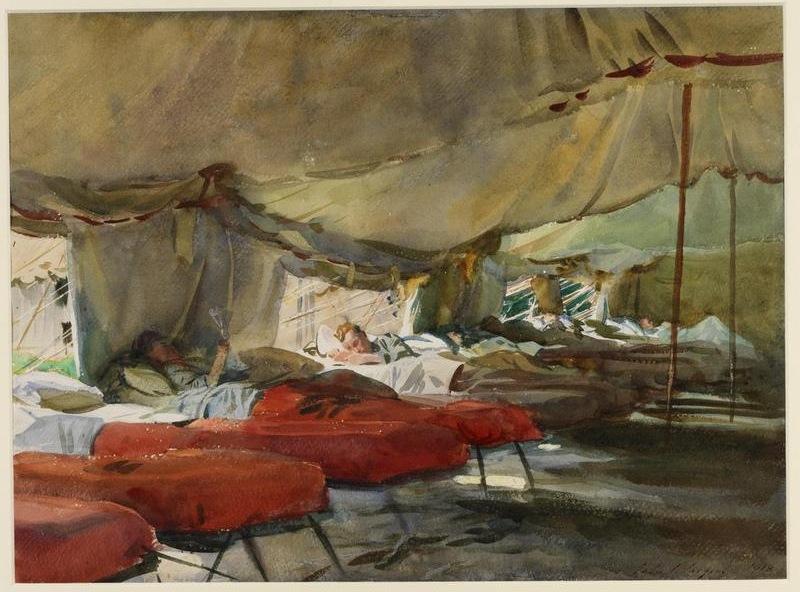
The hospitals set up immediately behind the lines were often housed in tents during the First World War, including wards and operating theatres.

This was particularly true of Casualty Clearing Stations, with base hospitals further away from the fighting sometimes making use of existing or more permanent buildings.

A casualty then travelled by motor or horse ambulance to a Casualty Clearing Station. These were basic hospitals and were the closest point to the front where female nurses were allowed to serve. Patients were usually transferred to a stationary or general hospital at a base for further treatment. A network of ambulance trains and hospital barges provided transport between these facilities, while hospital ships carried casualties evacuated back home to ‘Blighty’.

As well as battle injuries inflicted by shells and bullets, the First World War saw the first use of poison gas. It also saw the first recognition of psychological trauma, initially known as shell shock. In terms of physical injury, the heavily manured soil of the Western Front encouraged the growth of tetanus and gas gangrene, causing medical complications. Disease also flourished in unhygienic conditions, and the influenza epidemic of 1918 claimed many lives.

Josef Jakobs 1898 to 1941Last man to die in the Tower of London by firing squad

Early Life

Josef Jakobs was born 30 June 1898 in the city of Luxembourg. His German parents moved the family to Berlin in the early 1900s. Josef attended the Dominican College in Vechta and, at the outbreak of the war, joined the German Army. He served with the Fourth Foot Guard Regiment on the eastern and western fronts. He was wounded in 1918 near Amiens and sent to Berlin to recover.

Dentist

After the war, Josef studied dentistry in Berlin. In 1921, he traveled to Buenos Aires, Argentina to complete his dentistry degree. In 1924, Josef returned to Berlin, and after becoming accredited as a dentist in Germany, set up a dental practice. In 1926, he married Margarete Knoeffler and by 1932, they had three children, two boys and a girl.

Switzerland

The economic depression of the early 1930s caused Josef to close his dental practice. In 1934, he traveled to Switzerland with a friend to engage in counterfeit gold-making. His wife came to visit him in the summer of 1934, but by September, Josef and his friend had been arrested and both were imprisoned for almost two and a half years.

In June 1937 Josef was released from prison and returned to Berlin. He found a job as a traveling salesman for a while, selling books and typewriters, but in 1938, after meeting a former acquaintance, got involved in providing black market passports to Jews eager to escape Germany.

Black Market Deals

For a fee, often a hefty one, lawyer Dr. Juergen Ziebell, could secure Finnish, Irish or Uruguayan passports/visa to Jewish clients. Josef’s job was to bring possible clients to Dr. Ziebell, for which he received a “finder’s fee”.

One of Josef’s contacts was a Frau Reiwald who recommended Frau Lily Knips to Josef. Frau Knips had a son in England, and was desperate to leave Germany. Frau Knips decided not to a passport through Dr. Ziebell, but Josef tried to arrange various other financial deals with her, often of a very shady nature. In October 1938, Dr. Ziebell and his various business associates, including Josef, were arrested by the authorities. Frau Knips was able to arrange her own way to England, with the help of her son, and left Germany in April 1939. Josef was sent to Sachsenhausen Concentration Camp and was released in March 1940.

German Intelligence Service (Abwehr)

Josef may have been called up for military service and/or been approached by a recruiter for the Abwehr. Either way, in September 1940, Josef went to Hamburg to be trained in espionage by a certain Dr. Beier (Julius Jacob Boeckel) under the supervision of spymaster Nikolaus Ritter. While in Hamburg, Josef became enamoured with Clara Bauerle, a singer with the Bernhard Ette Orchestra.

Josef returned to Berlin on the weekends to visit his family. On one of these visits, he apparently divulged to a “friend” that he was planning to use his mission to England as a means to escape to America where he had an aunt. The “friend” denounced Josef to the Gestapo and very quickly, Josef was recalled to Hamburg. The Abwehr still considered Josef  suitable spy material and on 8 January, 1941, he was sent to The Hague to be trained in wireless transmitting and receiving.

To England

On 31 January 1941, left Schipol Airport, near Amsterdam, for England in the belly of a German bomber, most likely a Heinkel 111. Josef left the aircraft at approximately 8:30 pm and injured his ankle during his exit through the narrow hatch. Josef had never practiced a parachute jump or landing and his ankle injury was compounded when he landed. He found himself lying in an English potato field belonging to Dovehouse Farm with a broken ankle. Covering himself with his parachute, Josef smoked his supply of cigarettes throughout the night, drifting in and out of consciousness.

In the morning, around 8:30 am, he fired some shots into the air with his Mauser automatic pistol. A short while later, he fired some more shots into the air and was found by two farm hands on their way to work – Charles Baldock and Harry Coulson. Charles stayed with Josef while Harry went to nearby Wistow Fen Farm and notified Harry Godfrey, a member of the Ramsey Home Guard. Godfrey notified the police in the nearby town of Ramsey and accompanied Coulson back to the parachutist.

A short while later, Captain Newton and Lieutenant Curedale of the Home Guard also arrived, having been notified by the Ramsey Police of the capture of a possible enemy spy. Josef was searched by the men and a variety of items were found in his possession, the most damning of which was the wireless transmitter which was partially buried in the soil beneath Josef. Bundling Josef into the back of a horse-drawn cart, the men accompanied him to the Ramsey Police Station.

At the station, Josef was examined by Acting Inspector Horace Jaikens who summoned Dr. Willem Hertzog to diagnose Josef’s ankle injury. Dr. Hertzog determined that the ankle was indeed broken but that Josef was fit to be transported to London. The police made a more complete inventory of Josef possessions, taking particular note of his well-dressed appearance.

Meanwhile, Acting Sergeant Pottle from nearby Bury had been sent to the field at Dovehouse Farm where Josef had landed to recover a small shovel that had been in Josef’s possession. While there, Pottle gathered up some scattered paper fragments which later turned out to be part of Josef’s code disc which he had torn up during the night.

Back at the police station, Detective Sergeant Thomas Oliver Mills from Huntingdon asked Josef several more questions and summoned RSLO Major Dixon from Cambridge. The property in Josef’s possession was carefully itemized and found to contain several other interesting items: £497 in £1 notes, a wireless radio transmitter/receivera torch, two identity cards (one in the name of James Rymer), a ration bookseveral mystery tablets (possibly for use as secret writing materials), a flashlight, a German-English dictionary, a touring map of Great Britain,2.5 pounds of chocolate and smoking accessories. Upon the arrival of Dixon, around noon, Josef was loaded into the back of a car and accompanied to London by Mills and Dixon.

Arrival in London

Josef was driven to Cannon Row Police Station and arrived around 4 pm. He offered a voluntary statement to Major Thomas A. Robertson from the War Office, who was accompanied by John Marriott, also of the War Office. After the interview, Josef given some pain killers by the police surgeon and conveyed to the hospital wing of Brixton Prison.

The next day, despite his broken ankle, Josef was taken to Latchmere House, the MI5 interrogation centre for captured spies. Josef was given a brief interrogation by Colonel Robin Stephens but it was quickly recognized that Josef’s ankle required serious medical attention. After leaving Latchmere House, Josef was returned to Brixton Prison for the night.

The next morning, he was to the more advanced medical facilities at Dulwich Hospital. There he remained for two months, having developed fever, sepsis at the site of his broken ankle and broncho-pneumonia. Josef was eventually released to Latchmere House in reasonable physical condition on April 14 and was quickly convinced to write several personal statements regarding his life.

Interrogation

Over the next three months, Josef gave several statements to the officers at Latchmere HouseColonel Robin Stephens, commandant of Latchmere House and Dr Harold Dearden, psychiatrist at Latchmere House led the interrogation, attempting to glean every bit of information from captured spies. Normally, captured spies were turned into double agents, if they were found to be suitable. Since Josef’s capture had been widely publicized, it was determined that he did not meet the criteria to be turned into a double agent.

According to the Treachery Act, neutral aliens and British citizens were to be tried in a civilian court by a judge and jury. Their punishment would be death by hanging, unless they were soldiers, in which case, the Attorney General could decree that they be executed by firing squad. Enemy aliens could be tried by military court martial. Since Josef was a German citizen, and had no neutral alien or British accomplices, MI5 and the Director of Public Prosecutions decided that he would make an excellent candidate for trial by General Court Martial. An application to try Josef by court martial was submitted to the Attorney General in late June and approved. During that same period, Josef was used by the MI5 officers to “break” another German spy who had arrived in mid-May, Karel Richter.

Plans for a speedy court martial were hampered by the logistics of where to hold Josef prior to, and during, his court martial. The Office of the Judge Advocate General was in charge of the proceedings and after much deliberation, it was decided to designate a cell at Wandsworth Prison as a military prison. On 23 July, Josef was transferred to Wandsworth Prison and guarded by several Military Policemen under the authority of the Deputy Provost Marshal, Lt. Colonel C.R.T.M. Gerard. The following day, Josef was formally charged with an offence under the Treachery Act 1940 by Lt. Colonel William E. Hinchley-Cooke. Less than a week later, the Summary of Evidence was taken at Wellington Barracks under the direction of Lt. Col. George Mervyn Cornish, Officer Commanding Holding Battalion Grenadier Guards.

Conviction

On August 4 and 5, Josef was tried by General Court Martial at the Duke of York’s Headquarters in Chelsea. Unlike the other World War 2 spies, Josef was tried by Court Martial because (a) it was clear he was an enemy alien and (b) he was a member of the enemy’s armed forces. All of the other World War 2 spies were tried by civil court and hanged, most by Albert Pierrepoint.

Josef’s court martial was under the direction of Judge Advocate Carl Ludwig Stirling who provided legal advice for the members of the court, all of whom were high-ranking military officers. The attorney for the prosecution made his case and although Josef was provided with a defence attorney and an interpreter, it was all for nought.. After 10 minutes of deliberation shortly after noon on August 5, the members of the court returned a verdict of guilty and Josef was returned to Wandsworth Prison to await his fate.

The prison chaplain had been attempting to see Josef but because he was a military prisoner, the chaplain was not able to do so. After several letters between Bishop James Dey, Bishop of the Forces, and MI5, a military chaplain was found for Josef, Fr Edward Jackson Griffith. On August 8, Josef wrote a letter of appeal to His Majesty King George VI, but it was rejected.

Execution

In the early morning hours of Friday 15 August, 1941, Josef left Wandsworth Prison, taking his leave of the Governor of the Prison, Major Benjamin D. Grew. In the company of his military escort and Fr. Griffith, Josef was driven to the Tower of London. A doctor at the Tower offered him a prescription to calm his nerves and after initially refusing the offer, Josef accepted the medication.

He was led to the miniature firing range located between the inner and outer walls of the Tower, where the World War I spies had been executed – some with courage. A firing squad composed of members of the Scots Guards, Holding Battalion, awaited him. He was seated in a wooden Windsor chair and fastened to it with ropes. A circular target was pinned to his chest and a black hood covered his head. The commander of the firing squad, Major PDJ Waters MC gave the signals to the firing squad to take aim. Josef’s final words asked the soldiers of the firing squad to “Shoot straight, Tommies”. Colonel Robin Stephens, upon hearing how Josef faced his death, commented that Josef had been a brave man.

Some sources have suggested that Josef spent his last night at the Tower of London, but several eye-witness accounts unequivocally state that Josef spent his last night in Wandsworth Prison. In actual fact, the Tower of London was a Royal Palace and fortress, not a prison.

Autopsy & Burial

After the execution, Josef’s body was removed to the Tower Bridge mortuary where it was examined by Sir Bernard Spilsbury and the East District coroner, W.R.H. Heddy, who pronounced “death due to the passage of bullets through the heart”. On Monday August 18, Josef’s body was taken to St. Mary’s Roman Catholic Cemetery where Fr. Griffith conducted a funeral service in the chapel along with the Rev. Charles B. Flood. Josef’s body was buried in an unmarked grave in the common plot of the cemetery.
The letter that Josef wrote to his family on the eve of his death, which was to have been delivered at the cessation of hostilities, was held in MI5 files until 1993, when it was released to his granddaughters. Josef’s letter was not the only one to languish in the files of MI5.

Rose Greenhow spy in Civil War for the Confederates

Born to slaveholding parents in Maryland, Rose Greenhow was a Washington, D.C., socialite and a passionate sympathizer for the Confederate cause who became one of the most infamous Southern spies. A widow, she lived with her young daughter, Little Rose, on 16th Street Northwest near Lafayette Park, in close proximity to the White House, and was among the first Confederate secret agents in the capital.

In the pre-war years, Greenhow became acquainted with people at the highest levels of Washington society, including presidents and members of Congress. She socialized with then-Senator Jefferson Davis, the future President of the Confederacy, and considered Senator John C. Calhoun, the firebrand and ardent defender of slavery from South Carolina, a mentor.

At the outset of the war, Greenhow was asked by Lieutenant Colonel Thomas Jordan, an assistant to General P.G.T. Beauregard, the commanding general of nearby Confederate forces, to organize a spy ring in Washington, D.C., among Southern sympathizers that could provide information on Union military activities. She immediately agreed.

Greenhow became a driven and enthusiastic agent, later described by the Provost Marshal in Washington, D.C. as “formidable,” with “masterly skill.” In the early months of the war, she and her network employed a wide range of tactics to relay intelligence to Confederate forces in Virginia. Couriers carried messages that Rose stitched into tapestries or sewed into silk pouches concealed in garments and hair. Before the Confederates were driven away from the immediate Washington area, she transmitted signals across the Potomac River by placing varying numbers of burning candles in her window and communicated in Morse code using her window blinds.

camera icon - click to for more details about the image

Ciphered Greenhow letter

In July 1861, Greenhow relayed two ciphered messages to the Confederates about an imminent Union advance planned against Manassas Junction, Virginia, just 30 miles from Washington. Greenhow’s report, combined with other intelligence received, aided the South in its first major victory of the war at the First Battle of Bull Run. Brigadier General P.G.T. Beauregard, commanding the Confederate forces at Manassas Junction, later credited Greenhow’s intelligence as pivotal to the outcome of the battle.

camera icon - click to for more details about the image

From left: Map of Bull Run; Ciphered Greenhow letter; Beauregard’s headquarters at Bull Run; General P. G. T. Beauregard

Greenhow soon came under suspicion and Union General George McClellan, commander of the Army of the Potomac, ordered his intelligence chief, Allan Pinkerton, to investigate her activities. While personally surveilling Greenhow, Pinkerton witnessed a Union officer visiting her residence and sharing a map of Washington, D.C.’s defenses. Greenhow was arrested, and after searching her home, Pinkerton discovered one of her secret messages written in plain text, as well as sensitive documents and personal letters from well-known dignitaries. These included correspondence from Senator Henry Wilson of Massachusetts, the Chairman of the Senate Military Affairs Committee, who shared with Greenhow information about Union troop dispositions and defenses around the capital.

camera icon - click to for more details about the image

From left: Old Capitol Prison, Washington; Little Rose Greenhow; Senator Wilson letter to Rose O’Neal Greenhow; Rose O’Neal Greenhow; Rose O’Neal Greenhow with her daughter; Senator Henry Wilson

Greenhow was undaunted by her house arrest and continued to gather and transmit information to the South through her visitors, even using her young daughter who passed secret messages scrawled on candy wrappers. In January 1862, Greenhow was transferred to the Old Capitol Prison in Washington, D.C., and remained there for four months with her daughter.

After her release, Greenhow was deported to Richmond and welcomed as a hero. When Confederate President Jefferson Davis asked her to serve as a European envoy promoting the Confederate cause abroad, Greenhow departed for England. She published a memoir there and became quite popular with the European social elite, many of whom were sympathetic toward the South, and even had audiences with Queen Victoria and French Emperor Napoleon III.

In 1863, a year later, Greenhow returned to America aboard a British blockade-runner. As the ship neared the North Carolina coast, it was pursued by a Union gunboat and ran aground at the mouth of the Cape Fear River. Greenhow fled in a lifeboat, but drowned when the boat capsized near Fort Fisher, North Carolina, and the weight of the gold she was carrying dragged her underwater.

Sir Henry Dukes MI6 officer in WW1

 (10 February 1889 – 27 August 1967) was a British MI6 officer and author.

Early life and family

Paul Henry Dukes was born the third of five children on 10 February 1889 in BridgwaterSomerset, England. He was the son of the Congregationalist clergyman, Rev. Edwin Joshua Dukes (1847-1930), of Kingsland, London, and his wife, the former Edith Mary Pope (1863-1898), of Sandford, Devon. Edith was an academically gifted woman, the daughter of a schoolteacher, who obtained her Bachelor of Arts degree by correspondence course at the age of 20. In 1884, she married Edwin, who had returned from missionary work in China. She died from a disease of the thyroid gland, and in 1907, Edwin remarried to a 40-year-old widow named Harriet Rouse.

Paul’s siblings included the playwright Ashley Dukes (1885-1959) and the renowned physician Cuthbert Dukes (1890-1977). He had an elder sister, Irene Catherine Dukes (1887-1950), who led a life plagued by illness, and yet another, younger brother, Marcus Braden Dukes (1893-1936), who died in Kuala Lumpur while working as a government official. His sister-in-law was the renowned ballet dancer Marie Rambert. Paul Dukes was also the great-uncle of poet Aidan Andrew Dun, who is the grandson of his brother Ashley.

Paul was educated at Caterham School before going on to pursue a career in music at the Petrograd Conservatoire in Russia.

Career

As a young man he took a position as a language teacher in RigaLatvia. He later moved to St. Petersburg, having been recruited personally by Mansfield Smith-Cumming, the first “C” of MI6 (SIS), to act as a secret agent in Imperial Russia, relying on his fluency in the Russian language. At the time, he was employed at the Petrograd Conservatoire as a concert pianist and deputy conductor to Albert Coates. In his new capacity as sole British agent in Russia, he set up elaborate plans to help prominent White Russians escape from the Gulag and smuggled hundreds of them into Finland.

Known as the “Man of a Hundred Faces,” Dukes continued his use of disguises, which aided him in assuming a number of identities and gained him access to numerous Bolshevik organizations. He successfully infiltrated the Communist Party of the Soviet Union, the Comintern, and even the political police, or CHEKA. Dukes also learned of the inner workings of the Politburo, and passed the information to British intelligence.

He returned to Britain a distinguished hero, and in 1920 was knighted by King George V, who called Dukes the “greatest of all soldiers.” To this day, Dukes is the only person knighted based entirely on his exploits in espionage.

He briefly returned to active service in 1939, helping to locate a prominent Czech businessman who had disappeared after the Nazi occupation of Czechoslovakia. He referred to the businessman as Alfred Obry in his later book about the search, entitled An Epic of the Gestapo. According to A History of the British Secret Service (1969), “Paul Dukes was always a meticulous agent in paying attention to detail. He combed all the Czech papers and in one found this paragraph: ‘A thirteen-year-old boy found on the railway line to Tuschkau the completely unrecognizable corpse of a man. The body was mutilated beyond recognition and the right hand was missing. The police pronounced a verdict of suicide. From papers found on the body it appeared the person was Friedrich Sweiger, a tailor of Prague.’ Dukes immediately suspected Sweiger was in fact Obry, especially since this was the route Obry was to have taken on his escape. He built up a strong case against the Gestapo of murdering Obry and not only demanded exhumation of the body but succeeded in persuading the Germans to do this. The corpse was undoubtedly that of Obry.”

Dukes was also a leading figure in introducing yoga to the Western World.

Writing

His book Red Dusk and the Morrow chronicles the rise and fall of Bolshevism and he toured the world extensively giving lectures pertaining to this subject. Dukes’ other books are listed below.

Personal life

In 1922,Dukes was first married to Margaret Stuyvesant Rutherfurd (1891–1976), former wife of Ogden Livingston Mills, the U.S. Secretary of the Treasury. Margaret was the daughter of Anne Harriman, the second wife of William Kissam Vanderbilt, and her second husband, Lewis Morris Rutherfurd, Jr., son of the astronomer Lewis Morris Rutherfurd. They divorced in 1929, and Dukes later married Diana Fitzgerald in 1959.

He died on 27 August 1967 in Cape Town, South Africa, aged 78.

M15 Protecting the secrets of Great Britain from enemy forces

Suitcase wireless transmitter seized by MI5 from captured German spies during the Second World War. This is believed to have been the set belonging to agents Werner Heinrich Walti and Karl Theo Druecke, who were captured in 1940.

© IWM (COM 1500)

Suitcase wireless transmitter seized by MI5 from captured German spies. This is believed to have been the set belonging to agents Werner Heinrich Walti and Karl Theo Druecke who landed by means of a rubber dinghy dropped from a seaplane off the Scottish coast near Portgordon on the morning of 30 September 1940.

Unlike other European powers, Britain entered the twentieth century without a secret police force. However, in 1883 the London Metropolitan Police had formed a Special Branch to combat Irish nationalist terrorism.

In spite of being under-staffed and with limited powers, its duties expanded to include the monitoring of suspicious foreign nationals and political extremists. Fears of foreign powers such as Imperial Germany and Russia gripped the nation and the British authorities ordered the creation of a security service to combat an espionage offensive.

On 1 October 1909 the War Office’s Secret Service Bureau began its work. It soon developed ‘home’ and ‘foreign’ sections which became MI5 and MI6. The purpose of MI5 was to protect Britain’s secrets while MI6’s task was to find out the secrets of potential enemies abroad. 

The Home section was a small unit but achieved rapid success. By the outbreak of the First World War, it had assisted Special Branch in the arrest of twelve German spies. 

Carl Hans Lody was the first German spy discovered by MI5 during the First World War. German intelligence had sent Carl Lody, a naval reserve officer, to the United Kingdom in 1914 where he failed to pose as an American and began to attract suspicion. Lody was placed under surveillance which hindered his attempts to contact his controllers and on 2 October 1914, he was arrested in Ireland. Lody was found guilty of espionage and executed at the Tower of London on 6 November. 

On the morning of his execution, Lody was calm and asked an officer: ‘I suppose you will not shake hands with a spy?’ The officer replied: ‘No, but I will shake hands with a brave man.’

At the time of his death, Lody was the first man to be executed at the Tower of London for 150 years.

MI6 Going out and finding out the secrets of our enemies to use against them

Oluf Olsen, an SIS wireless operator, sits at his radio set deciphering an incoming message

© HU 68501

Oluf Olsen, an SIS wireless operator, sits at his radio set deciphering an incoming message.

MI6 is the Secret Intelligence Service and has the role of seeking out information on enemies abroad, developing contacts and gathering intelligence that helps further British interests. It was established in 1909 amid fears Germany was targeting Britain. 

During the Second World War, the service was dramatically expanded. Oluf Reed Olsen, a Norwegian who resisted the Nazis as soon as his country was invaded and was forced to flee, was recruited to MI6 to provide important intelligence about the activities of the Germans. He was parachuted back into Norway with a mission and supplies provided by MI6 – and his wartime actions earned him medals including the Distinguished Service Cross.

The work of MI6 was a closely guarded secret – its role and very existence was not officially recognized until the Intelligence Services Act of 1994 and the authorised history of the service ends in 1949. 

On the MI6 website, the service says more recent successes have gone unnoticed but that it  ‘is playing a major role in safeguarding the country’s people and interests’. 

Secret Communications

The Enigma was an electro-mechanical enciphering machine, ultimately produced in large quantities for the German Armed Forces. Invented in 1923, the first models were marketed for commercial company use, as a counter to industrial espionage.

© IWM (COM 22)

The Enigma was an electro-mechanical enciphering machine, ultimately produced in large quantities for the German Armed Forces. Invented in 1923, the first models were marketed for commercial company use, as a counter to industrial espionage.

Throughout history, governments and military commanders have tried to keep their communications secret by the use of codes and ciphers.

At the same time, the interception and decoding of enemy messages has been of paramount importance.

The development of cable and wireless communications made messages more secure but methods of eavesdropping soon developed creating the need for ever more sophisticate cryptography.

This Enigma Machine, like the one in this photograph, was invented in 1923 and the first models were marketed for commercial use as a counter to industrial espionage. But various German government and armed forces adopted the machine as a tool to maintain secure radio communications. 

The British Government Code and Cipher School was set up in 1939 at Bletchley Park in Buckinghamshire, and devoted large resources to breaking the various Enigma ciphers. This became known as the ULTRA programme, and was increasingly successful from 1941 onwards in penetrating German enciphered radio traffic.

Special Operations Executive (SOE)

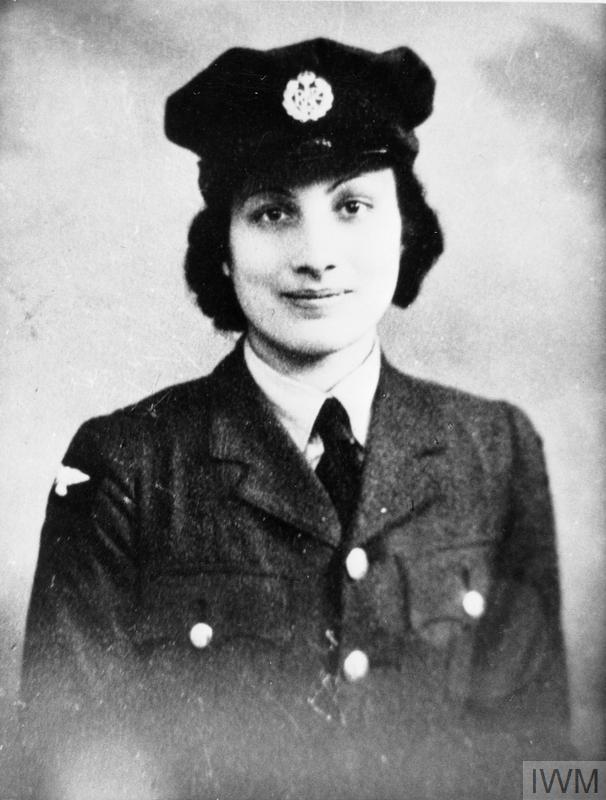
Hon. Assistant Section Officer Noor Inayat Khan (code name Madeleine), George Cross, MiD, Croix de Guerre avec Etoile de Vermeil.

© IWM (HU 74868)

Hon. Assistant Section Officer Noor Inayat Khan (code name Madeleine), George Cross, MiD, Croix de Guerre avec Etoile de Vermeil. Noor Inayat Khan served as a wireless operator with F Section, Special Operations Executive.

The Special Operations Executive, created during the Second World War with instruction to ‘set Europe ablaze’.

It was created in July 1940 after the triumph of Germany’s armies on the continent and the Nazi occupation of most of Europe. It would help resistance movements and carry out subversive operations in enemy-held territory.

Operating on a global scale, SOE’s headquarters in London were supplemented by subsidiary missions on every continent.

It maintained close relations with the governments-in-exile both for recruiting purposes and to coordinate resources and objectives. 

Although secret at the time, the story of the courage and skill of agents like Violette SzaboAdolphe RabinovitchOdette Sansom, George Starr and Noor Inayat Khan have become better known in recent years.

Food given to soldiers

Early Years of wars

During the late 18th and early 19th centuries, soldiers were given two meals a day. This was usually simple, slow-perishing food like salted pork or boiled beef, along with some bread. They also received a morale-boosting daily ration of a pint of wine or a third of a pint of rum or gin.

In 1811, the pioneering Donkin, Hall and Gamble company developed the vacuum tin can and the world’s first factory solely for canning food. From the Napoleonic Wars (1803-15) onwards, their invention had a major impact on how food could be delivered to troops engaged in conflict. Supplies, including meat, could be preserved and protected from damage prior to consumption.

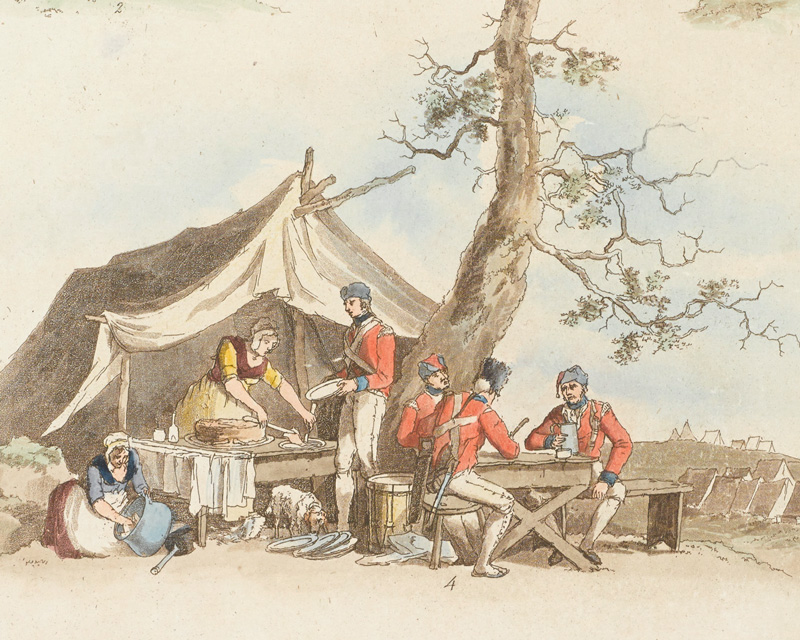
Soldiers eating in camp, c1803
View this object 

Soldiers eating in camp, c1803

Crimean disaster

However, by the mid-19th century, despite being one of the most successful armies of the time, the British Army was unable to maintain supplies to its troops. Its transport and logistics problems during the Crimean War (1854-56) became a national scandal.

Troops in the Crimea were regularly on half rations. Biscuits and salt meat were the staples, with the monthly vegetable ration often restricted to two potatoes and an onion per man. Many soldiers developed scurvy, which led to inflamed gums, making the hard biscuits difficult to eat. In fact, more soldiers were admitted to the hospital in Scutari for scurvy than for battle wounds.

Nearly 20,000 pounds (9 tonnes) of lime juice was provided, but the newly arrived cargo was ignored. Commissary-General William Filder (responsible for supplies) felt that it was not his job to tell the troops that it was there. As a result, all 278 cases sat untouched for two months.

After the Crimean War, Army dietary reforms were undertaken. These focused on providing a high-energy diet for soldiers, but one that was often lacking in variety and sometimes almost indigestible.

Early 20th Century

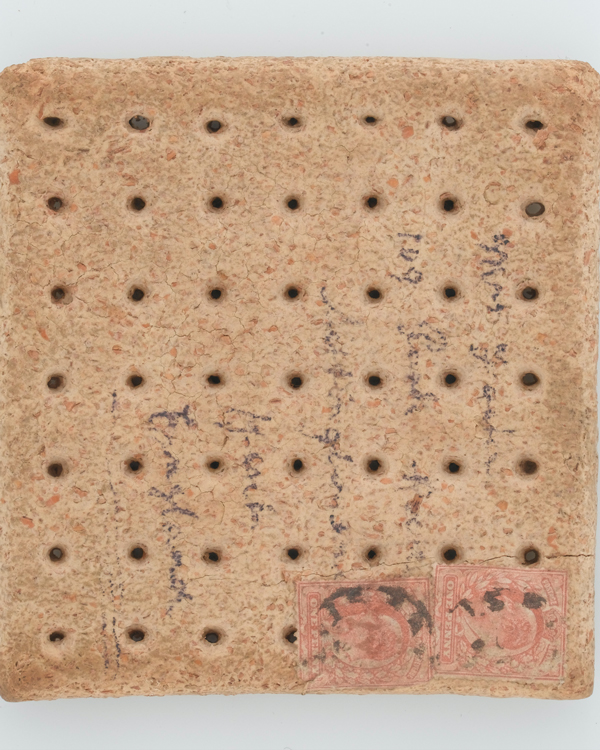
Hardtack biscuits became a staple of soldiers’ diets during the Boer War (1899-1902) and were universally loathed. The notoriously hard biscuits could crack teeth if not first soaked in tea or water!

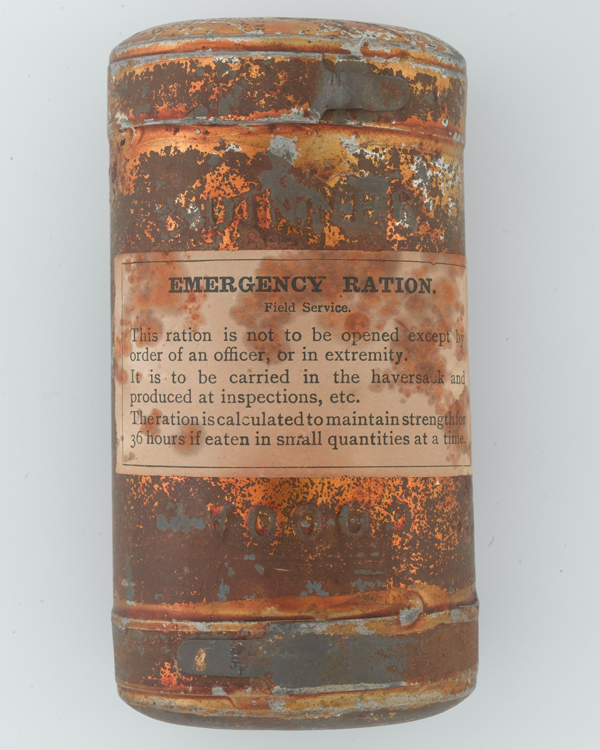
Tinned goods continued to be used to feed soldiers en masse at meal times. But the South African conflict also saw them used as ’emergency rations’, given to each soldier as part of their field kit. A typical emergency ration tin consisted of a meat ‘dinner’ in one end and cocoa in the other. It was designed to sustain a soldier for 36 hours while on active service.

Army ration biscuit sent home from South Africa, 1902
View this object 

Army ration biscuit sent home from South Africa, 1902

Tin of field service emergency rations, c1900
View this object 

Tin of field service emergency rations, c1900

First World War

By the First World War (1914-18), Army food was basic, but filling. Each soldier could expect around 4,000 calories a day, with tinned rations and hard biscuits staples once again. But their diet also included vegetables, bread and jam, and boiled plum puddings. This was all washed down by copious amounts of tea.

The mostly static nature of the war meant food supplies were generally reliable. And soldiers were able to supplement their rations with food parcels from home, with hot meals served behind the lines in canteens and kitchens, and with food obtained from local people.

Cooking in the front-line trenches was very difficult, so soldiers ate most of their rations cold. If cooking did occur, it was done on a small folding solid-fuel stove, known universally as a ‘Tommy Cooker’, that many men carried in their packs. Soldiers also cooked in pots over charcoal or wood. 

Usually, the men would create a stew by adding tinned meat and biscuits into the pot. When the food was ready, it would be dished out individually for men to eat from their mess tins.

As well as the endless supply of ‘bully beef’, soldiers grew to hate another tinned item, Maconochie’s stew. Made with beef – or gristle, more commonly – and sliced vegetables, such as turnips and carrots, Maconochie was deemed edible warmed up, but revolting served cold.

On top of his regular ration issue of food, each soldier was given an emergency ration. This comprised a tin of beef, along with some biscuits and a tin of sugar and tea. This ‘iron ration’ was only supposed to be eaten as a last resort, when normal supplies were unavailable.

Second World War

During the Second World War (1939-45), British troops were fed freshly cooked food when in camp or barracks. On deployments, field kitchens were sometimes established. These also provided hot, fresh meals, considered vital both for nutrition and morale.

However, soldiers at the front still relied on preserved foods. These largely consisted of tinned items, but also dehydrated meats and oatmeal that were designed to be mixed with water. Morale-boosting items, such as chocolate and sweets, were also provided. And powdered milk was issued for use in tea. 

These items were packaged in 24-Hour Ration packs. They were supposed to be used by each soldier until field kitchens were set up or standard food supplies, known as composite rations, were delivered.

Also known as the 14-Man Ration, the ‘compo’ ration came in a wooden crate and contained tinned and packaged food. A typical crate might include tins of bully beef, spam, steak and kidney pudding, beans, cheese, jam, biscuits, soup, sausages, and margarine. Cookable items could be heated up on a variety of portable stoves.

As in the First World War, soldiers were also issued with an emergency iron ration, usually consisting of high-energy foods like chocolate.

Post War era

Tinned rations continued to be provided after the Second World War. But as time went on, these were supplemented with packets of freeze-dried foods and products in vacuum-sealed plastic. Soldiers were supposed to be issued different menus for each day, but often ended up with the same one over and over again.

A 24-hour ration pack would contain enough calories to sustain a soldier in the field for one day. It would contain breakfast, a main meal, the ingredients to make a hot drink, and a variety of snacks including chocolate bars.

Diversity

One of the more controversial changes to Army ration packs was the removal of the chocolate bars for service in Iraq and Afghanistan, as they frequently melted in the desert heat. They were replaced by sachets of peanut butter, which were significantly less popular.

By the mid-1990s, the few remaining tins were replaced with foil-packed boil-in-the-bag meals.

The British Army has long employed overseas recruits and soldiers of every faith, so its rations have had to take these factors into consideration.

The multi-faith British Indian Army also had strict dietary guidelines when it came to feeding its troops. Two cooks, or langris, were normally maintained in each company of a battalion. The composition of the company would determine if a cook was a Muslim, Sikh or Hindu, and of what caste if the latter. This ensured that the correct food was prepared for troops of different religions and in the right way.

The Army also provided stackable cooking pots for Indian soldiers for use on campaign. Each soldier could then cook their own food if necessary. For high-caste brahmins, these cooking pots were of considerable importance, since it was necessary for them to prepare their own food in order to preserve caste.

Kitchens

During the First World War, separate kitchens were set up so that the dietary requirements of Muslim, Sikh and Hindu soldiers were met. This happened on the Western Front, as well as back in Britain.

In particular, the Indian hospital at Brighton made an effort to cater for patients’ religious and cultural needs. Muslims and Hindus were provided with separate water supplies and nine different kitchens.

Today’s British Army rations continue this tradition and have a wide range of menus with halal and kosher options now available for soldiers.