Nuremburg Trials WW2 Nazi Prisoners

International Military Tribunal
Judges’ bench during the tribunal at the Palace of Justice in NurembergAllied-occupied Germany
IndictmentConspiracycrimes against peacewar crimescrimes against humanitymass murderunethical human experimentationfalse imprisonmenthate crimes
Started20 November 1945
Decided1 October 1946
Defendants24 (see list)
Witnesses37 prosecution, 83 defense
Case history
Related actionsSubsequent Nuremberg trialsInternational Military Tribunal for the Far East
Court membership
Judges sittingIona Nikitchenko (Soviet Union)Geoffrey Lawrence (UK)Francis Biddle (US)Donnedieu de Vabres (France)and deputies

The Nuremberg trials were held by the Allies against representatives of the defeated Nazi Germany for plotting and carrying out invasions of other countries across Europe and committing atrocities against their citizens in World War II.

Between 1939 and 1945, Nazi Germany invaded many countries across Europe, inflicting 27 million deaths in the Soviet Union alone. Proposals for how to punish the defeated Nazi leaders ranged from a show trial (the Soviet Union) to summary executions (the United Kingdom). In mid-1945, France, the Soviet Union, the United Kingdom, and the United States agreed to convene a joint tribunal in Nurembergoccupied Germany, with the Nuremberg Charter as its legal instrument. Between 20 November 1945 and 1 October 1946, the International Military Tribunal (IMT) tried 22 of the most important surviving leaders of Nazi Germany in the political, military, and economic spheres, as well as six German organizations. The purpose of the trial was not just to convict the defendants but also to assemble irrefutable evidence of Nazi crimes, offer a history lesson to the defeated Germans, and delegitimize the traditional German elite.

The IMT verdict followed the prosecution in declaring the crime of plotting and waging aggressive war “the supreme international crime” because “it contains within itself the accumulated evil of the whole”. Most defendants were also charged with war crimes and crimes against humanity, and the systematic murder of millions of Jews in the Holocaust was significant to the trial. Twelve further trials were conducted by the United States against lower-level perpetrators and focused more on the Holocaust. Controversial at the time for their retroactive criminalization of aggression, the trials’ innovation of holding individuals responsible for violations of international law is considered “the true beginning of international criminal law“.

Origin

Jews arriving at Auschwitz concentration camp, 1944. According to legal historian Kirsten Sellars, the extermination camps “formed the moral core of the Allies’ case against the Nazi leaders”.[3]

Between 1939 and 1945, Nazi Germany invaded many European countries, including PolandDenmarkNorwaythe NetherlandsBelgiumLuxembourgFranceYugoslaviaGreece, and the Soviet Union. German aggression was accompanied by immense brutality in occupied areas; war losses in the Soviet Union alone included 27 million dead, mostly civilians, which was one seventh of the prewar population. The legal reckoning was premised on the extraordinary nature of Nazi criminality, particularly the perceived singularity of the systematic murder of millions of Jews.

In early 1942, representatives of nine governments-in-exile from German-occupied Europe issued a declaration to demand an international court to try the German crimes committed in occupied countries. The United States and United Kingdom refused to endorse this proposal, citing the failure of war crimes prosecutions following World War I. The London-based United Nations War Crimes Commission—without Soviet participation—first met in October 1943 and became bogged down in the scope of its mandate, with Belgian jurist Marcel de Baer and Czech legal scholar Bohuslav Ečer arguing for a broader definition of war crimes that would include “the crime of war”.[9][10] On 1 November 1943, the Soviet Union, United Kingdom, and United States issued the Moscow Declaration, warning Nazi leadership of the signatories’ intent to “pursue them to the uttermost ends of the earth…in order that justice may be done”. The declaration stated high-ranking Nazis who had committed crimes in several countries would be dealt with jointly, while others would be tried where they had committed their crimes.

Soviet jurist Aron Trainin developed the concept of crimes against peace (waging aggressive war) which would later be central to the proceedings at Nuremberg. Trainin’s ideas were reprinted in the West and widely adopted. Of all the Allies, the Soviet Union lobbied most intensely for trying the defeated German leaders for aggression in addition to war crimes. The Soviet Union wanted to hold a trial with a predetermined outcome similar to the 1930s Moscow trials, in order to demonstrate the Nazi leaders’ guilt and build a case for war reparations to rebuild the Soviet economy, which had been devastated by the war. The United States insisted on a trial that would be seen as legitimate as a means of reforming Germany and demonstrating the superiority of the Western system. The United States Department of War was drawing up plans for an international tribunal in late 1944 and early 1945. The British government still preferred the summary execution of Nazi leaders, citing the failure of trials following World War I and qualms about retroactive criminality. The form that retribution would take was left unresolved at the Yalta Conference in February 1945. On 2 May, at the San Francisco Conference, United States president Harry S. Truman announced the formation of an international military tribunal. On 8 May, Germany surrendered unconditionally, bringing an end to the war in Europe.

Establishment

Nuremberg charter

Aron Trainin (center, with moustache) speaks at the London Conference.
Aerial view of the Palace of Justice in 1945, with the prison attached behind it
Ruins of Nuremberg, c. 1945

At the London Conference, held from 26 June to 2 August 1945, representatives of France, the Soviet Union, the United Kingdom, and the United States negotiated the form that the trial would take. Until the end of the negotiations, it was not clear that any trial would be held at all. The offences that would be prosecuted were crimes against peace, crimes against humanity, and war crimes. At the conference, it was debated whether wars of aggression were prohibited in existing customary international law; regardless, before the charter was adopted there was no law providing for criminal responsibility for aggression. Despite misgivings from other Allies, American negotiator and Supreme Court justice Robert H. Jackson threatened the United States’ withdrawal if aggression was not prosecuted because it had been the rationale for American entry into World War II. However, Jackson conceded on defining crimes against peace; the other three Allies were opposed because it would undermine the freedom of action of the United Nations Security Council.

War crimes already existed in international law as criminal violations of the laws and customs of war, but these did not apply to a government’s treatment of its own citizens. Legal experts sought a way to try crimes against German citizens, such as the German Jews. A Soviet proposal for a charge of “crimes against civilians” was renamed “crimes against humanity” at Jackson’s suggestion after previous uses of the term in the post-World War I Commission of Responsibilities and in failed efforts to prosecute the perpetrators of the Armenian genocide. The British proposal to define crimes against humanity was largely accepted, with the final wording being “murder, extermination, enslavement, deportation, and other inhumane acts committed against any civilian population”. The final version of the charter limited the tribunal’s jurisdiction over crimes against humanity to those committed as part of a war of aggression. Both the United States—concerned that its Jim Crow system of racial segregation not be labeled a crime against humanity—and the Soviet Union wanted to avoid giving an international court jurisdiction over a government’s treatment of its own citizens.

The charter upended the traditional view of international law by holding individuals, rather than states, responsible for breaches. The other three Allies’ proposal to limit the definition of the crimes to acts committed by the defeated Axis was rejected by Jackson. Instead, the charter limited the jurisdiction of the court to Germany’s actions. Article 7 prevented the defendants from claiming sovereign immunity, and the plea of acting under superior orders was left for the judges to decide. The trial was held under modified common law. The negotiators decided that the tribunal’s permanent seat would be in Berlin, while the trial would be held at the Palace of Justice in Nuremberg. Located in the American occupation zone, Nuremberg was a symbolic location as the site of Nazi rallies. The Palace of Justice was relatively intact but needed to be renovated for the trial due to bomb damage; it had an attached prison where the defendants could be held. On 8 August, the Nuremberg Charter was signed in London.

Judges and prosecutors

In early 1946, there were a thousand employees from the four countries’ delegations in Nuremberg, of which about two thirds were from the United States. Besides legal professionals, there were many social-science researchers, psychologists, translators, interpreters, and graphic designers, the last to make the many charts used during the trial. Each state appointed a prosecution team and two judges, one being a deputy without voting rights.

Jackson was appointed the United States’ chief prosecutor, whom historian Kim Christian Priemel described as “a versatile politician and a remarkable orator, if not a great legal thinker”. The United States prosecution believed Nazism was the product of a German deviation from the West (the Sonderweg thesis) and sought to correct this deviation with a trial that would serve both retributive and educational purposes. As the largest delegation, it would take on the bulk of the prosecutorial effort. At Jackson’s recommendation, the United States appointed judges Francis Biddle and John Parker. The British chief prosecutor was Hartley ShawcrossAttorney General for England and Wales, assisted by his predecessor David Maxwell Fyfe. Although the chief British judge, Sir Geoffrey Lawrence (Lord Justice of Appeal), was the nominal president of the tribunal, in practice Biddle exercised more authority.

The French prosecutor, François de Menthon, had just overseen trials of the leaders of Vichy France; he resigned in January 1946 and was replaced by Auguste Champetier de Ribes. The French judges were Henri Donnedieu de Vabres, a professor of criminal law, and deputy Robert Falco, a judge of the Cour de Cassation who had represented France at the London Conference. The French government tried to appoint staff untainted by collaboration with the Vichy regime; some appointments, including Champetier de Ribes, were of those who had been in the French resistance. Expecting a show trial, the Soviet Union initially appointed as chief prosecutor Iona Nikitchenko, who had presided over the Moscow trials, but he was made a judge and replaced by Roman Rudenko, a show trial prosecutor chosen for his skill as an orator. The Soviet judges and prosecutors were not permitted to make any major decisions without consulting a commission in Moscow led by Soviet politician Andrei Vyshinsky; the resulting delays hampered the Soviet effort to set the agenda. The influence of the Soviet delegation was also constrained by limited English proficiency, lack of interpreters, and unfamiliarity with diplomacy and international institutions.

Requests by Chaim Weizmann, the president of the World Zionist Organization, as well as the Provisional Government of National Unity in Poland, for an active role in the trial justified by their representation of victims of Nazi crimes were rejected. The Soviet Union invited prosecutors from its allies, including Poland, Czechoslovakia, and Yugoslavia; Denmark and Norway also sent a delegation. Although the Polish delegation was not empowered to intervene in the proceedings, it submitted evidence and an indictment, succeeding at drawing some attention to crimes committed against Polish Jews and non-Jews.

Indictment

Handing over the indictment to the tribunal, 18 October 1945

The work of drafting the indictment was divided up by the national delegations. The British worked on aggressive war; the other delegations were assigned the task of covering crimes against humanity and war crimes committed on the Western Front (France) and the Eastern Front (the Soviet Union). The United States delegation outlined the overall Nazi conspiracy and criminality of Nazi organizations.The British and American delegations decided to work jointly in drafting the charges of conspiracy to wage aggressive war. On 17 September, the various delegations met to discuss the indictment.

The charge of conspiracy, absent from the charter, held together the wide array of charges and defendants and was used to charge the top Nazi leaders, as well as bureaucrats who had never killed anyone or perhaps even directly ordered killing. It was also an end run on the charter’s limits on charging crimes committed before the beginning of World War II. Conspiracy charges were central to the cases against propagandists and industrialists: the former were charged with providing the ideological justification for war and other crimes, while the latter were accused of enabling Germany’s war effort. The charge, a brainchild of War Department lawyer Murray C. Bernays, and perhaps inspired by his previous work prosecuting securities fraud, was spearheaded by the United States and less popular with the other delegations, particularly France.

The problem of translating the indictment and evidence into the three official languages of the tribunal—English, French, and Russian—as well as German was severe due to the scale of the task and difficulty of recruiting interpreters, especially in the Soviet Union. Vyshinsky demanded extensive corrections to the charges of crimes against peace, especially regarding the role of the German–Soviet pact in starting World War II. Jackson also separated out an overall conspiracy charge from the other three charges, aiming that the American prosecution would cover the overall Nazi conspiracy while the other delegations would flesh out the details of Nazi crimes. The division of labor, and the haste with which the indictment was prepared, resulted in duplication, imprecise language, and lack of attribution of specific charges to individual defendants.

Defendants

Main article: List of defendants at the International Military Tribunal

The defendants in the dock

Some of the most prominent Nazis—Adolf HitlerHeinrich Himmler, and Joseph Goebbels—had committed suicide and therefore could not be tried. The prosecutors aimed to prosecute key leaders in German politics, business, and the military. Most of the defendants had surrendered to the United States or United Kingdom.

The defendants, who were largely unrepentant, included former cabinet ministers: Franz von Papen (who had brought Hitler to power), Joachim von Ribbentrop (foreign minister), Konstantin von Neurath (foreign minister), Wilhelm Frick (interior minister), and Alfred Rosenberg, minister for the occupied eastern territories. Also prosecuted were leaders of the German economy, such as Gustav Krupp of the Krupp AG conglomerate, former Reichsbank president Hjalmar Schacht, and economic planners Albert Speer and Walther Funk, along with Speer’s subordinate and head of the forced labor programFritz Sauckel. While the British were skeptical of prosecuting economic leaders, the French had a strong interest in highlighting German economic imperialism. The military leaders were Hermann Göring—the most infamous surviving Nazi and the main target of the trial[88]Wilhelm KeitelAlfred JodlErich Raeder, and Karl Dönitz.[94] Also on trial were propagandists Julius Streicher and Hans FritzscheRudolf Hess, Hitler’s deputy who had flown to Britain in 1941; Hans Frank, governor-general of the General Governorate of Poland; Hitler Youth leader Baldur von SchirachArthur Seyss-InquartReich Commissioner for the Netherlands; and Ernst Kaltenbrunner, leader of Himmler’s Reich Security Main Office. Observers of the trial found the defendants mediocre and contemptible.

Although the list of defendants was finalized on 29 August, as late as October, Jackson demanded the addition of new names, but was denied. Of the 24 men indicted, Martin Bormann was tried in absentia, as the Allies were unaware of his death; Krupp was too ill to stand trial; and Robert Ley had committed suicide before the start of the trial. Former Nazis were allowed to serve as counsel and by mid-November all defendants had lawyers. The defendants’ lawyers jointly appealed to the court, claiming it did not have jurisdiction against the accused, but this motion was rejected. Defense lawyers saw themselves as acting on behalf of their clients and the German nation.

Initially, the Americans had planned to try fourteen organizations and their leaders, but this was narrowed to six: the Reich Cabinet, the Leadership Corps of the Nazi Party, the Gestapo, the SA, the SS and the SD, and the General Staff and High Command of the German military (Wehrmacht).The aim was to have these organizations declared criminal, so that their members could be tried expeditiously for membership in a criminal organization.Senior American officials believed that convicting organizations was a good way of showing that not just the top German leaders were responsible for crimes, without condemning the entire German people.

Evidence

United States Army clerks with evidence

Over the summer, all of the national delegations struggled to gather evidence for the upcoming trial. The American and British prosecutors focused on documentary evidence and affidavits rather than testimony from survivors. This strategy increased the credibility of their case, since survivor testimony was considered less reliable and more vulnerable to accusations of bias, but reduced public interest in the proceedings.The American prosecution drew on reports of the Office of Strategic Services, an American intelligence agency, and information provided by the YIVO Institute for Jewish Research and the American Jewish Committee, while the French prosecution presented many documents that it had obtained from the Center of Contemporary Jewish DocumentationThe prosecution called 37 witnesses compared to the defense’s 83, not including 19 defendants who testified on their own behalf. The prosecution examined 110,000 captured German documents and entered 4,600 into evidence,  with 30 kilometres (19 mi) of film and 25,000 photographs.

The charter allowed the admissibility of any evidence deemed to have probative value, including depositions. Because of the loose evidentiary rules, photographs, charts, maps, and films played an important role in making incredible crimes believable.[106] After the American prosecution submitted many documents at the beginning of the trial, the judges insisted that all of the evidence be read into the record, which slowed the trial. The structure of the charges also caused delays as the same evidence ended up being read out multiple times, when it was relevant to both conspiracy and the other charges.

Course of the trial

The International Military Tribunal began trial on 20 November 1945, after postponement requests from the Soviet prosecution, who wanted more time to prepare its case, were rejected. All defendants pleaded not guilty. Jackson made clear that the trial’s purpose extended beyond convicting the defendants. Prosecutors wanted to assemble irrefutable evidence of Nazi crimes, establish individual responsibility and the crime of aggression in international law, provide a history lesson to the defeated Germans, delegitimize the traditional German elite, and allow the Allies to distance themselves from appeasement. Jackson maintained that while the United States did “not seek to convict the whole German people of crime”, neither did the trial “serve to absolve the whole German people except 21 men in the dock”. Nevertheless, defense lawyers (although not most of the defendants) often argued that the prosecution was trying to promote German collective guilt and forcefully countered this strawman. According to Priemel, the conspiracy charge “invited apologetic interpretations: narratives of absolute, totalitarian dictatorship, run by society’s lunatic fringe, of which the Germans had been the first victims rather than agents, collaborators, and fellow travellers“. In contrast, the evidence presented on the Holocaust convinced some observers that Germans must have been aware of this crime while it was ongoing.

American and British prosecution

Nazi Concentration and Prison Camps (1945)

Presenting information on German aggression, 4 December

On 21 November, Jackson gave the opening speech for the prosecution. He described the fact that the defeated Nazis received a trial as “one of the most significant tributes that Power has ever paid to Reason”. Focusing on aggressive war, which he described as the root of the other crimes, Jackson promoted an intentionalist view of the Nazi state and its overall criminal conspiracy. The speech was favorably received by the prosecution, the tribunal, the audience, historians, and even the defendants.

Much of the American case focused on the development of the Nazi conspiracy before the outbreak of war. The American prosecution became derailed during attempts to provide evidence on the first act of aggression, against Austria. On 29 November, the prosecution was unprepared to continue presenting on the invasion of Czechoslovakia, and instead screened Nazi Concentration and Prison Camps. The film, compiled from footage of the liberation of Nazi concentration camps, shocked both the defendants and the judges, who adjourned the trial. Indiscriminate selection and disorganized presentation of documentary evidence without tying it to specific defendants hampered the American prosecutors’ work on the conspiracy to commit crimes against humanity. The Americans summoned Einsatzgruppen commander Otto Ohlendorf, who testified about the murder of 80,000 people by those under his command, and SS general Erich von dem Bach-Zelewski, who admitted that German anti-partisan warfare was little more than a cover for the mass murder of Jews.

Evidence about Ernst Kaltenbrunner‘s crimes is presented, 2 January 1946.

The British prosecution covered the charge of crimes against peace, which was largely redundant to the American conspiracy case. On 4 December, Shawcross gave the opening speech, much of which had been written by Cambridge professor Hersch Lauterpacht. Unlike Jackson, Shawcross attempted to minimize the novelty of the aggression charges, elaborating its precursors in the conventions of Hague and Geneva, the League of Nations Covenant, the Locarno Treaty, and the Kellogg–Briand Pact. The British took four days to make their case, with Maxwell Fyfe detailing treaties broken by Germany. In mid-December the Americans switched to presenting the case against the indicted organizations, while in January both the British and Americans presented evidence against individual defendants. Besides the organizations mentioned in the indictment, American, and British prosecutors also mentioned the complicity of the German Foreign Officearmy, and navy.

WW2 Civilians engaged in war work

The British government mobilised civilians more effectively than any other combatant nation. By 1944 a third of the civilian population were engaged in war work, including over 7,000,000 women.

Minister of Labour Ernest Bevin was responsible for Britain’s manpower resources. He introduced the Essential Work Order (EWO) which became law in March 1941. The EWO tied workers to jobs considered essential for the war effort and prevented employers from sacking workers without permission from the Ministry of Labour.

Bevin was also responsible for overhauling the reserved occupations scheme that gave groups of skilled workers in certain occupations exemption from military service.

Art

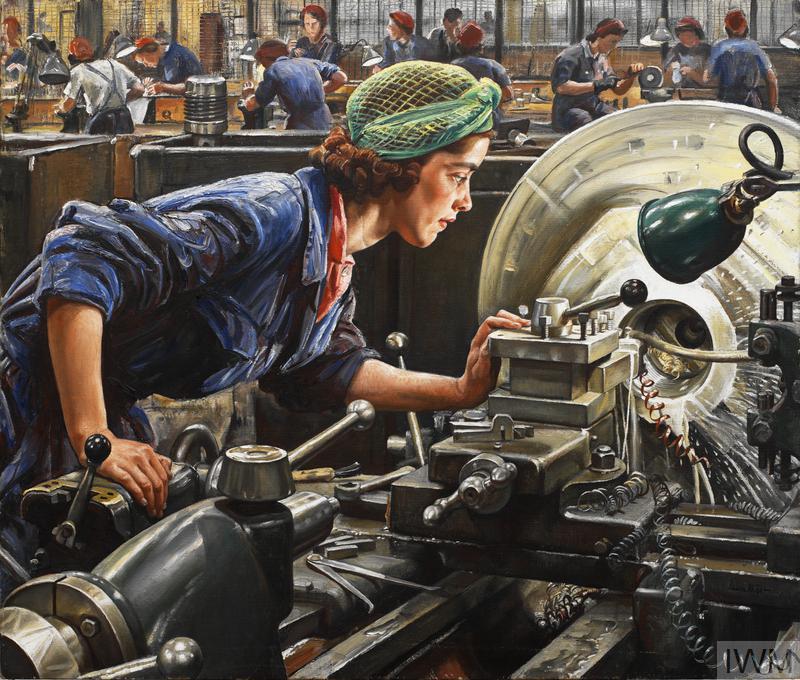
Ruby Loftus screwing a Breech-ring

portrait of a female factory worker operating a lathe during the Second World War.

Image: IWM (Art.IWM ART LD 2850)

Ruby Loftus had been brought to the attention of the War Artist’s Advisory Committee as ‘an outstanding factory worker’. 


Artist Laura Knight had originally expected to produce a studio portrait of Miss Loftus, however, the Ministry of Supply requested that she be painted at work in the Royal Ordnance Factory in Newport, South Wales. 

Here we see 21-year-old Ruby Loftus making a Bofors Breech ring, a task considered to be the most highly skilled job in the factory, normally requiring eight or nine years training. 


Ernest Bevin met with Ruby Loftus during a visit to No 11 Royal Ordnance Factory in 1943.  

See object record

Conscription of women

Women working in a Royal Ordnance Factory prepare for their shift in the "beauty parlour".

Image: IWM (HU 36287)

Women working in a Royal Ordnance Factory prepare for their shift in the “beauty parlour”.

From early 1941, it became compulsory for women aged between 18 and 60 to register for war work. Conscription of women began in December.

Unmarried ‘mobile’ women between the ages of 20 and 30 were called up and given a choice between joining the services or working in industry.

Pregnant women, those who had a child under the age of 14 or women with heavy domestic responsibilities could not be made to do war work, but they could volunteer. ‘Immobile’ women, who had a husband at home or were married to a serviceman, were directed into local war work.

As well as men and women carrying out paid war work in Britain’s factories, there were also thousands of part-time volunteer workers contributing to the war effort on top of their every day domestic responsibilities.

Other vital war work was carried out on the land and on Britain’s transport network.

WW2 Conscription

Conscription: the Second World War

Limited conscription of men

During the spring of 1939 the deteriorating international situation forced the British government under Neville Chamberlain to consider preparations for a possible war against Nazi Germany.  

Plans for limited conscription applying to single men aged between 20 and 22 were given parliamentary approval in the Military Training Act in May 1939. This required men to undertake six months’ military training, and some 240,000 registered for service.

Full conscription of men

On the day Britain declared war on Germany, 3 September 1939, Parliament immediately passed a more wide-reaching measure.

The National Service (Armed Forces) Act imposed conscription on all males aged between 18 and 41 who had to register for service. Those medically unfit were exempted, as were others in key industries and jobs such as baking, farming, medicine, and engineering.  

Conscientious objectors had to appear before a tribunal to argue their reasons for refusing to join-up. If their cases were not dismissed, they were granted one of several categories of exemption, and were given non-combatant jobs. 

Conscription helped greatly to increase the number of men in active service during the first year of the war. 

Conscription of women

In December 1941 Parliament passed a second National Service Act. It widened the scope of conscription still further by making all unmarried women and all childless widows between the ages of 20 and 30 liable to call-up.  

Men were now required to do some form of National Service up to the age of 60, which included military service for those under 51. The main reason was that there were not enough men volunteering for police and civilian defence work, or women for the auxiliary units of the armed forces. 

WW1 Biography of a serving soldier

William Francis Eve (1894-1981) was born in Clapham, London, on 22 September 1894, the son of Richard Edward Eve and Emmeline Augusta Eve. His father was a silversmith and the family lived at 9 Solon New Road, Clapham.

By 1911 William had moved in with his uncle Henry James Melhius and his wife Blanche Millicent at 3 Highworth Gardens, Midhurst Road, West Ealing, Middlesex. Around this time he also joined the Territorial Force, enlisting with The Queen’s Westminster Rifles.

Following the outbreak of war, Eve was called up on 26 August 1914 and joined his unit at its headquarters at 58 Buckingham Gate. Like most Territorial soldiers he immediately volunteered for ‘Foreign Service’.

After forming up at Hemel Hempstead, his battalion eventually landed at Le Havre on 2 November. The Queen’s Westminster Rifles were amongst the very first Territorials to enter the line as reinforcements for the hard-pressed British Expeditionary Force (BEF).

On recovering from trench foot, Eve was promoted to lance-corporal and eventually commissioned in September 1915 as a second lieutenant in the 2/6th (City of London) Battalion (Rifles), The London Regiment. Unfortunately, he developed epilepsy and was invalided from the Army in July 1916.

Eve settled at 79 Harrow View, Harrow, Middlesex. He married in 1922 and lived in Surrey where he died in February 1981.

WW1 Prime Minister during the Great War

David Lloyd George, 1st Earl Lloyd-George of Dwyfor (17 January 1863 – 26 March 1945) was Prime Minister of the United Kingdom from 1916 to 1922. A Liberal Party politician from Wales, he was known for leading the United Kingdom during the First World War, for social-reform policies, for his role in the Paris Peace Conference, and for negotiating the establishment of the Irish Free State.

Born in Chorlton-on-Medlock, Manchester, and raised in Llanystumdwy, Lloyd George gained a reputation as an orator and proponent of a Welsh blend of radical Liberal ideas that included support for Welsh devolution, the disestablishment of the Church of England in Wales, equality for labourers and tenant farmers, and reform of land ownership. He won an 1890 by-election to become the Member of Parliament for Caernarvon Boroughs, and was continuously re-elected to the role for 55 years. He served in Henry Campbell-Bannerman‘s cabinet from 1905. After H. H. Asquith succeeded to the premiership in 1908, Lloyd George replaced him as Chancellor of the Exchequer. To fund extensive welfare reforms, he proposed taxes on land ownership and high incomes in the 1909 People’s Budget, which the Conservative-dominated House of Lords rejected. The resulting constitutional crisis was only resolved after elections in 1910 and passage of the Parliament Act 1911. His budget was enacted in 1910, with the National Insurance Act 1911 and other measures helping to establish the modern welfare state. He was embroiled in the 1913 Marconi scandal but remained in office and secured the disestablishment of the Church of England in Wales.

In 1915, Lloyd George became Minister of Munitions and expanded artillery shell production for the war. In 1916, he was appointed Secretary of State for War but was frustrated by his limited power and clashes with Army commanders over strategy. Asquith proved ineffective as prime minister and was replaced by Lloyd George in December 1916. He centralised authority by creating a smaller war cabinet. To combat food shortages caused by u-boats, he implemented the convoy system, established rationing, and stimulated farming. After supporting the disastrous French Nivelle Offensive in 1917, he had to reluctantly approve Field Marshal Douglas Haig‘s plans for the Battle of Passchendaele, which resulted in huge casualties with little strategic benefit. Against British military commanders, he was finally able to see the Allies brought under one command in March 1918. The war effort turned in the Allies’ favour and was won in November. Following the December 1918 “Coupon” election, he and the Conservatives maintained their coalition with popular support.

Lloyd George was a leading proponent at the Paris Peace Conference of 1919, but the situation in Ireland worsened, erupting into the Irish War of Independence, which lasted until Lloyd George negotiated independence for the Irish Free State in 1921. At home, he initiated education and housing reforms, but trade-union militancy rose to record levels, the economy became depressed in 1920 and unemployment rose; spending cuts followed in 1921–22, and in 1922 he became embroiled in a scandal over the sale of honours and the Chanak Crisis. The Carlton Club meeting decided the Conservatives should end the coalition and contest the next election alone. Lloyd George resigned as prime minister, but continued as the leader of a Liberal faction. After an awkward reunion with Asquith’s faction in 1923, Lloyd George led the weak Liberal Party from 1926 to 1931. He proposed innovative schemes for public works and other reforms, but made only modest gains in the 1929 election. After 1931, he was a mistrusted figure heading a small rump of breakaway Liberals opposed to the National Government. In 1940, he refused to serve in Churchill’s War Cabinet. He was elevated to the peerage in 1945 but died before he could take his seat in the House of Lords.

Early life

David George was born on 17 January 1863 in Chorlton-on-Medlock, Manchester, to Welsh parents William George and Elizabeth Lloyd George. William died in June 1864 of pneumonia, aged 44. David was just over one year old. Elizabeth George moved with her children to her native Llanystumdwy in Caernarfonshire, where she lived in a cottage known as Highgate with her brother Richard, a shoemaker, lay minister and a strong Liberal. Richard Lloyd was a towering influence on his nephew and David adopted his uncle’s surname to become “Lloyd George”. Lloyd George was educated at the local Anglican school, Llanystumdwy National School, and later under tutors.

He was brought up with Welsh as his first language; Roy Jenkins, another Welsh politician, notes that, “Lloyd George was Welsh, that his whole culture, his whole outlook, his language was Welsh.”

Though brought up a devout evangelical, Lloyd George privately lost his religious faith as a young man. Biographer Don Cregier says he became “a Deist and perhaps an agnostic, though he remained a chapel-goer and connoisseur of good preaching all his life.” He was nevertheless, according to Frank Owen, “one of the foremost fighting leaders of a fanatical Welsh Nonconformity” for a quarter of a century.

Lloyd George c. 1890

Lloyd George qualified as a solicitor in 1884 after being articled to a firm in Porthmadog and taking Honours in his final law examination. He set up his own practice in the back parlour of his uncle’s house in 1885. Although many prime ministers have been barristers, Lloyd George is, as of 2025, the only solicitor to have held that office.

As a solicitor, Lloyd George was politically active from the start, campaigning for his uncle’s Liberal Party in the 1885 election. He was attracted by Joseph Chamberlain‘s “unauthorised programme” of Radical reform. After the election, Chamberlain split with William Ewart Gladstone in opposition to Irish Home Rule, and Lloyd George moved to join the Liberal Unionists. Uncertain of which wing to follow, he moved a resolution in support of Chamberlain at a local Liberal club and travelled to Birmingham to attend the first meeting of Chamberlain’s new National Radical Union, but arrived a week too early. In 1907 Lloyd George would tell Herbert Lewis that he had thought Chamberlain’s plan for a federal solution to the Home Rule Question correct in 1886 and still thought so, and that “If Henry Richmond, Osborne Morgan and the Welsh members had stood by Chamberlain on an agreement as regards the [Welsh] disestablishment, they would have carried Wales with them”

His legal practice quickly flourished; he established branch offices in surrounding towns and took his brother William into partnership in 1887.Lloyd George’s legal and political triumph came in the Llanfrothen burial case, which established the right of Nonconformists to be buried according to denominational rites in parish burial grounds, as given by the Burial Laws Amendment Act 1880 but theretofore ignored by the Anglican clergy. On Lloyd George’s advice, a Baptist burial party broke open a gate to a cemetery that had been locked against them by the vicar. The vicar sued them for trespass and although the jury returned a verdict for the party, the local judge misrecorded the jury’s verdict and found in the vicar’s favour. Suspecting bias, Lloyd George’s clients won on appeal to the Divisional Court of Queen’s Bench in London, where Lord Chief Justice Coleridge found in their favour. The case was hailed as a great victory throughout Wales and led to Lloyd George’s adoption as the Liberal candidate for Carnarvon Boroughs on 27 December 1888. The same year, he and other young Welsh Liberals founded a monthly paper, Udgorn Rhyddid (Bugle of Freedom).

In 1889, Lloyd George became an alderman on Carnarvonshire County Council (a new body which had been created by the Local Government Act 1888) and would remain so for the rest of his life.Lloyd George would also serve the county as a Justice of the Peace (1910), chairman of Quarter Sessions (1929–38), and Deputy Lieutenant in 1921.

Marriage

Lloyd George married Margaret Owen, the daughter of a well-to-do local farming family, on 24 January 1888. They had five children.

Early years as a member of Parliament (1890–1905)

Lloyd George’s career as a member of parliament began when he was returned as a Liberal MP for Caernarfon Boroughs (now Caernarfon), narrowly winning the by-election on 10 April 1890, following the death of the Conservative member Edmund Swetenham. He would remain an MP for the same constituency until 1945, 55 years later. Lloyd George’s early beginnings in Westminster may have proven difficult for him as a radical liberal and “a great outsider”.[10] Backbench members of the House of Commons were not paid at that time, so Lloyd George supported himself and his growing family by continuing to practise as a solicitor. He opened an office in London under the name of “Lloyd George and Co.” and continued in partnership with William George in Criccieth. In 1897, he merged his growing London practice with that of Arthur Rhys Roberts (who was to become Official Solicitor) under the name of “Lloyd George, Roberts and Co.”

Welsh affairs

Kenneth O. Morgan describes Lloyd George as a “lifelong Welsh nationalist” and suggests that between 1880 and 1914 he was “the symbol and tribune of the national reawakening of Wales“, although he is also clear that from the early 1900s his main focus gradually shifted to UK-wide issues. He also became an associate of Tom Ellis, MP for Merioneth, having previously told a Caernarfon friend in 1888 that he was a “Welsh Nationalist of the Ellis type”.

Decentralisation and Welsh disestablishment

One of Lloyd George’s first acts as an MP was to organise an informal grouping of Welsh Liberal members with a programme that included; disestablishing and disendowing the Church of England in Wales, temperance reform, and establishing Welsh home rule. He was keen on decentralisation and thus Welsh devolution, starting with the devolution of the Church in Wales saying in 1890: “I am deeply impressed with the fact that Wales has wants and inspirations of her own which have too long been ignored, but which must no longer be neglected. First and foremost amongst these stands the cause of Religious Liberty and Equality in Wales. If returned to Parliament by you, it shall be my earnest endeavour to labour for the triumph of this great cause. I believe in a liberal extension of the principle of Decentralization.”

During the next decade, Lloyd George campaigned in Parliament largely on Welsh issues, in particular for disestablishment and disendowment of the Church of England. When Gladstone retired in 1894 after the defeat of the second Home Rule Bill, the Welsh Liberal members chose him to serve on a deputation to William Harcourt to press for specific assurances on Welsh issues. When those assurances were not provided, they resolved to take independent action if the government did not bring a bill for disestablishment. When a bill was not forthcoming, he and three other Welsh Liberals (D. A. ThomasHerbert Lewis and Frank Edwards) refused the whip on 14 April 1894, but accepted Lord Rosebery‘s assurance and rejoined the official Liberals on 29 May.

WW1 How men were recruited for the war

How were people persuaded to join the army?

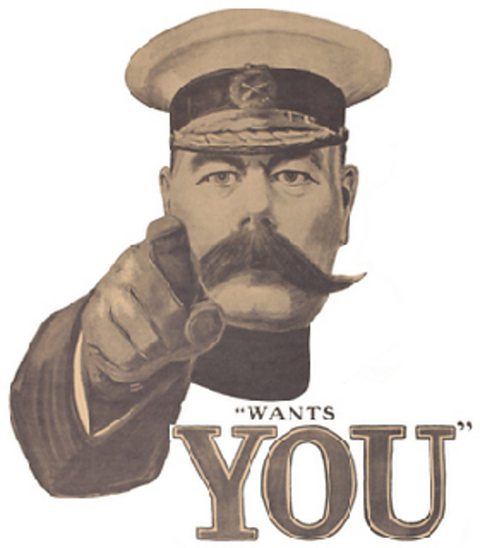
Original recruitment poster of Lord Kitchener pointing at the viewer

In August 1914, Lord Kitchener, the Secretary of State for War, realised Britain needed a bigger army.

He made a direct appeal to the men of Britain. Posters showed him pointing his finger at anyone passing by.

Men felt proud to fight for their country.

  • 54 million posters were issued.
  • 8 million letters were sent.
  • 12,000 meetings were held.
  • 20,000 speeches were given by military spokesmen.

In the first weekend of the war, 100 men an hour (3,000 a day) signed up to join the armed forces.

By the end of 1914 1,186,337 men had enlisted.

Who could join the army?

Image gallerySkip image gallery

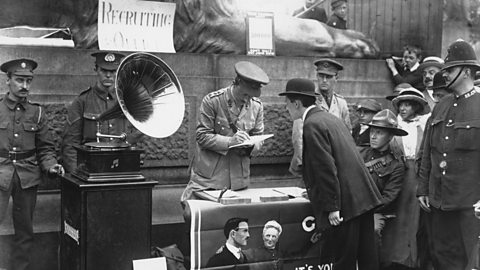
  1. Photograph of a man giving his name to an officer at a recruitment drive in Trafalgar Square during World War One
  2. Image caption,Recruitment drives were held in places like Trafalgar SquareOnly men aged between 18 and 41 could become soldiers. (The age limit was increased to 51 in April 1918.)
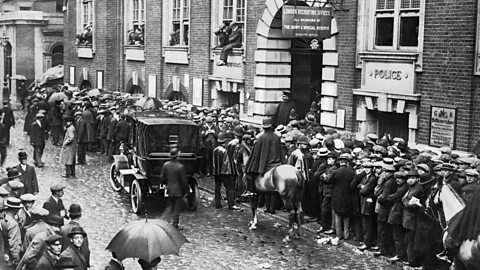
  3. Young men queuing eagerly along a street outside a recruitment station in World War One
  4. Image caption,Men queued outside recruitment offices to join the armySome men failed the medical test. Others had ‘reserved occupations’, like working in coal mines, shipyards, munitions factories and farms, which meant they stayed in Britain.
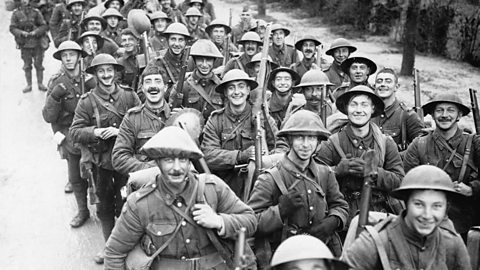
  5. A group of British soldiers in World War One smiling as they march to the trenches
  6. Image caption,Younger teenagers tried to join tooThey wanted to be treated like men and thought war would be exciting. Many lied about their age. Some boys as young as 13 or 14 went to war.

1. Photograph of a man giving his name to an officer at a recruitment drive in Trafalgar Square during World War One, 3.Recruitment drives were held in places like Trafalgar Square Only men aged between 18 and 41 could become soldiers. (The age limit was increased to 51 in April 1918.)

The Government wanted as many men as possible to join the forces willingly.

But in 1916 a law was passed to say men had to join whether they wanted to or not. This was called conscription.

WW1 How Britain got its food

During World War I, Britain primarily sourced its food through imports from its empire and other countries like the USA and Canada, as it only produced 40% of its food domestically. When German U-boats threatened these supply lines, Britain implemented a strict rationing system and a national propaganda campaign to increase domestic agricultural production, urging farmers to plow up more grassland and grow more cereals to feed the nation. 

Dependence on Imports

  • Pre-War Dependency:Before the war, Britain relied heavily on imported food, with roughly two-thirds of its food supply coming from overseas. 
  • Key Imports:Major food imports included wheat from the USA and Canada, meat from Argentina, and dairy products from Australia and New Zealand. 
  • Impact of War:The war effort required vast amounts of food for the civilian population and fodder for the large number of horses used for transport. 

The German Threat

  • Battle of the Atlantic:Germany aimed to starve Britain into submission by attacking Allied shipping, particularly in the Battle of the Atlantic. 
  • Food Shortages:These attacks led to increased shipping costs and food shortages, causing prices to rise rapidly, which resulted in panic buying and public discontent. 

Government and Public Response

  • Ministry of Food:A Ministry of Food was established to control prices, introduce rationing, and manage food distribution. 
  • Rationing System:A coupon system in ration books was introduced, requiring individuals to register at specific shops to purchase limited amounts of essential foods like sugar, butter, tea, and jam. 
  • “Dig for Victory”:To address food shortages, the government launched a propaganda campaign, including the “Dig for Victory” campaign, to encourage citizens to grow their own food to dig up their gardens etc
  • Increased Domestic Production:Farmers were encouraged and incentivized to increase domestic food production by converting grassland to arable land and cultivating more cereals to feed the nation. 
  • Land usage – every garden or piece of land was used to produce food for the masses to help farmers add to the food supply.

WW1 film ’17’ Directed by Sam Mendes. Based on his grandfathers experiences

Alfred was a Trinidadian and Tobagonian of Portuguese descent who served with the British Army during the First World War.

He fought for two years in Flanders and was awarded the Military Medal for bravely putting his own safety at risk to locate and rescue injured soldiers across No Man’s Land at the Battle of Passchendaele in mid-1917.

Due to his short stature, Alfred Mendes was often used as a messenger, having to brave No Man’s Land’s horrors and hazards.

Alfred recorded one incident in his autobiography.

On the morning of October 12, 1917, Alfred’s company received orders to “go forward to meet him with fixed bayonets”, if the German Army were encountered. 
Alfred’s C Company had lost contact with A, B and D Companies. Alfred, highly aware of the dangers sending a lone messenger into No Man’s Land brings, immediately volunteered to find the missing companies.

“The snipers got wind of me, and their individual bullets were soon seeking me out,” wrote Alfred, “until I came to the comforting conclusion that they were so nonplussed at seeing a lone man wandering circles about No Man’s Land, as must at times have been the case, that they decided, out of perhaps a secret admiration for my nonchalance, to dispatch their bullets safely out of my way.”

Alfred managed to find the wayward units and spent two days carrying messages between the companies. He returned “without a scratch but certainly with a series of hair-raising experiences that would keep my grand-and great-grandchildren enthralled for nights on end.”

In an interview with Variety, Sam Mendes said he had a childhood memory of Albert sharing a story about a “messenger who has a message to carry through”.
“It lodged with me as a child, this story or this fragment, and obviously I’ve enlarged it and changed it significantly,” Mendes said.

Ultimately, the story Sam Mendes told in 1917 of the pair of Lance-Corporals is fictional, insofar as there was no specific mission undertaken by Blake and Schofield to halt an attack on German lines on 6th April 1917.

However, the look and feel of the film 1917 is such, coupled with the urgency of the cinematography and performances, that it feels sufficiently authentic, as much as the popular image of World War One is often depicted.

But what about 1917’s historical accuracy? The movie strives for authenticity in the action and imagery it offers, but are the events depicted in line with the British or Commonwealth soldier’s experiences on the Western Front?

What is historically accurate about the movie 1917?

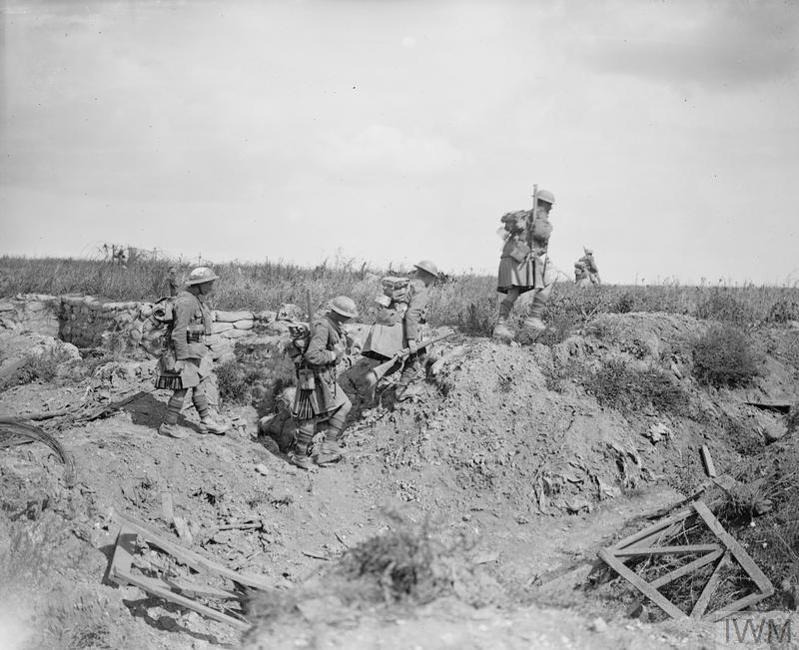
A troop of Black Watch WW1 era British soldiers going over the top of a set of trenches.

Image: British soldiers go over the top on the Western Front (© IWM Q 7009)

Sam Mendes employed historical and technical advisors Andrew Robertshaw and Paul Biddiss to work on the film. Their knowledge helped ground the actors in the physical and historical context of that specific period.

One of the key plot points is the sudden German withdrawal from the section of the line near Ecoust, northern France. The British Army had been caught unawares and the retreating Germans had left a blighted, scored land, stripped of resources and infrastructure, for the British to navigate.

This has a strong basis in reality. On 5th April 1917, the Imperial German Army completed Operation Alberich: a strategic retreat aimed at shortening the German line and strengthening new positions across the newly built Hindenburg Line.

The devastation wrought during Alberich was huge. Anything the Allies could use (pipes, cables, roads, bridges, tunnels, and even entire villages) was smashed to pieces. 

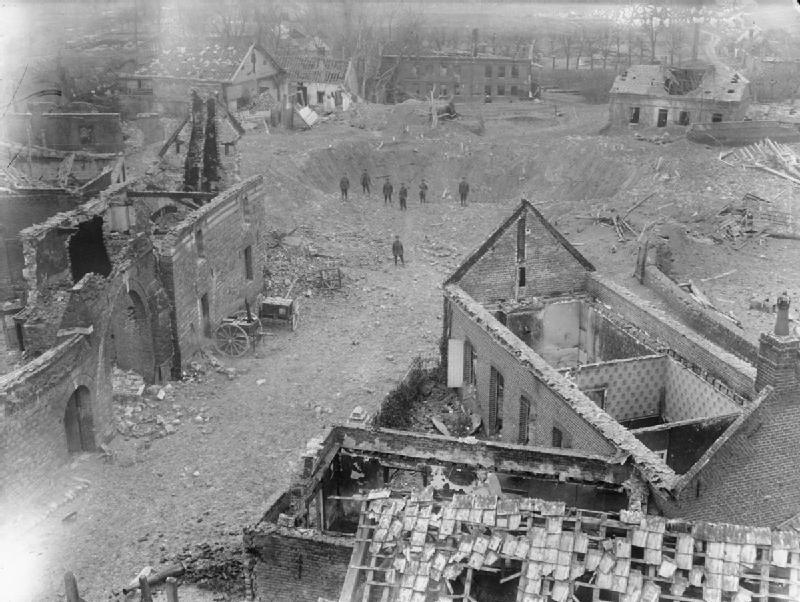
Mine crater in Athies, April 1917

Image: A mine crater in Athies, Pas-de-Calais, blasted to impede any British advance following Operation Alberich (Wikimedia Commons)

1917 also depicts many black and Sikh soldiers on the frontline to show this “wasn’t a war fought just by white men”.

Image: A Great War-era Sikh soldier. While Sikhs fought in great numbers on European battlefields, by the time of the film 1917’s events, they had been moved to other theatres (© IWM Q 24754)

The First World War was truly a global conflict, bringing in people and cultures from across the world to fight. Mendes is entirely right to point out this wasn’t simply a white man’s war, but the manner in which soldiers are presented is inaccurate.

Tens of thousands of black soldiers served with the British Army and many hundreds of thousands of black Africans served as part of the labour corps during the war. For instance, the British West Indian Regiment sent 15,000 men from the Caribbean to Europe to serve but their roles were restricted to support and logistical duties.

Likewise, Sikh and Indian personnel fought across the battlefields of the Great War. More than 74,000 Indian personnel of World War One are in Commonwealth War Graves’ care.

In the case of the movie 1917, however, the Sikh regiments had long since transferred away from the Western Front. After fighting in the brutal campaigns of 1915 at Neuve Chapelle, Ypres, and the Somme, the Sikhs had taken major casualties and transferred to other theatres of conflict.

At the time of 1917’s fictional story, no Sikh soldiers would have been in France or Belgium, and it would be unlikely to see a single Sikh soldier mixing in with British units as shown in the movie 1917.

Another inaccuracy is the care of wounded troops.

In 1917, as casualties mount, wounded men are taken to a casualty clearing station, just metres from the frontline. Medical tents spread out over an open field as surgeons do their level best to aid their injured comrades.

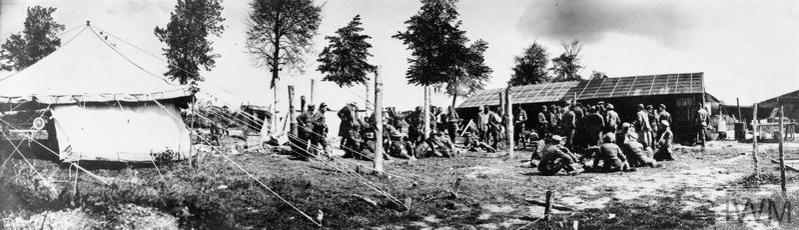
A World War One casualty clearing station showing various huts and wounded soldiers waiting for treatment outside.

Image: A Great War Casualty Clearing Station. Such stations would be far from the frontline, unlike the facility shown in 1917 (© IWM CO 3151)

The reality of getting wounded treatment was significantly more complex. Sometimes, depending on the nature of the battlefield, aid posts could be on the frontlines.

It is very unlikely, however, that they would set up a major medical hub so close to the front with little to no cover as depicted in 1917.

These places were hugely important but vulnerable, so would be built in abandoned buildings, underground bunkers, and even shell craters. Keeping them out in the open would present unnecessary danger.

Returning to 1917’s historical accuracies, it’s worth highlighting the touching interaction between Schofield and a French civilian nursing a baby amid the rubble of a shattered Ecoust. While this scenario is fictional it has its roots in reality. 

One of the objectives of Operation Alberich was to ensure as many French and Belgian refugees stayed in the Allied sector as possible.

Why? Extra mouths to feed. More civilians in Allied care meant more resources diverted to feed, clothe, and house them. In a conflict such as the First World War, any way to disadvantage your opponent must be explored. 

The devastation wrought on Ecoust is accurate too. Towns and villages across Northern France and Flanders were obliterated wholesale. Look at Ypres for example.

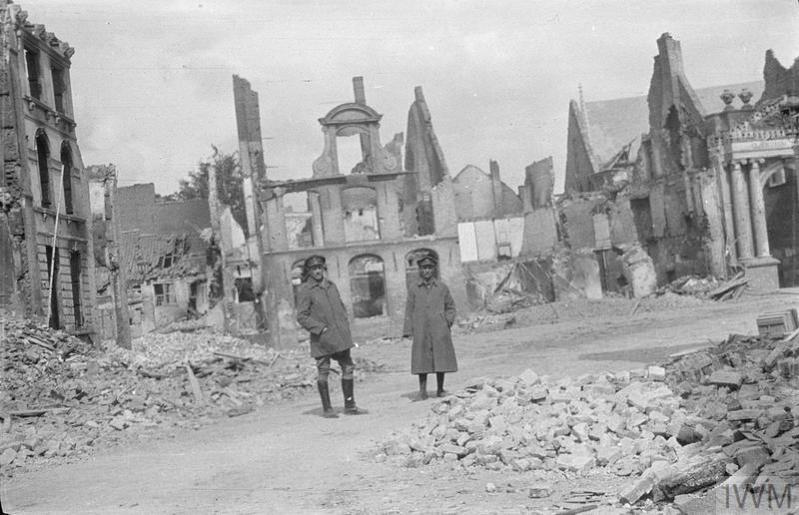
Two British soldiers standing amidst the devastation of Ypres town centre during World War One.

Image: Two soldiers stand amidst the devastation of Ypres town centre. Towns and villages across France and Flanders suffered a similar fate during the Great War, something 1917 accurately depicts (© IWM Q 56727)

The city was reduced to rubble and had to be built from the ground up post-war.

Overall, 1917 veers towards historical accuracy but many liberties have been taken to tell the story Sam Mendes wanted to tell. This is often the case.

Take for instance the film’s final British charge.

Once the whistle blows, the British infantry stream over the top in a solid mass with little attempt at unit cohesion. There’s no artillery support either, indicating this attack really would have been suicidal if Schofield hadn’t completed his mission.

In reality, all along the front Officers and Non-Commission Officers would be amongst their men, keeping them together, and guiding the attack. World War One infantry assaults were not simply picking up a gun and running at the enemy as presented in 1917’s climax.

How accurate were the trenches in 1917?

Trenches are probably the first thing people think of when they think of the Western Front.

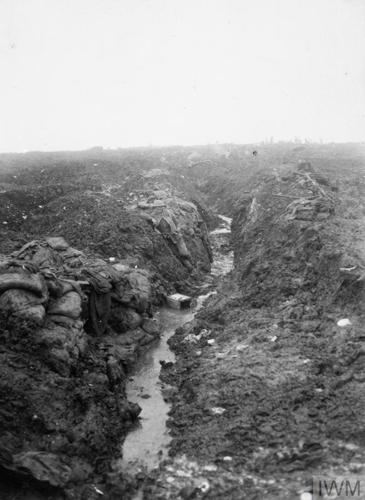
A section of flooded trench on the Western FrontImage: A section of flooded British trench (© IWM E(AUS) 575)

Hundreds of miles of trenches were dug across the war, stretching from Calais in Northern France to the Swiss border (although not in one continuous, unbroken line).

1917 presents trenches in different states.

We start with a British reserve trench in good condition, topped with sandbags and well-ordered dugouts. Troops mill to and forth on their way to their reserve areas or to move onto the frontline.

Elsewhere, we get a glimpse of British frontline trenches, replete with shell damage, puddles of mud, hungry opportunistic rats, and exhausted soldiers sheltering and snatching sleep while they can.

We see abandoned German trenches too: deeper, sturdier with large-scale bunkhouses, kitchens, and storage sections.

As a war film, 1917 presents an accurate portrayal of trench life. The rear communication and transport trenches are in better condition than the more robust, damaged frontline trenches.

One thing you may notice about the frontline troops is the boredom. 1917’s crew charged the extras with taking on soldiers’ daily routines to add to the sense of monotony many at the front experienced.

Fighting was only a small part of trench life. 1917 shows this by showing soldiers inspecting their clothes for lice, cleaning their boots, scooping mud, and water out of the trench, playing games like chess or cards, reading novels, or simply trying to sleep.

The historical context of WW1

1917 was a tumultuous year for the Allies.

February saw the German Navy recommence unrestricted submarine warfare in the Atlantic. Any ship crossing the ocean was fair game for German submariners. Over a million tons of Allied shipping was lost in February 1917 alone.

On the real April 6, 1917, the date on which the film’s fictional events take place, the United States declared war on Imperial Germany. This would have major consequences for Germany, as it was now facing the prospect of millions of fresh, well-equipped troops being sent to the Western Front. 

Major offensives that took place in 1917 include the Battle of Arras in April 1917, which included the stunning Canadian victory at Vimy, but the year is mostly dominated by Passchendaele.

The Third Battle of Ypres, also known as the Battle of Passchendaele, took place between July and November in the Ypres Salient in Belgium, Ypres.

Passchendaele is one of the defining battles of the First World War. It drew in millions of men on both sides, resulting in hundreds of thousands of casualties and deaths. Soldiers attacked through the churning bogs of No Man’s Land to be cut down by determined defenders.

Ultimately, the British Army advanced five miles and captured the important high ground around Ypres. Casualties were still shockingly high for such a comparatively small gain.

1917, the war film, really takes place in the opening stages that would go on to be a pivotal year in the course of the First World War.

Remembering the fallen soldiers of World War One

While the trials and tribulations of Lance-Corporal Blake and Schofield across 1917 are fictional, they draw heavily on the reality of the war. And for many, the Great War’s reality was also tinged with finality.

At the Commonwealth War Graves Commission, we are charged with caring for the Commonwealth’s war dead in perpetuity. 

An interesting production quirk of the 1917 film was all the extras playing British soldiers were given a real-life soldier to inhabit. Many of these men would not survive the war.

Commonwealth casualties of the First World War are instead commemorated in our war cemeteries. 

For instance, 1917 showcases the Devonshires charging into battle, with troops cut down by machine-gun bullets or artillery blasts.

But did you know the Devonshires have their own small war cemetery maintained by Commonwealth War Graves?

Image: Devonshire Cemetery, Mametz

Devonshire Cemetery, Mametz, marks the spot of the 8th and 9th Battalions of the Devonshire Regiment’s positions on the first day of the Battle of the Somme. 153 Devonshires are buried in the cemetery to this day.

If a casualty fell during the World War One but has no known war grave, they would be commemorated on a WW1 memorial, such as the Menin Gate or Thiepval Memorial.

1917 may have been fiction but our mission is very real.

Do you have a Blake or a Schofield in your family? If they fell in the First World War, they are commemorated by us, and we can help you uncover their story.

Use our Find War Dead tool to uncover their stories. Search by name, rank, country commemorated in, and many more fields designed to make your casualty search as smooth as possible. 

WW1 James Burns a Gunner in Northumberland Fuseliers

James Burns was born in Newcastle in 1897. He had 8 brothers and sisters and his eldest sister Mary who was 18 years old took care of the family as their parents had died very young. There was not alot of money as their was no welfare state then. They did have aunts and uncles who helped them.

James lied about his age to join the Army and said he was born in 1896 which made him 18 but he was actually only 16 because his birthday was not till the September. So when world war one came in August 1914 he could join up to the Army and not be a burden to his family. He would have somewhere to lay his head and be fed three times a day.

They were dark days and he was given the role of a gunner in the Northumbria Fuseliers. The big guns which were pulled by horses. So the gunners had to look after the horses as well feed them take care of them and get them water to drink.

The men had to created latrines for the men each time they decided their base for operations. Set up a food station and a medical tent. Alot of soldiers worked in wet mud most of the time and suffered from trench foot. Fleas had to be burned out the the seams in their uniform which came from the rats looking for food which lived in the trenches with them. A candle was run up the seams to kill the fleas but it was just as bad the nest day.

Many a time the food run out because of war supplies were often cut off from the front line. The red cross used to give the men tins of corned beef to survive on and many said they would have starved if the Red Cross had not been so brave and kind.

Dysentry was also a problem because of the filth not being able to wash your hand before eating or after going to the toilet. Germs passed from one person to another.

James was wounded and had a metal plate in his head after an explosion and was also gassed in the trenches. The guns were targetted by the Germans who tried to blow them up with mortar shells and bombs.

James met Agnes Elizabeth Todd born in August 1901 in Newcastle where she was in service to a Lord and Lady when he was 25 years old and she was 21 years old. They married in 1922 and had three children two girls and a boy. James first in 1925, Mary in 1927 and Agnes in 1928.

James died in 1953 of stomach cancer form the gassing but he did get to hold his grand daughter before he died. The only grandchild born from Mary his daughter. His son James died aged 47 years in 1975 after suffering for many years from Epilepsy endured in a fall as a trainee plumber by falling off a roof. He married but had no children.

Agnes died aged 60 years in 1989 from complications of medication for Rhematoid Arthritis which she developed in her 20’s. She married but had no children.

James wife Agnes died in 1988 aged 87 years of heart problems after a life of hard work and looking after a wounded husband.

Mary their daughter lived to a great age of 97 years she too worked hard as a tailoress and was widowed at 35 years. Her husband was a carpenter and was working away from home and died in a car crash.

Nothing is known of the 8 brothers and sisters James Burns had and nothing is known why his parents died so young, but the spanish influenza took many in the early days of the century. Many children did not live passed the age of 5 years as chicken pox, measles, whooping cough, influenza, was rife with no immunisations available in those days.

WW1 and the Red Cross who saved many lives with their support.

For weary refugees and prisoners of war, treasure was a bar of soap and a handkerchief.

Volunteer Ann Curtis, from Suffolk, knew a lot about this kind of treasure. She put in 88 hours of needlework to create individual treasure bags.

“About 1200 officers and men arriving in Switzerland for internment from Germany were provided with chintz treasure bags containing washing materials, handkerchiefs etc, which were very popular,” reported the Red Cross.

“Indeed, many of the bags were recognised three months later at the general repatriation doing duty as hand luggage.

“About 3,000 of these fitted bags were handed to the prisoners passing through Switzerland on their way home from Germany after the Armistice.

“Another 550 were given to civilian refugees passing through from Austria, Poland, Hungary, etc and were quite invaluable to the women, many of whom were accompanied by small children.”

The organisation relied on hundreds of volunteers like Ann to stitch, sew and knit products for prisoners of war and hospital and wards.

The Red Cross issued material and standard patterns to follow. Hour after hour, knitting needles clicked and scissors snipped in communities across the UK.

When she wasn’t sewing treasure bags, Ann Curtis made hot water bottle covers.

Eighty-three-year-old volunteer Martha Antobus in Cheshire knitted 40 pairs of woolly socks.

And Mr Stevenette, described as “an old gentleman of over 80, knitted 44 mufflers – his knitting exceeded all other workers.”

Pomeranian dog

There was such huge demand for these items that in 1915 the Red Cross set up the Central Work Rooms. Throughout the war over 1,200 women worked in these London offices. They produced 705,500 bandages and 75,530 garments ranging from hot water bottle covers, pyjamas, dressing gowns and kitbags to pants, surgeon’s gowns, socks and pillow cases.

They used flannel, sheep’s wool and even some dog’s wool made from long-haired breeds such as Pekinese and Pomeranians.

Sewing all these garments was not without its perils. VAD nurse Helen Beale wrote to her family:

“We are very pleased this evening as the pin that the girl swallowed on Wednesday last has just emerged safely – she has been having cotton wool sandwiches and suet pudding etc. It really is rather wonderful to think that it has travelled so far inside her without pricking!” 

Sometimes ‘doing your bit’ meant getting your feet wet.

During both world wars you could find children and adults doing their bit by getting muddy and wet in peat bogs. They were collecting sphagnum moss, a small, bright green plant that was often called ‘bog moss’. It was a time-consuming, cold and uncomfortable job.

The moss was harvested and dried on an industrial scale, particularly during the First World War. In those days, before antibiotics, this moss was mildly antiseptic and could soak up a lot of fluid.

In short, it was a brilliant wound dressing.

In Ireland, Red Cross sphagnum moss centres were set up in every county. Women volunteers collected enough sphagnum moss to make close to one million dressings.

Close up of someone walking barefoot through mud

Ethel Adams was one of these women. Volunteering in County Tyrone, Ethel gathered sphagnum moss almost full time. She picked, gathered and dried the moss, sending it off to the Red Cross depots in Belfast and Armagh. She paid for the postage herself as another way to support the cause.

“In County Tyrone, sphagnum moss depots did continuous work from 1916 to October 1918,” recorded the Red Cross journal.

“Sending their supplies to Derry and Belfast, they were manufactured into dressings, the moss from this county having been considered of exceptionally good quality.”

Ethel did not just collect moss on her own – she organised a local group to gather as much as possible.

As if that wasn’t enough, she then volunteered at the Belfast moss depot. Here she clocked up 100 hours of volunteering in just three months. Ethel received a war workers badge in recognition of her efforts.

If you think hospital food is bad today, spare a thought for patients during the First World War.

Hospital caterers had a budget of just 20 pence per day to cook up a varied diet for one patient. Anything more expensive was considered an extravagance.

Then food shortages began in 1917. By this time the Red Cross was running temporary hospitals across the UK. Known as auxiliary hospitals, they treated injured servicemen – but they also had to feed them. We worked with the Ministry of Food and the War Office to ensure our patients had enough to eat.

A meager meal
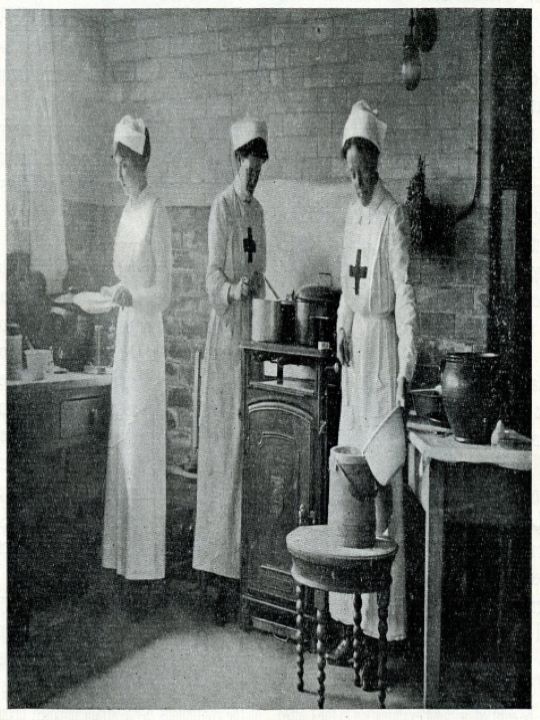
Three volunteers preparing a meal at a Red Cross hospital

Anne Auden was a Girl Guide who volunteered in the kitchens of Brookdale Red Cross hospital at Alderley Edge, Cheshire. For more than two years she popped in every week to roll up her sleeves and peel hundreds of potatoes.

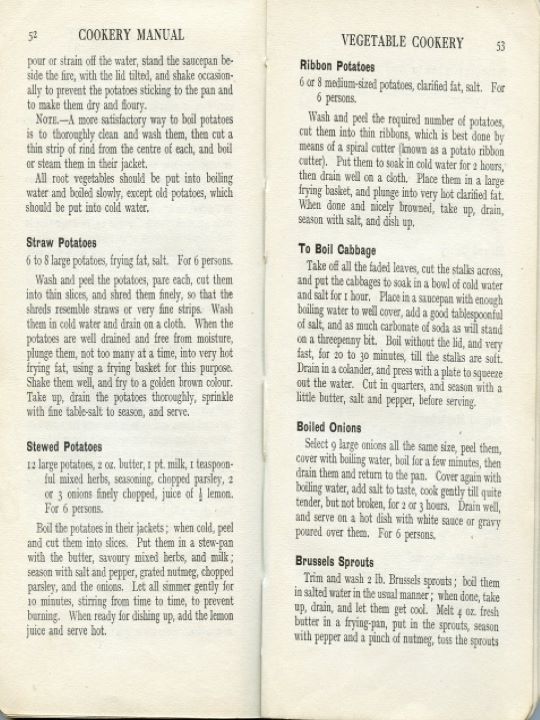
The Red Cross produced a cookery manual suggesting different ways to cook potatoes for patients (boil, stew, bake and fry in ‘ribbons or ‘straws’).

Many favourite foods – sugar, tea, meat, margarine, butter, cheese, fish, suet, golden syrup and jam – were all in limited supply. Bacon was off the menu as it was sold at double its pre-war price.

Breakfast in a Red Cross hospital was, therefore, porridge, cold boiled ham or fishcakes.

Dinner might be stewed tripe, boiled mutton, tapioca and savoury hash – no doubt made from some of Anne’s peeled potatoes.

For afters there were baked jam rolls, rhubarb and custard or bread and butter pudding. But some cooks struggled to get the recipes quite right…

One woman volunteered at a Red Cross hospital as a kitchen maid. In the topsy turvy world of the war, old class divides were often blurred. Women from rich families volunteered alongside working class women and girls.

This particular woman found herself serving as a kitchen maid to her own cook. But she did not share her cook’s expertise.

The Red Cross journal from 1916 reports that this woman “had been in trouble several times for her incompetence, and was passing a sleepless night of worry in connection with a lemon sponge.” It had not come right, and she knew what awaited her in the morning.

“Suddenly she had an idea. Rising from her bed, she crept to the kitchen… What exactly she did will never be known, but a message of thanks came down from the ward next day, with the comment that it was the best bread-and-butter pudding the patients had ever tasted.”

British Red Cross cookery manual excerpt on preparing vegetables