Soviet troops reportedly raped German women and girls, with total victim estimates ranging from tens of thousands to two million. During and after the occupation of Budapest, (Hungary), an estimated 50,000 women and girls were raped. Regarding rapes that took place in Yugoslavia, Stalin responded to a Yugoslav partisan leader’s complaints saying, “Can’t he understand it if a soldier who has crossed thousands of kilometres through blood and fire and death has fun with a woman or takes some trifle?”
In former Axis countries, such as Germany, Romania and Hungary, Red Army officers generally viewed cities, villages and farms as being open to pillaging and looting. For example, Red Army soldiers and NKVD members frequently looted transport trains in 1944 and 1945 in Poland and Soviet soldiers set fire to the city centre of Demmin while preventing the inhabitants from extinguishing the blaze, which, along with multiple rapes, played a part in causing over 900 citizens of the city to commit suicide. In the Soviet occupation zone of Germany, when members of the SED reported to Stalin that looting and rapes by Soviet soldiers could result in negative consequences for the future of socialism in post-war East Germany, Stalin reacted angrily: “I shall not tolerate anybody dragging the honour of the Red Army through the mud.” Accordingly, all evidence of looting, rapes and destruction by the Red Army was deleted from archives in the Soviet occupation zone.
According to recent figures, of an estimated 4 million POWs taken by the Russians, including Germans, Japanese, Hungarians, Romanians and others, some 580,000 never returned, presumably victims of privation or the Gulags, compared with 3.5 million Soviet POW who died in German camps out of the 5.6 million taken.
On 22 June 1941, Hitler launched an invasion of the Soviet Union with the largest invasion force in history, leading to some of the largest battles and most horrific atrocities. Operation Barbarossa comprised three army groups. The city of Leningrad was besieged while other major cities fell to the Germans during the invasion. Despite initial successes, the German offensive halted to a stop in the Battle of Moscow, and the Soviets launched a counteroffensive, pushing the Germans back. The failure of Operation Barbarossa reversed the fortunes of Germany. Stalin was confident that the Allied war machine would eventually defeat Germany. The Soviet Union repulsed Axis attacks, such as in the Battle of Stalingrad and the Battle of Kursk, which marked a turning point in the war. The Western Allies provided support to the Soviets in the form of Lend-Lease as well as air and naval support. Stalin met with Winston Churchill and Franklin D. Roosevelt at the Tehran Conference and discussed a two-front war against Germany and the future of Europe after the war. The Soviets launched successful offensives to regain territorial losses and began a push to Berlin. The Germans unconditionally surrendered in May 1945 after Berlin fell.
The bulk of Soviet fighting took place on the Eastern Front—including the Continuation War with Finland—but it also invaded Iran in August 1941 with the British, and the Soviets later entered the war against Japan in August 1945, which began with an invasion of Manchuria. The Soviets had border conflicts with Japan up to 1939 before signing a non-aggression pact with Japan in 1941. Stalin had agreed with the Western Allies to enter the war against Japan at the Tehran Conference in 1943 and at the Yalta Conference in February 1945 once Germany was defeated. The entry of the Soviet Union in the war against Japan along with the atomic bombings by the United States led to Japan to surrender, marking the end of World War II.
The Soviet Union suffered the greatest number of casualties in the war, losing more than 20 million citizens, about a third of all World War II casualties. The full demographic loss to the Soviet people was even greater.The German Generalplan Ost aimed to create more Lebensraum (lit. ’living space’) for Germany through extermination. An estimated 3.5 million Soviet prisoners of war died in German captivity as a result of deliberate mistreatment and atrocities, and millions of civilians, including Soviet Jews, were killed in the Holocaust. However, at the expense of a large sacrifice, the Soviet Union emerged as a global superpower.[6] The Soviets installed dependent communist governments in Eastern Europe, and tensions with the United States became known as the Cold War.
During the 1930s, Soviet foreign minister Maxim Litvinov emerged as a leading voice for the official Soviet policy of collective security with the Western powers against Nazi Germany. In 1935, Litvinov negotiated treaties of mutual assistance with France and with Czechoslovakia with the aim of containing Hitler’s expansion.[8] After the Munich Agreement, which gave parts of Czechoslovakia to Nazi Germany, the Western democracies’ policy of appeasement led the Soviet Union to reorient its foreign policy towards a rapprochement with Germany. On 3 May 1939, Stalin replaced Litvinov, who was closely identified with the anti-German position, with Vyacheslav Molotov.
In August 1939, Stalin accepted Hitler’s proposal into a non-aggression pact with Germany, negotiated by the foreign ministers Vyacheslav Molotov for the Soviets and Joachim von Ribbentrop for the Germans. Officially a non-aggression treaty only, an appended secret protocol, also reached on 23 August, divided the whole of eastern Europe into German and Soviet spheres of influence. The USSR was promised the eastern part of Poland, then primarily populated by Ukrainians and Belarusians, in case of its dissolution, and Germany recognised Latvia, Estonia and Finland as parts of the Soviet sphere of influence,[11] with Lithuania added in a second secret protocol in September 1939. Another clause of the treaty was that Bessarabia, then part of Romania, was to be joined to the Moldovan SSR, and become the Moldovan SSR under control of Moscow.
The pact was reached two days after the breakdown of Soviet military talks with British and French representatives in August 1939 over a potential Franco-Anglo-Soviet alliance. Political discussions had been suspended on 2 August, when Molotov stated that they could not be resumed until progress was made in military talks late in August, after the talks had stalled over guarantees for the Baltic states, while the military talks upon which Molotov insisted started on 11 August. At the same time, Germany—with whom the Soviets had started secret negotiations on 29 July– argued that it could offer the Soviets better terms than Britain and France, with Ribbentrop insisting, “there was no problem between the Baltic and the Black Sea that could not be solved between the two of us.” German officials stated that, unlike Britain, Germany could permit the Soviets to continue their developments unmolested, and that “there is one common element in the ideology of Germany, Italy and the Soviet Union: opposition to the capitalist democracies of the West”. By that time, Molotov had obtained information regarding Anglo-German negotiations and a pessimistic report from the Soviet ambassador in France.
Soviet cavalry on parade in Lviv (then Lwów), after the city’s surrender during the 1939 Soviet invasion of Poland
After disagreement regarding Stalin’s demand to move Red Army troops through Poland and Romania (which Poland and Romania opposed),on 21 August, the Soviets proposed adjournment of military talks using the pretext that the absence of the senior Soviet personnel at the talks interfered with the autumn manoeuvres of the Soviet forces, though the primary reason was the progress being made in the Soviet-German negotiations. That same day, Stalin received assurance that Germany would approve secret protocols to the proposed non-aggression pact that would grant the Soviets land in Poland, the Baltic states, Finland and Romania, after which Stalin telegrammed Hitler that night that the Soviets were willing to sign the pact and that he would receive Ribbentrop on 23 August. Regarding the larger issue of collective security, some historians state that one reason that Stalin decided to abandon the doctrine was the shaping of his views of France and Britain by their entry into the Munich Agreement and the subsequent failure to prevent the German occupation of Czechoslovakia. Stalin may also have viewed the pact as gaining time in an eventual war with Hitler in order to reinforce the Soviet military and shifting Soviet borders westwards, which would be militarily beneficial in such a war.
Stalin and Ribbentrop spent most of the night of the pact’s signing trading friendly stories about world affairs and cracking jokes (a rarity for Ribbentrop) about Britain’s weakness, and the pair even joked about how the Anti-Comintern Pact principally scared “British shopkeepers.” They further traded toasts, with Stalin proposing a toast to Hitler’s health and Ribbentrop proposing a toast to Stalin.
The division of Eastern Europe and other invasions
German and Soviet soldiers at the parade in Brest in front of a photo of Stalin
Planned and actual territorial changes in Eastern and Central Europe 1939–1940 (click to enlarge)Part of the 5 March 1940 memo from Lavrentiy Beria to Stalin proposing execution of Polish officers
After taking around 300,000 Polish prisoners in 1939 and early 1940, NKVD officers conducted lengthy interrogations of the prisoners in camps that were, in effect, a selection process to determine who would be killed.On March 5, 1940, pursuant to a note to Stalin from Lavrenty Beria, the members of the Soviet Politburo (including Stalin) signed and 22,000 military and intellectuals were executed – They were labelled “nationalists and counterrevolutionaries”, kept at camps and prisons in occupied western Ukraine and Belarus. This became known as the Katyn massacre. Major-GeneralVasili M. Blokhin, chief executioner for the NKVD, personally shot 6,000 of the captured Polish officers in 28 consecutive nights, which remains one of the most organized and protracted mass murders by a single individual on record. During his 29-year career Blokhin shot an estimated 50,000 people, making him ostensibly the most prolific official executioner in recorded world history.
In August 1939, Stalin declared that he was going to “solve the Baltic problem, and thereafter, forced Lithuania, Latvia and Estonia to sign treaties for “mutual assistance.”
In November 1939, the Soviet Union invaded Finland. The Finnish defensive effort defied Soviet expectations, and after stiff losses, as well as the unsuccessful attempt to install a puppet government in Helsinki, Stalin settled for an interim peace granting the Soviet Union parts of Karelia and Salla (9% of Finnish territory). Soviet official casualty counts in the war exceeded 200,000, while Soviet Premier Nikita Khrushchev later claimed the casualties may have been one million. After this campaign, Stalin took actions to modify training and improve propaganda efforts in the Soviet military.
In mid-June 1940, when international attention was focused on the German invasion of France, Soviet NKVD troops raided border posts in the Baltic countries.Stalin claimed that the mutual assistance treaties had been violated, and gave six-hour ultimatums for new governments to be formed in each country, including lists of persons for cabinet posts provided by the Kremlin. Thereafter, state administrations were liquidated and replaced by Soviet cadres, followed by mass repression in which 34,250 Latvians, 75,000 Lithuanians and almost 60,000 Estonians were deported or killed. Elections for parliament and other offices were held with single candidates listed, the official results of which showed pro-Soviet candidates approval by 92.8 percent of the voters of Estonia, 97.6 percent of the voters in Latvia and 99.2 percent of the voters in Lithuania. The resulting peoples’ assemblies immediately requested admission into the USSR, which was granted. In late June 1940, Stalin directed the Soviet annexation of Bessarabia and northern Bukovina, proclaiming this formerly Romanian territory part of the Moldavian SSR. But in annexing northern Bukovina, Stalin had gone beyond the agreed limits. The invasion of Bukovina violated the pact, as it went beyond the Soviet sphere of influence agreed with Germany.
After the Tripartite Pact was signed by Axis Powers Germany, Japan and Italy, in October 1940, Stalin personally wrote to Ribbentrop about entering an agreement regarding a “permanent basis” for their “mutual interests.” Stalin sent Molotov to Berlin to negotiate the terms for the Soviet Union to join the Axis and potentially enjoy the spoils of the pact. At Stalin’s direction, Molotov insisted on Soviet interest in Turkey, Bulgaria, Romania, Hungary, Yugoslavia and Greece, though Stalin had earlier unsuccessfully personally lobbied Turkish leaders to not sign a mutual assistance pact with Britain and France. Ribbentrop asked Molotov to sign another secret protocol with the statement: “The focal point of the territorial aspirations of the Soviet Union would presumably be centered south of the territory of the Soviet Union in the direction of the Indian Ocean.” Molotov took the position that he could not take a “definite stand” on this without Stalin’s agreement. Stalin did not agree with the suggested protocol, and negotiations broke down. In response to a later German proposal, Stalin stated that the Soviets would join the Axis if Germany foreclosed acting in the Soviet’s sphere of influence. Shortly thereafter, Hitler issued a secret internal directive related to his plan to invade the Soviet Union.
Photo from 1943 exhumation of mass grave of Polish officers killed by NKVD in the Katyn Forest in 1940
In an effort to demonstrate peaceful intentions toward Germany, on 13 April 1941, Stalin oversaw the signing of a neutrality pact with Japan. Since the Treaty of Portsmouth, Russia had been competing with Japan for spheres of influence in the Far East, where there was a power vacuum with the collapse of Imperial China. Although similar to the Molotov–Ribbentrop Pact with the Third Reich, that Soviet Union signed Soviet–Japanese Neutrality Pact with the Empire of Japan, to maintain the national interest of Soviet’s sphere of influence in the European continent as well as the Far East conquest, whilst among the few countries in the world diplomatically recognizing Manchukuo, and allowed the rise of German invasion in Europe and Japanese aggression in Asia, but the Japanese defeat of Battles of Khalkhin Gol was the forceful factor to the temporary settlement before Soviet invasion of Manchuria in 1945 as the result of Yalta Conference. While Stalin had little faith in Japan’s commitment to neutrality, he felt that the pact was important for its political symbolism, to reinforce a public affection for Germany, before military confrontation when Hitler controlled Western Europe and for Soviet Union to take control Eastern Europe. Stalin felt that there was a growing split in German circles about whether Germany should initiate a war with the Soviet Union, though Stalin was not aware of Hitler’s further military ambition.
During the early morning of 22 June 1941, Hitler terminated the pact by launching Operation Barbarossa, the Axis invasion of Soviet-held territories and the Soviet Union that began the war on the Eastern Front. Before the invasion, Stalin thought that Germany would not attack the Soviet Union until Germany had defeated Britain. At the same time, Soviet generals warned Stalin that Germany had concentrated forces on its borders. Two highly placed Soviet spies in Germany, “Starshina” and “Korsikanets”, had sent dozens of reports to Moscow containing evidence of preparation for a German attack. Further warnings came from Richard Sorge, a Soviet spy in Tokyo working undercover as a German journalist who had penetrated deep into the German Embassy in Tokyo by seducing the wife of General Eugen Ott, the German ambassador to Japan.
German soldiers march by a burning home in Soviet Ukraine, October 1941.
Seven days before the invasion, a Soviet spy in Berlin, part of the Rote Kapelle (Red Orchestra) spy network, warned Stalin that the movement of German divisions to the borders was to wage war on the Soviet Union. Five days before the attack, Stalin received a report from a spy in the German Air Ministry that “all preparations by Germany for an armed attack on the Soviet Union have been completed, and the blow can be expected at any time.” In the margin, Stalin wrote to the people’s commissar for state security, “you can send your ‘source’ from the headquarters of German aviation to his mother. This is not a ‘source’ but a dezinformator.” Although Stalin increased Soviet western border forces to 2.7 million men and ordered them to expect a possible German invasion, he did not order a full-scale mobilisation of forces to prepare for an attack.Stalin felt that a mobilization might provoke Hitler to prematurely begin to wage war against the Soviet Union, which Stalin wanted to delay until 1942 in order to strengthen Soviet forces.
In the initial hours after the German attack began, Stalin hesitated, wanting to ensure that the German attack was sanctioned by Hitler, rather than the unauthorized action of a rogue general.Accounts by Nikita Khrushchev and Anastas Mikoyan claim that, after the invasion, Stalin retreated to his dacha in despair for several days and did not participate in leadership decisions. But, some documentary evidence of orders given by Stalin contradicts these accounts, leading historians such as Roberts to speculate that Khrushchev’s account is inaccurate.
Stalin soon quickly made himself a Marshal of the Soviet Union, then country’s highest military rank and Supreme Commander in Chief of the Soviet Armed Forces aside from being Premier and General-Secretary of the ruling Communist Party of the Soviet Union that made him the leader of the nation, as well as the People’s Commissar for Defence, which is equivalent to the U.S. Secretary of War at that time and the U.K. Minister of Defence and formed the State Defense Committee to coordinate military operations with himself also as chairman. He chaired the Stavka, the highest defense organisation of the country. Meanwhile, Marshal Georgy Zhukov was named to be the Deputy Supreme Commander in Chief of the Soviet Armed Forces.
In the first three weeks of the invasion, as the Soviet Union tried to defend itself against large German advances, it suffered 750,000 casualties, and lost 10,000 tanks and 4,000 aircraft.[70] In July 1941, Stalin completely reorganized the Soviet military, placing himself directly in charge of several military organizations. This gave him complete control of his country’s entire war effort; more control than any other leader in World War II
A pattern soon emerged where Stalin embraced the Red Army‘s strategy of conducting multiple offensives, while the Germans overran each of the resulting small, newly gained grounds, dealing the Soviets severe casualties.[72] The most notable example of this was the Battle of Kiev, where over 600,000 Soviet troops were quickly killed, captured or missing.
By the end of 1941, the Soviet military had suffered 4.3 million casualties and the Germans had captured 3.0 million Soviet prisoners, 2.0 million of whom died in German captivity by February 1942. German forces had advanced c. 1,700 kilometres, and maintained a linearly-measured front of 3,000 kilometres. The Red Army put up fierce resistance during the war’s early stages. Even so, according to Glantz, they were plagued by an ineffective defence doctrine against well-trained and experienced German forces, despite possessing some modern Soviet equipment, such as the KV-1 and T-34 tanks.
While the Germans made huge advances in 1941, killing millions of Soviet soldiers, at Stalin’s direction the Red Army directed sizable resources to prevent the Germans from achieving one of their key strategic goals, the attempted capture of Leningrad. They held the city at the cost of more than a million Soviet soldiers in the region and more than a million civilians, many of whom died from starvation.
While the Germans pressed forward, Stalin was confident of an eventual Allied victory over Germany. In September 1941, Stalin told British diplomats that he wanted two agreements: (1) a mutual assistance/aid pact and (2) a recognition that, after the war, the Soviet Union would gain the territories in countries that it had taken pursuant to its division of Eastern Europe with Hitler in the Molotov–Ribbentrop Pact. The British agreed to assistance but refused to agree to the territorial gains, which Stalin accepted months later as the military situation had deteriorated somewhat by mid-1942. On 6 November 1941, Stalin rallied his generals in a speech given underground in Moscow, telling them that the German blitzkrieg would fail because of weaknesses in the German rear in Nazi-occupied Europe and the underestimation of the strength of the Red Army, and that the German war effort would crumble against the Anglo-American-Soviet “war engine”.
Correctly calculating that Hitler would direct efforts to capture Moscow, Stalin concentrated his forces to defend the city, including numerous divisions transferred from Soviet eastern sectors after he determined that Japan would not attempt an attack in those areas. By December, Hitler’s troops had advanced to within 25 kilometres (16 mi) of the Kremlin in Moscow. On 5 December, the Soviets launched a counteroffensive, pushing German troops back c. 80 kilometres (50 mi) from Moscow in what was the first major defeat of the Wehrmacht in the war.
Iconic photo of a Soviet officer (thought to be Ukrainian Alexei Yeryomenko) leading his soldiers into battle against the invading German army, 12 July 1942, in Soviet Ukraine
In early 1942, the Soviets began a series of offensives labelled “Stalin’s First Strategic Offensives”. The counteroffensive bogged down, in part due to mud from rain in the spring of 1942. Stalin’s attempt to retake Kharkov in the Ukraine ended in the disastrous encirclement of Soviet forces, with over 200,000 Soviet casualties suffered. Stalin attacked the competence of the generals involved.General Georgy Zhukov and others subsequently revealed that some of those generals had wished to remain in a defensive posture in the region, but Stalin and others had pushed for the offensive. Some historians have doubted Zhukov’s account.
Maxim Litvinov, the Soviet ambassador to the United States
At the same time, Hitler was worried about American popular support after the U.S. entry into the war following the Attack on Pearl Harbor, and a potential Anglo-American invasion on the Western Front in 1942 (which did not occur until the summer of 1944). He changed his primary goal from an immediate victory in the East, to the more long-term goal of securing the southern Soviet Union to protect oil fields vital to the long-term German war effort.While Red Army generals correctly judged the evidence that Hitler would shift his efforts south, Stalin thought it a flanking move in the German attempt to take Moscow.
The German southern campaign began with a push to capture the Crimea, which ended in disaster for the Red Army. Stalin publicly criticised his generals’ leadership. In their southern campaigns, the Germans took 625,000 Red Army prisoners in July and August 1942 alone.At the same time, in a meeting in Moscow, Churchill privately told Stalin that the British and Americans were not yet prepared to make an amphibious landing against a fortified Nazi-held French coast in 1942, and would direct their efforts to invading German-held North Africa. He pledged a campaign of massive strategic bombing, to include German civilian targets.[84]
Estimating that the Russians were “finished,” the Germans began another southern operation in the autumn of 1942, the Battle of Stalingrad. Hitler insisted upon splitting German southern forces in a simultaneous siege of Stalingrad and an offensive against Baku on the Caspian Sea. Stalin directed his generals to spare no effort to defend Stalingrad. Although the Soviets suffered in excess of more than 2 million casualties at Stalingrad,their victory over German forces, including the encirclement of 290,000 Axis troops, marked a turning point in the war.
Within a year after Barbarossa, Stalin reopened the churches in the Soviet Union. He may have wanted to motivate the majority of the population who had Christian beliefs. By changing the official policy of the party and the state towards religion, he could engage the Church and its clergy in mobilising the war effort. On 4 September 1943, Stalin invited the metropolitans Sergius, Alexy and Nikolay to the Kremlin. He proposed to reestablish the Moscow Patriarchate, which had been suspended since 1925, and elect the Patriarch. On 8 September 1943, Metropolitan Sergius was elected Patriarch. One account said that Stalin’s re
Russia entered the first world war with the largest army in the world, standing at 1,400,000 soldiers; when fully mobilized the Russian army expanded to over 5,000,000 soldiers (though at the outset of war Russia could not arm all its soldiers, having a supply of 4.6 million rifles).
The Russian empire gradually entered World War I during the three days before July 28, 1914. This began with Austria-Hungary‘s declaration of war on Serbia, which was a Russian ally. Russia sent an ultimatum, via Saint Petersburg, to Vienna, warning Austria-Hungary not to attack Serbia. Following the invasion of Serbia, Russia began to mobilize the reserve army on the border of Austria-Hungary. Consequently, on July 31, Germany demanded Russian demobilization. There was no response, which resulted in the German declaration of war on Russia on the same day (August 1, 1914). Per its war plan, Germany disregarded Russia and moved first against France, declaring war on August 3. Germany sent its main armies through Belgium to surround Paris. The threat to Belgium caused Britain to declare war on Germany on August 4.The Ottoman Empire soon joined the Central Powers and fought Russia along their border.
Historians researching the causes of World War I have emphasized the role of Germany and Austria-Hungary. Scholarly consensus has typically minimized Russian involvement in the outbreak of this mass conflict. Key elements were Russia’s defence of Orthodox Serbia, its pan-Slavic roles, its treaty obligations with France, and its concern with protecting its status as a world power. However, historian Sean McMeekin emphasizes Russian plans to expand its empire southward and to seize Constantinople (modern-day Istanbul) as an outlet to the Mediterranean Sea.
Archduke Franz Ferdinand, the heir to the Austro-Hungarian throne, was assassinated by Bosnian Serbs on June 28, 1914, due to Austria-Hungary’s annexation of the mainly Slavic province. Though Austria-Hungary couldn’t find evidence that the Serbian state had sponsored this assassination, it issued an ultimatum to Serbia during the July Crisis one month later, assuming it would be rejected and thus lead to war. Austria-Hungary deemed Serbia deserving of punishment for the assassination of Archduke Franz Ferdinand. Although Russia had no formal treaty obligation to Serbia, it stressed its desire to control the Balkans, having a long-term perspective toward gaining a military advantage over Germany and Austria-Hungary. Russia was incentivized to delay militarization, and most Russian leaders wanted to avoid war. However, Russia had yielded French support and feared that a failure to defend Serbia would harm Russian credibility, constituting a major political defeat in its goal of controlling the Balkans. Tsar Nicholas II mobilized Russian forces on July 30, 1914, to threaten Austria-Hungary if it invaded Serbia. Historian Christopher Clark believes that the “Russian general mobilization [of July 30] was one of the most momentous decisions of the August crisis“. The first general mobilization occurred before the German government declared a state of impending war.
Russia’s threats against Germany resulted in military action by German forces, which followed through with its mobilization and a declaration of war on August 1, 1914. At the outset of hostilities, Russian forces led offensives against Germany and Austria-Hungary.
Between 1873 and 1887, Russia was allied with Germany and Austria-Hungary in the League of the Three Emperors, and then with Germany in the 1887–1890 Reinsurance Treaty. Both collapsed because of the competing interests of Austria-Hungary and Russia in the Balkans. France took advantage of this, agreeing to the 1894 Franco-Russian Alliance, but Britain viewed Russia with deep suspicion because of the Great Game. In 1800, over 3,000 kilometres (1,900 mi) separated Russia and British India, but by 1902, it was lessened to 30 kilometres (19 mi) with Russian advances into Central Asia. The proximity threatened to bring the two powers into conflict along with the long-held Russian objective of gaining control of the Bosporus Straits, and with it access to the British-dominated Mediterranean Sea.
Britain’s isolation during the 1899–1902 Second Boer War and Russia being defeated in the 1905 Russo-Japanese War led both parties to seek allies. The Anglo-Russian Convention of 1907 settled disputes in Asia and allowed the establishment of the Triple Entente with France, which was largely informal. In 1908, Austria-Hungary annexed the former Ottoman province of Bosnia and Herzegovina, prompting the Russian response of the Balkan League to prevent further Austrian expansion.
In the 1912–1913 First Balkan War, Serbia, Bulgaria, and Greece captured most of the remaining Ottoman possessions in Europe. Disputes over their division resulted in the Second Balkan War, in which Bulgaria was comprehensively defeated by its former allies. This defeat turned Bulgaria into a revanchist local power, which fueled a second opportunity to fulfill its national aspirations. This left Serbia as the most important Russian ally in the region.
Russia’s industrial base and railway network had significantly improved since 1905, but from a relatively low base. In 1913, Nicholas II increased the Russian army of over 500,000 men. Although there was no formal alliance between Russia and Serbia, their close bilateral links provided Russia a route into the crumbling Ottoman Empire, where Germany also had significant interests. Combined with the increase in Russian military strength, Austria-Hungary and Germany felt threatened by Serbia’s expansion. When Austria invaded Serbia on July 28, 1914, Russian Foreign Minister Sergei Sazonov viewed it as an Austro-German conspiracy to end Russian influence in the Balkans.
On July 30, Russia declared a general mobilization in support of Serbia. The next day, on August 1, 1914, Germany declared war on Russia, followed by Austria-Hungary on August 6. Russia and the Entente declared war on the Ottoman Empire in November 1914 after Ottoman warships bombarded the Black Sea port of Odesa in late October.
Most historians agree that Russia’s top military leadership was generally tremendously incompetent. Tsar Nicholas II made all final decisions but was repeatedly given conflicting advice by his peers, resulting in unsound decision-making throughout his time in power. He set up a seriously flawed organizational structure that proved inadequate for the high pressures and wartime’s instant demands. The British historian David Stevenson, for example, points to the “disastrous consequences of deficient civil-military liaison,” in which civilians and generals were not in contact with each other. The government was unaware of its fatal weaknesses and remained out of touch with public opinion. The Foreign Minister had to warn Nicholas that “unless he yielded to the popular demand and unsheathed the sword on Serbia’s behalf, he would run the risk of revolution and the loss of his throne.” Nicholas yielded but lost his throne. Stevenson concludes:
Russian decision-making in July 1914 was more truly a tragedy of miscalculation… a policy of deterrence that failed to deter. Yet, like Germany, it too rested on the assumption that war was possible without domestic breakdown and that it could be waged with a reasonable prospect of success. Russia was more vulnerable to social upheaval than any other power. Its socialists were more estranged from the existing order than those elsewhere in Europe, and a strike wave among the industrial workforce reached a crescendo with the general stoppage in St. Petersburg in July 1914.
Foreign Minister Sergei Sazonov was not a powerful figure in the events leading up to Russia’s entry into World War I, nor did he play a consequential role in Russia’s decisions following their entry. According to historian Thomas Otte, “Sazonov felt too insecure to advance his positions against stronger men… Tsar Nicholas II tended to yield rather than press home his views… At the critical stages of the July crisis, Sazonov was inconsistent and showed an uncertain grasp of international realities.”
French ambassador Maurice Paléologue quickly became influential by repeatedly promising France would go to war alongside Russia, which reflected the position of President Raymond Poincaré.
Serious planning for a future war was practically impossible because of the complex rivalries and priorities given to royalty. The main criteria for high command were linkage to the royalty rather than expertise. Though the General Staff had the expertise, it was often outweighed by the elite Imperial Guards, a favourite bastion of the aristocracy that prized throwing parades over planning large-scale military maneuvers. This led to the grand dukes inevitably gaining high command.
Russia depended heavily on the French alliance since a two-front war against Germany had a chance of being won, but not if Russia was alone. The French ambassador, Maurice Paléologue, despised Germany and saw that when war broke out, France and Russia had to be close allies against Germany. His approach agreed with French President Raymond Poincaré. Unconditional French support to Russia was promised in the unfolding crisis with Germany and Austria-Hungary. Historians debate whether Paléologue exceeded his instructions but agree that he failed to inform Paris of what was happening exactly, not warning that Russian mobilization might launch a world war.[18][19][20]
On June 28, 1914, Archduke Franz Ferdinand of Austria was assassinated in Sarajevo, and Tsar Nicholas II vacillated as to Russia’s course of action. A relatively-new factor influencing Russian policy was the growth of Pan-Slavism, which identified Russia’s duty to all Slavs, especially those who practiced [impulse shifted attention away from the Ottoman Empire and toward the threat posed to the Slavic people by Austria-Hungary. Serbia identified itself as the champion of the Pan-Slavic ideal, and Austria-Hungary planned to destroy Serbia for that reason. Nicholas wanted to defend Serbia, but not to fight a war with Germany. In a series of letters exchanged with Kaiser Wilhelm of Germany (the so-called “Willy–Nicky correspondence“), both cousins proclaimed their desire for peace, and each attempted to get the other to back down. Nicholas desired Russia’s mobilization to be only against Austria-Hungary to avoid war with Germany. The Kaiser, however, had pledged to support Austria-Hungary.
Nicky (Tsar Nicholas II) (right) with Willy (Kaiser Wilhelm) in 1905. Nicholas is wearing a German Army uniform, and Wilhelm is wearing that of a Russian hussar regiment.
On July 25, 1914, Nicholas decided to intervene in the Austro-Serbian conflict, a step toward general war. He put the Russian army on “alert” on July 25. Although it was not general mobilization, the German and Austro-Hungarian borders were threatened and looked like military preparation for war. However, the Russian Army had few workable plans and no contingency plans for a partial mobilization. On July 30, 1914, Nicholas took the fateful step of confirming the order for general mobilization, despite being very reluctant.
On July 28, Austria-Hungary formally declared war against Serbia. Count Witte told the French Ambassador Maurice Palaeologus that the Russian point of view considered the war to be madness, Slavic solidarity to be simply nonsense and nothing could be hoped by war.
Russian prisoners at the Battle of Tannenberg where German forces annihilated the Russian Second Army.
On July 30, Russia ordered general mobilization but maintained that it would not attack if peace talks began. Reacting to the discovery of Russian partial mobilization ordered on July 25, Germany announced its pre-mobilization posture, the imminent danger of war. Germany told Russia to demobilize within twelve hours. In St. Petersburg, at 7 p.m., the German ultimatum to Russia expired. The German ambassador to Russia met Russian Foreign Minister Sergei Sazonov, asked three times if Russia would reconsider, and delivered the note accepting Russia’s war challenge and declaring war on August 1. On August 6, Franz Joseph I of Austria signed the Austro-Hungarian declaration of war against Russia.
At the outbreak of war, each of the European powers began to publish selected, and sometimes misleading, compendia of diplomatic correspondence, seeking to establish justification for their own entry into the war and to cast blame on other actors. The first of these color books to appear was the German White Book which appeared on August 4, 1914, the same day as Britain’s war declaration. The British Blue Book came out two days later, followed by the Russian Orange Book in mid-August.
The outbreak of war on August 1, 1914, found Russia grossly unprepared.[32] The Allies placed their faith in the Russian army. Its pre-war regular strength was 1,400,000, and mobilization added 3,100,000 reserves. In every other aspect, however, Russia was unprepared for war. Germany had ten times as much railway track per km2, and Russian soldiers traveled an average of 1,290 kilometres (800 mi) to reach the front, but German soldiers traveled less than a quarter of that distance to get to the front. Russian heavy industry was not large enough to equip the massive armies that the Tsar could raise, and its reserves of munitions were small. While the German army in 1914 was better equipped than any other man-for-man, the Russian army was severely short on artillery pieces, shells, motorized transports, and boots.
Before the war, Russian planners had neglected the critical logistical issue of how the Allies could ship supplies and munitions to Russia. With the Baltic Sea barred by German U-boats and surface ships and the Dardanelles by the guns of Germany’s ally, the Ottoman Empire, Russia initially could receive help only via Archangel, which was frozen solid in winter, or via Vladivostok, which was over 6,400 kilometres (4,000 mi) from the front line. By 1915, a new rail line was begun, which gave access to the ice-free port of Murmansk by 1917.
The Russian High Command was severely weakened by the mutual contempt between War Minister Vladimir Sukhomlinov and Grand Duke Nicholas, who commanded the armies in the field. However, an immediate attack was ordered against the German province of East Prussia. The Germans efficiently mobilized there, defeating the two Russian armies that invaded. The Battle of Tannenberg, where the entire Russian Second Army was annihilated, cast an ominous shadow over the empire’s future. The loyal officers who lost were the very ones that were needed to protect the dynasty. The Russian armies had some success against both the Austro-Hungarian and the Ottoman Armies, but the German Army steadily pushed them back. In September 1914, to relieve pressure on France, the Russians were forced to halt a successful offensive against Austria-Hungary in Galicia to attack German-held Silesia.
The main Russian goal was focused on the Balkans and especially taking control of Constantinople (Istanbul). The Ottoman entry into the war opened up new opportunities, but Russia was too hard-pressed to exploit them. Instead, the government incited Britain and France to the action at Gallipoli, which failed badly. Russia then incited a rebellion by the Armenians, who were massacred in one of the great atrocities of the war, the Armenian genocide. The combination of poor preparation and poor planning destroyed the morale of Russian troops and set the stage for the collapse of the entire regime in early 1917.
Gradually, a war of attrition set in on the vast Eastern Front; the Russians were facing the combined forces of Germany and Austria-Hungary and suffered staggering losses. General Anton Denikin, retreating from Galicia wrote:
The German heavy artillery swept away whole lines of trenches and their defenders with them. We hardly replied. There was nothing with which we could reply. Our regiments, although completely exhausted, were beating off one attack after another by bayonet… Blood flowed unendingly, the ranks became thinner and thinner and thinner. The number of graves multiplied.
World War I or the First World War (28 July 1914 – 11 November 1918), often abbreviated as WWI, was one of the deadliestglobal conflicts in history. It was fought between two coalitions, the Allies and the Central Powers. Fighting took place throughout Europe, the Middle East, Africa, the Pacific, and parts of Asia, especially East Asia. An estimated 9 million soldiers were killed in combat, plus another 23 million wounded, while 5 million civilians died as a result of military action, hunger, and disease. Millions more died as a result of genocide, while the 1918 Spanish flu pandemic was exacerbated by the movement of combatants during the war.
The first decade of the 20th century saw increasing diplomatic tension between the European great powers. This reached a breaking point on 28 June 1914, when a Bosnian Serb named Gavrilo Principassassinated Archduke Franz Ferdinand, heir to the Austro-Hungarian throne. Austria-Hungary held Serbia responsible, and declared war on 28 July. Russia came to Serbia’s defence, and by 4 August, defensive alliances had drawn in Germany, France, and Britain, with the Ottoman Empire joining the war in November.
German strategy in 1914, known as the Schlieffen Plan, was to first defeat France and bypass their fortifications by moving through Belgium, then attack Russia. However, this manoeuvre failed due to heavy French and Belgian resistance, and British reinforcements. By the end of 1914, the Western Front consisted of a continuous line of trenches stretching from the English Channel to Switzerland. The Eastern Front was more fluid, but neither side could gain a decisive advantage, despite a series of costly offensives. Fighting expanded onto secondary fronts as Bulgaria, Romania, Greece, and most notably Italy, and others entered the war between 1915 and 1916.
The United Statesentered the war on the side of the Allies in April 1917, while the Bolsheviks seized power in the Russian October Revolution, and made peace with the Central Powers in early 1918. Freed from the Eastern Front, Germany launched an offensive in the west on March 1918, hoping to achieve a decisive victory before American troops arrived in significant numbers. Failure left the German Imperial Army exhausted and demoralised, and when the Allies took the offensive in August 1918, German forces could not stop the advance.
Between 29 September and 3 November 1918, Bulgaria, the Ottoman Empire, and Austria-Hungary agreed to armistices with the Allies, leaving Germany isolated. Facing revolution at home, and with his army on the verge of mutiny, Kaiser Wilhelm II abdicated on 9 November. The Armistice of 11 November 1918 brought the fighting to a close, while the Paris Peace Conference imposed various settlements on the defeated powers, the best-known being the Treaty of Versailles. The dissolution of the Russian, German, Austro-Hungarian, and Ottoman Empires resulted in the creation of new independent states, among them Poland, Czechoslovakia, and Yugoslavia. Failure to manage the instability that resulted from this upheaval during the interwar period contributed to the outbreak of World War II in September 1939.
Names
The term world war was first coined in September 1914 by German biologist and philosopher Ernst Haeckel. He claimed that “there is no doubt that the course and character of the feared ‘European War’ … will become the first world war in the full sense of the word,” in The Indianapolis Star on 20 September 1914.
The term First World War had been used by Lt-Col. Charles à Court Repington, as a title for his memoirs (published in 1920); he had noted his discussion on the matter with a Major Johnstone of Harvard University in his diary entry of 10 September 1918.
Prior to World War II, the events of 1914–1918 were generally known as the Great War or simply the World War. In August 1914, The Independent magazine wrote “This is the Great War. It names itself”. In October 1914, the Canadian magazine Maclean’s similarly wrote, “Some wars name themselves. This is the Great War.”Contemporary Europeans also referred to it as “the war to end war” and it was also described as “the war to end all wars” due to their perception of its then-unparalleled scale, devastation, and loss of life. After World War II began in 1939, the terms (often abbreviated as WWI or WW1) became more standard, with British Empire historians, including Canadians, favouring “The First World War” and Americans “World War I”
Political and military alliances
Rival military coalitions in 1914: Triple Entente in green; Triple Alliance in brown. Only the Triple Alliance was a formal “alliance”; the others listed were informal patterns of support.
In order to isolate France and avoid a war on two fronts, Bismarck negotiated the League of the Three Emperors (German: Dreikaiserbund) between Austria-Hungary, Russia and Germany. After Russian victory in the 1877–1878 Russo-Turkish War, the League was dissolved due to Austrian concerns over Russian influence in the Balkans, an area they considered of vital strategic interest. Germany and Austria-Hungary then formed the 1879 Dual Alliance, which became the Triple Alliance when Italy joined in 1882. For Bismarck, the purpose of these agreements was to isolate France by ensuring the three Empires resolved any disputes between themselves; when this was threatened in 1880 by British and French attempts to negotiate directly with Russia, he reformed the League in 1881, which was renewed in 1883 and 1885. After the agreement lapsed in 1887, he replaced it with the Reinsurance Treaty, a secret agreement between Germany and Russia to remain neutral if either were attacked by France or Austria-Hungary.
Bismarck viewed peace with Russia as the foundation of German foreign policy but after becoming Kaiser in 1890, Wilhelm II forced him to retire and was persuaded not to renew the Reinsurance Treaty by Leo von Caprivi, his new Chancellor. This provided France an opportunity to counteract the Triple Alliance, by signing the Franco-Russian Alliance in 1894, followed by the 1904 Entente Cordiale with Britain, and the Triple Entente was completed by the 1907 Anglo-Russian Convention. While these were not formal alliances, by settling long-standing colonial disputes in Africa and Asia, British entry into any future conflict involving France or Russia became a possibility. British and Russian support for France against Germany during the Agadir Crisis in 1911 reinforced their relationship and increased Anglo-German estrangement, deepening the divisions that would erupt in 1914.
German industrial strength significantly increased after 1871, driven by the creation of a unified Reich, French indemnity payments, and the annexation of Alsace-Lorraine. Backed by Wilhelm II, Admiral Alfred von Tirpitz sought to use this growth in economic power to build a Kaiserliche Marine, or Imperial German Navy, which could compete with the British Royal Navy for world naval supremacy. His thinking was influenced by US naval strategist Alfred Thayer Mahan, who argued possession of a blue-water navy was vital for global power projection; Tirpitz had his books translated into German, while Wilhelm made them required reading for his advisors and senior military personnel.
However, it was also an emotional decision, driven by Wilhelm’s simultaneous admiration for the Royal Navy and desire to outdo it. Bismarck calculated that Britain would not interfere in Europe so long as its maritime supremacy remained secure, but his dismissal in 1890 led to a change in policy and an Anglo-German naval arms race. Despite the vast sums spent by Tirpitz, the launch of HMS Dreadnought in 1906 gave the British a technological advantage over their German rival which they never lost. Ultimately, the race diverted huge resources into creating a German navy large enough to antagonise Britain, but not defeat it; in 1911, Chancellor Theobald von Bethmann Hollweg acknowledged defeat, leading to the Rüstungswende or ‘armaments turning point’, when he switched expenditure from the navy to the army.
This decision was not driven by a reduction in political tensions, but German concern over Russia’s recovery from defeat in the Russo-Japanese War and subsequent 1905 Russian Revolution. Economic reforms backed by French funding led to a significant post-1908 expansion of railways and infrastructure, particularly in its western border regions. Since Germany and Austria-Hungary relied on faster mobilisation to compensate for their numerical inferiority compared to Russia, the threat posed by the closing of this gap was more important than competing with the Royal Navy. After Germany expanded its standing army by 170,000 troops in 1913, France extended compulsory military service from two to three years; similar measures were taken by the Balkan powers and Italy, which led to increased expenditure by the Ottomans and Austria-Hungary. Absolute figures are hard to calculate due to differences in categorising expenditure, since they often omit civilian infrastructure projects like railways which also had a military use. However, from 1908 to 1913, military spending by the six major European powers increased by over 50% in real terms.
The years before 1914 were marked by a series of crises in the Balkans as other powers sought to benefit from Ottoman decline. While Pan-Slavic and Orthodox Russia considered itself the protector of Serbia and other Slav states, they preferred the strategically vital Bosporus straits to be controlled by a weak Ottoman government, rather than an ambitious Slav power like Bulgaria. Since Russia had its own ambitions in northeastern Anatolia and their clients had over-lapping claims in the Balkans, balancing these divided Russian policy-makers and added to regional instability.
Austrian statesmen viewed the Balkans as essential for the continued existence of their Empire and Serbian expansion as a direct threat. The 1908–1909 Bosnian Crisis began when Austria annexed the former Ottoman territory of Bosnia and Herzegovina, which it had occupied since 1878. Timed to coincide with the Bulgarian Declaration of Independence from the Ottoman Empire, this unilateral action was denounced by the European powers, but accepted as there was no consensus on how to reverse it. Some historians see this as a significant escalation, ending any chance of Austria co-operating with Russia in the Balkans while damaging relations with Serbia and Italy, both of whom had their own expansionist ambitions in the region.
Tensions increased after the 1911–1912 Italo-Turkish War demonstrated Ottoman weakness and led to the formation of the Balkan League, an alliance of Serbia, Bulgaria, Montenegro, and Greece. The League quickly over-ran most of Ottoman Balkan territory in the 1912–1913 First Balkan War, much to the surprise of outside observers. The Serbian capture of ports on the Adriatic resulted in partial Austrian mobilisation on 21 November 1912, including units along the Russian border in Galicia. In a meeting the next day, the Russian government decided not to mobilise in response, unwilling to precipitate a war for which they were not yet prepared.
The Great Powers sought to re-assert control through the 1913 Treaty of London, which created an independent Albania, while enlarging the territories of Bulgaria, Serbia, Montenegro and Greece. However, disputes between the victors sparked the 33-day Second Balkan War, when Bulgaria attacked Serbia and Greece on 16 June 1913; it was defeated, losing most of Macedonia to Serbia and Greece, and Southern Dobruja to Romania. The result was that even countries which benefited from the Balkan Wars, such as Serbia and Greece, felt cheated of their “rightful gains”, while for Austria it demonstrated the apparent indifference with which other powers viewed their concerns, including Germany. This complex mix of resentment, nationalism and insecurity helps explain why the pre-1914 Balkans became known as the “powder keg of Europe“.
Prelude
Sarajevo assassination
Traditionally thought to show the arrest of Gavrilo Princip (right), this photo is now believed by historians to depict an innocent bystander, Ferdinand Behr
On 28 June 1914, Archduke Franz Ferdinand of Austria, heir presumptive to Emperor Franz Joseph, visited Sarajevo, capital of the recently annexed provinces of Bosnia and Herzegovina. Six assassins from the movement known as Young Bosnia, or Mlada Bosna, took up positions along the route taken by the Archduke’s motorcade, with the intention of assassinating him. Supplied with arms by extremists within the Serbian Black Hand intelligence organisation, they hoped his death would free Bosnia from Austrian rule, although there was little agreement on what would replace it.
Nedeljko Čabrinović threw a grenade at the Archduke’s car and injured two of his aides, who were taken to hospital while the convoy carried on. The other assassins were also unsuccessful but an hour later, as Ferdinand was returning from visiting the injured officers, his car took a wrong turn into a street where Gavrilo Princip was standing. He stepped forward and fired two pistol shots, fatally wounding Ferdinand and his wife Sophie, who both died shortly thereafter.[36] Although Emperor Franz Joseph was shocked by the incident, political and personal differences meant the two men were not close; allegedly, his first reported comment was “A higher power has re-established the order which I, alas, could not preserve”.
According to historian Zbyněk Zeman, his reaction was reflected more broadly in Vienna, where “the event almost failed to make any impression whatsoever. On 28 and 29 June, the crowds listened to music and drank wine, as if nothing had happened.” Nevertheless, the impact of the murder of the heir to the throne was significant, and has been described by historian Christopher Clark as a “9/11 effect, a terrorist event charged with historic meaning, transforming the political chemistry in Vienna”.
The Austro-Hungarian authorities encouraged the subsequent anti-Serb riots in Sarajevo, in which Bosnian Croats and Bosniaks killed two Bosnian Serbs and damaged numerous Serb-owned buildings. Violent actions against ethnic Serbs were also organised outside Sarajevo, in other cities in Austro-Hungarian-controlled Bosnia and Herzegovina, Croatia and Slovenia. Austro-Hungarian authorities in Bosnia and Herzegovina imprisoned and extradited approximately 5,500 prominent Serbs, 700 to 2,200 of whom died in prison. A further 460 Serbs were sentenced to death. A predominantly Bosniak special militia known as the Schutzkorps was established and carried out the persecution of Serbs.
The trench warfare of the Western Front encouraged the development of new weaponry to break the stalemate. Poison gas was one such development.
The first significant gas attack occurred at Ypres in April 1915, when the Germans released clouds of poisonous chlorine. The gas inflicted significant casualties among the British and Canadian forces at Ypres and caused widespread panic and confusion amongst the French colonial troops.
The chlorine was a strong irritant on the lungs, with prolonged exposure proving fatal. The immediate public outcry for retaliation resulted in quick adoption of defensive anti-gas measures including new companies of Royal Engineers responsible for offensive gas warfare.
Poison gas was initially released from cylinders, but this required ideal weather conditions and could be very risky. In the first British gas attack, at Loos in September 1915, much of the gas was blown back into the faces of the British troops. From 1916, gas was employed in shells instead, which allowed attacks from a much greater range.
Gases used included chlorine, mustard gas, bromine and phosgene, and the German Army was the most prolific user of gas warfare.
Gas did not prove as decisive a weapon as was anticipated but it was effective in clearing enemy forward positions. As a result, anti-gas measures became increasingly sophisticated. Primitive cotton face pads soaked in bicarbonate of soda were issued to troops in 1915, but by 1918 filter respirators using charcoal or chemicals to neutralise the gas were common.
The physical effects of gas were agonising and it remained a pervasive psychological weapon. Although only 3 per cent of gas casualties proved immediately fatal, hundreds of thousands of ex-soldiers continued to suffer for years after the war.
On 22 April 1915, German forces launched a renewed offensive against the Ypres Salient. Their attack featured a weapon that had not been used before on the Western Front – poison gas. Archibald James, an observer in the Royal Flying Corps, saw it being used for the first time.
A soldiers evidence
I witnessed from the air the first gas attack when the Germans used chlorine gas in the Ypres Salient. Suddenly we saw to the north of us in the salient this yellow wall moving quite slowly towards our lines. We hadn’t any idea what it was. We reported it of course when we landed. And an hour or so later the smell of chlorine actually reached our aerodrome.
Other attacks soon followed. British officer Martin Greener watched as one gas cloud approached his position.
Just at dawn they opened a very heavy fire, especially machine-gun fire, and the idea of that was apparently to make you get down. And then the next thing we heard was this sizzling – you know, I mean you could hear this damn stuff coming on – and then saw this awful cloud coming over. A great yellow, greenish-yellow, cloud. It wasn’t very high; about I would say it wasn’t more than 20 feet up. Nobody knew what to think. But immediately it got there we knew what to think, I mean we knew what it was. Well then of course you immediately began to choke, then word came: whatever you do don’t go down. You see if you got to the bottom of the trench you got the full blast of it because it was heavy stuff, it went down.
Prolonged exposure to the gas could be fatal. But British private George White recalled how unconcerned he felt about it.
Well, we weren’t in the thick of it but we were in the tail end of it so that we could smell it. So what we used to do was to wet a piece of implement and wear that across your mouth while the gas attack was on. That’s how it was. I don’t think there’s anything worse than gas. But it never seemed to occur to me about getting killed or anything of that sort. You just went about the job and that was that.
When the gas approached Allied lines, many of the troops understandably fled from it. Bert Newman of the Royal Army Medical Corps remembered this in particular.
And when this gas came over you could see on the brow all these Algerians running from this gas. Of course, the Canadians were there also and they got badly gassed. In the end you could see all these poor chaps laying on the Menin Road, gasping for breath. And the thing was it was no gas masks then, you see, and a lot of these chaps just had to wet their handkerchiefs and put it over their mouth or do what they could, you see. Well, we had a sergeant major with us called Bright who served in the South African war. And he thought to himself, ‘Well, I don’t know, I must try and relieve them somehow.’ So he got two or three big jars of Vaseline and he put it in the throats of these poor chaps to try to relieve them a bit, you see. There was no treatment for them but that’s what he did to try to stop them from gasping with this gas you see.
British NCO Alfred West recalled another way in which troops tried to counter the effects of the gas.
I remember them coming back with their handkerchiefs putting them in the water but a lot of them were… And the wounded – these French Algerians, I saw some of those. They were trying to drink some water out the side of the road. And they were almost visibly blowing up – their bodies were going coloured, but they were blowing up. You could put your finger and make a little hole, almost, in them. And ’cause all the roads there were, instead of hedges it was water channels – most of the roads round there – and there was plenty of water, you see. But the water wasn’t good and they were lying down, getting down and drinking it but that was the worst thing they could do. But there was nothing else they could do.
Jack Dorgan, of the Northumberland Fusiliers, suffered from the poison gas. He explained how he and the other British soldiers were affected.
Our eyes were streaming with water and with pain. Luckily again for me I was one of those who could still see. But we had no protection, no gas masks or anything of that kind. All we had was roll of bandages from our first aid kit which we carried in the corner of our tunic. So we had very little protection for our eyes. And then you had to be sent back. Anyone who could see, like I was, would go in front. And half a dozen or 10 or 12 men each with their hand on the shoulder of the man in front of them and lines – you could see lines and lines and lines of British soldiers going back with rolls of bandages round their eyes going back towards Ypres.
Beryl Hutchinson, a member of the First Aid Nursing Yeomanry, helped treat gassed soldiers. Afterwards, she was summoned to British General Headquarters.
So we went and climbed that long hill at Montreuil and got to the holy of holies, and were duly admitted. And sent in to an enormous room – yards of room – it was under the castle there, you know what these French castles are. And at the far end was this enormous table with officers dotted all around as though it was a stage set. So we trotted up, our knees shattering not knowing whether we were going to be executed as spies or not! And it appears they hadn’t had any real word about the gas attack and the effects. And they started asking us about it, ‘Were our respirators any good?’ And we said no, they weren’t, they were just little bits of wet cotton wool. And all those sorts of questions as they had no idea about what the gas attack was.
Stretcher bearer William Collins described the primitive means of combating the gas that soldiers were supplied with.
About midday that day, supplies of the first so-called gas masks came up. And all it consisted of was a pad of wool covered by gauze with an elastic band running right round and about four inches by two. It fitted over the nostrils and mouth and then the elastic went up over the head. But I found that in using it in the gas cloud that after a couple of minutes one couldn’t breathe and so it was pushed up over the forehead and we swallowed the gas. And could only put the thing back again for very short periods. It was not a practical proposition at all.
The development of tanks in World War I was a response to the stalemate that developed on the Western Front. Although vehicles that incorporated the basic principles of the tank (armour, firepower, and all-terrain mobility) had been projected in the decade or so before the War, it was the alarmingly heavy casualties of the start of its trench warfare that stimulated development. Research took place in both Great Britain and France, with Germany only belatedly following the Allies’ lead.
In Great Britain, an initial vehicle, nicknamed Little Willie, was constructed at William Foster & Co., during August and September 1915.The prototype of a new design that became the Mark I tank was demonstrated to the British Army on 2 February 1916. Although initially termed “Landships” by the Landship Committee, production vehicles were named “tanks”, to preserve secrecy. The term was chosen when it became known that the factory workers at William Foster referred to the first prototype as “the tank” because of its resemblance to a steel water tank.
The Germans, on the other hand, began development only in response to the appearance of Allied tanks on the battlefield. Whilst the Allies manufactured several thousand tanks during the war, Germany deployed only 18 of its own.
The first tanks were mechanically unreliable. There were problems that caused considerable attrition rates during combat deployment and transit. The heavily shelled terrain was impassable to conventional vehicles, and only highly mobile tanks such as the Renault FTs and Mark IV performed reasonably well. The Mark I’s rhomboid shape, caterpillar tracks, and 26-foot (8 m) length meant that it could negotiate obstacles, especially wide trenches, that wheeled vehicles could not. Along with the tank, the first self-propelled gun (the British Gun Carrier Mk I) and the first armoured personnel carrier followed the invention of tanks.
Adolf Hitler, the leader of Germany’s Nazi Party, was one of the most powerful and notorious dictators of the 20th century. Hitler capitalized on economic woes, popular discontent and political infighting to take absolute power in Germany beginning in 1933. Germany’s invasion of Poland in 1939 led to the outbreak of World War II, and by 1941 Nazi forces had occupied much of Europe. Hitler’s virulent anti-Semitism and obsessive pursuit of Aryan supremacy fueled the murder of some 6 million Jews, along with other victims of the Holocaust. After the tide of war turned against him, Hitler committed suicide in a Berlin bunker in April 1945.
In 1913, Hitler moved to Munich, in the German state of Bavaria. When World War I broke out the following summer, he successfully petitioned the Bavarian king to be allowed to volunteer in a reserve infantry regiment.
Deployed in October 1914 to Belgium, Hitler served throughout the Great War and won two decorations for bravery, including the rare Iron Cross First Class, which he wore to the end of his life.
Hitler was wounded twice during the conflict: He was hit in the leg during the Battle of the Somme in 1916, and temporarily blinded by a British gas attack near Ypres in 1918. A month later, he was recuperating in a hospital at Pasewalk, northeast of Berlin, when news arrived of the armistice and Germany’s defeat in World War I.
Like many Germans, Hitler came to believe the country’s devastating defeat could be attributed not to the Allies, but to insufficiently patriotic “traitors” at home—a myth that would undermine the post-war Weimar Republic and set the stage for Hitler’s rise.Play Video
Joseph Goebbels
Nazi Party
After Hitler returned to Munich in late 1918, he joined the small German Workers’ Party, which aimed to unite the interests of the working class with a strong German nationalism. His skilled oratory and charismatic energy helped propel him in the party’s ranks, and in 1920 he left the army and took charge of its propaganda efforts.
In one of Hitler’s strokes of propaganda genius, the newly renamed National Socialist German Workers Party, or Nazi Party, adopted a version of the swastika—an ancient sacred symbol of Hinduism, Jainism and Buddhism—as its emblem. Printed in a white circle on a red background, Hitler’s swastika would take on terrifying symbolic power in the years to come.
By the end of 1921, Hitler led the growing Nazi Party, capitalizing on widespread discontent with the Weimar Republic and the punishing terms of the Versailles Treaty. Many dissatisfied former army officers in Munich would join the Nazis, notably Ernst Röhm, who recruited the “strong arm” squads—known as the Sturmabteilung (SA)—which Hitler used to protect party meetings and attack opponents.
Beer Hall Putsch
On the evening of November 8, 1923, members of the SA and others forced their way into a large beer hall where another right-wing leader was addressing the crowd. Wielding a revolver, Hitler proclaimed the beginning of a national revolution and led marchers to the center of Munich, where they got into a gun battle with police.
Hitler fled quickly, but he and other rebel leaders were later arrested. Even though it failed spectacularly, the Beer Hall Putsch established Hitler as a national figure, and (in the eyes of many) a hero of right-wing nationalism.
‘Mein Kampf’
Tried for treason, Hitler was sentenced to five years in prison, but would serve only nine months in the relative comfort of Landsberg Castle. During this period, he began to dictate the book that would become “Mein Kampf” (“My Struggle”), the first volume of which was published in 1925.
In it, Hitler expanded on the nationalistic, anti-Semitic views he had begun to develop in Vienna in his early twenties, and laid out plans for the Germany—and the world—he sought to create when he came to power.
Hitler would finish the second volume of “Mein Kampf” after his release, while relaxing in the mountain village of Berchtesgaden. It sold modestly at first, but with Hitler’s rise it became Germany’s best-selling book after the Bible. By 1940, it had sold some 6 million copies there.
Hitler’s second book, “The Zweites Buch,” was written in 1928 and contained his thoughts on foreign policy. It was not published in his lifetime due to the poor initial sales of “Mein Kampf.” The first English translations of “The Zweites Buch” did not appear until 1962 and was published under the title “Hitler’s Secret Book.”
Obsessed with race and the idea of ethnic “purity,” Hitler saw a natural order that placed the so-called “Aryan race” at the top.
For him, the unity of the Volk (the German people) would find its truest incarnation not in democratic or parliamentary government, but in one supreme leader, or Führer.
“Mein Kampf“ also addressed the need for Lebensraum (or living space): In order to fulfill its destiny, Germany should take over lands to the east that were now occupied by “inferior” Slavic peoples—including Austria, the Sudetenland (Czechoslovakia), Poland and Russia.
The Schutzstaffel (SS)
By the time Hitler left prison, economic recovery had restored some popular support for the Weimar Republic, and support for right-wing causes like Nazism appeared to be waning.
Over the next few years, Hitler laid low and worked on reorganizing and reshaping the Nazi Party. He established the Hitler Youth to organize youngsters, and created the Schutzstaffel (SS) as a more reliable alternative to the SA.
Members of the SS wore black uniforms and swore a personal oath of loyalty to Hitler. (After 1929, under the leadership of Heinrich Himmler, the SS would develop from a group of some 200 men into a force that would dominate Germany and terrorize the rest of occupied Europe during World War II.)
The Third Reich
In 1932, Hitler ran against the war hero Paul von Hindenburg for president, and received 36.8 percent of the vote. With the government in chaos, three successive chancellors failed to maintain control, and in late January 1933 Hindenburg named the 43-year-old Hitler as chancellor, capping the stunning rise of an unlikely leader.
January 30, 1933 marked the birth of the Third Reich, or as the Nazis called it, the “Thousand-Year Reich” (after Hitler’s boast that it would endure for a millennium).
Reichstag Fire
Though the Nazis never attained more than 37 percent of the vote at the height of their popularity in 1932, Hitler was able to grab absolute power in Germany largely due to divisions and inaction among the majority who opposed Nazism.
After a devastating fire at Germany’s parliament building, the Reichstag, in February 1933—possibly the work of a Dutch communist, though later evidence suggested Nazis set the Reichstag fire themselves—Hitler had an excuse to step up the political oppression and violence against his opponents.
On March 23, the Reichstag passed the Enabling Act, giving full powers to Hitler and celebrating the union of National Socialism with the old German establishment (i.e., Hindenburg).
That July, the government passed a law stating that the Nazi Party “constitutes the only political party in Germany,” and within months all non-Nazi parties, trade unions and other organizations had ceased to exist.
His autocratic power now secure within Germany, Hitler turned his eyes toward the rest of Europe.
In 1933, Germany was diplomatically isolated, with a weak military and hostile neighbors (France and Poland). In a famous speech in May 1933, Hitler struck a surprisingly conciliatory tone, claiming Germany supported disarmament and peace.
But behind this appeasement strategy, the domination and expansion of the Volk remained Hitler’s overriding aim.
By early the following year, he had withdrawn Germany from the League of Nations and begun to militarize the nation in anticipation of his plans for territorial conquest.
Night of the Long Knives
On June 29, 1934, the infamous Night of the Long Knives, Hitler had Röhm, former Chancellor Kurt von Schleicher and hundreds of other problematic members of his own party murdered, in particular troublesome members of the SA.
When the 86-year-old Hindenburg died on August 2, military leaders agreed to combine the presidency and chancellorship into one position, meaning Hitler would command all the armed forces of the Reich.
Persecution of Jews
On September 15, 1935, passage of the Nuremberg Laws deprived Jews of German citizenship, and barred them from marrying or having relations with persons of “German or related blood.”
Though the Nazis attempted to downplay its persecution of Jews in order to placate the international community during the 1936 Berlin Olympics (in which German-Jewish athletes were not allowed to compete), additional decrees over the next few years disenfranchised Jews and took away their political and civil rights.
In addition to its pervasive anti-Semitism, Hitler’s government also sought to establish the cultural dominance of Nazism by burning books, forcing newspapers out of business, using radio and movies for propaganda purposes and forcing teachers throughout Germany’s educational system to join the party.
Much of the Nazi persecution of Jews and other targets occurred at the hands of the Geheime Staatspolizei (GESTAPO), or Secret State Police, an arm of the SS that expanded during this period.Play Video
World War II History
Outbreak of World War II
In March 1936, against the advice of his generals, Hitler ordered German troops to reoccupy the demilitarized left bank of the Rhine.
Over the next two years, Germany concluded alliances with Italy and Japan, annexed Austria and moved against Czechoslovakia—all essentially without resistance from Great Britain, France or the rest of the international community.
Once he confirmed the alliance with Italy in the so-called “Pact of Steel” in May 1939, Hitler then signed a non-aggression pact with the Soviet Union. On September 1, 1939, Nazi troops invaded Poland, finally prompting Britain and France to declare war on Germany.
Blitzkrieg
After ordering the occupation of Norway and Denmark in April 1940, Hitler adopted a plan proposed by one of his generals to attack France through the Ardennes Forest. The blitzkrieg (“lightning war”) attack began on May 10; Holland quickly surrendered, followed by Belgium.
German troops made it all the way to the English Channel, forcing British and French forces to evacuate en masse from Dunkirk in late May. On June 22, France was forced to sign an armistice with Germany.
Hitler had hoped to force Britain to seek peace as well, but when that failed he went ahead with his attacks on that country, followed by an invasion of the Soviet Union in June 1941.
After the attack on Pearl Harbor that December, the United States declared war on Japan, and Germany’s alliance with Japan demanded that Hitler declare war on the United States as well.
At that point in the conflict, Hitler shifted his central strategy to focus on breaking the alliance of his main opponents (Britain, the United States and the Soviet Union) by forcing one of them to make peace with him.
World War II began in September of 1939 when both Britain and France declared war on Nazi Germany followings its invasion of Poland. While other allied nations such as Canada and Australia joined Britain and France in their fight against Nazi aggression in Europe, the United States remained on the outside.
The United States would not join the Allied war effort until 1941 when it was attacked by the Japanese Empire in Pearl Harbor on December 7th. So, why then did the United States not join the war effort before the Pearl Harbor attack?
In order to understand this decision by the United States, it is first important to understand the foreign policy of the time and lack of support for war by the American public. The world was only 20 years removed from World War I which shocked Americans to the realities of war and the brutality of trench warfare. In general, the American public were not ready for another major conflict after World War I stayed for so long as a stalemate and the cost of life that the First World War caused. The United States in 1939 was not the military powerhouse it is today and it was a considerable risk to the United States to participate in another worldwide conflict.
As well, many Americans viewed the development of dictators in Europe following World War I as a sign that World War I ended in failure and many wanted to remain separate as to not get pulled into another major conflict. In fact, many Americans viewed World War II as a European problem and did not necessarily see America as having a large role to play.
Politically, the United States struggled with the question of joining the war before it did. Some in America believed that the United States should join to support its allies and stop the spread of fascism. This opinion grew in popularity among American politicians after major German advances in Europe, including: the German advances in Denmark, and the surrender of France to German forces. This viewpoint argued that American forces were needed to help Britain fight off the aggressive and powerful German forces. On the other hand, some believed that the advances of the German army in Europe proved that the United States should remain out of the conflict, as the German forces were seen as too strong. For example, Joseph P. Kennedy, who was the American ambassador to Great Britain, held this view and argued that America risked losing if it went up against Nazi Germany. Although the United States did not join direct warfare until 1941 when it was attacked, it did support the Allied effort in the war during the previous years through the Lend-Lease Act. Passed in March of 1941, the Lend-Lease Act allowed President Roosevelt to support the forces of Britain, the Soviet Union and China with ammunition and weapons shipments.
In the end, the United States was forced into the war on December 7th, 1941 when Japan surprise attack the United States at Pearl Harbor. With the help of American troops, the Allies were able to push back Germany in Europe by 1944 and the United States ended World War II in August of 1945 with the atomic bombing of Japan.
Fear that German bombing would cause civilian deaths prompted the government to evacuate children, mothers with infants and the infirm from British towns and cities during the Second World War. Evacuation took place in several waves. The first came on 1 September 1939 – the day Germany invaded Poland and two days before the British declaration of war. Over the course of three days 1.5 million evacuees were sent to rural locations considered to be safe.
THE FIRST WAVE OF EVACUATIONS
Evacuation was voluntary, but the fear of bombing, the closure of many urban schools and the organised transportation of school groups helped persuade families to send their children away to live with strangers. The schoolchildren in this photograph assembled at Myrdle School in Stepney at 5am on 1 September 1939. The adults accompanying them are wearing arm bands, which identify them as volunteer marshals.
RECRUITING VOLUNTEERS
Evacuation was a huge logistical exercise which required thousands of volunteer helpers. The first stage of the process began on 1 September 1939 and involved teachers, local authority officials, railway staff, and 17,000 members of the Women’s Voluntary Service (WVS). The WVS provided practical assistance, looking after tired and apprehensive evacuees at railway stations and providing refreshments in reception areas and billeting halls. Volunteers were also needed to host evacuees.
LEAVING THE CITIES
Children were evacuated from cities across Britain. The children in this photograph are evacuees from Bristol, who have arrived at Brent railway station near Kingsbridge in Devon, 1940. Parents were issued with a list detailing what their children should take with them when evacuated. These items included a gas mask in case, a change of underclothes, night clothes, plimsolls (or slippers), spare stockings or socks, toothbrush, comb, towel, soap, face cloth, handkerchiefs and a warm coat. The children pictured here seem well-equipped for their journey, but many families struggled to provide their children with all of the items listed.
LIFE IN THE COUNTRYSIDE
Evacuees and their hosts were often astonished to see how each other lived. Some evacuees flourished in their new surroundings. Others endured a miserable time away from home. Many evacuees from inner-city areas had never seen farm animals before or eaten vegetables. In many instances a child’s upbringing in urban poverty was misinterpreted as parental neglect. Equally, some city dwellers were bored by the countryside, or were even used for tiring agricultural work. Some evacuees made their own arrangements outside the official scheme if they could afford lodgings in areas regarded as safe, or had friends or family to stay with.
NURSERY SCHOOL
Many stately homes in the English countryside were given over for use as nursery schools or homes for young children evacuated from cities across the country. This lithograph print is one of a series of five entitled ‘Children in Wartime’ by artist Ethel Gabain. This work was commissioned in 1940 by the War Artists Advisory Committee, who wanted a record of the civilian evacuation scheme.
RETURNING HOME AGAINST ADVICE
By the end of 1939, when the widely expected bombing raids on cities had failed to materialise, many parents whose children had been evacuated in September decided to bring them home again. By January 1940 almost half of the evacuees returned home. The government produced posters like this one, urging parents to leave evacuees where they were while the threat of bombing remained likely.
ANOTHER WAVE OF EVACUATIONS
Additional rounds of official evacuation occurred nationwide in the summer and autumn of 1940, following the German invasion of France in May-June and the beginning of the Blitz in September. Evacuation was voluntary and many children remained in the cities. Some stayed to help, care for or support their families.
V-WEAPON ATTACKS
The German V-weapon attacks on cities in the east and south-east of England, which began in June 1944, prompted another wave of evacuations from these areas.
RETURNING HOME AT THE END OF THE WAR
For some children, the end of the war brought an end to a prolonged period of fear, confusion and separation. For others, it brought considerable upheaval as they returned to cities and families they barely remembered. But the government’s voluntary evacuation scheme was an enormous undertaking that saw millions of children sent to places of safety, away from the threat of German bombs.
Since the beginning of the Great War, each of the warring sides tried to starve the other. To reach this objective, they focused their efforts to destroy the enemy supplies. Great part of them was transported by merchant ships: that’s why the control over the seas became extremely important.
Even if the sneaky U-Boats caused great destruction, the naval blockades imposed by the Allied forces proved decisive. It has been estimated that in 1915, the German Empire lost almost half of the materials that used to received before. The loss of fertilizers was particularly serious, causing in a few months a drastic decrease in agricultural production. The plan organized by Hindenburg (*1) to optimize resources, had no other effect than prolonging the agony. Malnutrition shattered the morale of the troops, lacking the strength needed to fight. The number of victims among the civilians was huge.
*1: Paul von Hindenberg, German military officer, statesman, and politician.


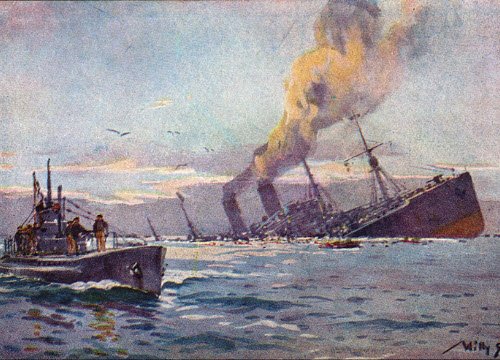
 Weevles Updates Disabled Bloggers Team


