I love this song from when I was little it is Gala Freed From Desire from 97 I have just been singing it in The Hall on the karaoke here at NTDF. The song came out and was released in July 1997 when I was ten years old when I was in class seven at Glebe School when I was little. I love listening to the song in my music library on my iPhone with my Sony Headphones and sometimes with my Airpods Headphones on when I am out and about walking.
I am looking forward to watching this really old Wwe NXT pay per view on Netflix sometime soon. It is Wwe NXT Takeover Wargames 2017 it was on Saturday the 18th November 2017 when I was thirty one when I was in my early thirties when I was younger. It is on for 2 hours and 30 minutes 2 and a half hours.
The British government mobilised civilians more effectively than any other combatant nation. By 1944 a third of the civilian population were engaged in war work, including over 7,000,000 women.
Minister of Labour Ernest Bevin was responsible for Britain’s manpower resources. He introduced the Essential Work Order (EWO) which became law in March 1941. The EWO tied workers to jobs considered essential for the war effort and prevented employers from sacking workers without permission from the Ministry of Labour.
Bevin was also responsible for overhauling the reserved occupations scheme that gave groups of skilled workers in certain occupations exemption from military service.
Art
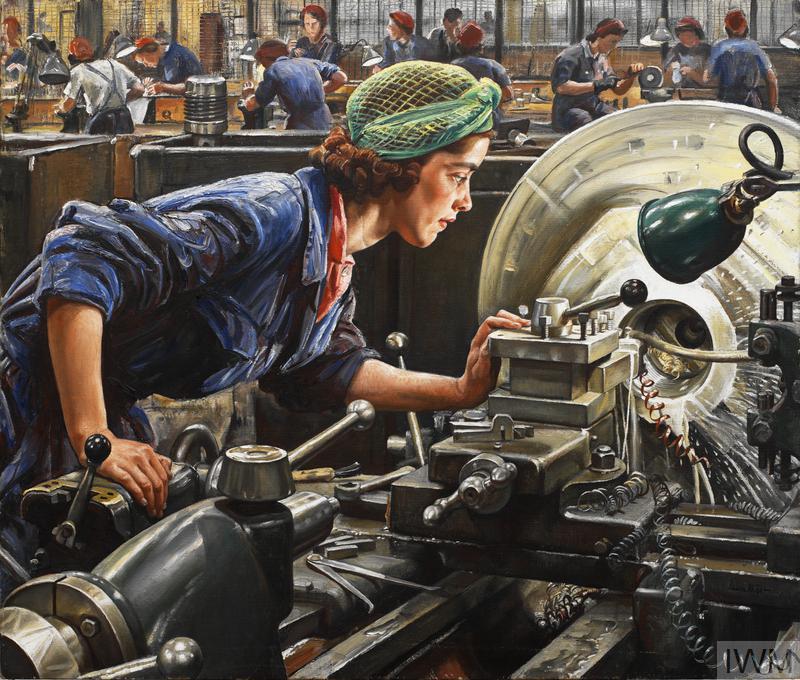
Ruby Loftus screwing a Breech-ring
Image: IWM (Art.IWM ART LD 2850)
Ruby Loftus had been brought to the attention of the War Artist’s Advisory Committee as ‘an outstanding factory worker’.
Artist Laura Knight had originally expected to produce a studio portrait of Miss Loftus, however, the Ministry of Supply requested that she be painted at work in the Royal Ordnance Factory in Newport, South Wales.
Here we see 21-year-old Ruby Loftus making a Bofors Breech ring, a task considered to be the most highly skilled job in the factory, normally requiring eight or nine years training.
Women working in a Royal Ordnance Factory prepare for their shift in the “beauty parlour”.
From early 1941, it became compulsory for women aged between 18 and 60 to register for war work. Conscription of women began in December.
Unmarried ‘mobile’ women between the ages of 20 and 30 were called up and given a choice between joining the services or working in industry.
Pregnant women, those who had a child under the age of 14 or women with heavy domestic responsibilities could not be made to do war work, but they could volunteer. ‘Immobile’ women, who had a husband at home or were married to a serviceman, were directed into local war work.
As well as men and women carrying out paid war work in Britain’s factories, there were also thousands of part-time volunteer workers contributing to the war effort on top of their every day domestic responsibilities.
Other vital war work was carried out on the land and on Britain’s transport network.
During the spring of 1939 the deteriorating international situation forced the British government under Neville Chamberlain to consider preparations for a possible war against Nazi Germany.
Plans for limited conscription applying to single men aged between 20 and 22 were given parliamentary approval in the Military Training Act in May 1939. This required men to undertake six months’ military training, and some 240,000 registered for service.
Full conscription of men
On the day Britain declared war on Germany, 3 September 1939, Parliament immediately passed a more wide-reaching measure.
The National Service (Armed Forces) Act imposed conscription on all males aged between 18 and 41 who had to register for service. Those medically unfit were exempted, as were others in key industries and jobs such as baking, farming, medicine, and engineering.
Conscientious objectors had to appear before a tribunal to argue their reasons for refusing to join-up. If their cases were not dismissed, they were granted one of several categories of exemption, and were given non-combatant jobs.
Conscription helped greatly to increase the number of men in active service during the first year of the war.
Conscription of women
In December 1941 Parliament passed a second National Service Act. It widened the scope of conscription still further by making all unmarried women and all childless widows between the ages of 20 and 30 liable to call-up.
Men were now required to do some form of National Service up to the age of 60, which included military service for those under 51. The main reason was that there were not enough men volunteering for police and civilian defence work, or women for the auxiliary units of the armed forces.
William Francis Eve (1894-1981) was born in Clapham, London, on 22 September 1894, the son of Richard Edward Eve and Emmeline Augusta Eve. His father was a silversmith and the family lived at 9 Solon New Road, Clapham.
By 1911 William had moved in with his uncle Henry James Melhius and his wife Blanche Millicent at 3 Highworth Gardens, Midhurst Road, West Ealing, Middlesex. Around this time he also joined the Territorial Force, enlisting with The Queen’s Westminster Rifles.
Following the outbreak of war, Eve was called up on 26 August 1914 and joined his unit at its headquarters at 58 Buckingham Gate. Like most Territorial soldiers he immediately volunteered for ‘Foreign Service’.
After forming up at Hemel Hempstead, his battalion eventually landed at Le Havre on 2 November. The Queen’s Westminster Rifles were amongst the very first Territorials to enter the line as reinforcements for the hard-pressed British Expeditionary Force (BEF).
On recovering from trench foot, Eve was promoted to lance-corporal and eventually commissioned in September 1915 as a second lieutenant in the 2/6th (City of London) Battalion (Rifles), The London Regiment. Unfortunately, he developed epilepsy and was invalided from the Army in July 1916.
Eve settled at 79 Harrow View, Harrow, Middlesex. He married in 1922 and lived in Surrey where he died in February 1981.
In 1915, Lloyd George became Minister of Munitions and expanded artillery shell production for the war. In 1916, he was appointed Secretary of State for War but was frustrated by his limited power and clashes with Army commanders over strategy. Asquith proved ineffective as prime minister and was replaced by Lloyd George in December 1916. He centralised authority by creating a smaller war cabinet. To combat food shortages caused by u-boats, he implemented the convoy system, established rationing, and stimulated farming. After supporting the disastrous French Nivelle Offensive in 1917, he had to reluctantly approve Field Marshal Douglas Haig‘s plans for the Battle of Passchendaele, which resulted in huge casualties with little strategic benefit. Against British military commanders, he was finally able to see the Allies brought under one command in March 1918. The war effort turned in the Allies’ favour and was won in November. Following the December 1918 “Coupon” election, he and the Conservatives maintained their coalition with popular support.
Lloyd George was a leading proponent at the Paris Peace Conference of 1919, but the situation in Ireland worsened, erupting into the Irish War of Independence, which lasted until Lloyd George negotiated independence for the Irish Free State in 1921. At home, he initiated education and housing reforms, but trade-union militancy rose to record levels, the economy became depressed in 1920 and unemployment rose; spending cuts followed in 1921–22, and in 1922 he became embroiled in a scandal over the sale of honours and the Chanak Crisis. The Carlton Club meeting decided the Conservatives should end the coalition and contest the next election alone. Lloyd George resigned as prime minister, but continued as the leader of a Liberal faction. After an awkward reunion with Asquith’s faction in 1923, Lloyd George led the weak Liberal Party from 1926 to 1931. He proposed innovative schemes for public works and other reforms, but made only modest gains in the 1929 election. After 1931, he was a mistrusted figure heading a small rump of breakaway Liberals opposed to the National Government. In 1940, he refused to serve in Churchill’s War Cabinet. He was elevated to the peerage in 1945 but died before he could take his seat in the House of Lords.
Early life
David George was born on 17 January 1863 in Chorlton-on-Medlock, Manchester, to Welsh parents William George and Elizabeth Lloyd George. William died in June 1864 of pneumonia, aged 44. David was just over one year old. Elizabeth George moved with her children to her native Llanystumdwy in Caernarfonshire, where she lived in a cottage known as Highgate with her brother Richard, a shoemaker, lay minister and a strong Liberal. Richard Lloyd was a towering influence on his nephew and David adopted his uncle’s surname to become “Lloyd George”. Lloyd George was educated at the local Anglican school, Llanystumdwy National School, and later under tutors.
He was brought up with Welsh as his first language; Roy Jenkins, another Welsh politician, notes that, “Lloyd George was Welsh, that his whole culture, his whole outlook, his language was Welsh.”
Though brought up a devout evangelical, Lloyd George privately lost his religious faith as a young man. Biographer Don Cregier says he became “a Deist and perhaps an agnostic, though he remained a chapel-goer and connoisseur of good preaching all his life.” He was nevertheless, according to Frank Owen, “one of the foremost fighting leaders of a fanatical Welsh Nonconformity” for a quarter of a century.
Legal practice and early politics
Lloyd George c. 1890
Lloyd George qualified as a solicitor in 1884 after being articled to a firm in Porthmadog and taking Honours in his final law examination. He set up his own practice in the back parlour of his uncle’s house in 1885. Although many prime ministers have been barristers, Lloyd George is, as of 2025, the only solicitor to have held that office.
As a solicitor, Lloyd George was politically active from the start, campaigning for his uncle’s Liberal Party in the 1885 election. He was attracted by Joseph Chamberlain‘s “unauthorised programme” of Radical reform. After the election, Chamberlain split with William Ewart Gladstone in opposition to Irish Home Rule, and Lloyd George moved to join the Liberal Unionists. Uncertain of which wing to follow, he moved a resolution in support of Chamberlain at a local Liberal club and travelled to Birmingham to attend the first meeting of Chamberlain’s new National Radical Union, but arrived a week too early. In 1907 Lloyd George would tell Herbert Lewis that he had thought Chamberlain’s plan for a federal solution to the Home Rule Question correct in 1886 and still thought so, and that “If Henry Richmond, Osborne Morgan and the Welsh members had stood by Chamberlain on an agreement as regards the [Welsh] disestablishment, they would have carried Wales with them”
His legal practice quickly flourished; he established branch offices in surrounding towns and took his brother William into partnership in 1887.Lloyd George’s legal and political triumph came in the Llanfrothen burial case, which established the right of Nonconformists to be buried according to denominational rites in parish burial grounds, as given by the Burial Laws Amendment Act 1880 but theretofore ignored by the Anglican clergy. On Lloyd George’s advice, a Baptist burial party broke open a gate to a cemetery that had been locked against them by the vicar. The vicar sued them for trespass and although the jury returned a verdict for the party, the local judge misrecorded the jury’s verdict and found in the vicar’s favour. Suspecting bias, Lloyd George’s clients won on appeal to the Divisional Court of Queen’s Bench in London, where Lord Chief JusticeColeridge found in their favour. The case was hailed as a great victory throughout Wales and led to Lloyd George’s adoption as the Liberal candidate for Carnarvon Boroughs on 27 December 1888. The same year, he and other young Welsh Liberals founded a monthly paper, Udgorn Rhyddid (Bugle of Freedom).
Lloyd George married Margaret Owen, the daughter of a well-to-do local farming family, on 24 January 1888. They had five children.
Early years as a member of Parliament (1890–1905)
Lloyd George’s career as a member of parliament began when he was returned as a Liberal MP for Caernarfon Boroughs (now Caernarfon), narrowly winning the by-election on 10 April 1890, following the death of the Conservative member Edmund Swetenham. He would remain an MP for the same constituency until 1945, 55 years later. Lloyd George’s early beginnings in Westminster may have proven difficult for him as a radical liberal and “a great outsider”.[10] Backbench members of the House of Commons were not paid at that time, so Lloyd George supported himself and his growing family by continuing to practise as a solicitor. He opened an office in London under the name of “Lloyd George and Co.” and continued in partnership with William George in Criccieth. In 1897, he merged his growing London practice with that of Arthur Rhys Roberts (who was to become Official Solicitor) under the name of “Lloyd George, Roberts and Co.”
Welsh affairs
Kenneth O. Morgan describes Lloyd George as a “lifelong Welsh nationalist” and suggests that between 1880 and 1914 he was “the symbol and tribune of the national reawakening of Wales“, although he is also clear that from the early 1900s his main focus gradually shifted to UK-wide issues. He also became an associate of Tom Ellis, MP for Merioneth, having previously told a Caernarfon friend in 1888 that he was a “Welsh Nationalist of the Ellis type”.
Decentralisation and Welsh disestablishment
One of Lloyd George’s first acts as an MP was to organise an informal grouping of Welsh Liberal members with a programme that included; disestablishing and disendowing the Church of England in Wales, temperance reform, and establishing Welsh home rule. He was keen on decentralisation and thus Welsh devolution, starting with the devolution of the Church in Wales saying in 1890: “I am deeply impressed with the fact that Wales has wants and inspirations of her own which have too long been ignored, but which must no longer be neglected. First and foremost amongst these stands the cause of Religious Liberty and Equality in Wales. If returned to Parliament by you, it shall be my earnest endeavour to labour for the triumph of this great cause. I believe in a liberal extension of the principle of Decentralization.”
During the next decade, Lloyd George campaigned in Parliament largely on Welsh issues, in particular for disestablishment and disendowment of the Church of England. When Gladstone retired in 1894 after the defeat of the second Home Rule Bill, the Welsh Liberal members chose him to serve on a deputation to William Harcourt to press for specific assurances on Welsh issues. When those assurances were not provided, they resolved to take independent action if the government did not bring a bill for disestablishment. When a bill was not forthcoming, he and three other Welsh Liberals (D. A. Thomas, Herbert Lewis and Frank Edwards) refused the whip on 14 April 1894, but accepted Lord Rosebery‘s assurance and rejoined the official Liberals on 29 May.
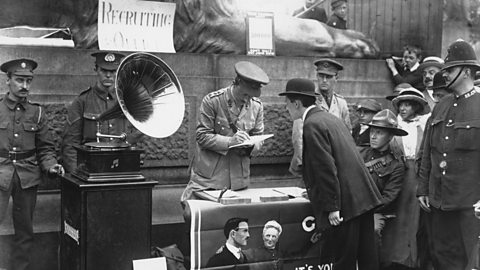
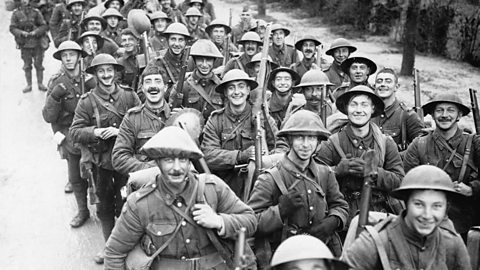
Image caption,Recruitment drives were held in places like Trafalgar SquareOnly men aged between 18 and 41 could become soldiers. (The age limit was increased to 51 in April 1918.)
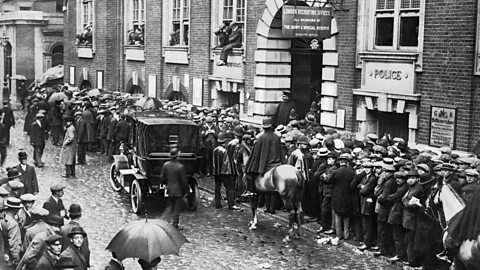
Image caption,Men queued outside recruitment offices to join the armySome men failed the medical test. Others had ‘reserved occupations’, like working in coal mines, shipyards, munitions factories and farms, which meant they stayed in Britain.
Image caption,Younger teenagers tried to join tooThey wanted to be treated like men and thought war would be exciting. Many lied about their age. Some boys as young as 13 or 14 went to war.
1. Photograph of a man giving his name to an officer at a recruitment drive in Trafalgar Square during World War One, 3.Recruitment drives were held in places like Trafalgar Square Only men aged between 18 and 41 could become soldiers. (The age limit was increased to 51 in April 1918.)
The Government wanted as many men as possible to join the forces willingly.
But in 1916 a law was passed to say men had to join whether they wanted to or not. This was called conscription.
I am looking forward to watching this old television series on Netflix sometime soon it is Breaking Bad. They is five seasons of it Season 1 to 5 and I have only seen the first Season and seen all of the episode’s from that Season which I will be looking forward to watching again on Netflix soon when I watch Season 1 of Breaking Bad. The Series ran from Sunday the 28th September 2008 when I was twenty two to Sunday the 29th September 2013 when I was twenty seven when I was younger.









 Weevles Updates Disabled Bloggers Team