
I am looking forward to watching and catching up with the last three episode’s Coronation Street from last Friday Monday and tonight. I have not seen it yet so I am looking forward to seeing it and seeing what happens.
Weevles Updates Disabled Bloggers Team
Weevl Bloggers Corner
I am looking forward to watching and catching up with the last three episode’s Coronation Street from last Friday Monday and tonight. I have not seen it yet so I am looking forward to seeing it and seeing what happens.
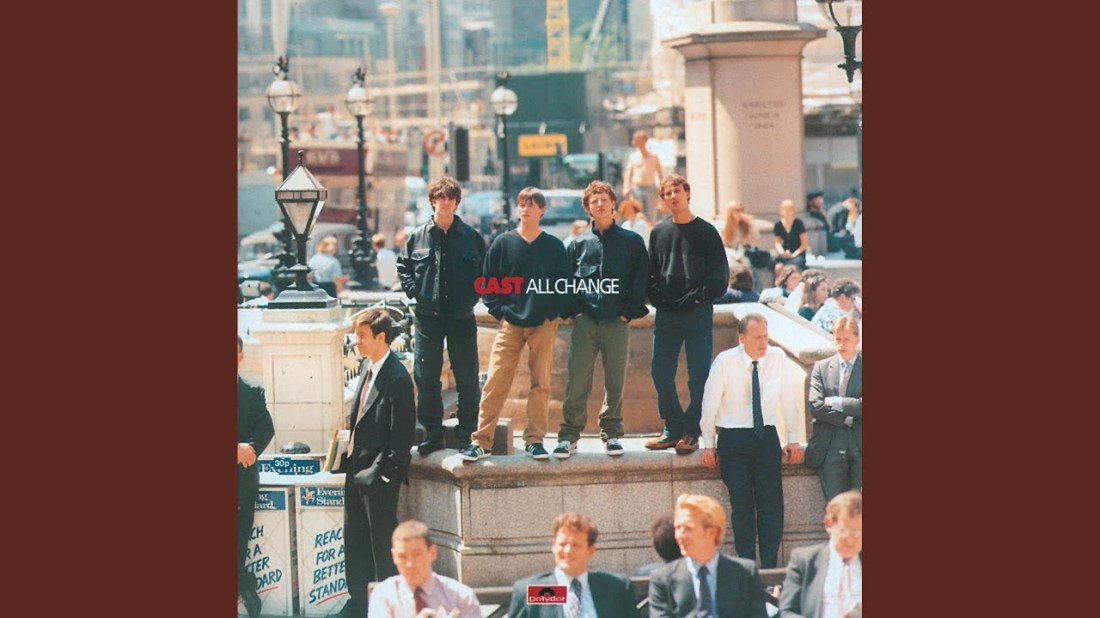

I love this song from when I was little it is one of my favourite songs it is Cast Walkaway from 1996. I have just been singing it on the karaoke in The Hall in Neil’s Art Session. It came out and was released on Monday the 18th March 96 when I was nine years old and still at Glebe School. I love listening to the song in my music library on my iPhone with my Sony Headphones on when I am out and walking and sometimes with my Airpods Headphones on when I am out and about walking.

We’re celebrating Sue’s 70th Birthday and we will be celebrating it again this Friday night at Kingstreet Club in North Shields.
During World War I, Britain primarily sourced its food through imports from its empire and other countries like the USA and Canada, as it only produced 40% of its food domestically. When German U-boats threatened these supply lines, Britain implemented a strict rationing system and a national propaganda campaign to increase domestic agricultural production, urging farmers to plow up more grassland and grow more cereals to feed the nation.
Dependence on Imports
The German Threat
Government and Public Response
Alfred was a Trinidadian and Tobagonian of Portuguese descent who served with the British Army during the First World War.
He fought for two years in Flanders and was awarded the Military Medal for bravely putting his own safety at risk to locate and rescue injured soldiers across No Man’s Land at the Battle of Passchendaele in mid-1917.
Due to his short stature, Alfred Mendes was often used as a messenger, having to brave No Man’s Land’s horrors and hazards.
Alfred recorded one incident in his autobiography.
On the morning of October 12, 1917, Alfred’s company received orders to “go forward to meet him with fixed bayonets”, if the German Army were encountered.
Alfred’s C Company had lost contact with A, B and D Companies. Alfred, highly aware of the dangers sending a lone messenger into No Man’s Land brings, immediately volunteered to find the missing companies.
“The snipers got wind of me, and their individual bullets were soon seeking me out,” wrote Alfred, “until I came to the comforting conclusion that they were so nonplussed at seeing a lone man wandering circles about No Man’s Land, as must at times have been the case, that they decided, out of perhaps a secret admiration for my nonchalance, to dispatch their bullets safely out of my way.”
Alfred managed to find the wayward units and spent two days carrying messages between the companies. He returned “without a scratch but certainly with a series of hair-raising experiences that would keep my grand-and great-grandchildren enthralled for nights on end.”
In an interview with Variety, Sam Mendes said he had a childhood memory of Albert sharing a story about a “messenger who has a message to carry through”.
“It lodged with me as a child, this story or this fragment, and obviously I’ve enlarged it and changed it significantly,” Mendes said.
Ultimately, the story Sam Mendes told in 1917 of the pair of Lance-Corporals is fictional, insofar as there was no specific mission undertaken by Blake and Schofield to halt an attack on German lines on 6th April 1917.
However, the look and feel of the film 1917 is such, coupled with the urgency of the cinematography and performances, that it feels sufficiently authentic, as much as the popular image of World War One is often depicted.
But what about 1917’s historical accuracy? The movie strives for authenticity in the action and imagery it offers, but are the events depicted in line with the British or Commonwealth soldier’s experiences on the Western Front?
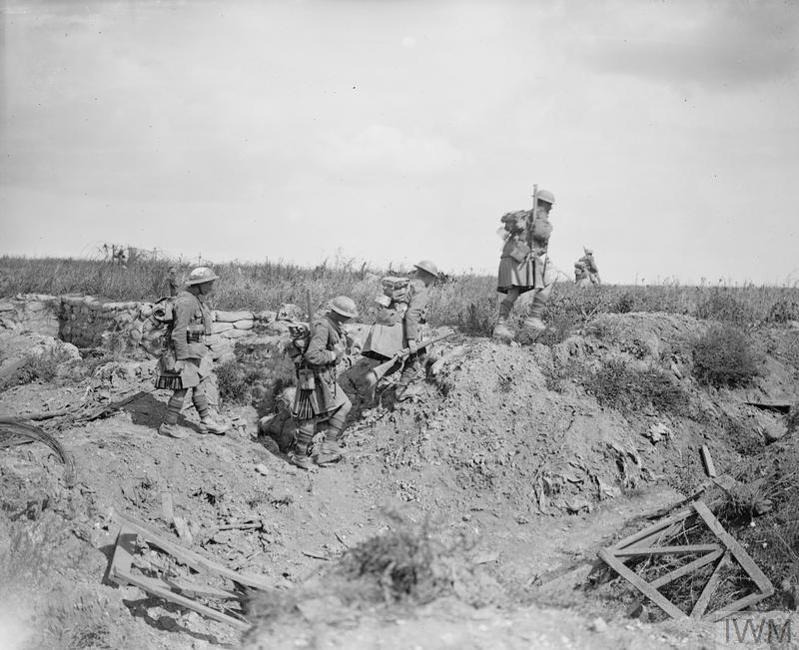
Image: British soldiers go over the top on the Western Front (© IWM Q 7009)
Sam Mendes employed historical and technical advisors Andrew Robertshaw and Paul Biddiss to work on the film. Their knowledge helped ground the actors in the physical and historical context of that specific period.
One of the key plot points is the sudden German withdrawal from the section of the line near Ecoust, northern France. The British Army had been caught unawares and the retreating Germans had left a blighted, scored land, stripped of resources and infrastructure, for the British to navigate.
This has a strong basis in reality. On 5th April 1917, the Imperial German Army completed Operation Alberich: a strategic retreat aimed at shortening the German line and strengthening new positions across the newly built Hindenburg Line.
The devastation wrought during Alberich was huge. Anything the Allies could use (pipes, cables, roads, bridges, tunnels, and even entire villages) was smashed to pieces.
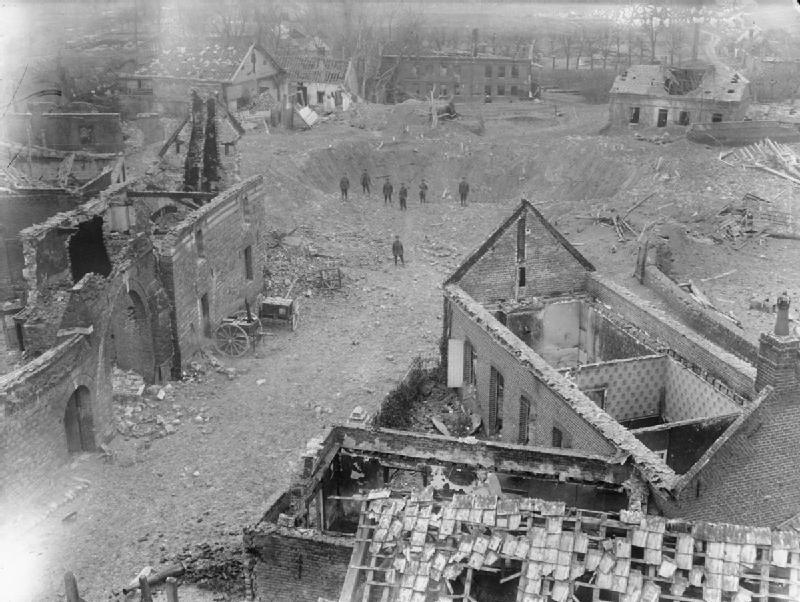
Image: A mine crater in Athies, Pas-de-Calais, blasted to impede any British advance following Operation Alberich (Wikimedia Commons)
1917 also depicts many black and Sikh soldiers on the frontline to show this “wasn’t a war fought just by white men”.
Image: A Great War-era Sikh soldier. While Sikhs fought in great numbers on European battlefields, by the time of the film 1917’s events, they had been moved to other theatres (© IWM Q 24754)
The First World War was truly a global conflict, bringing in people and cultures from across the world to fight. Mendes is entirely right to point out this wasn’t simply a white man’s war, but the manner in which soldiers are presented is inaccurate.
Tens of thousands of black soldiers served with the British Army and many hundreds of thousands of black Africans served as part of the labour corps during the war. For instance, the British West Indian Regiment sent 15,000 men from the Caribbean to Europe to serve but their roles were restricted to support and logistical duties.
Likewise, Sikh and Indian personnel fought across the battlefields of the Great War. More than 74,000 Indian personnel of World War One are in Commonwealth War Graves’ care.
In the case of the movie 1917, however, the Sikh regiments had long since transferred away from the Western Front. After fighting in the brutal campaigns of 1915 at Neuve Chapelle, Ypres, and the Somme, the Sikhs had taken major casualties and transferred to other theatres of conflict.
At the time of 1917’s fictional story, no Sikh soldiers would have been in France or Belgium, and it would be unlikely to see a single Sikh soldier mixing in with British units as shown in the movie 1917.
Another inaccuracy is the care of wounded troops.
In 1917, as casualties mount, wounded men are taken to a casualty clearing station, just metres from the frontline. Medical tents spread out over an open field as surgeons do their level best to aid their injured comrades.
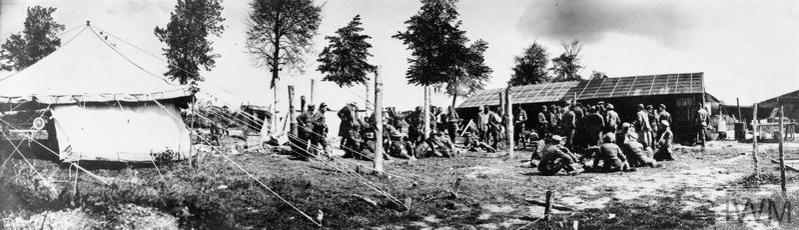
Image: A Great War Casualty Clearing Station. Such stations would be far from the frontline, unlike the facility shown in 1917 (© IWM CO 3151)
The reality of getting wounded treatment was significantly more complex. Sometimes, depending on the nature of the battlefield, aid posts could be on the frontlines.
It is very unlikely, however, that they would set up a major medical hub so close to the front with little to no cover as depicted in 1917.
These places were hugely important but vulnerable, so would be built in abandoned buildings, underground bunkers, and even shell craters. Keeping them out in the open would present unnecessary danger.
Returning to 1917’s historical accuracies, it’s worth highlighting the touching interaction between Schofield and a French civilian nursing a baby amid the rubble of a shattered Ecoust. While this scenario is fictional it has its roots in reality.
One of the objectives of Operation Alberich was to ensure as many French and Belgian refugees stayed in the Allied sector as possible.
Why? Extra mouths to feed. More civilians in Allied care meant more resources diverted to feed, clothe, and house them. In a conflict such as the First World War, any way to disadvantage your opponent must be explored.
The devastation wrought on Ecoust is accurate too. Towns and villages across Northern France and Flanders were obliterated wholesale. Look at Ypres for example.
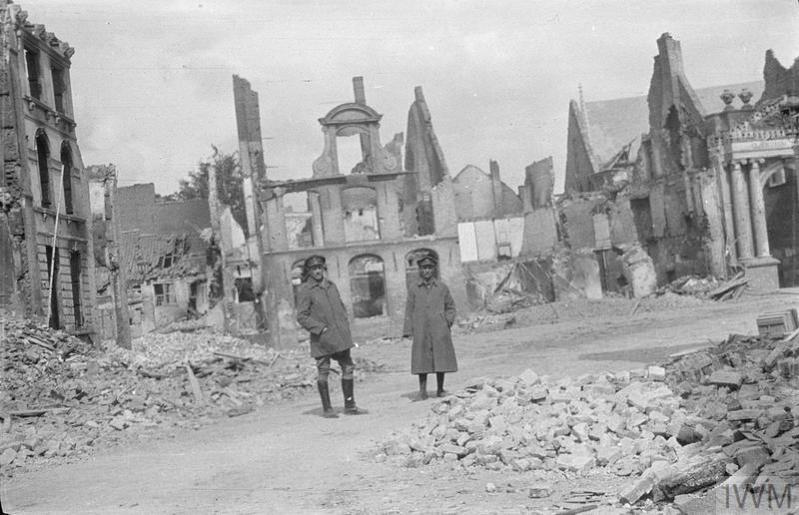
Image: Two soldiers stand amidst the devastation of Ypres town centre. Towns and villages across France and Flanders suffered a similar fate during the Great War, something 1917 accurately depicts (© IWM Q 56727)
The city was reduced to rubble and had to be built from the ground up post-war.
Overall, 1917 veers towards historical accuracy but many liberties have been taken to tell the story Sam Mendes wanted to tell. This is often the case.
Take for instance the film’s final British charge.
Once the whistle blows, the British infantry stream over the top in a solid mass with little attempt at unit cohesion. There’s no artillery support either, indicating this attack really would have been suicidal if Schofield hadn’t completed his mission.
In reality, all along the front Officers and Non-Commission Officers would be amongst their men, keeping them together, and guiding the attack. World War One infantry assaults were not simply picking up a gun and running at the enemy as presented in 1917’s climax.
Trenches are probably the first thing people think of when they think of the Western Front.
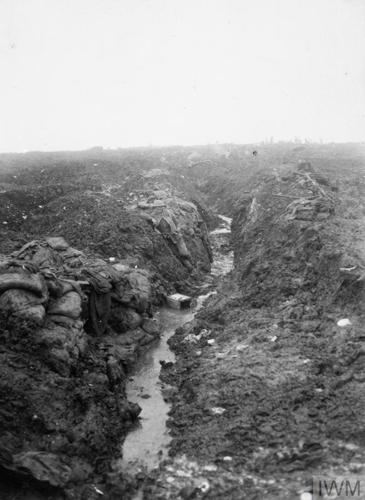 Image: A section of flooded British trench (© IWM E(AUS) 575)
Hundreds of miles of trenches were dug across the war, stretching from Calais in Northern France to the Swiss border (although not in one continuous, unbroken line).
1917 presents trenches in different states.
We start with a British reserve trench in good condition, topped with sandbags and well-ordered dugouts. Troops mill to and forth on their way to their reserve areas or to move onto the frontline.
Elsewhere, we get a glimpse of British frontline trenches, replete with shell damage, puddles of mud, hungry opportunistic rats, and exhausted soldiers sheltering and snatching sleep while they can.
We see abandoned German trenches too: deeper, sturdier with large-scale bunkhouses, kitchens, and storage sections.
As a war film, 1917 presents an accurate portrayal of trench life. The rear communication and transport trenches are in better condition than the more robust, damaged frontline trenches.
One thing you may notice about the frontline troops is the boredom. 1917’s crew charged the extras with taking on soldiers’ daily routines to add to the sense of monotony many at the front experienced.
Fighting was only a small part of trench life. 1917 shows this by showing soldiers inspecting their clothes for lice, cleaning their boots, scooping mud, and water out of the trench, playing games like chess or cards, reading novels, or simply trying to sleep.
1917 was a tumultuous year for the Allies.
February saw the German Navy recommence unrestricted submarine warfare in the Atlantic. Any ship crossing the ocean was fair game for German submariners. Over a million tons of Allied shipping was lost in February 1917 alone.
On the real April 6, 1917, the date on which the film’s fictional events take place, the United States declared war on Imperial Germany. This would have major consequences for Germany, as it was now facing the prospect of millions of fresh, well-equipped troops being sent to the Western Front.
Major offensives that took place in 1917 include the Battle of Arras in April 1917, which included the stunning Canadian victory at Vimy, but the year is mostly dominated by Passchendaele.
The Third Battle of Ypres, also known as the Battle of Passchendaele, took place between July and November in the Ypres Salient in Belgium, Ypres.
Passchendaele is one of the defining battles of the First World War. It drew in millions of men on both sides, resulting in hundreds of thousands of casualties and deaths. Soldiers attacked through the churning bogs of No Man’s Land to be cut down by determined defenders.
Ultimately, the British Army advanced five miles and captured the important high ground around Ypres. Casualties were still shockingly high for such a comparatively small gain.
1917, the war film, really takes place in the opening stages that would go on to be a pivotal year in the course of the First World War.
While the trials and tribulations of Lance-Corporal Blake and Schofield across 1917 are fictional, they draw heavily on the reality of the war. And for many, the Great War’s reality was also tinged with finality.
At the Commonwealth War Graves Commission, we are charged with caring for the Commonwealth’s war dead in perpetuity.
An interesting production quirk of the 1917 film was all the extras playing British soldiers were given a real-life soldier to inhabit. Many of these men would not survive the war.
Commonwealth casualties of the First World War are instead commemorated in our war cemeteries.
For instance, 1917 showcases the Devonshires charging into battle, with troops cut down by machine-gun bullets or artillery blasts.
But did you know the Devonshires have their own small war cemetery maintained by Commonwealth War Graves?
Image: Devonshire Cemetery, Mametz
Devonshire Cemetery, Mametz, marks the spot of the 8th and 9th Battalions of the Devonshire Regiment’s positions on the first day of the Battle of the Somme. 153 Devonshires are buried in the cemetery to this day.
If a casualty fell during the World War One but has no known war grave, they would be commemorated on a WW1 memorial, such as the Menin Gate or Thiepval Memorial.
1917 may have been fiction but our mission is very real.
Do you have a Blake or a Schofield in your family? If they fell in the First World War, they are commemorated by us, and we can help you uncover their story.
Use our Find War Dead tool to uncover their stories. Search by name, rank, country commemorated in, and many more fields designed to make your casualty search as smooth as possible.
 Weevles Updates Disabled Bloggers Team