I bought and downloaded more really old songs from The Bee Gees the other night from before I was born on my iTunes in to my music library on my iPhone the other night on Monday night. I bought and downloaded twelve songs from The Bee Gees and I almost have the whole album of The Ultimate Bee Gees in my music library on my iPhone.
I am looking forward to watching all of the really old Wwe pay per views from 2008 on Netflix soon too. They’re from when I was twenty one then twenty two years old when I was younger. I think the wrestling was really good back then too and the Wwe pay per views from that year.
I am looking forward to watching all the Wwe pay per views from 2007 from when I was twenty years old then twenty one years old from when I was in my early twenties when I was younger on Netflix sometime soon. I thought the wrestling was really good back then too and the Wwe pay per views they were good.
I love this song it is Shamrock Tell Me Ma from 1998 I have just been singing it on the karaoke in The Hall in Neil’s Art Session. I love listening to the song on my Sony Headphones and sometimes with my Airpods Headphones on when I am out and about walking. The song came out and was released on Sunday the 8th November 98 when I was twelve years old when I was in year seven when I was in my first year Southlands School when I was younger just after I left Glebe School.
WW2 was the deadliest military conflict in history. An estimated total of 70–85 million deaths were caused by the conflict, representing about 3% of the estimated global population of 2.3 billion in 1940. Deaths directly caused by the war (including military and civilian fatalities) are estimated at 50–56 million, with an additional estimated 19–28 million deaths from war-related disease and famine. Civilian deaths totaled 50–55 million. Military deaths from all causes totaled 21–25 million, including deaths in captivity of about 5 million prisoners of war. More than half of the total number of casualties are accounted for by the dead of the Republic of China and of the Soviet Union. The following tables give a detailed country-by-country count of human losses. Statistics on the number of military wounded are included whenever available.
Recent historical scholarship has shed new light on the topic of Second World War casualties. Research in Russia since the collapse of the Soviet Union has caused a revision of estimates of Soviet World War II fatalities. According to Russian government figures, USSR losses within postwar borders now stand at 26.6 million, including 8 to 9 million due to famine and disease. In August 2009 the Polish Institute of National Remembrance (IPN) researchers estimated Poland’s dead at between 5.6 and 5.8 million. Historian Rüdiger Overmans of the Military History Research Office (Germany) published a study in 2000 estimating the German military dead and missing at 5.3 million, including 900,000 men conscripted from outside of Germany’s 1937 borders, in Austria, and in east-central Europe. The Red Army claimed responsibility for the majority of Wehrmacht casualties during World War II. The People’s Republic of China puts its war dead at 20 million, while the Japanese government puts its casualties due to the war at 3.1 million. An estimated 7–10 million people died in the Dutch, British, French and US colonies in South and Southeast Asia, mostly from war-related famine.
Classification of casualties
Bodies of U.S. Marines on the beach of Tarawa. The Marines secured the island after 76 hours of intense fighting. Over 1,000 American and ~4600 Japanese troops died in the fighting.
Compiling or estimating the numbers of deaths and wounded caused during wars and other violent conflicts is a controversial subject. Historians often put forward many different estimates of the numbers killed and wounded during World War II. The authors of the Oxford Companion to World War II maintain that “casualty statistics are notoriously unreliable”. The table below gives data on the number of dead and military wounded for each country, along with population information to show the relative impact of losses. When scholarly sources differ on the number of deaths in a country, a range of war losses is given, in order to inform readers that the death toll is disputed. Since casualty statistics are sometimes disputed the footnotes to this article present the different estimates by official governmental sources as well as historians. Military figures include battle deaths (KIA) and personnel missing in action (MIA), as well as fatalities due to accidents, disease and deaths of prisoners of war in captivity. Civilian casualties include deaths caused by strategic bombing, Holocaust victims, German war crimes, Japanese war crimes, population transfers in the Soviet Union, Allied war crimes, and deaths due to war-related famine and disease.
The sources for the casualties of the individual countries do not use the same methods, and civilian deaths due to starvation and disease make up a large proportion of the civilian deaths in China and the Soviet Union. The losses listed here are actual deaths; hypothetical losses due to a decline in births are not included with the total dead. The distinction between military and civilian casualties caused directly by warfare and collateral damage is not always clear-cut. For states that suffered huge losses such as the Soviet Union, China, Poland, Germany, and Yugoslavia, sources can give only the total estimated population loss caused by the war and a rough estimate of the breakdown of deaths caused by military activity, crimes against humanity and war-related famine. The casualties listed here include 19 to 25 million war-related famine deaths in the USSR, China, Indonesia, Vietnam, the Philippines, and India that are often omitted from other compilations of World War II casualties.
The footnotes give a detailed breakdown of the casualties and their sources, including data on the number of wounded where reliable sources are available. Several categories are used to classify World War II casualties, mainly to separate between military people and civilians. Due of the broad effects of war-induced famines, genocides like the Holocaust, and strategic bombings, civilians casualties frequently outnumbered military fatalities.
Human losses by country
Total deaths by country
Figures are rounded to the nearest hundredth place.
Military casualties include deaths of regular military forces from combat as well as non-combat causes. Partisan and resistance fighter deaths are included with military losses. The deaths of prisoners of war in captivity and personnel missing in action are also included with military deaths. Whenever possible the details are given in the footnotes.
The armed forces of the various states are treated as single entities, for example the deaths of Austrians, French and foreign nationals of German ancestry in eastern Europe in the Wehrmacht are included with German military losses. For example, Michael Strank is included in the American, not Czechoslovak, war dead total.
The bare minimum amount of military deaths from all causes is 21,124,905.
Civilian war dead are included with the territories where they resided. For example, German Jewish refugees in France who were deported to the death camps are included with French casualties in the published sources on the Holocaust.
The official casualty statistics published by the governments of the United States, France, and the United Kingdom do not give the details of the national origin, ethnic background, and religion of the losses.
The source of the figures is Vadim Erlikman [ru].Erlikman, a Russian historian, notes that these figures are his estimates.
The population listed here of 194.090 million is taken from Soviet-era sources. Recent studies published in Russia put the actual corrected population in 1940 at 192.598 million.
Estimates in the west for the population transfers differ. According to Sergei Maksudov, a Russian demographer living in the west, the population of the territories annexed by the USSR was 23 million less the net population transfers out of 3 million persons who emigrated from the USSR including 2,136,000 Poles who left the USSR; 115,000 Polish soldiers of the Anders Army; 392,000 Germans who left in the era of the Nazi-Soviet Pact and 400,000 Jews, Romanians, Germans Czech and Hungarians who emigrated after the war The Polish government-in-exile put the population of the territories of Poland annexed by the Soviet Union at 13.199 million.
Polish sources put the number of refugees from the territories of Poland annexed by the Soviet Union living in post war Poland at about 2.2 million, about 700,000 more than those listed in the Soviet sources of Poles repatriated. The difference is due to the fact that Poles from the eastern regions who were deported to Germany during the war or had fled Volhynia and Eastern Galicia were not included in the figures of the organized transfers in 1944–47.
According to Erlikman, in addition to the war dead, there were 1,700,000 deaths due to Soviet repression (200,000 executed; 4,500,000 sent to prisons and Gulag of whom 1,200,000 died; 2,200,000 deported of whom 300,000 died).
German sources do not provide figures for Soviet citizens conscripted by Germany. Russian historian Grigoriy Krivosheyev puts the losses of the “Vlasovites, Balts and Muslims etc.” in German service at 215,000.
United States
Estimated breakdown for each US state and territory of total war dead
This table displays the number of people who are believed to have died in the United States by state and territory. In 1939 when World War 2 began, the Census Bureau estimated the population to be 130,879,718 people (excluding the population of Hawaii and Alaska). This list includes those who died at sea.
Included in the figures of total war dead for each country are victims of the Holocaust.
Jewish deaths
The Holocaust is the term generally used to describe the genocide of approximately six million European Jews during World War II. Martin Gilbert estimates 5.7 million (78%) of the 7.3 million Jews in German-occupied Europe were Holocaust victims. Estimates of Holocaust deaths range between 4.9 and 5.9 million Jews.Statistical breakdown of Jewish dead
Yad Vashem estimated that, in early 2019, its Central Database of Shoah Victims’ Names contained the names of 4.8 million Jewish Holocaust dead.
The figures for the pre-war Jewish population and deaths in the table below are from The Columbia Guide to the Holocaust. The low, high and average percentage figures for deaths of the pre-war population have been added.
The total population figures from 1933 listed here are taken from The Columbia Guide to the Holocaust. From 1933 to 1939 about 400,000 Jews fled Germany, Austria, and Czechoslovakia. Some of these refugees were in western Europe when Germany occupied these countries in 1940. In 1940 there were 30,000 Jewish refugees in the Netherlands, 12,000 in Belgium, 30,000 in France, 2,000 in Denmark, 5,000 in Italy, and 2,000 in Norway.
Hungarian Jewish losses of 569,000 presented here include the territories annexed in 1939–41. The number of Holocaust dead in 1938 Hungarian borders were 220,000.According to Martin Gilbert, the Jewish population inside Hungary’s 1941 borders was 764,000 (445,000 in the 1938 borders and 319,000 in the annexed territories). Holocaust deaths from inside the 1938 borders was 200,000, not including 20,000 men conscripted as forced labor for the military.
Netherlands figure listed in the table of 112,000 Jews taken from The Columbia Guide to the Holocaust includes those Jews who were resident in Holland in 1933. By 1940, the Jewish population had increased to 140,000 with the inclusion of 30,000 Jewish refugees. In the Netherlands, 8,000 Jews in mixed marriages were not subject to deportation. However, an article in the Dutch periodical De Groene Amsterdammer maintains that some Jews in mixed marriages were deported before the practice was ended by Hitler.
Hungarian Jewish Holocaust victims within the 1939 borders were 200,000.
Donald L. Niewyk, professor of history at Southern Methodist University, maintains that the Holocaust can be defined in four ways: first, that it was the genocide of the Jews alone; second, that there were several parallel Holocausts, one for each of the several groups; third, the Holocaust would include Roma and the handicapped along with the Jews; fourth, it would include all racially motivated German crimes, such as the murder of Soviet prisoners of war, Polish and Soviet civilians, as well as political prisoners, religious dissenters, and homosexuals. Using this definition, the total number of Holocaust victims is between 11 million and 17 million people.
According to the College of Education of the University of South Florida “Approximately 11 million people were killed because of Nazi genocidal policy”.
R.J. Rummel estimated the death toll due to Nazi Democide at 20.9 million persons.
Timothy Snyder put the number of victims of the Nazis killed as a result of “deliberate policies of mass murder” only, such as executions, deliberate famine and in death camps, at 10.4 million persons including 5.4 million Jews.
German scholar Hellmuth Auerbach puts the death toll in the Hitler era at 6 million Jews killed in the Holocaust and 7 million other victims of the Nazis.
Dieter Pohl puts the total number of victims of the Nazi era at between 12 and 14 million persons, including 5.6–5.7 million Jews.
Roma Included in the figures of total war dead are the Roma victims of the Nazi persecution; some scholars include the Roma deaths with the Holocaust. Most estimates of Roma (Gypsies) victims range from 130,000 to 500,000. Ian Hancock, Director of the Program of Romani Studies and the Romani Archives and Documentation Center at the University of Texas at Austin, has argued in favour of a higher figure of between 500,000 and 1,500,000 Roma dead. Hancock writes that, proportionately, the death toll equaled “and almost certainly exceed[ed], that of Jewish victims”. In a 2010 publication, Ian Hancock stated that he agrees with the view that the number of Romanis killed has been underestimated as a result of being grouped with others in Nazi records under headings such as “remainder to be liquidated”, “hangers-on” and “partisans”.
In 2018, the United States Holocaust museum had the number of murdered during the time period of the holocaust at 17 million – 6 million Jews and 11 million others.
The following figures are from The Columbia Guide to the Holocaust, the authors maintain that “statistics on Gypsy losses are especially unreliable and controversial. These figures (cited below) are based on necessarily rough estimates”.
Prisoners of War: POW deaths in Nazi captivity totalled 3.1 million including 2.6 to 3.0 million Soviet prisoners of war.
Ethnic Poles: According to the United States Holocaust Memorial Museum “It is estimated that the Germans killed at least 1.9 million non-Jewish Polish civilians during World War II.” They maintain that “Documentation remains fragmentary, but today scholars of independent Poland believe that 1.8 to 1.9 million Polish civilians (non-Jews) were victims of German Occupation policies and the war.” However, the Polish government affiliated Institute of National Remembrance (IPN) in 2009 estimated 2,770,000 ethnic Polish deaths due to the German occupation (see World War II casualties of Poland).
Russians, Ukrainians and Belarusians: According to Nazi ideology, Slavs were useless sub-humans. As such, their leaders, the Soviet elite, were to be killed and the remainder of the population enslaved, starved to death, or expelled further eastward. As a result, millions of civilians in the Soviet Union were deliberately killed, starved, or worked to death.Contemporary Russian sources use the terms “genocide” and “premeditated extermination” when referring to civilian losses in the occupied USSR.[citation needed] Civilians killed in reprisals during the Soviet partisan war and wartime-related famine account for a major part of the huge toll. The Cambridge History of Russia puts overall civilian deaths in the Nazi-occupied USSR at 13.7 million persons including 2 million Jews. There were an additional 2.6 million deaths in the interior regions of the Soviet Union. The authors maintain “scope for error in this number is very wide”. At least 1 million perished in the wartime GULAG camps or in deportations. Other deaths occurred in the wartime evacuations and due to war related malnutrition and disease in the interior. The authors maintain that both Stalin and Hitler “were both responsible but in different ways for these deaths”, and “In short the general picture of Soviet wartime losses suggests a jigsaw puzzle. The general outline is clear: people died in colossal numbers but in many different miserable and terrible circumstances. But individual pieces of the puzzle do not fit well; some overlap and others are yet to be found”. Bohdan Wytwycky maintained that civilian losses of 3.0 million Ukrainians and 1.4 million Belarusians “were racially motivated”.[241]According to Paul Robert Magocsi, between 1941 and 1945, approximately 3,000,000 Ukrainian and other non-Jewish victims were killed as part of Nazi extermination policies in the territory of modern Ukraine. Dieter Pohl puts the total number of victims of the Nazi policies in the USSR at 500,000 civilians killed in the repression of partisans, 1.0 million victims of the Nazi Hunger Plan, c. 3.0 million Soviet POW and 1.0 million Jews (in pre-war borders). Soviet author Georgiy A. Kumanev put the civilian death toll in the Nazi-occupied USSR at 8.2 million (4.0 million Ukrainians, 2.5 million Belarusians, and 1.7 million Russians). A report published by the Russian Academy of Sciences in 1995 put the death toll due to the German occupation at 13.7 million civilians (including Jews): 7.4 million victims of Nazi genocide and reprisals; 2.2 million persons deported to Germany for forced labor; and 4.1 million famine and disease deaths in occupied territory. Sources published in the Soviet Union were cited to support these figures.
Homosexuals: According to the United States Holocaust Memorial Museum “Between 1933 and 1945 the police arrested an estimated 100,000 men as homosexuals. Most of the 50,000 men sentenced by the courts spent time in regular prisons, and between 5,000 and 15,000 were interned in concentration camps.” They also noted that there are no known statistics for the number of homosexuals who died in the camps.
Other victims of Nazi persecution: Between 1,000 and 2,000 Roman Catholic clergy, about 1,000 Jehovah’s Witnesses, and an unknown number of Freemasons perished in Nazi prisons and camps. “The fate of black people from 1933 to 1945 in Nazi Germany and in German-occupied territories ranged from isolation to persecution, sterilization, medical experimentation, incarceration, brutality, and murder.” During the Nazi era Communists, Socialists, Social Democrats, and trade union leaders were victims of Nazi persecution.
Serbs: The numbers of Serbs murdered by the Ustaše is the subject of debate and estimates vary widely. Yad Vashem estimates over 500,000 murdered, 250,000 expelled and 200,000 forcibly converted to Catholicism. The estimate of the United States Holocaust Memorial Museum is that the Ustaše murdered between 320,000 and 340,000 ethnic Serbs in the Independent State of Croatia between 1941 and 1945, with roughly 45,000 to 52,000 murdered at the Jasenovac concentration camp alone. According to the Wiesenthal Center at least 90,000 Serbs, Jews, Gypsies and anti-fascist Croatians perished at the hands of the Ustashe at the camp at Jasenovac.According to Yugoslav sources published in the Tito era the estimates of the number of Serb victims range from 200,000 to at least 600,000 persons.See also World War II persecution of Serbs.
During World War II, the German military helped fulfill Nazism’s racial, political, and territorial ambitions. Long after the war, a myth persisted claiming the German military (or Wehrmacht) was not involved in the Holocaust and other crimes associated with Nazi genocidal policy. This belief is untrue. The German military participated in many aspects of the Holocaust: in supporting Hitler, in the use of forced labor, and in the mass murder of Jews and other groups targeted by the Nazis.
The military’s complicity extended not only to the generals and upper leadership but also to the rank and file. In addition, the war and genocidal policy were inextricably linked. The German army (or Heer) was the most complicit as a result of being on the ground in Germany’s eastern campaigns, but all branches participated.
Soviet POWs held by the Nazis in Mauthausen concentration camp. It is estimated that at least 3.3 million Soviet POWs died in German custody.[258]
Nazi Germany ordered, organized and condoned a substantial number of war crimes in World War II. The most notable of these is the Holocaust in which millions of Jews, Poles, and Romani were systematically murdered or died from abuse and mistreatment. Millions also died as a result of other German actions.
Forced laborers in Southeast Asia: 70,000, 30,000 interned non-Asian civilians
Timor: 60,000
Thailand and Pacific Islands: 60,000.
Gruhl estimates POW deaths in Japanese captivity at 331,584.Detailed by country
China: 270,000
Netherlands: 8,500
Britain: 12,433
Canada: 273
Philippines: 20,000
Australia: 7,412
New Zealand: 31
United States: 12,935
Out of 60,000 Indian Army POWs taken at the Fall of Singapore, 11,000 died in captivity.There were 14,657 deaths among the total 130,895 western civilians interned by the Japanese due to famine and disease.
The development of tanks in World War I was a response to the stalemate that developed on the Western Front. Although vehicles that incorporated the basic principles of the tank (armour, firepower, and all-terrain mobility) had been projected in the decade or so before the War, it was the alarmingly heavy casualties of the start of its trench warfare that stimulated development.
Research took place in both Great Britain and France, with Germany only belatedly following the Allies’ lead.
In Great Britain, an initial vehicle, nicknamed Little Willie, was constructed at William Foster & Co., during August and September 1915. The prototype of a new design that became the Mark I tank was demonstrated to the British Army on 2 February 1916. Although initially termed “Landships” by the Landship Committee, production vehicles were named “tanks”, to preserve secrecy. The term was chosen when it became known that the factory workers at William Foster referred to the first prototype as “the tank” because of its resemblance to a steel water tank.
The Germans, on the other hand, began development only in response to the appearance of Allied tanks on the battlefield. Whilst the Allies manufactured several thousand tanks during the war, Germany deployed only 18 of its own.
The first tanks were mechanically unreliable. There were problems that caused considerable attrition rates during combat deployment and transit. The heavily shelled terrain was impassable to conventional vehicles, and only highly mobile tanks such as the Renault FTs and Mark IV performed reasonably well. The Mark I’s rhomboid shape, caterpillar tracks, and 26-foot (8 m) length meant that it could negotiate obstacles, especially wide trenches, that wheeled vehicles could not. Along with the tank, the first self-propelled gun (the British Gun Carrier Mk I) and the first armoured personnel carrier followed the invention of tanks.
Mark 3II; tank no. 799 captured near Arras on 11 April 1917A German-captured British tank in 19171917: British tanks captured by the Germans being transported by railGerman forces using captured British Mark IVs during the Second Battle of the Marne
The conceptual roots of the tank go back to ancient times, with siege engines that were able to provide protection for troops moving up against stone walls or other fortifications. With the coming of the Industrial Revolution and the demonstrable power of steam, James Cowan presented a proposal for a Steam Powered Land Ram in 1855, towards the end of the Crimean War. Looking like a helmet on ‘footed’ Boydell wheels, early forerunners of the Pedrail wheel, it was essentially an armoured steam tractor equipped with cannon and rotating scythes sprouting from the sides. Lord Palmerston is said to have dismissed it as ‘barbaric’.
Hornsby tractorArtillery tractors (here a Holt tractor) were in use in the French Army in 1914–1915. Here, in the Vosges, spring 1915
From 1904 to 1909, David Roberts, the engineer and managing director of Hornsby & Sons of Grantham, built a series of tractors using his patented ‘chain-track’, which were put through their paces by the British Army, a (small) section of which wanted to evaluate artillery tractors. At one point in 1908, Major William E. Donohue of the Mechanical Transport Committee remarked to Roberts that he should design a new machine with armour that could carry its own gun. However, disheartened by years of ultimately-fruitless tinkering for the Army, Roberts did not take up the idea. In later years, he expressed regret at not having pursued it.
An engineer in the Austro-Hungarian Army, Lieutenant Gunther Burstyn, designed a tracked armoured vehicle in 1911 carrying a light gun in a rotating turret; equipped also with hinged ‘arms’, two in front and two at the rear, carrying wheels on the ends to assist with obstacles and trenches, it was a very forward-looking design, if rather small. The Austro-Hungarian government said that it would be interested in evaluating it if Burstyn could secure commercial backing to produce a prototype. Lacking the requisite contacts, he let it drop. An approach to the German government was similarly fruitless.
In 1912, Lancelot De Mole, of South Australia, submitted a proposal to the British War Office for a “chain-rail vehicle which could be easily steered and carry heavy loads over rough ground and trenches”. De Mole made more proposals to the War Office in 1914 and 1916, with a culminating proposal in late 1917, accompanied by a huge one-eighth scale model, but all fell on substantially-deaf ears. De Mole’s proposal already had the climbing face, which was so typical of the later World War I British tanks, but it is unknown whether there was some connection.
Inquiries to the government of Australia after the war yielded polite responses that Mr. De Mole’s ideas had unfortunately been too advanced for the time to be properly recognised at their just value. The Commission on Awards to Inventors in 1919, which adjudicated all the competing claims to the development of the tank, recognised the brilliance of De Mole’s design and even considered that it was superior to the machines actually developed, but its narrow remit allowed it only to make a payment of £987 to De Mole to cover his expenses. He noted in 1919 that he was urged by friends before the war to approach the Germans with his design but declined to do so for patriotic reasons.
Before World War I, motorised vehicles were still relatively uncommon, and their use on the battlefield was initially limited, especially of heavier vehicles. Armoured cars soon became more common with most belligerents, especially in more-open terrain. On 23 August 1914 the French Colonel Jean Baptiste Eugène Estienne, later a major proponent of tanks, declared, “Gentlemen, victory will belong in this war to the one of the two belligerents that will manage to be the first to succeed in putting a 75 mm cannon on a vehicle that can move on all types of terrain.”
Armored cars indeed proved useful in open land, such as in deserts, but were not very good at crossing obstacles, such as trenches and barriers, or in more-challenging terrain. The other issue was that it was very hard to add much protection or armament.
The main limitation was the wheels, which gave a high ground pressure for the vehicle’s weight. That could be solved by adding more wheels, but unless they also were driven, the effect was to reduce traction on the powered wheels. Driving extra wheels meant more drive train weight, which required a larger and heavier engine to maintain performance. Even worse, none of the extra weight was put into an improvement of armour or armament carried, and the vehicles could still not cross very rough terrain.
The adoption of caterpillar tracks offered a new solution to the problem. The tracks spread the weight of the vehicles over a much greater area, all of which was for traction to move the vehicle. The limitation on armour and firepower was no longer the ground pressure but the power and weight of the power-plant.
The remaining issue was how to use and configure a vehicle. Major Ernest Dunlop Swinton of the Royal Engineers was the official British war correspondent serving in France in 1914 and recounted in his book Eyewitness how the idea of using caterpillar tracks to drive an armoured fighting vehicle came to him on 19 October 1914 while he was driving through northern France. In July 1914, he had received a letter from a friend, Hugh Marriott, a mining engineer, who drew his attention to a Holt caterpillar tractor that Marriott had seen in Belgium.
Marriott thought that it might be useful for transport over difficult ground, and Swinton had passed the information on to the appropriate departments. Swinton then suggested the idea of an armoured tracked vehicle to the military authorities by sending a proposal to Lieutenant-Colonel Maurice Hankey, who tried to interest Lord Kitchener in the idea. When that failed, he sent a memorandum in December to the Committee of Imperial Defence, of which he was himself the secretary. Winston Churchill the First Lord of the Admiralty was one of the members of the committee. Hankey proposed to build a gigantic steel roller pushed by tracked tractors to shield the advancing infantry.
Churchill, in turn, wrote a note on 5 January to Prime Minister H. H. Asquith and warned that the Germans might any moment introduce a comparable system. A worried Asquith now ordered Kitchener to form a committee, headed by General Scott-Moncrieff, to study the feasibility of Swinton’s idea; however, after trials with a Holt 75 horsepower machine, the committee concluded in February 1915 that the idea was impractical.
Landship Committee
Churchill, however, decided that unless the Army took up the idea, the Navy should proceed independently, even if it exceeded the limits of his authority. He created the Landship Committee in February 1915, initially to investigate designs for a massive troop transporter. As a truer picture of front-line conditions was developed the aims of the investigation changed. A requirement was formulated for an armoured vehicle capable of 4 mph (6.4 km/h), climbing a 5 feet (1.5 m) high parapet, crossing an 8 feet (2.4 m) wide gap, and armed with machine guns and a light artillery piece.
A similar proposal was working its way through the Army GHQ in France, and in June, the Landships Committee was made a joint service venture between the War Office and the Admiralty. The Naval involvement in Armoured Fighting Vehicle (AFV) design had originally come about through the Royal Naval Air Service Armoured Car Division, the only British unit fielding AFVs in 1914. Surprisingly, until the end of the war, most experimentation on heavy land vehicles was conducted by the Royal Naval Air Service Squadron 20.
At first, protecting heavy gun tractors with armour appeared the most promising line of development. Alternative early ‘big wheel’ designs on the lines of the Russiantsar tank of 1915 were soon understood to be impractical. However, adapting the existing Holt Company caterpillar designs, the only robust tracked tractors available in 1915 into a fighting machine, which France and Germany did, was decided against. Although armour and weapon systems were easy to acquire, other existing caterpillar and suspension units were too weak, existing engines were underpowered for the vehicles that the designers had in mind and the ability to cross trenches was poor because of the shortness of the wheelbase.
The Killen-Strait tractor with three tracks was used for the first experiments in June but was much too small to be developed further. The large Pedrail monotrack vehicle was proposed in a number of different configurations, but none were adopted. Trials to couple two American Bullock tractors failed. There also were considerable differences of opinion between the several committee members. Col R.E.B. Crompton, a veteran military engineer and electrical pioneer, drafted numerous designs with Lucien Legros for armoured troop carrying vehicles and gun-armed vehicles, to have used either Bullock tracks or variants of the Pedrail.
At the same time, Lt Robert Macfie, of the RNAS, and Albert Nesfield, an Ealing-based engineer, devised a number of armoured tracked vehicles, which incorporated an angled front ‘climbing face’ to the tracks. The two men fell out bitterly as their plans came to nought; Macfie in particular pursued a vendetta against the other members of the Landships Committee after the war.
To resolve the threatened dissipation of effort, it was ordered in late July that a contract was to be placed with William Foster & Co. Ltd, a company having done some prewar design work on heavy tractors and known to Churchill from an earlier experiment with a trench-crossing supply vehicle, to produce a proof-of-concept vehicle with two tracks, based on a lengthened Bullock tractor chassis. Construction work began three weeks later.
A Mark I tank, moving from left to right. The rhomboidal shape allowed it to climb parapets and cross trenches. Photo by Ernest Brooks.
Fosters of Lincoln built the 14 ton “Little Willie“, which first ran on 8 September. Powered by a 105 hp (78 kW) Daimler engine, the 10-foot-high (3.0 m) armoured box was initially fitted with a low Bullock caterpillar. A rotating top turret was planned with a 40 mm gun but abandoned due to weight problems, leaving the final vehicle unarmed and little more than a test-bed for the difficult track system. Difficulties with the commercial tracks supplied led to Tritton designing a completely new track system different from, and vastly more robust than, any other system then in use.
The next design by Lieutenant Walter Gordon Wilson RNAS, a pre-war motor engineer, added a larger track frame to the hull of “Little Willie”. In order to achieve the demanded gap clearance a rhomboidal shape was chosen—stretching the form to improve the track footprint and climbing capacity. To keep a low centre of gravity the rotating turret design was dropped in favour of sponsons on the sides of the hull fitted with naval 6-pounder (57 mm) guns.
A final specification was agreed on in late September for trials in early 1916, and the resulting 30 ton “Big Willie” (later called “Mother”) together with “Little Willie” underwent trials at Hatfield Park on 29 January and 2 February. Attendees at the second trial included Lord Kitchener, Lloyd George, Reginald McKenna and other political luminaries. On 12 February an initial order for 100 “Mother” type vehicles was made, later expanded to 150.
Crews rarely called tanks “Willies”; at first they referred to them as “cars”, and later informally “buses”. Although landship was a natural term coming from an Admiralty committee, it was considered too descriptive and could give away British intentions. The committee, therefore, looked for an appropriate code term for the vehicles. Factory workers assembling the vehicles had been told they were producing “mobile water tanks” for desert warfare in Mesopotamia. Water Container was therefore considered but rejected because the committee would inevitably be known as the WC Committee (WC meaning water closet was a common British term for a toilet).
The term tank, as in water tank, was in December 1915 accepted as its official designation. From then on, the term “tank” was established among British and also German soldiers. While in German Tank specifically refers to the World War I type (as opposed to modern Panzer), in English, Russian and other languages the name even for contemporary armored vehicles is still based on the word tank.
A captured British tank in German hands destroying a tree
It is sometimes mistakenly stated that, after completion, the tanks were shipped to France in large wooden crates. For secrecy and in order to not arouse any curiosity, the crates and the tanks themselves were then each labeled with a destination in Russian, “With Care to Petrograd“. In fact, the tanks were never shipped in crates: the inscription in Russian was applied on the hull for their transport from the factory to the first training centre at Thetford.
The first fifty had been delivered to France on 30 August. They were ‘male’ or ‘female’, depending upon whether their armament comprised two 6-pounder cannons and three Hotchkiss machine guns or four Vickers machine guns and one Hotchkiss. It had a crew of eight, four of whom were needed to handle the steering and drive gears. The tanks were capable of, at best, 6 km/h (3.7 mph), matching the speed of marching infantry with whom they were to be integrated to aid in the destruction of enemy machine guns. In practice, their speed on the broken ground could be as little as 1 mph.
After the war the Royal Commission on Awards to Inventors decided that the principal inventors of the Tank were Sir William Tritton, managing director of Fosters, and Major Walter Gordon Wilson. Fosters returned to manufacturing Traction engines and steam lorries, but incorporated a small trademark outline image of a tank on the front smokebox door of their postwar road locomotives. During WWII, Tritton and Wilson were called upon to design a Heavy tank, which was known as TOG1, (named for “The Old Gang”), but this was not a success. However, Lincoln City erected a full-size outline Mk 1 as a memorial to the invention of the tank in 2015, and placed it on the Tritton Road roundabout.
For secrecy, the six new tank companies were assigned to the Heavy Section of the Machine Gun Corps.[6] The first use of tanks on the battlefield was the use of British Mark I tanks by C and D Companies HS MGC at the Battle of Flers-Courcelette (part of the Battle of the Somme) on Friday 15 September 1916, with mixed results. Many broke down, but nearly a third succeeded in breaking through. Of the forty-nine tanks shipped to the Somme, only thirty-two were able to begin the first attack in which they were used, and only nine made it across “no man’s land” to the German lines. The tanks had been rushed into combat before the design was mature enough (against the wishes of Churchill and Ernest Swinton) and the number was small but their use gave important feedback on how to design newer tanks, the soundness of the concept and their potential to affect the course of the war.
On the other hand, the French Army was critical of the British employment of small numbers of tanks at the battle. It felt the British had sacrificed the secrecy of the weapon but used it in numbers too small to be decisive. Since the British attack was part of an Anglo-French offensive, and the Russians were attacking at the same time, Haig felt justified in making a maximum effort, regardless of the limitations of the tank force.
Tank crews who had read press reports depicting the new weapon driving through buildings and trees, and crossing wide rivers, were disappointed. The Mark I’s were nonetheless capable of performing on the real battlefield of World War I, one of the most difficult battlefield terrains in history. Despite their reliability problems, when they worked, they could cross trenches or craters of 9 feet (2.7 m) and drive right through barbed wire. It was still common for them to get stuck, especially in larger bomb craters, but overall, the rhomboid shape allowed for extreme terrain mobility.
Splatter mask used by tank crews in World War One
Most World War I tanks could travel only at about a walking pace at best. Their steel armour could stop small arms fire and fragments from high-explosive artillery shells. However, they were vulnerable to a direct hit from artillery and mortar shells. The environment inside was extremely unpleasant; as ventilation was inadequate the atmosphere was heavy with poisonous carbon monoxide from the engine and firing the weapons, fuel and oil vapours from the engine and cordite fumes from the weapons. Temperatures inside could reach 50°C (122°F). Entire crews lost consciousness inside the tanks, or collapsed when again exposed to fresh air. Crews learned how to create and leave behind supply dumps of fuel, motor oil, and tread grease, and converted obsolete models into supply vehicles for newer ones.
To counter the danger of bullet splash or fragments knocked off the inside of the hull, the crew wore helmets with goggles and chainmail masks (known as splatter masks). Fragments were not as dangerous as fire, because of explosive fumes and the large amount of fuel aboard; smoking was prohibited inside and within 20 yards outside tanks. Gas masks were also standard issue, as they were to all soldiers at this point in the war due to the use of chemical warfare. The side armour of 8 mm initially made them largely immune to small arms fire, but could be penetrated by the recently developed armour-piercing K bullets.
There was also the danger of being overrun by infantry and attacked with grenades. The next generation had thicker armour, making them nearly immune to the K bullets. In response, the Germans developed a larger purpose-made anti-tank rifle, the 3.7 cm TAK 1918 anti-tank gun, and also a Geballte Ladung (“Bunched Charge”)—several regular stick grenades bundled together for a much bigger explosion.
Engine power was a primary limitation on the tanks; the roughly one hundred horsepower engines gave a power-to-weight ratio of 3.3 hp/ton (2.5 kW/ton). By the end of the 20th century, power-to-weight ratios exceeded 20 hp/ton (15 kW/ton).
Many feel that because the British Commander Field MarshalDouglas Haig was himself a horse cavalryman, his command failed to appreciate the value of tanks. In fact, horse cavalry doctrine in World War I was to “follow up a breakthrough with harassing attacks in the rear”, but there were no breakthroughs on the Western Front until the tanks came along. Despite these supposed views of Haig, he made an order for 1,000 tanks shortly after the failure at the Somme and always remained firmly in favour of further production.
In 1919, Major General Sir Louis Jackson said: “The tank was a freak. The circumstances which called it into existence were exceptional and not likely to recur. If they do, they can be dealt with by other means.”
Renault FT tanks being operated by the US Army in France. Light tanks with a crew of only two, these were mass-produced during World War I.
France at the same time developed its own tracked AFVs, but the situation there was very different. In Britain a single committee had coordinated design, and had to overcome the initial resistance of the Army, while the major industries remained passive. Almost all production effort was thus concentrated into the Mark I and its direct successors, all very similar in shape. In France, on the other hand, there were multiple and conflicting lines of development which were badly integrated, resulting in three major and quite disparate production types.
A major arms producer, Schneider, took the lead in January 1915 and tried to build a first armoured vehicle based on the Baby Holt tractor but initially the development process was slow until in July they received political, even presidential, support by combining their project with that of a mechanical wire cutter devised by engineer and politician Jean-Louis Bréton. In December 1915, the influential Colonel Estienne made the Supreme Command very enthusiastic about the idea of creating an armoured force based on these vehicles; strong Army support for tanks was a constant during the decades that followed. Already in January and February 1916, quite substantial orders were made at that moment with a total number of 800, much larger than the British ones.
French Saint-Chamond tanks had long bodies with a lot of the vehicle projecting forward off of the short caterpillar tracks, making them more liable to get ditched in trenches.
Army enthusiasm and haste had its immediate drawbacks however. As a result of the involvement of inexperienced army officers ordered to devise a new tank based on the larger 75 hp Holt chassis in a very short period of time, the first French tanks were poorly designed with respect to the need to cross trenches and did not take the sponson-mounting route of the British tanks. The first, the CharSchneider CA equipped with a short 75 mm howitzer, had poor mobility due to a short track length combined with a hull that overhung both front and rear.
It was unreliable as well; a maximum of only about 130 of the 400 built were ever operational at the same time. Then industrial rivalry began to play a detrimental role: it created the heavy Char St Chamond, a parallel development not ordered by the Army but approved by government through industrial lobbying, which mounted much more impressive weaponry—its 75mm was the most powerful gun fielded by any operational tank up until 1941—but also combined many of the Schneider CA’s faults with an even larger overhanging body. Its innovative petro-electrical transmission, while allowing for easy steering, was insufficiently developed and led to a large number of breakdowns.
But industrial initiative also led to swift advances. The car industry, already used to vehicle mass production and having much more experience in vehicle layout, designed the first practical light tanks in 1916, a class largely neglected by the British. It was Renault‘s excellent small tank design, the FT, incorporating a proper climbing face for the tracks, that was the first tank to incorporate a top-mounted turret with a full 360° traverse capability.
The FT was in many respects the first truly ‘modern’ tank, having a layout that has been followed by almost all designs ever since: driver at the front; main armament in a fully rotating turret on top; engine at the rear. Previous models had been “box tanks”, with a single crowded space combining the role of engine room, fighting compartment, ammunition stock and driver’s cabin. (A very similar Peugeot prototype, with a fixed casemate mounting a short 75mm cannon, was trialed in 1918 but the idea was not pursued). The FT had the largest production run of any tank of the war, with over 3700 built, more numerous than all British and German tanks combined. That this would happen was at first far from certain; some in the French army lobbied for the alternative mass production of super-heavy tanks.
Much design effort was put in this line of development resulting in the gigantic Char 2C, the most complex and technologically advanced tank of its day. Its very complexity ensured it being produced too late to participate in World War I and in the very small number of just ten, but it was the first tank with a three-man turret; the heaviest to enter service until late in World War II and still the largest ever operational tank.
French production at first lagged behind the British. After August 1916 however, British tank manufacture was temporarily halted to wait for better designs, allowing the French to overtake their allies in numbers. When the French used tanks for the first time on 16 April 1917, during the Nivelle Offensive, they had four times more tanks available. But that did not last long as the offensive was a major failure; the Schneiders were badly deployed and suffered 50% losses from German long-range artillery. The Saint-Chamond tanks, first deployed on 5 May, proved to be so badly designed that they were unable to cross the first line of German trenches.
German developments
Germany concentrated more on the development of anti-tank weapons than on development of tanks themselves. They only developed one type of tank which saw combat in the war. The A7VSturmpanzerwagen was designed in 1917 and was used in battle from March 1918. It was manned by a crew of 18, and had eight machine guns and a 57-millimetre cannon. Only 20 A7Vs were produced during the war. The Germans did, however, capture Allied tanks and re-purpose them for their own uses.
Battle of Cambrai
British-operated FT tank attached to Canadian troops
The first battle in which tanks made a great impact was the Battle of Cambrai in 1917. British Colonel J.F.C. Fuller, chief of staff of the Tank Corps, was responsible for the tanks’ role in the battle. They made an unprecedented breakthrough but the opportunity was not exploited. Ironically, it was the soon-to-be-supplanted horse cavalry that had been assigned the task of following up the motorised tank attack.
Tanks became more effective as the lesson of the early tanks was absorbed. The British produced the Mark IV in 1917. Similar to the early Marks in appearance, its construction was considered to produce a more reliable machine; the long-barrelled naval guns were shortened, (the barrels of the earlier, longer guns were prone to digging in the mud when negotiating obstacles) and armour was increased just enough to defeat the standard German armour-piercing bullet.
A British Mark V* tank – carries an unditching beam on the roof that could be attached to the tracks and used to free itself from muddy trenches and shell craters
The continued need for four men to drive the tank was solved with the Mark V which used Wilson’s epicyclic gearing in 1918. Also in 1918 the French produced the Renault FT, the result of a co-operation between Estienne and Louis Renault. As mentioned before, it had the innovative turret position, and was operated by two men. At just 8 tons it was half the weight of the Medium A Whippet but the version with the cannon had more firepower. It was conceived for mass production, and the FT became the most produced tank of World War I by a wide margin, with over 3,000 delivered to the French Army. Large numbers were also used by the Americans and several were lent to the British.
In July 1918, the French used 480 tanks (mostly FTs) at the Battle of Soissons, and there were even larger assaults planned for the next year. In Plan 1919, the Entente hoped to commit over 30,000 tanks to battle in that year.
Finally, in a preview of later developments, the British developed the Whippet. This tank was specifically designed to exploit breaches in the enemy front with its relatively higher speed (around 8 mph vs 3–4 mph for the British heavy tanks). The Whippet was faster than most other tanks, although it carried only machine gun armament, meaning it was not suited to combat with armoured vehicles but instead with infantry. Postwar tank designs reflected this trend towards greater tactical mobility.
The German General Staff did not have enthusiasm for tanks but allowed the development of anti-tank weapons. Regardless, the development of a German tank was underway. The only project to be produced and fielded was the A7V, although only twenty were built. The majority of the fifty or so tanks fielded by Germany were captured British vehicles. A7Vs were captured by the Allies, but they were not used, and most ended up being scrapped.
The first tank-versus-tank battles took place on 24 April 1918. It was an unexpected engagement between three German A7Vs and three British Mk. IVs at Villers-Bretonneux.
Fuller‘s Plan 1919, involving massive use of tanks for an offensive, was never used because the blockade of Germany and the entry of the US brought an end to the war.
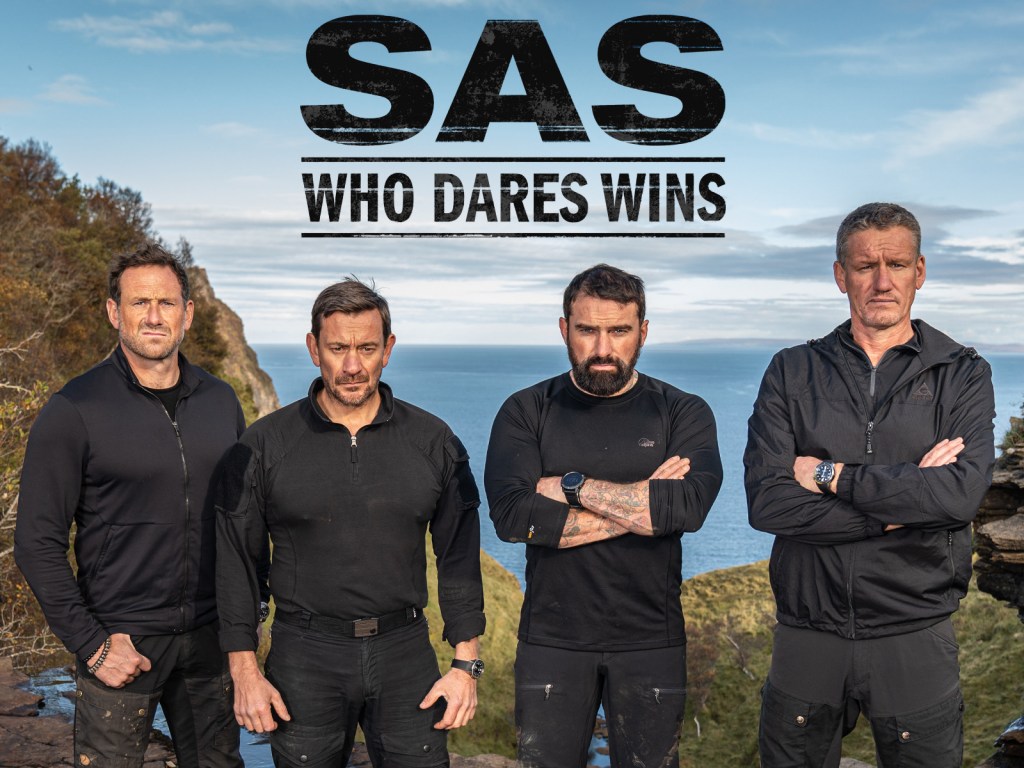
I am still really enjoying watching SAS Who Dares Wins it has been really good so far. It is on channel 4 most nights and it has been just as good as last year too. It is on for an hour and it is on for 45 minutes when I watch it on channel 4 catch up.
A Service Medal is awarded to all those who meet a particular set of criteria. These criteria are usually that an individual has served in a specific area, usually for a specified minimum time between set dates.
There were a total of six service medals available for men and women who saw military service in the First World War.
Sometimes these are misleadingly known as ‘campaign’ medals, which actually refer to medals that were awarded for participating in a particular series of military operations in a certain area with a defined goal. However, these were not awarded in the First World War and are more relevant to medals from other wars such as the Boer or Second World War.
Who might been awarded them?
The Service Medals were awarded to the servicemen and women who met the criteria. An individual could earn between one and four, but usually received two or three.
Why were people awarded Service Medals?
Medals have been awarded to commemorate wars and battles throughout history dating back to the Roman Empire. First World War Service Medals indicate that the individual served Britain overseas during the war during a particular period or in a particular role.
Other types of medals include those awarded for bravery, long service, or a specific type of work.
Also known as the Mons Star, the medal is a bronze star with a red, white and blue ribbon, reflecting the French Tricolore.
It was issued to British forces who had served in France or Belgium from 5 August 1914 (the declaration of war) to midnight 22 November 1914 (the end of the First Battle of Ypres).
These were soldiers that were there at the very beginning of the war and so it was primarily awarded to the ‘Old Contemptibles’, the professional pre-war soldiers of the British Expeditionary Force.
The recipient’s service number, rank, name and unit were impressed on the back.
Some medals have a horizontal metal bar worn on the ribbon and inscribed ‘5th Aug.-22nd Nov. 1914’, this distinguished those who had served under enemy fire.
This clasp was replaced by a small silver rosette when the ribbon was worn without the medal.
There were approximately 378,000 1914 Stars issued.
This bronze medal is very similar to the 1914 Star but has the dates 1914-15 in the centre of the star.
It was issued to a much wider range of recipients. These included all who served in any theatre of war outside the UK between 5 August 1914 and 31 December 1915, except those eligible for the 1914 Star.
The recipient’s service number, rank, name and unit were impressed on the reverse.
An estimated 2.4 million 1914-15 Stars were issued.
Neither the 1914 Star nor the 1914-15 Star were awarded alone. The recipient would also have received the British War Medal and the Victory Medal.
This silver medal was awarded to officers and men of the British and Imperial Forces who either entered a theatre of war (an area of active fighting) or served overseas (perhaps as a garrison soldier) between 5 August 1914 and 11 November 1918 inclusive.
This was later extended to services in Russia, Siberia and some other areas in 1919 and 1920.
The ribbon has a central band of orange edged with white, black and blue lines and although many other medal ribbons symbolise something, it seems that the colour and pattern of the British War Medal ribbon has no special significance.
The recipient’s service number, rank, name and unit were inscribed on the rim of the medal.
The front depicts King George V with a latin inscription about the King, similar to what you would find on coins.
The back shows the dates of the First World War and St. George on horseback trampling underfoot the eagle shield of the central powers (German and Austro-Hungarian Empires), with a skull and cross-bones.
Approximately 6.4 million of these medals were issued, giving some indication of the scale of the First World War.
In addition around 110,000 bronze versions were issued, mainly to members of the Chinese, Maltese, Indian, and South African Native Labour Corps.
The Allies each issued their own bronze victory medal but with a similar design, equivalent wording and identical ribbon.
The colours represent the combined colours of the Allied nations, with the rainbow additionally representing the calm after the storm. The ribbon consists of a double rainbow with red at the centre.
The British version depicts the winged figure of Victory on the front of the medal and on the back, it says ‘The Great War for Civilisation 1914-1919’.
To qualify, an individual had to have entered a theatre of war (an area of active fighting), not just served overseas. Their service number, rank, name and unit were impressed on the rim.
Approximately 5.7 million Victory Medals were issued.
Wearing or displaying medals together
The only medal that could be awarded on its own was the British War Medal. So, if any of the other medals is found on its own, it must be a ‘split group’ i.e. other medals are missing. The British War Medal weighs an ounce; if it alone is missing from a group of medals, it might indicate that it was once pawned or sold for its scrap silver value, and melted down.
Medals should always be worn (or mounted, if displayed) in an ‘order of precedence’. You can find the ‘order of precedence’ list in the Medals Yearbook (details below) . The medal with precedence is on the left of the group when seen by someone meeting the wearer (or looking at a display).
Because the medals were worn or displayed together, some of the markings can tell us something about any missing medals. The British War Medal is silver, quite a soft medal; it often shows ‘contact marks’ if it has rubbed alongside other medals. Marks to the right of King George V’s head indicate that a Victory Medal was probably also awarded and marks to the left that probably either a 1914 or 1914–15 star was awarded.
This bronze medal was awarded to those who were either Members of the Territorial Force or Territorial Force Nursing Service on 4 August 1914 OR members with four years or more service prior to 4 August 1914 and who rejoined by 30 September 1914 who also:
– had volunteered prior to 30 September 1914 for overseas service
– and served outside the United Kingdom between 4 August 1914 and 11 November 1918
– and who were not eligible for the 1914 Star or 1914-15 Star
The ribbon is yellow with two narrow green stripes. This bronze medal depicts George V on the front. It says ‘Territorial War Medal’ and ‘For Voluntary Service Overseas 1914-19’ on the reverse.
Only 34,000 were issued.
Decorations and awards
Mercantile Marine War Medal (1914-1918)
This bronze medal was awarded by the Board of Trade to members of the Merchant Navy who had served at sea for at least 6 months or sailed on at least one voyage through a war zone.
The front depicts George V and the back shows a merchant ship in stormy seas, an enemy submarine sinking and a sailing vessel with the words ‘For War Service – Mercantile Marine – 1914-1918’.
The ribbon has two bands of green and red separated by a thin white stripe. The colours represent starboard and port lights with the masthead light in the centre.
A total of 133,135 were issued.
Your research
Medals can be very useful if you are trying to find out more about the person who received them. To issue and name the medals correctly, extensive records (‘medal rolls’) were compiled. The Army created an index of over 5 million cards – it is the best single source for most people starting First World War family history research, since if a soldier served overseas, they would have been eligible for at least one medal, and so would have an index card. The originals of the medal roll index cards are held at The National Archives (TNA) at Kew and their website gives a comprehensive explanation of what a medal index card can tell you.
Long before World War One, Germany had created a plan to avoid fighting with its rivals France and Russia at the same time.
This was known as the Schlieffen Plan – named after Alfred von Schlieffen, the German General who devised it in 1905. The plan was that Germany would invade France through Belgium and win a swift victory before Russia (an ally of France) had time to respond.
The plan gambled that Britain would not intervene in response to the invasion of Belgium. It also assumed that it would take Russia six weeks to organise its army before it could enter a war.
The plan was wrong about both.
A defensive war
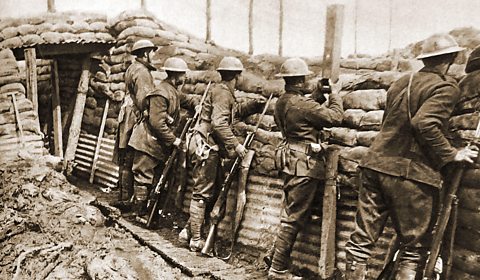
Image caption,Canadian troops stand ready to repel a German attack on the trenches. One soldier keeps a look out using a periscope to see over edge of the trench. Around 650,000 Canadian soldiers fought in WW1.
In the east, the Russian Army was able to mobilise more quickly than the Germans had anticipated and began advancing towards Germany’s borders.
In the west, Britain chose to send an army – the British Expeditionary Force – across the English Channel to honour a previous treaty to uphold Belgium’s neutrality.
The result of Britain’s intervention meant that they were able to successfully disrupt Germany’s plan to surround Paris and force a French surrender.
This failure, along with the introduction of modern weapons such as machine guns forced both sides to dig trenches as a means of protection from gunfire and as an attempt to encircle the opposition.
Germany’s “quick” war would go on for four years and cost millions of lives.
What was trench warfare like in WW1?
While much of a soldier’s life at the front line was characterised by boredom and not much happening, when fighting broke out it could be terrifying.
WW1 artillery bombardments
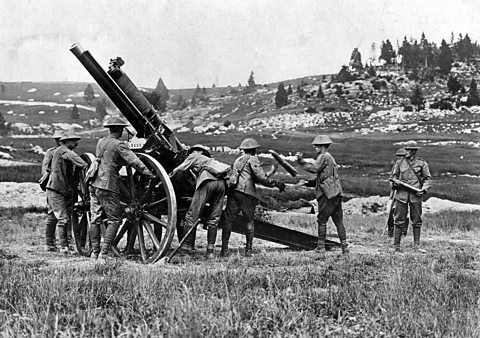
Image caption,A British artillery field gun from World War One. British munitions factories produced over 170 million artillery shells during WW1.
As trenches were very good at defending soldiers from the direct attacks of enemy soldiers, other methods for winning battles were soon developed.
Huge field guns called howitzers were developed that would bombard enemy trenches with explosive shells. They were designed to destroy the trenches, tear through barbed wire defences, and shatter the morale of the enemy soldiers.
These bombardments could last for hours or even days. The British bombardment of German trenches at the Battle of the Somme in 1916 lasted for eight days!
The horror and destruction of these bombardments caused great suffering to soldiers. It even created a new medical condition called shellshock – where experience of the shelling left soldiers too traumatised to carry out their duties.
‘Over the top’: WW1 trench raids
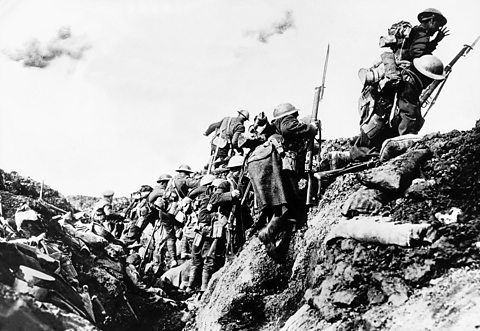
Image caption,British soldiers go ‘over the top’ of their trench during the Battle of the Somme, 1916. Over 100,000 British Army soldiers died during the battle.
Another feature of trench warfare were trench raids. These involved soldiers leaving the safety of their own trenches and advancing on their enemy’s trenches to attempt to capture them.
This became known as going ‘over the top’ since it involved soldiers climbing out of their own trenches.These raids were very dangerous as they involved crossing the stretch of land between the trenches known as no man’s land.
Before such raids, artillery would bombard o man’s land to destroy barbed wire defences as well as the enemy trenches.
While this weakened the enemy, it also made o man’s land very hard to cross quickly as there were lots of holes, shell craters, and fallen trees.
WW1 machine guns
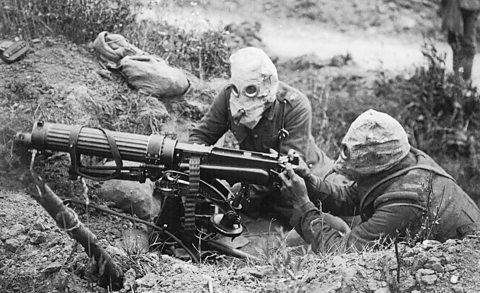
Image caption,A British Vickers machine gun crew wearing gas masks near Ovillers during the Battle of the Somme, 1916. The gun could fire around 500 bullets per minute.
Trench raids were made highly dangerous by the arrival of modern weapons such as machine guns.
Machine guns – such as the Vickers model used by the British army – could fire over 400 bullets a minute.
With that kind of firepower, only a few machine guns were needed to make crossing no man’s land deadly.
On the first day of the Battle of the Somme, the British army lost over 57,000 men – many of them killed or injured by German machine guns.
Poison gas in WW1
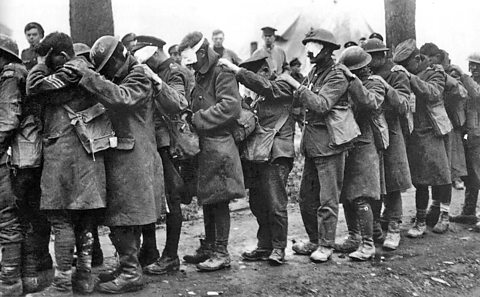
Image caption,Men of the British 55th (West Lancashire) Division blinded by a poison gas attack, 1918. As well as choking soldiers, poisonous gases such as mustard gas caused skin to blister and could damage the eyes.
Another terrifying weapon that the soldiers In the trenches had to deal with was attack from poison gas.
There were several different kinds of gas used. The most common were:
chlorine gas
phosgene gas
‘mustard’ gas
Poison gas had been created decades before World War One but it had never been used on such a large scale before.
The first major use of poison gas in World War One came on 22nd April 1915 at Ypres in Belgium.
The German army released chlorine gas and clouds of it drifted across to the allied trenches. The gas caused extreme breathing problems and even death in the British, Canadian, and French forces. As this point, troops had no gas masks to protest themselves.
Poison gas became a common weapon and it became standard for soldiers to be issued with gas masks and protective clothing.
While these gases did not kill huge numbers of soldiers, they did cause horrible injuries in tens of thousands of soldiers.
Many of the gases caused permanent damage to the lungs and throat. Others caused agonising blisters on the skin and left people blind.
What was it like to live in WW1 trenches?
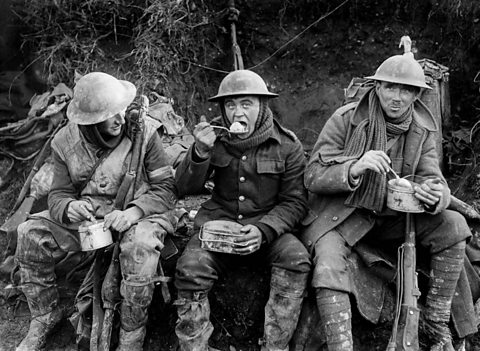
Image caption,British soldiers eating hot food in the Ancre Valley during the Battle of the Somme, 1916. Typical army food rations included cans of preserved meat, vegetables, bread. and hard biscuits.
For many, daily life in the trenches was one of routine and mundane tasks.
Each day would begin at dawn with the soldiers ordered to ‘Stand To’. This was an order to protect the trenches from a potential German attack.
As the sun would rise behind the German trenches, dawn was a particularly good time for them to attack the British trenches as the British would have been blinded by the rising sun.
Once it was determined that the Germans were not going to attack, the British troops would be ordered to ‘Stand Down’ and the men would make their breakfast – this usually consisted of tea and bacon which was made on a simple, portable cooker called a primus stove.
Daily tasks in the trenches
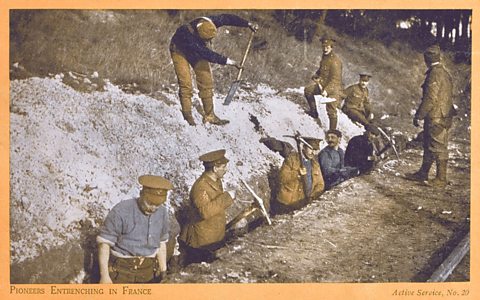
Image caption,A British Pioneer Regiment digging defensive trenches at the Western Front, World War One. The digging and repairing of trenches was a typical daily task for soldiers at the Western Front.
After breakfast, the troops would complete a wide range of tasks including cleaning their rifles and carrying out basic duties:
strengthening and repairing trenches
digging new latrines
ensuring that the sandbags that were part of the trench defences were refilled
restocking the trenches with ammunition and food supplies
The army also had regiments of engineers at their disposal. Their job was to repair bridges and roads to allow supplies to reach the trenches or to allow the army to advance against the Germans.
Some soldiers were signallers and it was their responsibility to lay telephones lines so that messages could be carried throughout the trenches and back to army headquarters.
These lines would often get damaged during enemy bombardments and would need to be repaired or replaced regularly.
Rest and relaxation in the trenches
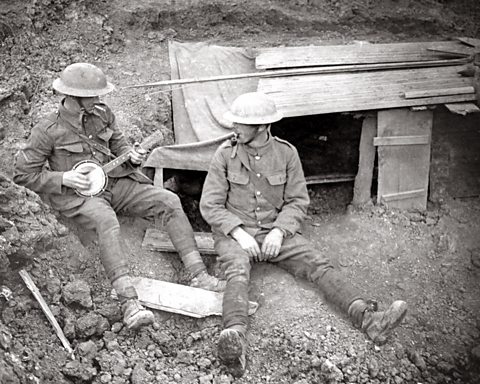
Image caption,A British soldier plays a banjo outside a trench dugout on the Western Front, 1916. Soldiers would spend around a week at a time in the trenches. They would then get several days away from the front lines to rest and recover.
Soldiers did not spend all their time fighting. If the men had completed their tasks, they were given time to themselves.
Some would write letters home to their loved ones, others would keep a diary, whilst others would pass the time playing cards or chess.
Soldiers also didn’t spend all of their time at trenches in the front line.
The troops were on a constant rotation and it was expected that they would receive 14 days off duty before serving in the trenches for a total of 16 days.
When not in the trenches, soldiers could enjoy time off in the French and Belgian towns that were under British control. This gave them time to rest and recover from the difficult and dangerous lives they lived in the trenches.
However, this did not always happen. The Scottish Black Watch regiment once served 48 days in the trenches without a break.
Health and hygiene in WW1 trenches
Image caption,Australian ambulance men carrying soldiers suffering from Trench Foot at Bernafay, northern France, during World War One. Around 75,000 British soldiers suffered from the condition during WW1.
Hygiene and sanitation in the trenches was difficult to maintain.
Whilst the troops were encouraged to use toilet pits called latrines, some men opted to use nearly holes and craters made by shell explosions.
When drinking water was in short supply, some troops would drink water from these shell holes. Contaminated water lead to outbreaks of cholera.
Rats were a constant issue in the trenches. Dead bodies attracted them to the trenches and the troops soon found that the rats were helping themselves to the food supplies and spreading lice throughout the trenches.
Lice would lay their eggs in the seams of the troops’ overcoats, and in the case of the Scottish soldiers, in the pleats of their kilts. The lice caused the spread of trench fever and typhus amongst the soldiers.
The mud also created health problems for the troops as it prevented men from keeping their feet dry and clean.
This led to many soldiers developing a condition known as trench foot. This disease would rot the flesh from a soldier’s feet, exposing the bone and muscle underneath.
The lack of fresh fruit caused some to develop trench mouth. This was a disease which would cause the gums to bleed and recede.
Left untreated, ulcers could form along the inside of the mouth and down the throat, resulting in the soldier experiencing pain whilst they ate and swallowed.
They would also have chronic bad breath. Many soldiers who suffered from this condition took up smoking as a means of masking their breath.
Shell shock
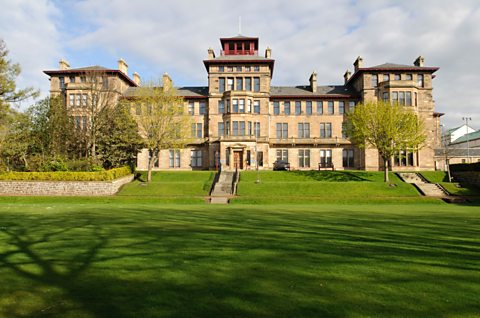
Image caption,Between 1916 and 1919 Craiglockhart, Edinburgh, was used as a military psychiatric hospital for the treatment of British officers suffering from shell shock.
The horrors that the soldiers faced on a daily basis, combined with the noise from artillery bombardments, caused many men to develop shell shock.
These men would display symptoms such as their limbs shaking uncontrollably, foaming at the mouth and becoming incontinent. Some became confused and would even be found wandering behind the trench system without knowing where they were.
We now call this condition post-traumatic stress disorder.
Unfortunately, in the early stages of the war, the army viewed shell shock as cowardice. Of the 306 British soldiers executed by firing squad (and since pardoned), many showed symptoms of shell shock.
Eventually military hospitals, such as the one at Craiglockhart in Edinburgh, were established to help treat soldiers suffering from shell shock.










_tank.jpg)
.jpg)






 Weevles Updates Disabled Bloggers Team
