Albert Ball VC

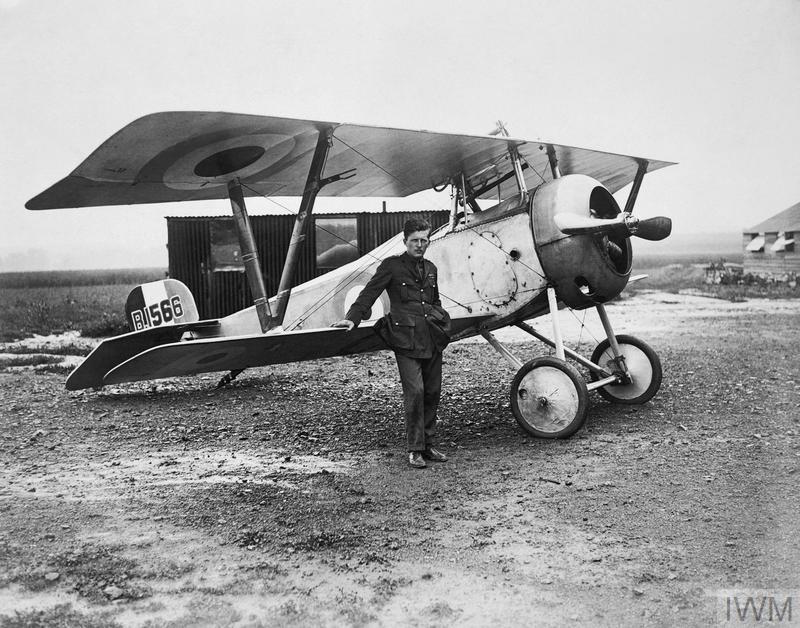
Albert Ball was one of the United Kingdom’s highest-scoring air aces.
Albert Ball (1896-1917) was a British fighter pilot and, with 44 official victories, was one of the United Kingdom’s highest-scoring air aces. In 1914 Ball enlisted in the British Army before transferring to the Royal Flying Corps in 1915. Following an intense aerial fight over the Western Front in May 1917, Ball crashed and died. He was posthumously awarded the Victoria Cross, Britain’s highest military award for bravery in the face of the enemy.
Andrew Beauchamp-Proctor VC

Andrew Beauchamp-Proctor was South Africa’s top flying ace during the First World War.
Image: © IWM (Art.IWM ART 2880)
Andrew Beauchamp-Proctor (1894-1921) was South Africa’s top flying ace during the First World War. Following the outbreak of war in 1914, Beauchamp-Proctor served with the Duke of Edinburgh’s Own Rifles in the German South-West Africa campaign. Following an honourable discharge in 1915, he returned to university before enlisting with the Royal Flying Corps in March 1917. He won all of his 54 victories in 1918 and was awarded the Victoria Cross the next year. He was killed in a flight training accident in 1921.
William ‘Billy’ Bishop VC
William ‘Billy’ Bishop was Canada’s highest-scoring fighter pilot and one of the war’s top flying aces.
William ‘Billy’ Bishop (1894-1956) was Canada’s highest-scoring fighter pilot and one of the war’s top flying aces. Bishop served with the Canadian Expeditionary Force before transferring to the Royal Flying Corps in December 1915. He is credited with 72 victories and was awarded the Victoria Cross for a solo attack on a German aerodrome on 2 June 1917. Bishop survived the war and went on to become an Air Marshal in charge of recruitment during the Second World War.
Georges Guynemer

Georges Guynemer was a French fighter pilot and air ace credited with over 50 victories over the course of his service.
Georges Guynemer (1894-1917, pictured in the car) was a French fighter pilot and air ace credited with over 50 victories over the course of his service. He started out as a mechanic before becoming a pilot in April 1915. He died on the Western Front in September 1917. Although not his country’s top flying ace, he became France’s most popular and revered ace of the First World War.
Max Immelmann

Max Immelmann was the first German air ace of the First World War.
Max Immelmann (1890-1916) was the first German air ace of the First World War. His death in June 1916 caused such shock that another German air ace, Oswald Boelcke, was temporarily grounded for fear of the effect successive pilots’ deaths would have on home morale. Immelmann developed an aerial loop-and-roll manoeuvre that allowed pilots to dive behind a pursuing fighter. This became a standard technique throughout the war and is still known as the ‘Immelmann Turn’.
Edward ‘Mick’ Mannock VC

Edward ‘Mick’ Mannock was Britain’s highest scoring fighter pilot of the First World War.
Edward ‘Mick’ Mannock (1887-1918) was Britain’s highest scoring fighter pilot of the First World War. He served in the Royal Engineers before transferring to the Royal Flying Corps. Mannock was killed over the Western Front in July 1918 and posthumously awarded the Victoria Cross the following year. He was originally credited with 73 victories, but this figure has since been debated. Regardless, Mannock was one of the most successful air aces of the First World War.
James McCudden VC

With 57 victories, James McCudden was one of the highest scoring British fighter pilots of the First World War.
James McCudden (1895-1918) joined the Royal Flying Corps as a mechanic in 1913. With 57 victories he went on to become one of the highest scoring British fighter pilots of the First World War. McCudden was awarded the Victoria Cross in the spring of 1918 and after a brief rest was posted back to the Western Front to take control of his own squadron. He was killed in a flying accident on 9 July.
Manfred von Richthofen aka ‘The Red Baron’

Manfred von Richthofen, also known as the ‘Red Baron’, is perhaps the most famous air ace of the First World War.
Manfred von Richthofen (1892-1918), also known as the ‘Red Baron’, is perhaps the most famous air ace of the First World War. He was the highest-scoring ace of the war with 80 official victories. After serving in the German Army on the Western Front, Richthofen transferred to the air service in May 1915 and was later given command of the ‘Flying Circus’, a unit comprised of Germany’s elite fighter pilots. He was killed in action in April 1918 and buried by the British with full military honours.

 Weevles Updates Disabled Bloggers Team