
© IWM (COM 1500)
Suitcase wireless transmitter seized by MI5 from captured German spies. This is believed to have been the set belonging to agents Werner Heinrich Walti and Karl Theo Druecke who landed by means of a rubber dinghy dropped from a seaplane off the Scottish coast near Portgordon on the morning of 30 September 1940.
Unlike other European powers, Britain entered the twentieth century without a secret police force. However, in 1883 the London Metropolitan Police had formed a Special Branch to combat Irish nationalist terrorism.
In spite of being under-staffed and with limited powers, its duties expanded to include the monitoring of suspicious foreign nationals and political extremists. Fears of foreign powers such as Imperial Germany and Russia gripped the nation and the British authorities ordered the creation of a security service to combat an espionage offensive.
On 1 October 1909 the War Office’s Secret Service Bureau began its work. It soon developed ‘home’ and ‘foreign’ sections which became MI5 and MI6. The purpose of MI5 was to protect Britain’s secrets while MI6’s task was to find out the secrets of potential enemies abroad.
The Home section was a small unit but achieved rapid success. By the outbreak of the First World War, it had assisted Special Branch in the arrest of twelve German spies.
Carl Hans Lody was the first German spy discovered by MI5 during the First World War. German intelligence had sent Carl Lody, a naval reserve officer, to the United Kingdom in 1914 where he failed to pose as an American and began to attract suspicion. Lody was placed under surveillance which hindered his attempts to contact his controllers and on 2 October 1914, he was arrested in Ireland. Lody was found guilty of espionage and executed at the Tower of London on 6 November.
On the morning of his execution, Lody was calm and asked an officer: ‘I suppose you will not shake hands with a spy?’ The officer replied: ‘No, but I will shake hands with a brave man.’
At the time of his death, Lody was the first man to be executed at the Tower of London for 150 years.
MI6 Going out and finding out the secrets of our enemies to use against them

© HU 68501
Oluf Olsen, an SIS wireless operator, sits at his radio set deciphering an incoming message.
MI6 is the Secret Intelligence Service and has the role of seeking out information on enemies abroad, developing contacts and gathering intelligence that helps further British interests. It was established in 1909 amid fears Germany was targeting Britain.
During the Second World War, the service was dramatically expanded. Oluf Reed Olsen, a Norwegian who resisted the Nazis as soon as his country was invaded and was forced to flee, was recruited to MI6 to provide important intelligence about the activities of the Germans. He was parachuted back into Norway with a mission and supplies provided by MI6 – and his wartime actions earned him medals including the Distinguished Service Cross.
The work of MI6 was a closely guarded secret – its role and very existence was not officially recognized until the Intelligence Services Act of 1994 and the authorised history of the service ends in 1949.
On the MI6 website, the service says more recent successes have gone unnoticed but that it ‘is playing a major role in safeguarding the country’s people and interests’.
Secret Communications

© IWM (COM 22)
The Enigma was an electro-mechanical enciphering machine, ultimately produced in large quantities for the German Armed Forces. Invented in 1923, the first models were marketed for commercial company use, as a counter to industrial espionage.
Throughout history, governments and military commanders have tried to keep their communications secret by the use of codes and ciphers.
At the same time, the interception and decoding of enemy messages has been of paramount importance.
The development of cable and wireless communications made messages more secure but methods of eavesdropping soon developed creating the need for ever more sophisticate cryptography.
This Enigma Machine, like the one in this photograph, was invented in 1923 and the first models were marketed for commercial use as a counter to industrial espionage. But various German government and armed forces adopted the machine as a tool to maintain secure radio communications.
The British Government Code and Cipher School was set up in 1939 at Bletchley Park in Buckinghamshire, and devoted large resources to breaking the various Enigma ciphers. This became known as the ULTRA programme, and was increasingly successful from 1941 onwards in penetrating German enciphered radio traffic.
Special Operations Executive (SOE)
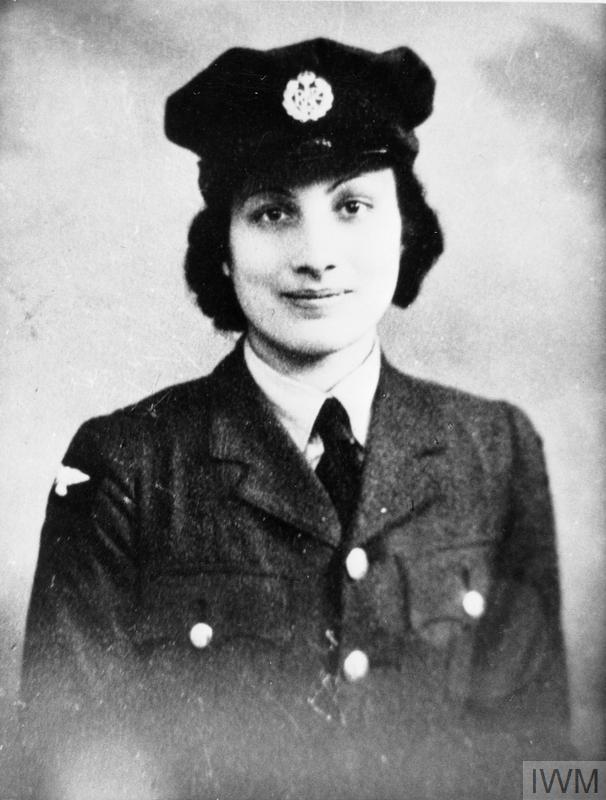
© IWM (HU 74868)
Hon. Assistant Section Officer Noor Inayat Khan (code name Madeleine), George Cross, MiD, Croix de Guerre avec Etoile de Vermeil. Noor Inayat Khan served as a wireless operator with F Section, Special Operations Executive.
The Special Operations Executive, created during the Second World War with instruction to ‘set Europe ablaze’.
It was created in July 1940 after the triumph of Germany’s armies on the continent and the Nazi occupation of most of Europe. It would help resistance movements and carry out subversive operations in enemy-held territory.
Operating on a global scale, SOE’s headquarters in London were supplemented by subsidiary missions on every continent.
It maintained close relations with the governments-in-exile both for recruiting purposes and to coordinate resources and objectives.
Although secret at the time, the story of the courage and skill of agents like Violette Szabo, Adolphe Rabinovitch, Odette Sansom, George Starr and Noor Inayat Khan have become better known in recent years.

 Weevles Updates Disabled Bloggers Team