My Grandmother Agnes Elizabeth Burns (Todd) was born in Newcastle from Scottish parents who had moved from Glasgow before she was born. Her Father was a comptometer on the Glasgow Herald. This job entailed using tweezers to put in the lettering for all the stories before the newspaper was printed and sent out to the public. His eye sight suffered greatly over the years because of this and he had to find another job when he could no longer continue. This meant moving to Newcastle to become a blacksmith and here the family settled. He was George Todd and his wife was Agnes Todd. They had four children Agnes was the youngest.
Life was hard as with most people of that time, and my Grandmother went into service at 16 years old after her schooling. She worked for Duke of Northumberland in their great house and the Duchess gave my Grandmother a silver picture frame when she left aged 21 to work in a bakers shop in Newcastle. The wages were higher and not so long hours.
The bakers was called Carricks in Newcastle Grainger Street and the business continues today but the old cafe has gone. As a waitress she served lovely sandwhiches and cakes to the patrons. She told me as a treat to the staff down stairs washing all the dishes and preping the food, she would send clean cups with cakes in down with the dirty dishes so the staff could find them and enjoy the cakes in secret. There was a ‘dolly’ to put the dishes in like a box on the wall which acted like a lift if you pulled the pully rope. It got food from the kitchen and sent dirty dishes down for washing.
At 20 years old she met a dashing young man James Archibold Burns( my Grandfather) who had fought in WW1 but been injured by an explosion which resulted in a metal plate in his head and gassed in the trenches but he was on the mend. His family owned a chip shop in Benwell and when he inherited the business he was not really interested and placed a manager there, the manageress was robbing the business blind and he lost it to the bank as the mortgage was not being paid while he was away fighting. My Grandmother and Grandfather married in 1922 and had three children, a boy and two girls. They also lived in Newcastle close by to Agnes and George their grandparents.
The eldest of the girls was my Mum who became a tailoress and her sister became a secretary and married an airman and moved to Southhampton. She developed Rheumatoid Arthritis very severely and was in a wheelchair in her thirties.
The boy became a plumber but fell off a roof at 18 years old and became epileptic and never really worked after the accident because of the medication, he died aged 47.
Grandmother used to make extra money during the second world war as everything was on ration, by trading goods eg she had a friend who was a chemist so she got lipsticks cheap and exchanged them for extra rashers of bacon from the butchers wife. She stood in any queue at the shops even if she did not know what they were selling and bought whatever it was, and exchanged it for food. She baked every Sunday to fill the cupboards and pantry for the coming week. Bread, pies, pasties, cakes (even though sugar was rationed)
My Grandfather died aged just 57 years of cancer which was probably caused by the Wills cigarettes soldiers were given in the war for free. Or by the gas in the war who knows. I was born by then so he did see his only grandchild.
So Grandmother had a hard life emotionally but so did many others. Many children did not survive past five years old in the early part of the century.
She was cremated in the same cemetry as her husband in Newcastle, her ashes placed in the Garden of Remembrance.
Lives well lived full of love and sacrifice, the like of which we will never see again. Love to them both.
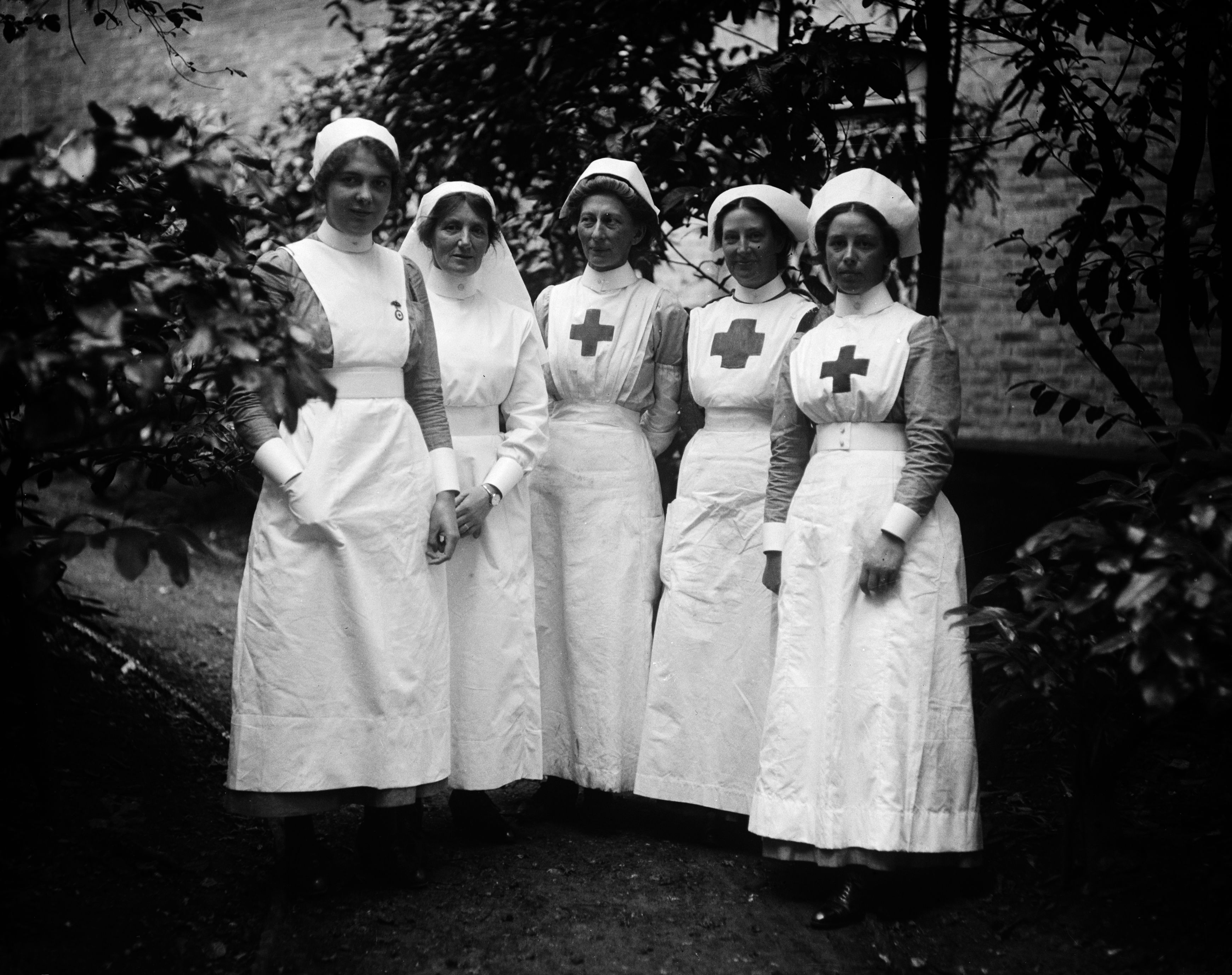
September 1915: A group of nurses at Hamworth Hall in the U.K., which was serving as a Red Cross Hospital during WWI.
Before Florence Nightingale reorganized the care of wounded soldiers during the Crimean War in 1854, it had been the task of camp followers — wives and prostitutes — to treat them with whatever primitive medical help was available. Nightingale insisted that conditions for the wounded were killing men as fast as the enemy. She demanded clean bandages and bedding, fresh air, nourishing food and decent trained care. A few years later and across the world, Clara Barton fought for the same principles in the American Civil War. Both women, and those they inspired to serve, saved countless lives. They attended to the wounded while there was still a chance of treating them, and forever changed how the war-wounded were perceived by the military — no longer as collateral damage in battle, but as lives that could be saved.
And yet, though both are remembered today as heroes, they were often at loggerheads with their governments before they got their way. And even years later, well into the First World War, which came to an end a century ago on Nov. 11, 1918, some officers still felt that women didn’t belong on the battlefield. As I learned while researching a novel with a battlefield nurse protagonist, many women had to prove themselves all over again as competent assets to the army, able to fend for themselves and provide skilled care that returned wounded men to regiments hungry to replace casualties. They were not just a higher class of camp followers.
By 1914, medical care had come a long way. The various combatants approached medical care in different ways. The French were far behind, their mindsets still almost medieval. Some accounts of the cellars and barns and railway cars where the wounded were housed are harrowing. Indeed, decades earlier, they’d decided, as part of a program separating church and state, to prevent nuns, historically the healers in war and peace, from serving with the Army hospitals. A few nuns did work independently of the Army to open hospitals wherever they could. There is also the story of French noblewomen who rushed to sign up for French hospital nursing, only to discover that they must treat the ranks as well as officers. Conversely, the Germans had decent male-only hospitals in their deep, multilayered trenches, so unlike the shallow ones the Allies dug. Even surgery could be done in some of these facilities. Meanwhile, St. Louis sent a unit of nurses and doctors — and an early X-ray machine — to Rouen, long before the U.S. entered the war.
For the British, the declaration of war in 1914 meant that women took over the work of men wherever possible. Postmasters became postmistresses. Women learned to drive omnibuses or to take over desks wherever men could be spared. Others dug up gardens and fallow land to grow needed foodstuffs for the home front, after U-boats attacked convoys coming in from the Empire and the U.S. British farmers were desperate for help. Many women went into factories, and were very good at setting fuses in shells and bullets. It was dangerous work, and the chemicals they dealt with made many ill.
And, on the battlefield, the nurses stepped in. What they would experience over nearly five years of war was horror, privation, exhaustion and danger. Their reward was the satisfaction of saving lives.
For our fictional take on the nurse’s situation, we made protagonist Bess Crawford the daughter of an officer in the British Army, giving her a less Victorian upbringing as well as parents who were more likely to agree that she could train, but it was not uncommon for families to refuse permission, feeling that this would be too shocking.
The women who did volunteer went through several layers of medical training as well. For the Queen Alexandra’s Imperial Military Nursing Service, training was mandatory. There were other volunteer nursing groups, like the VADs (Voluntary Aid Detachments) — with whom Agatha Christie trained — with less strict training, who helped in the wards at secondary nursing tasks.
The regulated nursing groups like the Queen Alexandra’s were given the rank of officer in order to protect them and give them some standing when dealing with doctors, other ranks and high command. These women were expected to uphold the integrity of their service. Their relationships with the men under their care had to be completely professional. They could be expelled if they had affairs or even became engaged. And yet these young women who had never seen a man in his underclothes were expected to work with the mutilated bodies of wounded fresh from the trenches. All of which they did with great courage and dedication, often staying with their patients as the Germans overran a sector. Indeed, the British nurse Edith Cavell not only stayed with her wounded in Belgium, but was accused by the Germans of helping the local underground. She was executed by firing squad on Oct. 12, 1915.
How did a grateful nation reward all those women who had come to its defense? Rather stingily, considering their service and the losses they’d suffered as a generation of fathers, husbands, and sons died for King and Country.
Some women finally gained the vote in 1918 — at war’s end — as promised earlier in the war when the Suffragettes had agreed to halt their civil protests for the duration. But the franchise was only extended to women who were 35, the head of household or the owner of property. The war nurses were not eligible unless they fit into one of these categories. Nor were those who worked on the land or drove the buses or set the fuse in all those shells. Even so, there were men who went on record predicting dire consequences to the nation arising from women being allowed to vote or stand for Parliament, because they were as a sex emotionally unsteady.
Britain didn’t collapse. Still, it was not until 1928 that all women over 21 received the same rights as men, in the Representation of the People (Equal Franchise) Act. American women were granted that right in 1920, in the 19th Amendment.
Less than a hundred years ago… I wonder sometimes how many women today understand what a hard-won right that was. Certainly nursing was a high-profile example of what women could achieve, although their sisters in other positions were the backbone of England’s work force and clearly visible on an almost daily basis. This was repeated in WWII and, in both instances, these women were expected to quietly return home and resume their places as wives and mothers.
After World War I, however, that wasn’t always possible. Britain had lost a generation of men, and many women had to find work to support themselves and their children. At the same time, many employers had to swallow their feelings about hiring women, and fill vacancies where they could. Still, in the hundred years since the Armistice, we have really not made a hundred years of progress in how women are viewed in many workplaces. The nursing profession is thus perhaps the best example of one in which the work of women in the Great War had a proud and lasting impact on the future. Contrary to what some hoped at the time, that war did not end all wars — and in those that followed, nurses carried on the tradition of duty and service begun by Florence Nightingale and so faithfully embodied by the courageous women of World War I.
Our project is about drawing attention to the social & economic deficits that many face as a consequence of the rapid digital transformation of society and the subsequent automation that is widely found in everyday life. This is affecting many in ways that have not been fully documented by policy makers nor is readily acknowledged by many businesses, whose expectations are that customers default to accessing their services online.
Many older age residents are experiencing a technologically driven world that is challenging their independence because many household tasks now require access to the internet, and with the increasing roll out of automation of day-to-day interactions such as car parking to telephone communication systems, many are feeling disenfranchised. This is further compounded by a reduction of informal information hubs such as post offices, local access to libraries, corner shops where locals stopped for a ‘catch up’. These community connections are gradually being eroded and being replaced by online access.
The impact cannot be underestimated for those whose first ‘language’ is not digital, and who are not conversant with using online services and are, in many cases, resistant to learning because of the media’s negative perceptions of cybercrime, including the acceleration in the way social media language is used in a fast-paced virtual space.
Other groups affected by the dominance of the internet are those who have experienced Hate Crime, where disabled people are disproportionately represented. Contrary to what we are told, online abuse is not a priority for internet-based services because they cannot moderate effectively. Secondly, young people are often caught up in the web of cyber bullying, which again, is very difficult to police because much of this goes under the radar of parents/guardians and social media companies. .
Many individuals are classified as living in poverty, which because of their status, have no access to managing the demands services placed on them. There are those who are required to apply for work to retain DWP help, which we know from research undertaken, affects many families across the borough. Many don’t have easy access to computers and a considerable number have little competency required to complete both online benefit applications as well as the demands of providing evidence that they are applying for jobs.
There is a fourth grouping made up of ex-services personnel who are challenged by technology because it has not been a central to their roles in armed forces, where many have only seen conflict; refugees whose English language is not there first language with no access to mobile products. They experience a sense of feeling overwhelmed; even where technology can translate English into their own language it is still fraught with misunderstanding because of cultural differences. Furthermore, these groups experience the same challenges as residents who live in poverty with little competencies in using internet-based services.
And lastly, Disabled people of all ages can be grouped as one because often it is the barriers to digital access that is the common denominator. Digital technology has come a long way from the early incarnations designed for the ‘abled’ rather than with features supporting those with sensory/physical and intellectual disabilities. Many of the solutions are readily found hidden away in operating systems such as Microsoft tools, where some simple adaptations can make all the difference. However, assistive technology is the obvious remedy to those who need more than the quick fix. Having trusted sources to investigate your needs is vital in making available assistive technology available. Unfortunately, for many we work with, this technology is a step to far because of cost. Aware of the limitations our project is working towards introducing access to the potential of assistive technology using a variety of approaches. Our Digital First Aid incorporates access to information and potential temporary loans for people to try before they buy as well as provide a safe space to use access technology during visits to our drop-in sessions – this is an ongoing development.



 Weevles Updates Disabled Bloggers Team